


Weaker, in the bottle: the same unit removes moisture, and evaporation from a wetted surface runs faster in dry air. A 50ml quoted at 6–8 weeks will run shorter through a season of nightly AC. The oil has not weakened; it is leaving sooner.
The one placement to avoid outright: directly in the blast. It strips the reeds fast and throws the fragrance at a single wall instead of into the room — the worst of both effects at once, and the only genuinely wrong answer on this page.
The free adjustments: keep the door shut, which AC use tends to enforce anyway · put the bottle in the circulation but out of the jet · nose height on a surface near the bed · and consider three reeds rather than six, because a well-mixed sealed bedroom needs less emission, not more, and three roughly doubles the life.
The honest gap: if you want that evenness on demand rather than only when the AC runs, Sukoon at ₹1,899 is very often the correct bedroom answer. Between Safar ₹3,999 — named and sold as a car and travel diffuser — and Vaayu ₹11,999 at 1000 m³, roughly 2,000–3,000 sq ft, SOSA has no mid-sized waterless machine for one bedroom.
2. And containment comes with it. Nobody air-conditions a room with the door and windows open, so an AC habit is a closed-room habit, and containment is half of this equation. A bedroom with its door shut is a genuine bounded volume rather than a corner of the flat continuously exchanging air with the hall. Between the closing and the stirring, the AC is quietly doing both of the things this whole subject asks you to do manually.
3. Weaker in the bottle, because the air is being dried. Air conditioning removes moisture; that is half of what it is for in an Indian summer. Evaporation from a wetted surface — and a reed is a wetted fibre surface — runs faster into dry air than into humid air. So a bottle that would show 6–8 weeks on a 50ml in ordinary conditions will finish sooner through a season of nightly cooling. I will not put a number on it, because it depends on your unit, your room, your hours and your weather, and an invented figure would be worth nothing. The direction is reliable; the size is not mine to publish.
4. Directly in the blast is the one placement to avoid outright. Not near the AC, not below it, but in the jet itself. The airstream leaving a split unit is fast and directional, so a bottle standing in it has two things done to it at once: the reeds are stripped at a rate that empties the bottle quickly, and the fragrance is thrown along the jet at a single wall rather than circulated through the room. You get the shortest bottle and the least even room, which is a rare combination of both failures. Move it out of the throw and into the part of the room where air is returning towards the unit rather than leaving it.
5. So the practical answer is: keep the AC, move the bottle, and think about the reed count. A well-mixed sealed bedroom does not need six reeds — it needs distribution, which it now has. Three reeds is a soft level that roughly doubles the life, and it is the free way to take back most of what the dry air is costing you. If you can smell the fragrance continuously, all night, without a break, it is set too strong for the room rather than working well; home fragrance is meant to register on arrival and at transitions rather than press on you constantly. The reed count is the dial for that, and it costs nothing to turn.
Alcohol-free, phthalate-free, made in Pune. A portion of every order supports girl-child education through Nanhi Kali.
The three things an air conditioner does to a fragranced room
The confusion in this question comes from treating the AC as one influence when it is three, two of which help and one of which costs. Separating them tells you exactly what to change, and none of the changes is a purchase.
 Morning Freshness₹749A split unit does not bring air in from outside — it takes the room's own air, cools it and returns it. Repeat that for an hour and the room's air has been through the machine and back many times over, mixing as it goes. For a passive diffuser that is transformative, because the concentration gradient a point source produces is smooth but steep, and mixing flattens it. What you are getting is the same benefit a ceiling fan gives, from a device you were running for another reason. The corollary is worth stating: it also means the intensity right beside the bottle drops slightly, because the peak has been shared out across the room. If what you loved was the smell at arm's length, this will feel like a redistribution rather than an amplification, and it is.
 Mountain Breeze₹849Dehumidifying is half of what an air conditioner does, and dry air accepts vapour more readily than saturated air does. So the reeds give up oil faster and the bottle finishes earlier than the quoted 6–8 weeks on a 50ml. This is the exact opposite of the monsoon case, where saturated air slows diffusion and makes the same bottle hang close and last longer — the same product, two seasons, two evaporation curves, one composition. What must not happen is the smell changing rather than shortening, and that is a formulation question: every SOSA reed sits on a heat-stable CCT carrier rather than DPG, which can crack and go bitter above 40°C, and the range is tested at 45°C and 85% relative humidity for exactly these swings.
 Garden Bloom₹799Everything above assumes the bottle is in the room's circulation rather than in the unit's output. Standing it in the airstream itself is a different situation and a bad one. The jet from a split unit is fast and aimed, so it strips the reed surfaces at a rate no other household position matches, and it carries what it strips along a narrow path to whatever wall it is pointed at. The result is a bottle that finishes early and a room that smells of nothing except one strip of wall. Near the circulation is right; inside the jet is wrong, and that single sentence governs fans, windows and air conditioners equally.
Why the bedroom smells strongest at night — and why you may be the last to know
Put the two helpful effects together and you have the explanation for something people report constantly without knowing why: the air-conditioned bedroom is very often the best-smelling room in an Indian home. It is small, it is shut, it is stirred continuously for hours, and you are lying within a couple of metres of the bottle for most of that time. Every term in the equation is favourable at once. Compare it with the living room, which is larger, opens onto a hall and possibly a balcony, and is occupied at a distance of four or five metres from wherever the diffuser looks best. Same bottle, same reeds, entirely different result, and none of it is about the oil.
There is a catch in your ability to observe it, and it is worth naming because it saves people money. Receptors adapt to a constant stimulus within minutes. The molecules keep arriving and the brain stops forwarding the report. You are in that bedroom for hours, mostly asleep, which makes you the least reliable instrument in the house for judging it. It is entirely routine to lie in a well-fragranced room and honestly conclude the diffuser has stopped working. So before you change anything, leave for fifteen minutes and walk back in, and ask somebody who does not live there. Sensitivity varies between people, and a visitor is a far better instrument than a resident. If guests remark on the scent while you cannot detect it, the room is working for everybody, including you.
The second thing this explains is a complaint that looks like the opposite problem and is really the same mechanism running too well. A sealed, mixed, air-conditioned bedroom with six reeds in a 50ml bottle can be genuinely too much, particularly with one of the deeper compositions. If you can smell it continuously and without relief, it is not working well — it is set too strong for the room. Home fragrance is meant to be noticed on arrival and at transitions. That is what the reed count is for, and it is the reason our strength scale runs from 8.9 to 9.5 as a measure of perceived intensity rather than quality: so that somebody buying for a small sealed bedroom can choose downwards on purpose rather than assume the highest number is the best bottle.
Stronger or weaker, term by term
The whole question laid out as a table, because the honest answer genuinely is both and it depends which term you are asking about. The last two rows are the arrangements to avoid.
| Term | What the AC does | Stronger or weaker | What to do |
|---|---|---|---|
| Transport through the room | Recirculates the room's own air continuously | Stronger, and much more even — the missing half of a reed's job | Nothing. Place the bottle in the circulation and let it work |
| Containment | Enforces a closed door and closed windows | Stronger. The room keeps what it makes | Nothing. This is why AC bedrooms perform so well |
| Humidity | Removes moisture from the air | Weaker over time — dry air speeds evaporation, so the bottle finishes sooner than 6–8 weeks | Run three reeds instead of six, which roughly doubles the life |
| Temperature | Lowers it | Slightly slows evaporation on its own, which partly offsets the drying | Nothing. It is the smaller of the two influences in practice |
| Intensity beside the bottle | Shares the peak out across the room | Slightly weaker at arm's length, stronger everywhere else | Expected. This is what evenness costs |
| Your own perception at night | Constant stimulus for hours while you sleep | Feels weaker, is not. Receptors adapt within minutes | Leave for fifteen minutes and walk back in; ask a visitor |
| Bottle standing directly in the blast | Strips the reeds and throws the fragrance at one wall | Weaker room and a much shorter bottle at the same time | The one placement to avoid outright. Move it out of the jet |
| AC on with a window open | Cooled, scented air replaced continuously from outside | Weaker on every term | Close the window. Containment is half the equation and free |
Softest at 8.9 · Evening Calm₹799Shop → 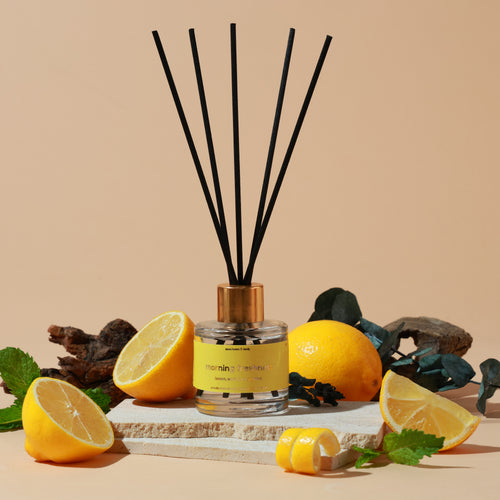 Bright · Morning Freshness₹749Shop →
 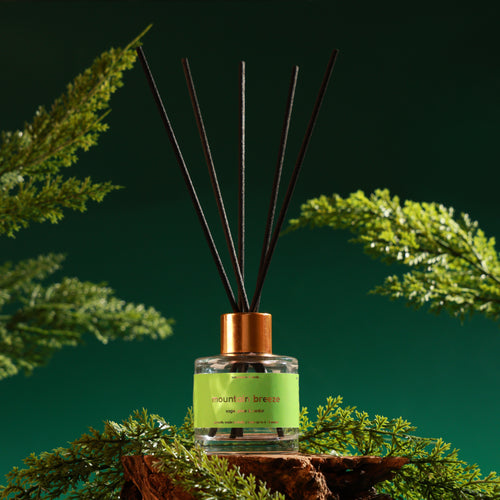 Most present at 9.4 · Mountain Breeze₹849Shop →
The free adjustments, in the order I would make them
First, get the bottle out of the jet and into the circulation. Stand somewhere in the room while the unit is running and you can feel where the throw ends and the general movement begins; that quieter, moving air is where the diffuser belongs. In practice this usually means the far side of the bed from the unit, on a surface at or slightly below nose height when you are sitting up, rather than the shelf directly under the AC that seems so convenient. Nothing else on this list matters as much, and this one takes a minute.
Second, drop to three reeds if you are running six. This is the adjustment almost nobody makes, and in an air-conditioned bedroom it is close to free money. The room is being mixed for you, so the extra emission from three more reeds is not buying reach — it is buying intensity you may not want and weeks you are then losing to dry air. Three reeds roughly doubles the life. Flip them every three to five days rather than daily; a flip restores output for a few hours and adds no range whatsoever, which is worth knowing before you make a ritual of it.
Third, keep the window shut, which is presumably already true, and consider the hours. An air conditioner running with a window open is cooling and scenting the outdoors, and everybody knows the first half of that sentence without noticing the second. Beyond that, remember that every millilitre leaves through the reeds whether anyone is in the room or not — so the only genuine waste in a reed diffuser is oil evaporating into an empty room. A bedroom scented all day for an occupancy of eight hours at night is spending more than it needs to, and moving the bottle to whichever room you are actually in, or dropping the reed count while you are out, costs nothing. If the room is now doing what you wanted, stop here and keep the money.
If you want that evenness without depending on the AC
The obvious limitation of everything above is that it stops when the AC does. A room that is beautifully even in May and flat in November has not developed a fault; it has lost its transport for the season, and the same is true of a ceiling fan. If you want the evenness to be a property of the room rather than of the weather, that is what an active diffuser actually sells — and it is worth being honest that the price buys transport and control, not a better fragrance. Here is the ladder, with the counterweights and the gap in our own range.
| Option | What it is | When it is right | Price |
|---|---|---|---|
| 1. The reed you own, out of the jet, three reeds, door shut ★ | The AC supplies the transport and the containment; you supply the placement and the dose | First, and for most air-conditioned bedrooms it is the whole answer. Silent, no power, nothing to fill or charge, works in a power cut, roughly ₹13–₹15 a day, and it never breaks | ₹0 |
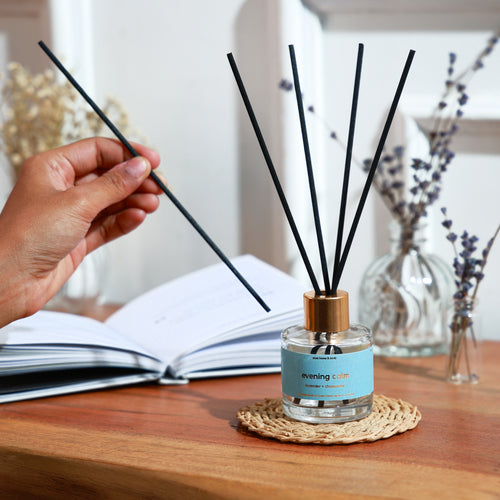
| 2. A softer composition for a sealed room | Evening Calm ₹799 at 8.9, the softest in the range, or Morning Freshness ₹749 at 9.0 | When a well-mixed sealed bedroom has made your current bottle too present. The scale measures perceived intensity, not quality, and choosing downwards is a legitimate decision | ₹749–₹799 |
| 3. Boond | Ultrasonic, 300ml tank, up to about 150 sq ft, roughly six hours, USB, night light | The cheapest honest way to have moved air in a small bedroom when the AC is off. It adds humidity, which some people welcome in a dry air-conditioned room, and it needs filling | ₹899 |
| 4. Sukoon | Ultrasonic, 500ml, 270–320 sq ft, 16–18 hours on low, three 15ml Hotel Collection scents included | Very often the correct bedroom answer and never to be skipped on the way to something dearer. In a hard-water city it can leave a fine white mineral dust | ₹1,899 |
| 5. Safar, with the disclosure attached | Waterless cold diffusion of undiluted oil, 20ml, cordless with a 2000 mAh battery, three speeds, a 1 / 2 / 3-hour auto-off timer. Named and sold as a car and travel perfume diffuser | When you want undiluted oil with no water and no added humidity at personal scale — which suits a dry air-conditioned room. Not set-and-forget: the timer runs hours and it needs recharging | ₹3,999 |
| The honest gap: no mid-sized waterless machine | Vaayu ₹11,999 is a waterless cold-air nebuliser rated to 1000 m³, roughly 2,000–3,000 sq ft, with a 400ml tank and app control | Nothing sits between Safar and Vaayu for one bedroom. In 120 sq ft most of what Vaayu can do is wasted; it earns its price on a whole floor, an open-plan living-dining, a clinic or a showroom | — |

Versailles
This is the question I most enjoy answering, because the honest reply is both and almost nobody expects it. People arrive braced for a verdict — the AC is ruining it, or the AC is the reason it works — and the truth is that it is doing two different things to two different objects. It is distributing the fragrance around your room and it is taking oil out of your bottle, at the same time, all season. Once you can hold both of those in your head, the decisions become obvious rather than anxious.
What I want people to take from it is the reed count, because that is where the whole thing resolves. An air-conditioned bedroom is the most favourable room in an Indian home for a passive diffuser — small, sealed, continuously stirred, and you are lying two metres from the bottle for eight hours. It does not need six reeds. It needs three, and the two things you get in exchange are a bottle that lasts and a fragrance that stays in the background where it belongs. A diffuser you can smell continuously is set too strong for the room, and the reed count is a free dial that almost nobody touches.
The only firm instruction on this page is about the blast, and I would put it on the box if I could. Do not stand the bottle in the airstream from a split unit. It is the one placement that fails in both directions at once — the reeds are stripped fast and the fragrance is fired at one wall — and it is the arrangement I see most often in photographs people send us, usually because the shelf under the AC was the free surface. Move it across the room. It costs nothing, it will roughly change your experience of the product, and it is a better piece of advice than anything I could sell you. Everything is composed in Pune, and a part of every order funds a girl's classroom through Nanhi Kali.
Frequently asked questions
- Where should I place a reed diffuser? — the full placement method.
- Should I put it near a ceiling fan? — yes, and it is the best free fix there is.
- Does an open window make it disappear faster? — yes, and in two separate ways.
- Weaker with the balcony door open — a much larger opening than a window.
- Directly under the AC — the one placement to avoid outright.
- Door, window, bed or centre? — the four candidates, ranked.
- Cross-ventilation — a straight line through the room, and how to place off it.
- Why it performs differently with the fan on — the mechanism behind the observation.
- Change the placement before you buy anything — the family pillar.
- Brand: the SOSA founder story.
SOSA facts verified August 2026: Reed diffusers are supplied in 50ml and 130ml only — 50ml suits rooms up to about 150 sq ft and lasts 6–8 weeks, 130ml suits rooms above 150 sq ft and lasts 14–18 weeks, at roughly ₹13–₹15 a day. Six reeds is full projection; three is a soft bedside level and roughly doubles the life; two or three reeds in a 50 sq ft bathroom can make a 50ml last nearly three months; flip the reeds every 3–5 days. Morning Freshness ₹749 / ₹1,249 · Evening Calm ₹799 / ₹1,299 · Garden Bloom ₹799 / ₹1,299 · Mountain Breeze ₹849 / ₹1,349 · Fresh Brew ₹849 / ₹1,349. Strength scale, perceived intensity rather than quality: Evening Calm 8.9 softest, Garden Bloom 8.9, Morning Freshness 9.0, Mountain Breeze 9.4, Fresh Brew 9.5 deepest. Six fibre reeds rather than rattan, heat-stable CCT carrier rather than DPG, alcohol-free, phthalate-free, paraben-free, IFRA-compliant, 0 ppm formaldehyde, refillable glass bottle, tested at 45°C and 85% RH, composed in Pune. Refills 300ml ₹2,399 and 500ml ₹3,499, oil only. Machines: Boond ₹899 (300ml, up to about 150 sq ft, ~6h, USB, night light) · Sukoon ₹1,899 (500ml, 270–320 sq ft, 16–18h on low, three 15ml Hotel Collection scents included) · Megh ₹3,499 (6L, ~100h runtime but only ~215 sq ft, never a coverage upgrade) · Safar ₹3,999, a waterless cold-diffusion device named and sold as a car and travel perfume diffuser, with a 20ml bottle, a 2000 mAh battery, three speeds and a 1 / 2 / 3-hour auto-off timer · Vaayu ₹11,999, a waterless cold-air nebuliser rated to 1000 m³, roughly 2,000–3,000 sq ft, with a 400ml tank and app control, and the wrong purchase for one bedroom. No coverage figure is published for Safar and none is quoted here. Reed oil, the water-based Hotel Collection and pure fragrance oil are not interchangeable across these mechanisms. No health, air-quality, allergy, sleep or mood claims are made anywhere on this page. Free shipping above ₹499. SOSA is an independent Indian fragrance house; the Hotel Collection is SOSA's own interpretation inspired by the world's finest hotels and SOSA is not affiliated with or endorsed by any hotel brand. Prices subject to change — see the live product pages.