




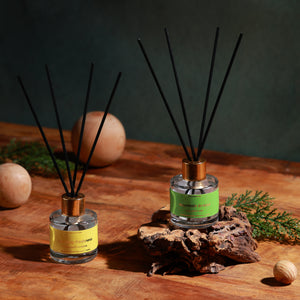
Rattan clogs at 85% relative humidity; fibre does not. Rattan is a natural cane with open, irregular pores that swell with moisture. Fibre reeds have a manufactured, consistent capillary structure that does not swell.
The signature symptom is a bottle that appears to last longer while the room gets quieter. Longevity and output are the same quantity read from opposite ends.
Flipping is the free test. If a flip of all six reeds produces nothing within a day, the reeds are the problem — and reeds are a consumable that we do not sell separately.
2. The first sign is not a smell, it is a level. A bottle whose oil has barely dropped in a month is either in a cold, sealed, still room, or it has stopped wicking. Those two are easy to tell apart: in the first case the reeds are still supple and a flip still lifts the room for an evening.
3. Run the wet-line test before you decide anything. Lift one reed with a gloved hand and find the boundary between oil-soaked and dry fibre. Barely above the oil line means the reed is not wicking. High and dark means it is saturated and stalled, and a flip is the answer.
4. Then run the pinch test. Roll the exposed end gently between gloved fingers. A healthy reed is slightly oily and flexible. A clogged one is stiff, tacky and often slightly darker in a band near the neck of the bottle.
5. Flip all six before you spend anything. A genuine flip should produce a noticeable lift within a few hours and a changed room by the next day. If twenty-four hours later nothing has changed, you have your answer for free.
6. Dust and reed count both accelerate it. A bottle on an open shelf near a main road clogs sooner than one in a bedroom, and ten reeds clog sooner than six because there is more exposed surface collecting residue in the same air.
7. The fix is fresh reeds, not fresh oil — and we do not sell reeds separately. That is a real gap in our range. A new bottle arrives with six fresh fibre reeds; plain reeds from a craft supplier work in between. Refresh every few months rather than waiting for a failure.
Composed and handmade in small batches in Pune, and a portion of every order supports girl-child education through Nanhi Kali.

Part one — how a reed actually closes
A reed is not a straw. It is a bundle of very fine parallel channels, and oil rises through them because the liquid's attraction to the channel wall beats gravity over a short distance. The rate at which that happens depends on how many channels are open, how wide they are, and how thick the oil is. Clogging is simply the number of open channels falling, and three separate things reduce it — one chemical, one environmental, one structural. They rarely arrive alone, which is why a reed that has survived a hot summer often gives up in the following monsoon.
 Morning Freshness₹749 · 9.0/10An exposed reed end is a tacky surface with an enormous area, held permanently in moving air. Every particle that touches it stays. In an Indian city that means road dust, construction fines, cooking aerosol and, near an open window, whatever the season is carrying. Those particles do not sit politely on the outside; the oil film draws them into the mouths of the channels. A visible grey or black speckling near the tip is late-stage evidence, not early warning — by the time you can see it, the top few millimetres are already contributing very little. Placement helps: waist to chest height in gently passing air, away from open windows and never above a live hob.
Part two — fibre and rattan through an Indian year
This is the comparison that made the decision for us. It is not a claim that rattan is a bad material; in a temperate, dry, low-dust climate it performs perfectly well and looks lovely. It is a claim that the Indian year asks something of a reed that rattan is poorly built to give.
| Condition | What rattan does | What fibre does | Effect on the room | Effect on the bottle |
|---|---|---|---|---|
| 85% monsoon humidity ★ | Cane swells, pores take on water, wicking can stop within days | Structure does not swell; wicking holds close to normal | Rattan goes silent in July; fibre carries on | Rattan: level freezes. Fibre: normal drop |
| 45°C dry summer heat | Wicks fast, dries at the tip, residue bakes on hard | Wicks fast but evenly; residue accumulates faster than usual | Both project well, then fade early | Both empty weeks ahead of schedule |
| Dusty city air, open shelf | Irregular pores trap particles readily | Traps particles too, but the path is more uniform | Gradual flattening, base notes dominate | Level slows without the room improving |
| Cold, sealed, air-conditioned room | Oil thickens, climb slows, cane stiffens | Oil thickens, climb slows, structure unchanged | Quiet room in both cases — and often nothing is wrong | Both last well beyond the stated weeks |
| Months three to six of use | Usually spent, often earlier | Reaching the end of a useful life | A flip stops producing a lift | Level stalls while oil remains |
| The honest caveat: fibre delays clogging, it does not abolish it. Every reed is a consumable and ours should be refreshed every few months. SOSA does not sell replacement reeds as a separate product — the refill is oil only. Six fresh fibre reeds come in every new bottle, and plain undyed reeds from a craft or packaging supplier will do the job between bottles. | ||||
Mountain Breeze · six fibre reedsfrom ₹849Shop → 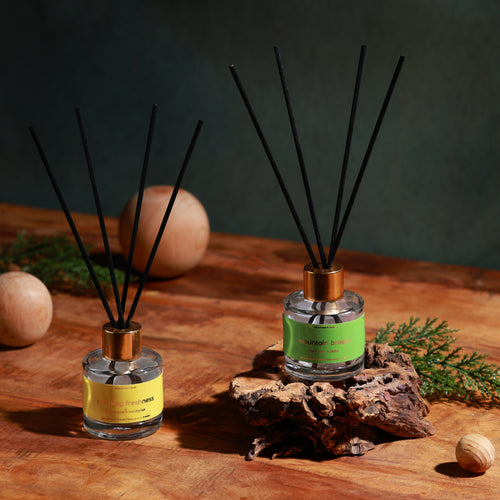 Fresh & Grounded duo · twelve reeds₹1,548Shop →
 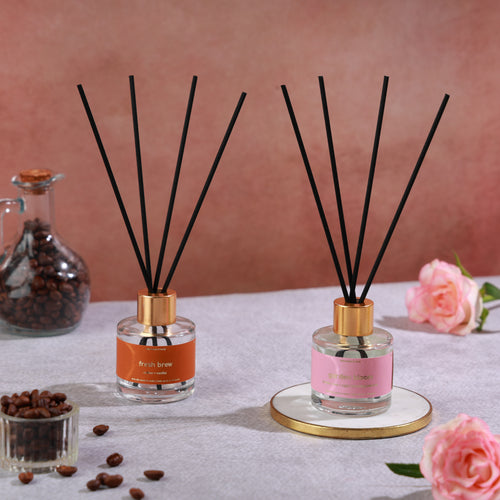 Oil refill · 300ml₹2,399Shop →
Part three — the longevity illusion, and what it costs
Here is the arithmetic that makes clogging so hard to notice. A 50ml bottle at six reeds is designed to run for six to eight weeks, which means it gives up roughly six to eight millilitres a week — a drop that is genuinely difficult to see in weeks one and two and obvious by week four. Now suppose the reeds clog to half their original flow at week five. The level stops moving in any way you can perceive, and the bottle appears to be heading for five or six months. You have not gained four months of fragrance. You have paid for 50ml of oil and are receiving perhaps 30ml of it in the room, with the rest ageing in the glass. Top notes are the first casualty, because they are lost to time rather than delivered to the air, which is why a stalled bottle also smells flatter and more base-heavy when you hold a reed to your nose.
The second cost is diagnostic. Because the format is quiet by design, a slow clog is almost impossible to hear happening. Olfactory adaptation makes it worse: your nose stops reporting a constant within minutes and adapts hardest in your own home, so the fragrance's decline and your own habituation are indistinguishable from the inside. The only reliable witnesses are the level, the wet line and a visitor. Somebody who has just walked in from outside will tell you in five seconds what a fortnight of standing in your own hallway cannot.
And the third cost is that people fix the wrong half. Faced with a quiet, full bottle, the instinct is to buy more oil — a new bottle, or a ₹2,399 refill — and pour it through the same reeds. That is pouring good oil into a closed pipe. Reeds are the consumable and oil is the stable part; ours sits on a heat-stable CCT base that has been tested through 45°C summers and 85% monsoon humidity and does not need rescuing. If a flip of all six reeds produces nothing within a day, the money that fixes your room is spent on reeds, not on fragrance.
Part four — the clog triage, in the order to run it
Four tests, in ascending order of effort, all of them free. Run them in order and stop at the first one that gives you a clear answer. Wear gloves for anything that involves lifting a reed, and stand the bottle on a tray while you work — reed oil marks wood and stone.
| Test | How to run it | Clogged reading | Healthy reading | Then what |
|---|---|---|---|---|
| 1. The level ★ | Mark the glass with tape; look again in a week | No perceptible movement in a normal warm room | A visible drop by week three or four | No movement — go to test 2 |
| 2. The wet line | Lift one reed and find the soaked-to-dry boundary | Barely above the oil after weeks in place | Climbing steadily, well up the reed | Low line — go to test 3. High and dark — flip |
| 3. The pinch | Roll the exposed end between gloved fingers | Stiff, tacky, a dull band near the neck | Supple, lightly oily, no crust | Stiff and tacky — reeds are spent |
| 4. The flip | Invert all six, return them, wait 24 hours | No lift at all, room unchanged next morning | A clear rise within hours, settling by evening | No lift — refresh the reeds, keep the oil |
| If tests 1–4 all read healthy | Ask someone who has just arrived from outside | They smell nothing either — a room or scent problem | They smell it immediately — adaptation, not a clog | Move the bottle into passing air, or move up the range |
Versailles
The first reed diffusers I made used rattan, because that is what the reference books and every supplier catalogue assume. They were beautiful. They also stopped working in my own Pune flat in the second week of a monsoon, and when I asked around, everyone I knew with an imported diffuser had quietly had the same experience and assumed the fragrance had simply run out of energy. It had not. The delivery had closed and nobody had told them that was a thing that happens.
Switching to fibre was not a design flourish. It was the only way to make a product that behaves the same in February and in July, and testing through 45°C heat and 85% humidity is what that decision cost. Fibre reeds are less romantic than cane. They also still work in the month you have guests, the windows shut and the air thick.
What I have not solved is selling you replacement reeds on their own. It is the most requested thing I cannot yet supply, and I would rather write that sentence than imply otherwise. Until then: six fresh reeds come with every bottle, plain reeds from a craft supplier are a reasonable stopgap, and refreshing every few months will keep a bottle honest. Everything is composed and handmade in small batches in Pune, and a part of every order funds a girl's classroom through Nanhi Kali.
Frequently asked questions
- Why have my reeds stopped absorbing oil? — the four causes of capillary failure.
- Why are my reeds turning dark? — reading the shade, and the sticky kind that matters.
- When do reeds need replacing? and how often? — the five signs and the schedule.
- The complete reed replacement guide — this page and the eight around it, in one place.
- Brand: the SOSA founder story.
SOSA reed diffuser range & prices (verified August 2026): alcohol-free, phthalate-free, paraben-free and IFRA-compliant compositions on a heat-stable coconut-derived (CCT) carrier, low-VOC, supplied in a refillable glass bottle with six fibre reeds; 50ml lasts 6–8 weeks and 130ml lasts 14–18 weeks. Morning Freshness (Malabar lemon · peppermint · Nilgiri eucalyptus) 50ml ₹749 · 130ml ₹1,249 · 9.0/10; Garden Bloom (British rose · night-blooming jasmine) 50ml ₹799 · 130ml ₹1,299 · 8.9/10; Evening Calm (Kashmir lavender · chamomile) 50ml ₹799 · 130ml ₹1,299 · 8.9/10; Fresh Brew (Coorg coffee · Kerala vanilla) 50ml ₹849 · 130ml ₹1,349 · 9.5/10; Mountain Breeze (Himalayan pine · sage · Indian cedar) 50ml ₹849 · 130ml ₹1,349 · 9.4/10. Reed diffuser refills are oil only — you reuse your own vessel and reeds: 300ml ₹2,399 (roughly 8–11 months) · 500ml ₹3,499 (roughly 14–18 months), about ₹7–8 per ml against ₹15–17 per ml for a 50ml bottle. Duo sets ₹1,498–₹1,598 for 2 × 50ml and ₹2,498–₹2,598 for 2 × 130ml. Strength figures are positions on SOSA’s own internal strength scale, not an industry standard. Replacement reeds are not sold as a separate SKU; SOSA guidance is to refresh reeds every few months. The reed line is separate from the water-based Hotel Collection for ultrasonic machines (15ml ₹299 · 100ml ₹999 · 300ml ₹1,799) and the two are not interchangeable. Diffusers: Boond 300ml ₹899 · Sukoon 500ml ₹1,899 · Megh 6L ₹3,499 · waterless Vaayu ₹11,999. Composed and handmade in small batches in Pune, India; tested through 45°C summer heat and 85% monsoon humidity. Free shipping above ₹499. A portion of every order supports girl-child education through Nanhi Kali. Prices subject to change — see the live product pages.