




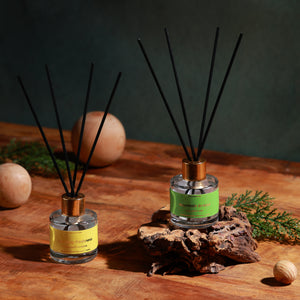
Indian variable one — humidity. Saturated air carries fragrance molecules less readily, so in a humid month projection shortens and the scent hangs close to the bottle. This is the season where moving the diffuser into the room’s airflow beats adding reeds.
Indian variable two — open windows. Air that leaves takes the fragrance with it. A flat with cross-ventilation all day is simply not a home-fragrance environment during those hours; it becomes one the moment the windows close.
What that means for the mechanism: in a humid coastal flat an ultrasonic water machine adds humidity to a room that already has plenty, which is the honest argument for waterless cold-air nebulising instead. In a dry AC bedroom the same humidity is welcome.
The honest gap: Safar ₹3,999 is named and sold as a car and travel diffuser with no published room coverage; Vaayu ₹11,999 is rated to 2,000–3,000 sq ft and is wrong for one bedroom. There is no mid-sized waterless bedroom nebuliser between them.
2. Work with the windows, not against them. Air that leaves takes the fragrance with it. If your windows are open from six in the morning until sunset — which is normal, sensible and good for the house — those hours are not fragrance hours, and no product changes that. The hours after they close are when everything you buy actually performs. Decide which hours you are buying before you decide what to buy.
3. Expect humidity to change the character rather than to break anything. Saturated air carries fragrance molecules less readily, so in a humid month projection shortens and the scent hangs closer to the source. The same bottle honestly smells warmer and closer in a monsoon than in a dry January, and that is an evaporation curve rather than a fault. In those weeks, moving the diffuser into the room’s airflow path does more than adding reeds.
4. Choose the mechanism against your own air. In a dry, sealed, air-conditioned bedroom, Sukoon at ₹1,899 is close to ideal: ultrasonic water mist covering a published 270–320 sq ft, and the little humidity it adds is welcome. In a humid coastal flat the same machine is adding moisture where there is already too much, and Safar at ₹3,999 — waterless cold-air nebulising of undiluted oil, no water, no added humidity, no white mineral dust — is the honest alternative. Know before you buy that it is named and sold as a car and travel diffuser and has no published room-coverage figure.
5. Clean and air the room first, always. Fragrance does not remove a smell. Adding a pleasant odour to an unpleasant one produces a mixture rather than a cancellation, and the mixture is frequently worse because the brain now tracks two things. Cooking aerosols condense onto curtains and soft furnishings and re-release for hours after the air itself is clear, which is why a flat can smell of last night’s tadka at nine the next morning. Source, then ventilation, then fragrance — in that order, every time.
Free shipping above ₹499, and a portion of every order supports girl-child education through Nanhi Kali.
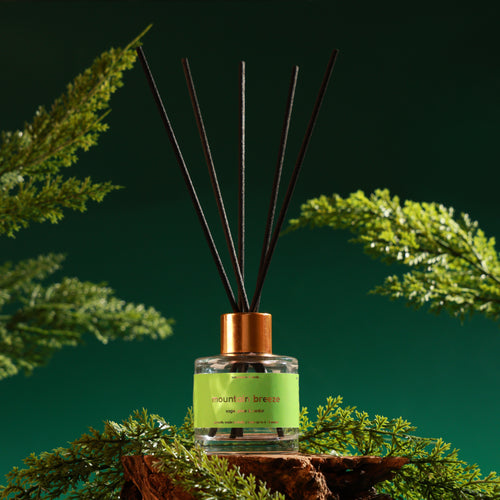
The two Indian variables, named honestly
Almost every guide written about home fragrance was written for a European flat: sealed, temperate, centrally heated, windows shut for eight months of the year. An Indian flat is a different physical object, and two of its properties change the answer rather than decorate it. Neither of them is a problem to be defeated. Both of them are conditions to be worked with, and once you can name them you will stop blaming the oil for things the air is doing.
 Evening Calm₹799In a humid month the diffuser has not weakened; the air has changed. Saturated air carries fragrance molecules less readily, so projection shortens and the scent stays closer to the bottle — which is exactly the “it only smells right next to it” complaint, arriving seasonally. Higher temperature at the same time lifts the top notes faster and lets the base dominate sooner, so the same composition honestly reads warmer and heavier in a monsoon than in winter. The useful response is not more reeds. It is moving the bottle into the path the room’s air already takes, so that what does evaporate gets carried somewhere.
 Morning Freshness₹749This is the variable people find hardest to accept, because opening the windows is the right thing to do and it is also the thing costing you the effect. Continuous cross-ventilation always costs projection, because the fragrance leaves with the air. A home with the windows open all day is not a home-fragrance environment during those hours; it becomes one the moment they close. Height compounds it — wind speed increases with altitude, so a balcony door on the twentieth floor turns the room’s air over far more aggressively than a second-floor window. Nothing about the diffuser has changed. The room is simply exchanging its air more often.
 Sukoon₹1,899An ultrasonic machine vibrates a water-and-oil mixture into a visible wet mist, which moves air and covers a room properly — a real step up in reach from a reed — but the oil is diluted and the output adds humidity. In a dry sealed AC bedroom that is a bonus. In a coastal flat in August it is moisture you did not want. Waterless cold-air nebulising is the opposite trade: pressurised air shatters undiluted oil into a dry micro-mist, adding no humidity and leaving no white mineral dust, which is most of why the same oil reads as stronger. That is Safar ₹3,999 at personal scale — named and sold as a car and travel diffuser, with no published room-coverage figure — and Vaayu ₹11,999 at building scale.
The scale caveat — and why your flat is the easier problem
Here is the caveat stated as plainly as I can, and then the good news that follows from it. A resort is solving a much harder problem than you are. A lobby with a double-height ceiling and open sides has an enormous air volume that is constantly being replaced, and to hold a perceptible concentration in it you need a commercial machine pushing undiluted oil into the building’s own moving air, running for hours, every day. That is not an upgraded version of a home diffuser; it is a different class of equipment doing a different job. Nothing you buy for a flat competes with it, and nothing you buy for a flat should try.
The good news is the arithmetic runs the other way in your favour. Concentration is quantity per unit of volume, and your bedroom has almost no volume by comparison. A closed 120 sq ft room reaches a perceptible, even level quickly and holds it, because it exchanges its air slowly. This is why the correct advice for a small Indian bedroom is so often to use less than people expect — three reeds rather than six, the softest scent in the range rather than the deepest — and why “cloying” in a small flat is nearly always a description of over-dosing rather than of a composition. You are not under-equipped. You are frequently over-dosed and under-contained.
And the part that is not reproducible, said warmly rather than dodged. Some of what you loved at that resort was that you were on holiday. You had arrived from somewhere else, so your nose was un-adapted in a way it never is at home; somebody else had made the bed; there was no laundry drying in the corner and nothing on the list for the evening. The fragrance was doing perhaps half the work and the circumstances were doing the rest. That is worth knowing before you spend, because readers who understand it stop trying to buy their way to the other half and start enjoying the half that is genuinely available — which is consistency, dryness, one signature scent kept for a year, and a room that greets them when they walk in.
| Format & mechanism | In a humid month | Adds humidity? | Space it suits | What it costs you |
|---|---|---|---|---|
| Reed diffuser ₹749–₹849 · passive capillary ★ | Projection shortens; scent hangs close. Move it into the airflow rather than adding reeds | No | 50ml up to ~150 sq ft, 130ml above. A fragrant zone rather than a fragranced room | Nothing — no power, water, charging or noise. ~₹13–₹15 a day. CCT carrier, tested at 45°C and 85% RH |
| Boond ₹899 · ultrasonic water mist | Works, but adds moisture to already-moist air | Yes | Up to ~150 sq ft | Water, dilution, refilling, USB power; ~6 hours from 300ml |
| Sukoon ₹1,899 · ultrasonic water mist ★ | Excellent in a dry AC bedroom; think twice in a humid coastal flat | Yes — a bonus in dry air, a cost in wet air | 270–320 sq ft, published | Water, dilution, filling, possible white mineral dust in hard-water cities. Three 15ml Hotel Collection scents included |
| Megh ₹3,499 · ultrasonic water mist | Adds a great deal of moisture | Yes, substantially | ~215 sq ft — less than the ₹1,899 Sukoon | A runtime and humidity machine, ~100 hours from 6L. Never a coverage upgrade |
| Safar ₹3,999 · waterless cold-air nebulising ★ | The honest answer when water is ruled out — undiluted oil, dry mist | No. No dilution, no added humidity, no white dust | No published figure. Personal and small-space scenting | Recharging, a small pump sound, a 1/2/3-hour auto-off. Named and sold as a car and travel diffuser |
| Vaayu ₹11,999 · waterless cold-air nebulising | The resort mechanism, sized for a building | No | 1000 m³ — roughly 2,000–3,000 sq ft | ₹11,999 and nine-tenths wasted in one bedroom. Right for a whole floor, open-plan living-dining, a villa, clinic or reception |
Silent baseline · Mountain Breeze₹849Shop →  Room coverage · Sukoon₹1,899Shop →
  The oils · Hotel Collection₹999Shop →
Building it, room by room, in an ordinary flat
Choose two rooms and leave the rest alone. The bedroom is the easiest win in any Indian flat, because it is small, it has a door, and it spends long hours closed. The entry or the drawing room is the second, because it is where arrival happens and where guests form their impression. Kitchens and balconies are not fragrance rooms — a kitchen has its own strong smell and constant air exchange, and a balcony is outdoors with a railing. Two rooms with two different registers also solves the problem a single bottle cannot: a flat that smells the same everywhere stops smelling of anything within a week. The Fresh & Grounded duo at ₹1,548 is that pairing already boxed.
Place for the airflow you actually have. A reed diffuser adds no air of its own, so it depends entirely on the room to distribute what it releases — which is why placement matters more for a reed than for any machine. Put it where air already travels: a metre inside the doorway, on a console in the passage, on the counter near where you stand. Not on a windowsill in direct sun, which cooks the top notes. Not directly under a running split AC, which strips them within days and leaves you with the base wondering where the fragrance went. And not on the entrance console itself if you can avoid it — an entrance is the most turbulent point in a flat, repeatedly stripped by the door opening and then met at very close range.
Use the AC to your advantage, because it is doing two useful things at once. A running air conditioner recirculates air within a closed room, which distributes fragrance far more evenly than still air does — this is why a sealed bedroom often reads as the best-scented room in an Indian flat at night. It also dries the air, which speeds evaporation, so you get better distribution and a shorter bottle life in the same season. If you own a Sukoon, an AC bedroom is the room where its added humidity is a genuine benefit rather than a cost. If your flat is humid and unairconditioned, that is the case for waterless Safar instead — and here is where the range stops helping: between Safar and Vaayu there is no mid-sized waterless bedroom nebuliser, so a humid 150 sq ft room that wants waterless, room-filling scent is a specification we do not have a perfect product for.
What to buy for an Indian flat, in order
Free adjustments first, because placement and closed hours do more here than any upgrade. Then the reed, then the machine chosen against your own air rather than against a price list. The last row is the gap in our own range, and in a humid flat it is the row that matters most: the product a coastal reader keeps describing to me is waterless, scheduled and sized for one bedroom, and it does not exist.
| Step | What it is | When it is the right answer | Price |
|---|---|---|---|
| 1. Closed hours, placement, and a clean aired room ★ | Scent the hours the windows are shut; move the bottle into the airflow but out of the AC blast and the sun; clean and ventilate before you fragrance | Always first, and free. Fragrance does not remove a smell — source, then ventilation, then fragrance | ₹0 |
| 2. A reed diffuser, sized to the room | Passive capillary, six fibre reeds, heat-stable CCT carrier, tested at 45°C and 85% RH. 50ml up to ~150 sq ft for 6–8 weeks; 130ml above that for 14–18 | The silent, unpowered baseline for any Indian room, and the only option here that never needs power, water, filling or charging | ₹749–₹1,349 |
| 3. Sukoon ★ | Ultrasonic water mist, 270–320 sq ft published, 16–18 hours on low from 500ml, three 15ml Hotel Collection scents included | A dry, sealed, air-conditioned bedroom or study, where the added humidity is welcome. The value answer for most Indian flats | ₹1,899 |
| 4. Safar | Waterless cold-air nebulising of undiluted oil, no added humidity, no white dust, 3 speeds, 1/2/3-hour auto-off, 20ml bottle, 2000 mAh Type-C | A humid coastal flat, or any room where more moisture is the last thing you want. Named and sold as a car and travel diffuser; no published room coverage; needs recharging | ₹3,999 |
| 5. Vaayu | The resort mechanism domestically: 1000 m³, 400ml tank lasting about 90+ days, app scheduling with 1h/4h/8h/24h windows, under 38 dB | Only if the space genuinely is large — an open-plan living-dining, a whole floor, a villa, a clinic, a salon or a reception. Not one bedroom | ₹11,999 |
| The honest gap | A waterless nebuliser sized for one Indian bedroom, which SOSA does not make. Safar is personal scale with no published coverage; Vaayu is rated to 2,000–3,000 sq ft. Nothing sits between them | Said plainly, because in a humid flat “no water” and “one room” is the commonest pair of constraints we cannot perfectly serve | — |
Versailles
I trained in Versailles and then came back and composed for Pune, and the gap between those two things is the reason this page exists. Almost every rule in classical home fragrance was written for a sealed temperate flat — windows shut, air still, forty degrees never happening. Then you bring it to a Mumbai August or a Delhi May and the carrier cracks, the rattan wicks unevenly, and the customer concludes that the oil was bad. It usually was not. The formulation had simply never met this air.
So the two things I would want you to take from this page are not products. The first is that humidity does not weaken a fragrance, it shortens its reach — the scent is hanging close to the bottle rather than disappearing, and moving the bottle into the room’s airflow does more than adding reeds ever will. The second is that open windows are not a mistake to be corrected. They are the right way to live in an Indian flat, and they simply mean your fragrance hours are the closed ones. Buy for those hours and you will stop feeling cheated.
And the resort. Some of it was the machine, and you can have a version of that. Some of it was that you had arrived from somewhere, and someone else had made the bed, and nothing was your responsibility for three days. I cannot sell you that and I would not respect a page that implied I could. What I can tell you is that a small Indian bedroom, closed, with one scent kept for a year, is a genuinely lovely thing and costs ₹749. Everything is composed in Pune, and part of every order funds a girl’s classroom through Nanhi Kali.
Frequently asked questions
- My house smells boring after the hotel — novelty, adaptation, and the practical ladder.
- The holiday room — what is reproducible and what is not.
- The resort arrival moment — scale and scheduling, not strength.
- Why a ₹1,000 reed feels nothing like it — a ₹3,000 reed would feel the same.
- A signature smell for your home — one scent, kept for a year.
- Coming home to it — the scheduling answer, and why the room must be ready first.
- That hotel smell every evening — occupancy hours and the cost of an empty room.
- You do not need a luxury home — a small room is easier, not harder.
- What to buy first — the whole order, cheapest honest option at the top.
- Brand: the SOSA founder story.
Facts verified August 2026: Passive capillary — SOSA reed diffusers, five scents, 50ml ₹749–₹849 for rooms up to ~150 sq ft lasting 6–8 weeks, 130ml ₹1,249–₹1,349 above 150 sq ft lasting 14–18 weeks, six fibre reeds included (six for full projection, three for a soft bedside level and roughly double the life), flipped every 3–5 days, about ₹13–₹15 a day, heat-stable CCT carrier rather than DPG, alcohol-free, phthalate-free, paraben-free, IFRA-compliant, 0 ppm formaldehyde, refillable glass, tested at a 45°C heat soak and 85% RH, composed in Pune; duos ₹1,498–₹1,598 for 50ml × 2 and ₹2,498–₹2,598 for 130ml × 2; refills 300ml ₹2,399 and 500ml ₹3,499, oil only and never a first purchase. Ultrasonic water mist — Boond ₹899 (300ml, up to ~150 sq ft, ~6 hours, USB, night light), Sukoon ₹1,899 (500ml, 270–320 sq ft, 16–18 hours on low, three 15ml Hotel Collection scents included), Megh ₹3,499 (6L tank, ~100 hours, ~215 sq ft — less than Sukoon, and never a coverage upgrade). Waterless cold-air nebulising — Safar ₹3,999 (20ml bottle, 2000 mAh Type-C, up to 10 hours continuous or around 30 hours intermittent per charge, 3 speeds, 1/2/3-hour auto-off, 6.9 cm, named and sold as a car and travel diffuser with bedside and hotel room among its stated uses, no published room-coverage figure) and Vaayu ₹11,999 (up to 1000 m³ or roughly 2,000–3,000 sq ft, 400ml tank lasting up to about 90+ days, Bluetooth app plus onboard buttons, 1h/4h/8h/24h run windows, choice of days, adjustable intensity, key-lock, under 38 dB, freestanding or wall/HVAC mount, 5W, CE, RoHS, SGS). Between Safar and Vaayu there is no mid-sized waterless bedroom nebuliser in the SOSA range. Hotel Collection oils are water-based and ultrasonic-only — 15ml ₹299 (a refill), 100ml ₹999, 300ml ₹1,799, pack of 7 ₹1,799 — and cannot be used in reed diffusers, nor reed oil in ultrasonic machines; there is no hotel-inspired reed diffuser. No health, air-quality, allergy, mould or antimicrobial claims are made, no claim is made that fragrance improves sleep, mood or concentration, and fragrance does not remove a smell: source, ventilation, then fragrance. Free shipping above ₹499. A portion of every order supports girl-child education through Nanhi Kali. SOSA is an independent Indian fragrance house; the Hotel Collection scents referenced here are SOSA’s own interpretations inspired by the world’s finest hotels, and SOSA is not affiliated with, endorsed by or a supplier to any hotel brand. Prices subject to change — see the live product pages.