

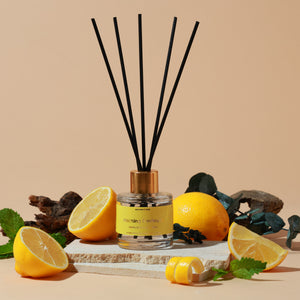
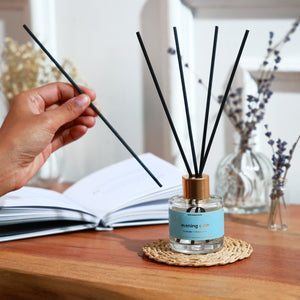
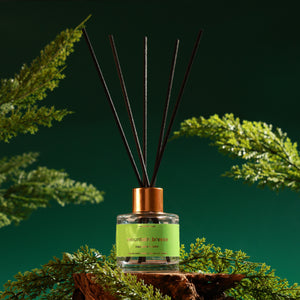

A reed does the opposite, by design. Oil climbs six fibre reeds and evaporates from their surface into still air. Nothing in the object moves air, so the room is the delivery system, and the room is not under your control.
Do these first, because two of them are the same mechanism for free: six reeds rather than three, halve the bottle-to-person distance, nose height on a surface, out of the draught but not in a dead corner, close the door, and turn the ceiling fan on low — a fan is transport, which is the exact thing a reed lacks.
The honest ladder if that is not enough: Sukoon ₹1,899, 270–320 sq ft, first — it is very often the correct bedroom answer. Megh ₹3,499 is not a coverage upgrade: six litres, about 100 hours of runtime, only about 215 sq ft. Vaayu ₹11,999 is rated to 1000 m³, roughly 2,000–3,000 sq ft, and is the wrong purchase for one bedroom.
The gap, said plainly: between Safar ₹3,999, which is named and sold as a car and travel diffuser, and Vaayu, SOSA has no mid-sized waterless bedroom nebuliser. Nothing in the range is “a Vaayu for one room”.
- The straight answer, with the mechanism
- Three things an active device does that a reed structurally cannot
- The part of the mechanism you can have for nothing
- The three mechanisms, side by side
- What active diffusion does not fix
- What to buy, in order — and the gap in our own range
- A note from Sonal
- FAQs
2. Because a moving plume starts a circulation, and circulation is what evenness is made of. A stream of air leaving an outlet entrains the still air around it and sets up a slow turnover in the room. That turnover is the mixing step. It is why a room with an active diffuser reads as uniformly scented within minutes rather than as one strong corner, and it is the reason a ceiling fan on low helps a reed so much — the fan is supplying, from outside, the one thing the bottle cannot supply from inside.
3. Because concentration stops being a function of distance. This is the sentence worth keeping. With a reed, how much you smell is decided by how far you are from the bottle. With an active device, it is decided by the machine’s output rate against the room’s volume — and the volume is the same whether you are at the bed, the desk or the door. You have swapped a geometry problem for a settings problem, and settings are adjustable.
4. Because output becomes constant rather than weather-dependent. Reed emission climbs in a 40°C room, falls in saturated monsoon air, and tapers as the bottle empties — a real and unavoidable property of evaporation from a wetted surface. A machine at a given intensity puts out the same amount on a hot day, a wet day, and in week nine. Consistency across a room and consistency across a month are two different requests, and this answers both.
5. And because you get a schedule. A reed runs continuously whether the room is occupied or not. An active diffuser can be told to run for an hour before you use the room and then stop. That is not only economical; it is the reason the room still smells of something to you at all, since receptors adapt to a constant stimulus within minutes and a diffuser you can smell all day is usually one set too high for the space.
Do the free fixes first — a large share of people who read this page are finished by the end of them. Alcohol-free, phthalate-free, made in Pune. A portion of every order supports girl-child education through Nanhi Kali.

Three things an active device does that a reed structurally cannot
I want to take the word “active” apart, because it is used loosely and it hides the actual argument. Active does not mean stronger. A reed diffuser and a nebuliser can run closely related fragrances at similar perceived intensities and still produce two completely different rooms — and the difference is not in the oil. It is in three separate jobs the machine does before the fragrance ever reaches you.
 Sukoon₹1,899An ultrasonic diffuser vibrates a water-and-oil mixture with a piezo plate until it leaves the surface as a visible wet mist. A waterless cold-air nebuliser does something different and, to my mind, more elegant: pressurised air shatters undiluted oil into a dry micro-mist, with no water, no dilution, no heat and nothing added to the room’s humidity. Both share the point that matters here. The fragrance arrives in the room already divided into airborne droplets. A reed offers a wetted fibre surface and waits for molecules to leave it one at a time, which is a beautifully quiet process and an extremely slow way to fill a volume.
 Mountain Breeze₹849This is the load-bearing one. Vapour leaving a reed has no momentum; it can only be carried. Mist leaving an outlet is a moving stream, and a moving stream entrains the still air beside it and sets a slow circulation going in the room. That circulation is the mixing step, and mixing is what evenness physically is. Nothing else in home fragrance produces it. Not a second bottle, not a bigger bottle, not a more intense oil — all three raise how much leaves the source and none of them adds a single unit of transport. Evenness is a property of moved air, and it cannot be bought any other way.
 Evening Calm₹799Evaporation from a wet surface is governed by temperature, humidity and the air moving over it, which is why the same bottle behaves like a different product across an Indian year: brisk in a hot dry room, close and short-range in saturated monsoon air. Reed count is the only dial you have, and it is a coarse one — six reeds is full projection, three is a soft bedside level that roughly doubles the life. An active diffuser replaces all of that with an intensity setting and a timer. Vaayu runs on 1h, 4h, 8h or 24h windows with a choice of days; Safar has three speeds and a 1, 2 or 3-hour auto-off.
The part of the mechanism you can have for nothing
I would rather you spent nothing and were happy than spent ₹1,899 and were only slightly happier, so here is the whole free list before any of the paid advice. Reed count first. Six reeds is full projection and three is a soft bedside level that roughly doubles the life of the bottle; if you have three in, the fastest change available to you costs zero rupees. Then distance. Halving the gap between the bottle and where you actually sit or sleep does more than any change of scent, because with a point source distance is the dominant term. Then height — at or slightly below nose height, on a surface, not on the floor and not on a high shelf. Then the draught. Not on a windowsill, not in a running AC’s blast and not beside an open balcony door, but not in a dead corner either; you want the bottle in the room’s circulation, not in its exhaust. Then the door — containment is half of the equation and costs nothing at all.
And then the one I would put above all the others. Turn the ceiling fan on low. A fan is the transport a reed structurally does not have, and switching it on is the closest thing in this subject to buying the second half of an active diffuser for free. It genuinely helps, it helps immediately, and it is the single most useful thing on this page for most readers. It will shorten the bottle, because moving air over a wetted surface speeds evaporation, and I would rather tell you that than let you discover it in week five. That is a trade you get to make with your eyes open: a fan on low turns a fragrant corner into a fragranced room and turns eight weeks into something shorter. Many people find that is exactly the deal they wanted.
One more thing that costs nothing: change how you are judging the result. Sitting in a room is the worst possible way to assess it, because a constant stimulus is exactly what olfactory receptors adapt to, usually within minutes. The signal keeps arriving and your brain stops reporting it. Leave for fifteen minutes and walk back in, and ask somebody who does not live there. A visitor is a better instrument than you are, and I have lost count of the number of people who were about to replace a diffuser that their guests could smell from the lift.
The three mechanisms, side by side
There are exactly three ways a home fragrance can get into your air, and every product on any shelf is one of them. Read the middle column as the honest answer to the question at the top of this page, and the last row as the one thing that most changes the shape of a room and costs nothing.
| Mechanism | What disperses the oil | What transports it | Shape across a room | What it costs you |
|---|---|---|---|---|
| Passive capillary — the reed | Nothing; evaporation from a wetted fibre surface | Whatever air the room is already moving | A peak at the bottle falling away with distance — a fragrant zone, not a fragranced room | ₹749–₹1,349, roughly ₹13–₹15 a day, silent and never switched on |
| Ultrasonic water mist ★ | A piezo plate vibrating a water-and-oil mixture into a visible wet mist | The machine, via a moving plume that starts a circulation | Broadly even across the rated area, with a local feature near the outlet | ₹899–₹3,499, power, refilling, added humidity, possible white mineral dust in hard water |
| Waterless cold-air nebulising | Pressurised air shattering undiluted oil into a dry micro-mist | The device’s own air stream, then the room’s airflow carrying a mist fine enough to stay suspended | The most even of the three, and the technology hotels use | ₹3,999–₹11,999, power or charging, and at SOSA a gap in the middle of the range |
| A second reed diffuser | Nothing; twice the surface | Still nothing | Two hills with a valley between — the midpoint is the farthest point from both | Another ₹749–₹849, and the same disappointment twice |
| A ceiling fan on low ★ | Nothing — it is not a dispersal device | Real, immediate transport, applied to the reeds you already own | Noticeably flatter, in a closed room, within minutes | Nothing, except a shorter bottle |
Active · Sukoon 270–320 sq ft₹1,899Shop → 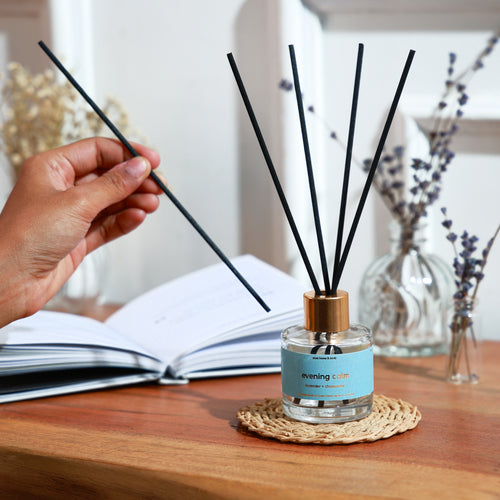 Passive · Evening Calm 8.9₹799Shop →
 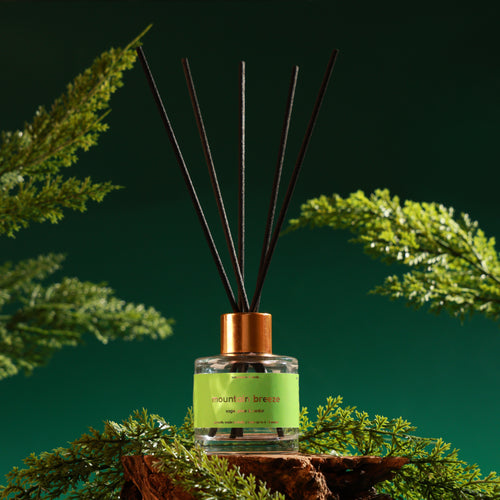 Passive · Mountain Breeze 9.4₹849Shop →
What active diffusion does not fix, and one thing you must check before you buy
I will not sell you a machine on an overstatement, so here are the limits. An active diffuser does not defeat ventilation. Air that leaves a room takes the fragrance with it, and a balcony door standing open turns over the whole room’s air; a machine running into that is a machine scenting the outdoors. Close the door for the hours that matter, whichever mechanism you own. Nor does it make a room even if the room is not one volume — an L-shaped space used at both ends, or two rooms joined by a doorway, will still favour the limb the machine is standing in. And it does not remove a smell. Fragrance is a mixture, not a cancellation; source first, then ventilation, then fragrance, in that order and never the other way round.
The thing to check before you buy is compatibility, because this is the most common disappointment in the whole subject and it has nothing to do with performance. Switching mechanism may mean switching scent. Reed oil cannot go into an ultrasonic machine. The water-based Hotel Collection cannot go into reeds — there is no hotel-inspired reed diffuser, in either direction. Safar takes pure fragrance oil. So if what you love is Fresh Brew in your reeds, please do not buy a machine expecting to pour Fresh Brew into it. The correct instruction is add a mechanism, not switch to one, and a great many people end up keeping the reed for the bedside and running the machine for the room.
There is one more asymmetry worth stating, and it is the reason the two mechanisms coexist happily in my own flat. A reed has no single point of failure. It does not stop in a power cut, it does not need a socket, there is nothing to fill, charge or remember, it makes no noise at all, and there is no version of it that stops working in year three. A machine buys you evenness, control and a schedule, and in exchange it becomes an appliance with a lifespan. That is a real trade and reasonable people land on both sides of it.
What to buy, in order — and the gap in our own range
In the order I would actually spend, assuming the free list has already been worked through and given a week. The last row is the thing I cannot sell you, and it is the most useful line in the table for anybody with one bedroom and an evenness problem.
| Step | What it is | When it is the right answer | Price |
|---|---|---|---|
| 1. The free list, then the fan ★ | Reed count, distance, height, draught, door, and a ceiling fan on low | Always first. A large share of readers stop here, and the fan is genuine transport | ₹0 |
| 2. A reed sized to the room | 50ml for up to about 150 sq ft, 6–8 weeks; 130ml above that, 14–18 weeks | If the room was simply under-dosed rather than under-distributed | ₹749–₹1,349 |
| 3. Sukoon ₹1,899 ★ | Ultrasonic, 500ml, 270–320 sq ft, 16–18h on low, three 15ml scents included | The first genuine step into active diffusion, and very often the correct bedroom answer | ₹1,899 |
| 4. Safar ₹3,999 | Waterless cold diffusion of undiluted oil, 20ml, cordless, three speeds, a 1 / 2 / 3-hour timer. Named and sold as a car and travel diffuser | When you want the waterless mechanism at personal scale and can live with recharging it. Not set-and-forget | ₹3,999 |
| Megh ₹3,499 and Vaayu ₹11,999 — the two I would talk you out of | Megh holds six litres and runs about 100 hours but covers only about 215 sq ft, less than the Sukoon. Vaayu is rated to 1000 m³, roughly 2,000–3,000 sq ft | Megh for runtime and humidity, not coverage. Vaayu for a whole floor, an open-plan living-dining, a clinic or a showroom — never for one bedroom | ₹3,499 / ₹11,999 |
| The honest gap | Between Safar and Vaayu, SOSA has no mid-sized waterless bedroom nebuliser. Nothing in the range is “a Vaayu for one room” | Said plainly rather than papered over with the nearest product | — |
Versailles
The question on this page is the one I most enjoy answering, because the reader has already done the hard part. They are not asking which scent is best. They are asking whether a different method would give a different result, which is precisely the right question and one that almost nobody arrives at on their own. Most people spend two or three purchases along the emission axis first — more reeds, a bigger bottle, a deeper fragrance — before it occurs to them that the problem might be structural.
What I want to be careful about is the word better. An active diffuser is not a better product than a reed. It is a different machine solving a different half of the problem. I keep Evening Calm on my own bedside table and I would not swap it for anything, because it needs no socket, makes no sound, and is simply there. What it will never do is make the far corner of the room smell the same as the near one, and no amount of reed count changes that, because reed count is a volume dial and the problem is a shape.
So the honest advice is a sequence, not a product. Work the free list. Turn the fan on low for a week and judge the room by walking into it after fifteen minutes away, not by sitting in it. If you are still short of what you want, then Sukoon at ₹1,899 is where the ladder honestly begins, and if a machine is not for you, the bottle is not a consolation prize. Everything is composed in Pune, and a part of every order funds a girl’s classroom through Nanhi Kali.
Frequently asked questions
- Even distribution across a bedroom — the head question, answered from first principles.
- Hot spots instead of consistency — why point sources make peaks.
- The same strength at bed, desk and door — a demanding and completely legitimate requirement.
- One strong corner and three weak ones — the practical fixes in order.
- Several passive or one active? — scored honestly, including the rows passive wins.
- Fragrance in the air, not around the bottle — the vocabulary you need to search well.
- Distribution versus strength — the shape of the curve, not its height.
- Choosing by distribution, not bottle size — how to read a listing properly.
- Should I look beyond reed diffusers? — the family pillar, with the free fixes first.
- Brand: the SOSA founder story.
SOSA facts verified August 2026: Reed diffusers are supplied in 50ml and 130ml only — 50ml suits rooms up to about 150 sq ft and lasts 6–8 weeks, 130ml suits rooms above 150 sq ft and lasts 14–18 weeks, at roughly ₹13–₹15 a day. Six reeds is full projection; three is a soft bedside level and roughly doubles the life; two or three reeds in a 50 sq ft bathroom can make a 50ml last nearly three months; flip the reeds every 3–5 days. Morning Freshness ₹749 / ₹1,249 · Evening Calm ₹799 / ₹1,299 · Garden Bloom ₹799 / ₹1,299 · Mountain Breeze ₹849 / ₹1,349 · Fresh Brew ₹849 / ₹1,349. Duos: Day & Night ₹1,498, Fresh & Grounded ₹1,548, Warmth & Bloom ₹1,598 (50ml × 2); 130ml duos ₹2,498 / ₹2,548 / ₹2,598. Strength scale, perceived intensity rather than quality: Evening Calm 8.9 softest, Garden Bloom 8.9, Morning Freshness 9.0, Mountain Breeze 9.4, Fresh Brew 9.5 deepest. Six fibre reeds rather than rattan, heat-stable CCT carrier rather than DPG, alcohol-free, phthalate-free, paraben-free, IFRA-compliant, 0 ppm formaldehyde, refillable glass bottle, tested at 45°C and 85% RH, composed in Pune. Refills 300ml ₹2,399 and 500ml ₹3,499, oil only and never a first purchase. Machines: Boond ₹899 (300ml, up to about 150 sq ft, ~6h, USB, night light) · Sukoon ₹1,899 (500ml, 270–320 sq ft, 16–18h on low, three 15ml Hotel Collection scents included) · Megh ₹3,499 (6L, ~100h runtime but only ~215 sq ft, never a coverage upgrade) · Safar ₹3,999, a waterless cold-diffusion device named and sold as a car and travel perfume diffuser, with a 20ml bottle, a 2000 mAh battery, up to 10 hours continuous or about 30 hours intermittent per charge, three speeds and a 1 / 2 / 3-hour auto-off timer · Vaayu ₹11,999, a waterless cold-air nebuliser rated to 1000 m³, roughly 2,000–3,000 sq ft, with a 400ml tank, app and onboard control and under 38 dB operation, and the wrong purchase for one bedroom. Aangan ₹25,999 and Meenar ₹38,500 are commercial machines and are not home recommendations. No coverage figure is published for Safar and none is quoted here. Between Safar and Vaayu, SOSA has no mid-sized waterless bedroom nebuliser. Reed oil, the water-based Hotel Collection and pure fragrance oil are not interchangeable across these mechanisms. No health, air-quality, allergy, sleep or mood claims are made anywhere on this page, and fragrance is not presented as a way to remove a smell. Free shipping above ₹499, and a portion of every order supports girl-child education through Nanhi Kali. SOSA is an independent Indian fragrance house; the Hotel Collection is SOSA's own interpretation inspired by the world's finest hotels and SOSA is not affiliated with or endorsed by any hotel brand. Prices subject to change — see the live product pages.