



The method, in three movements: 1) prove the source — if it is right at the bottle, the oil is intact and you are done investigating it. 2) exhaust free transport — six fibre reeds rather than three, halve the distance, nose height on a surface, out of the draught but not in a dead corner, close the door, and a ceiling fan on low, which is the best free fix in this whole subject. 3) decide whether you want a zone or a volume, and buy the smallest thing that meets it.
The three honest paths: a reed at ₹749–₹849 — silent, no power, no maintenance, roughly ₹13–₹15 a day, a zone rather than a room, and it never breaks. Sukoon ₹1,899 — 270–320 sq ft, water-diluted, adds humidity, needs filling, and very often the correct bedroom answer. Safar ₹3,999 — undiluted oil, waterless, cordless, three speeds and a 1 / 2 / 3-hour timer, named and sold as a car and travel diffuser.
The honest gap: between Safar and Vaayu ₹11,999 there is no mid-sized waterless bedroom nebuliser. Vaayu covers up to 1000 m³, roughly 2,000–3,000 sq ft, and is the wrong purchase for one bedroom. Megh ₹3,499 holds six litres and covers about 215 sq ft, so it is never a coverage upgrade.
2. Understand what a reed can and cannot do, because the limitation is structural rather than a matter of quality. A reed diffuser is a point source with no transport. Once the vapour leaves the fibre, it moves by molecular diffusion, which is far too slow to cross metres of a room usefully, and by whatever air the room happens to be moving — convection off a warm wall, a fan, an air conditioner, a draught under a door. That air does nearly all the work and is not under the bottle's control. So the object reliably produces a good zone and cannot produce an even room.
3. Exhaust free transport before spending anything. Six reeds rather than three, since six is full projection and three is a soft bedside level that roughly doubles the life. Halve the distance between the bottle and where you sit — the single biggest lever, and the reason a bedside table is the correct home for a reed rather than a compromise. Nose height, on a surface. Out of the draught but not in a dead corner. Close the door, because containment is half the equation. And run the ceiling fan on low, which is the best free fix in this entire subject, because a fan supplies precisely the transport a reed structurally lacks. It shortens the bottle's life; both halves are true and the choice should be yours.
4. Then answer one question honestly: do you want a zone, or a volume? A zone means a chair, a bed, a desk, a bathroom — somewhere you are, reliably scented. A volume means the same intensity at the bed, the door and the window, which is a legitimate requirement and one that no passive device can meet by design. Evenness is a property of moved air and cannot be bought any other way. Say which you want before you look at any product, and the shortlist becomes very short.
5. Buy the smallest thing that meets the requirement. For a zone, a reed at ₹749–₹849 is the right object and nothing dearer improves it. For an ordinary bedroom or living room, Sukoon at ₹1,899 covers 270–320 sq ft with 16–18 hours on low and includes three 15ml Hotel Collection scents. For the waterless mechanism at personal scale, Safar at ₹3,999, which is named and sold as a car and travel diffuser, runs 1, 2 or 3-hour timer cycles and needs recharging. Vaayu at ₹11,999 is for a whole floor or a large open-plan home, and in one bedroom nine-tenths of it is wasted. And know before ordering that reed oil cannot go into an ultrasonic machine and the water-based Hotel Collection cannot go into reeds.
Alcohol-free, phthalate-free, made in Pune. A portion of every order supports girl-child education through Nanhi Kali.
The method, in three movements
Everything this family has established reduces to three moves, taken in order. The order matters more than any individual step, because each one rules out a category of spending and the first two are free.
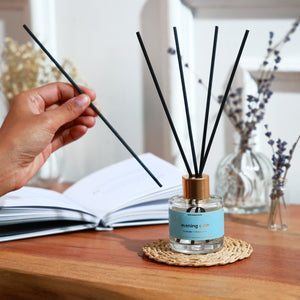
 Garden Bloom₹799Stand beside the bottle. If it smells right, the oil is intact and no new fragrance will improve your room. Carry the bottle to where you actually sit for one evening as a confirmation: same oil, same reeds, one variable changed. And rule out your own nose before ruling out the product, because receptors adapt to a constant stimulus within minutes and the signal stops being reported even though it keeps arriving. Leave for fifteen minutes and walk back in, and ask a visitor — a visitor is a better instrument than the resident, and if guests notice it while you cannot, the room is working for everybody but you.
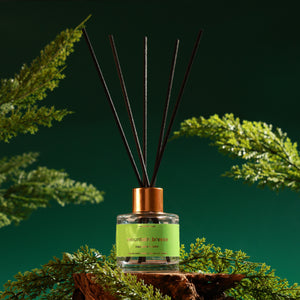
 Mountain Breeze₹849Reed count: six is full projection, three is a soft bedside level and roughly doubles the life. Distance: halve it. Height: at or slightly below the nose, on a surface, not the floor and not a high shelf. Placement: out of the draught but not in a dead corner, since a windowsill, an open balcony door or an AC blast all flush fragrance away faster than the reeds supply it. Containment: close the door. And the ceiling fan on low, not directly under the blades at full speed, in a closed room, for the hours you are in it. Flip the reeds every three to five days, though honestly a flip restores output for hours rather than adding range.
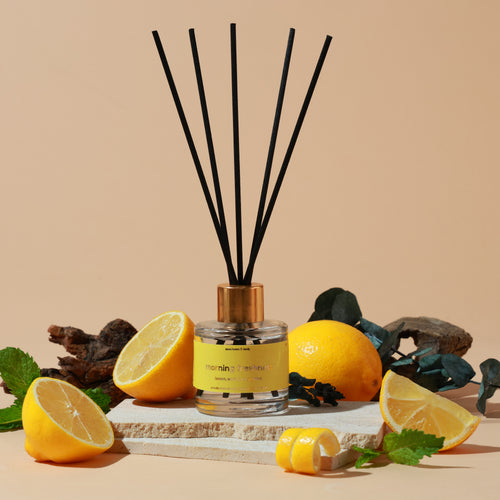
 Sukoon₹1,899Write down which you want. A zone is a chair, a bed, a desk, a bathroom, and a reed is the right object for it — 50ml for up to about 150 sq ft lasting 6–8 weeks, 130ml above that lasting 14–18. A volume means the same intensity across a room, and only moved air produces it: Sukoon at ₹1,899 for 270–320 sq ft is very often the correct answer and should never be skipped on the way to something dearer. Then stop. Buying above your requirement is how people end up with a machine rated for 2,000–3,000 sq ft in a 120 sq ft bedroom.
The five definitions, in one place
These are the terms the rest of this family uses, gathered here so the whole argument fits on one screen. They are worth knowing because they turn a vague dissatisfaction into a specific requirement, and a specific requirement is easy to shop for.
Emission is how much fragrance leaves the bottle in a given time. It is set by the reed count, the temperature, the humidity and the composition itself, and it is the quantity every intuitive upgrade raises. Transport is how far that fragrance travels once it has left. It is set by moving air, and a passive diffuser contributes nothing to it. The governing consequence of this cluster follows immediately: you cannot fix a transport problem by increasing emission, which is why more reeds, a bigger bottle, a stronger oil and a second diffuser all disappoint in the same characteristic way.
Fragrance strength is how much odorant is in the material — a property of the liquid, measurable on a bench in Pune, unchanged by your room. Diffusion strength is how much of it reaches you where you are — a property of the room and its airflow. And the fifth: volume is a duration specification, not a coverage specification. A bigger bottle lasts longer; it does not reach further. The proof sits inside our own range, where Megh at ₹3,499 has a six-litre tank and about 100 hours of runtime and covers only around 215 sq ft — less than the ₹1,899 Sukoon's 270–320. It is a runtime and humidity machine, and I would not sell it to anyone as a coverage upgrade.
The three mechanisms, and what each one is actually for
There are only three ways of getting fragrance into a room, and each has a shape of problem it is right for. Read the last two columns before the price.
| Mechanism | How it works | What it gives you | The honest cost | Price |
|---|---|---|---|---|
| Passive capillary — the reed | Oil climbs six fibre reeds and evaporates. No energy in, no air moved | A reliable zone; silence; no power, water, filling or charging; works in a power cut; never breaks | No transport and no control. A zone, not a room | ₹749–₹1,349 |
| Ultrasonic water mist — Boond, Sukoon, Megh | A piezo plate vibrates a water-and-oil mixture into a visible wet mist, which moves air | A genuine step up in reach and on-demand control. Sukoon: 270–320 sq ft, 16–18h on low | The oil is diluted in water, the output adds humidity, it needs a socket and filling, and hard water can leave white mineral dust | ₹899 / ₹1,899 / ₹3,499 |
| Waterless cold-air nebulising — Safar, Vaayu | Pressurised air shatters undiluted oil into a dry micro-mist that travels with the room's own airflow | No water, dilution, heat, added humidity or dust. Safar: cordless, three speeds, 1 / 2 / 3-hour timer | Safar is named and sold as a car and travel diffuser, needs recharging and is not set-and-forget. Vaayu is rated to 1000 m³ and is wrong for one bedroom | ₹3,999 / ₹11,999 |
| Two reeds instead of one | Two point sources, neither moving air | Genuinely right for a long or L-shaped room used at both ends, two rooms that are one volume, different scents per zone, or a budget short of a machine | Two peaks with a valley between — the midpoint is the farthest point from both. Not evenness | ₹1,498–₹1,598 as a duo |
| The gap in the range | Nothing between Safar and Vaayu | Nothing at all — there is no “Vaayu for one room” | Said plainly, because the alternative is selling somebody a 2,000–3,000 sq ft machine for a bedroom | — |

What “enough” means, and how to know when to stop
A requirement stated as stronger has no stopping point, which is how people end up buying three bottles and then a machine. A requirement stated as an experience does. So describe what you want as a scene rather than as an adjective: I want to smell it when I get into bed, or I want the living room to be scented for the two hours before guests arrive, or I want it noticeable from anywhere in a 12 by 10 room. Each of those has an obvious answer and a natural end.
Two things are worth calibrating against. The first is that a diffuser you can smell continuously is set too strong for the room. Home fragrance is meant to register on arrival and at transitions, not to be a constant presence, and constant presence is in any case impossible to perceive — receptors adapt within minutes. The second is that almost any composition, at too high a dose, flattens into a single sweet or sharp impression. That flattening is exactly what people mean when they describe a room as smelling like a shop, and it is the failure mode of pursuing strength for its own sake. Our reeds sit between 8.9 and 9.5 on a perceived-intensity scale specifically so that somebody buying for a small sealed bedroom can choose deliberately downwards.
And keep the counterweights in view when comparing a reed with a machine, because the arithmetic is not one-directional. A 50ml at ₹749–₹849 runs six to eight weeks, which is roughly ₹13 to ₹15 a day, and three bottles in one room is three times that, indefinitely; against that, Sukoon at ₹1,899 or Safar at ₹3,999 is paid once, plus oil. But a machine needs power, filling or charging, and has a lifespan, while a reed needs no socket, works in a power cut and never breaks. We publish no oil-consumption rate for our machines, so I will not compute a running cost for one; anybody who quotes you a precise figure is estimating. A 300ml refill at ₹2,399 is roughly six 50ml fills, which is the honest answer for a reader tired of repurchasing, though it is oil alone and never a first purchase.
What to buy, in what order — and what I would leave on the shelf
The full ladder, ending with the gap in our own range. Note that the first step is free and that a good share of readers never pass it, which is the single most important fact on this page.
| Step | What it is | When it is the right answer | Price |
|---|---|---|---|
| 1. The free method ★ | Prove the source, then six reeds, half the distance, nose height, out of the draught, door closed, ceiling fan on low | First, for everybody. The fan is the transport a reed structurally lacks | ₹0 |
| 2. The right reed, in the right size | Five scents, 8.9 to 9.5 on the SOSA scale. 50ml up to ~150 sq ft and 6–8 weeks; 130ml above that and 14–18 weeks. Six fibre reeds, refillable glass, roughly ₹13–₹15 a day | When a zone is what you want. Nothing dearer improves a zone, and this is the object that asks nothing of you | ₹749–₹1,349 |
| 3. Sukoon ultrasonic | 500ml, 270–320 sq ft, 16–18 hours on low, three 15ml Hotel Collection scents included | Very often the correct bedroom answer, and never to be skipped on the way to something dearer. Water-diluted, adds humidity, needs a socket and filling, white mineral dust in hard-water cities | ₹1,899 |
| 4. Safar waterless | Undiluted oil shattered into a dry mist — no water, dilution, humidity or dust. 20ml, 2000 mAh, up to 10 hours continuous or around 30 intermittent, three speeds, 1 / 2 / 3-hour timer, 6.9 cm. Named and sold as a car and travel diffuser | When you want the waterless mechanism at personal scale — car, handbag, desk, bedside, a hotel room. Not set-and-forget, and it needs recharging | ₹3,999 |
| Not this: Megh, Vaayu for one bedroom, or a stronger oil for reach — the honest gap | Megh: six litres, ~100 hours, ~215 sq ft — less than the ₹1,899 Sukoon. Vaayu ₹11,999: up to 1000 m³, roughly 2,000–3,000 sq ft. A stronger oil raises the whole gradient without reshaping it. Between Safar and Vaayu there is no mid-sized waterless bedroom nebuliser, and nothing in the range is a Vaayu for one room | Megh is a runtime and humidity machine. Vaayu earns its price on a whole floor, an open-plan living-dining, a villa, clinic, salon, showroom or reception. Aangan ₹25,999 and Meenar ₹38,500 are commercial and are never a home recommendation | ₹3,499 / ₹11,999 |

Versailles
Almost every message we receive on this subject begins with a compliment and ends with a complaint, and the two are about different things. It smells wonderful when I’m near it — I just wish the whole room were like that. The first half is about the fragrance and the second half is about the air, and for years the industry has answered the second half by selling more of the first. That is the mistake this whole set of pages exists to prevent.
What I would want a reader to take from the family is a habit rather than a product: separate the two quantities before you spend. Ask whether the thing you are short of is coming out of the bottle or getting across the room. If it is coming out of the bottle — and one minute beside it will tell you — then you have already bought the right thing and the remaining work is free, or nearly so. A closed door and a fan on low is not a consolation prize; it is the correct engineering answer, and it happens to cost nothing.
And if you do need the method, buy the smallest one that meets your requirement. I would rather sell a ₹1,899 Sukoon that suits a bedroom than an ₹11,999 machine that suits a floor, and I would rather tell you plainly that between Safar and Vaayu we have nothing shaped like a mid-sized bedroom nebuliser than pretend otherwise. Keep the reed either way. It is silent, needs nothing, works in a power cut, costs about ₹13 to ₹15 a day and never breaks. Everything is composed in Pune, and a part of every order funds a girl’s classroom through Nanhi Kali.
Frequently asked questions
- Strong in the bottle, quiet in the room — headspace, and why it saturates in seconds.
- If the concentrate is powerful, why is the diffuser subtle? — payload and delivery.
- Why a stronger-smelling oil doesn’t mean better projection — intensity and projection, defined.
- Fragrance strength versus diffusion strength — one is in the material, the other reaches you.
- Strong on the reeds, absent in the air — the saturated layer at the fibre.
- Does a stronger fragrance solve poor coverage? — answered directly, and it is no.
- Why a fine fragrance can still feel weak passively — quality and reach are unrelated axes.
- Weak fragrance, or limiting delivery? — a test you can run tonight.
- Change the oil or change the diffuser? — the decision, made cleanly.
- Brand: the SOSA founder story.
SOSA products — facts verified August 2026: Reed diffusers in 50ml and 130ml only. Morning Freshness ₹749 / ₹1,249 · Evening Calm ₹799 / ₹1,299 · Garden Bloom ₹799 / ₹1,299 · Mountain Breeze ₹849 / ₹1,349 · Fresh Brew ₹849 / ₹1,349. SOSA strength scale, a measure of perceived intensity rather than quality: Evening Calm 8.9, Garden Bloom 8.9, Morning Freshness 9.0, Mountain Breeze 9.4, Fresh Brew 9.5. 50ml suits rooms up to ~150 sq ft and lasts 6–8 weeks; 130ml suits above 150 sq ft and lasts 14–18 weeks; roughly ₹13–₹15 a day; two or three reeds in a 50 sq ft bathroom can make a 50ml last close to three months. Six fibre reeds — fibre rather than rattan — in a refillable glass bottle, on a heat-stable CCT (caprylic/capric triglyceride) carrier rather than DPG, alcohol-free, phthalate-free, paraben-free, IFRA-compliant, 0 ppm formaldehyde, climate-tested at 45°C and 85% RH, composed in Pune. Flip the reeds every three to five days. Duos ₹1,498–₹1,598 (50ml × 2) and ₹2,498–₹2,598 (130ml × 2). Refills 300ml ₹2,399 · 500ml ₹3,499, oil only and never a first purchase. Machines: Boond ₹899 (300ml, ≤~150 sq ft, ~6h, USB, night light) · Sukoon ₹1,899 (500ml, 270–320 sq ft, 16–18h on low, three 15ml Hotel Collection scents included) · Megh ₹3,499 (6L, ~100h runtime, ~215 sq ft) · Safar ₹3,999, named and sold as a waterless car perfume diffuser, 20ml, 2000 mAh, up to 10 hours continuous or around 30 hours intermittent per charge, three speeds and a 1 / 2 / 3-hour auto-off timer, 6.9 cm · Vaayu ₹11,999 (waterless cold-air nebuliser, up to 1000 m³ or roughly 2,000–3,000 sq ft, 400ml tank up to ~90+ days, Bluetooth app and onboard controls, 1h / 4h / 8h / 24h windows, under 38 dB, 5W, CE, RoHS, SGS). Aangan ₹25,999 and Meenar ₹38,500 are commercial machines and are never a home recommendation. Hotel Collection oils are water-based and ultrasonic-only: 15ml ₹299 · 100ml ₹999 · 300ml ₹1,799 · pack of 7 ₹1,799. Reed oil and Hotel Collection oil are not interchangeable in either direction and there is no hotel-inspired reed diffuser. No health, air-quality, allergy or sleep claims are made for any SOSA product; fragrance does not remove an unwanted smell, which is a matter of source, then ventilation, then fragrance. Free shipping above ₹499. A portion of every order supports girl-child education through Nanhi Kali. SOSA is an independent Indian fragrance house; the Hotel Collection scents are SOSA's own interpretations inspired by the world's finest hotels, and SOSA is not affiliated with or endorsed by any hotel brand. Prices subject to change — see the live product pages.