


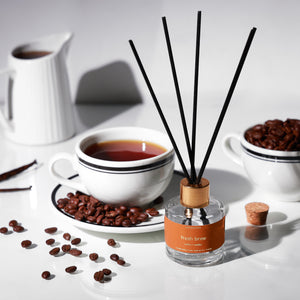


State two — undersupplied: the reeds have stopped drawing. The wet line sits barely above the oil after the first fortnight. Add reeds or refresh them, and top the bottle to the neck.
State three — genuinely slow: a cold, sealed, low-traffic room really does evaporate less. Wet line normal, reed smells strong held close, a visitor notices the scent. Nothing is broken.
The thing nobody says out loud: the level is a slow, blunt instrument. A 50ml over its stated 6–8 weeks loses roughly a millilitre a day, which is invisible against curved glass on any given morning.
2. Wet line high and the reed dark — you are stalled. The reed is full to the top and delivering nothing, because the exposed end has accumulated the heavy fraction of the composition and sealed itself. Flip all six reeds, put them back, and judge the room the following evening rather than the following minute.
3. Wet line barely above the oil after week two — you are undersupplied. The reeds are not drawing. Either there are too few of them, or the oil has fallen below a useful immersion depth, or the reeds are simply old. Top the bottle to the neck and add or refresh reeds.
4. Wet line normal and everything else in order — you are probably fine. Hold a reed a few inches from your nose. If it smells clearly of the composition, oil is moving. A cold, sealed, still room genuinely evaporates less, and your own nose is the least reliable witness in the house.
5. Do not buy a bigger bottle to fix a static level. More oil behind a stalled reed is more oil sitting still. Size buys duration, never projection, and a 130ml with saturated reeds is exactly as quiet as a 50ml with saturated reeds.
6. Do not top up on top of old reeds and call it solved. Reeds are the consumable in this system; the oil is the stable part. People replace the oil and keep the reeds, and it is almost always the other way round.
Composed and handmade in small batches in Pune, and a portion of every order supports girl-child education through Nanhi Kali.

Part one — the three states a frozen level can mean
A reed diffuser is a two-stage machine with no moving parts: oil is lifted up the fibre by capillary action, and it leaves from the exposed end into the air. The level in the glass falls only when both stages are running. Stop either one and the level stops falling, which is why a static level on its own tells you almost nothing — it is the same reading for a bottle that has silted up, a bottle that has never got started, and a bottle behaving perfectly in a cold sealed room. The three cards below are the three states, in the order I would check them. Each one has a physical tell you can read in seconds, and none of the tells is your own nose in your own living room.
 Oil refill₹2,399 · 300mlThe opposite failure, and the one people misread most often. Here the wet line has barely risen — after the first couple of weeks it still sits close to the oil surface, and most of the reed is dry to the touch. Nothing is reaching the air because nothing is reaching the top. Three causes, all free to check: too few reeds standing in the bottle, so total wicking capacity is low; too little immersion, because the level has dropped and only a short stub of each reed is submerged; or reeds that have simply aged past their useful life and are no longer drawing the way fresh fibre does. Fibre reeds hold up far better than rattan in Indian humidity — that is precisely why we use them — but they are still the consumable part of the system, and SOSA guidance is to refresh them every few months.
Part two — the thirty-second triage, in one table
This is the whole diagnostic on one screen. Take one reed out, read the two columns on the left, and the rest of the row tells you what you are looking at. The only equipment is a pair of gloves and a tray to stand things on, because reed oil marks wood and stone.
| What the wet line does | How the reed looks and feels | Held close, the reed smells | The state you are in | Your first move |
|---|---|---|---|---|
| Sits high — near the top of the reed ★ | Dark, heavy, slightly tacky | Muted, thick, not much like the bottle | Stalled and saturated | Flip all six · free · judge tomorrow evening |
| Barely above the oil after week two | Pale and dry along most of its length | Faint — there is little oil up there to smell | Starved of supply | Top to the neck, add or refresh reeds |
| Steady around the middle, moving slowly | Evenly tinted, flexible, not tacky | Clearly of the composition | Working — the room is simply slow | Change placement and airflow, buy nothing |
| High on some reeds, low on others | Mixed — usually the older reeds are darker | Uneven from reed to reed | Part-flipped, or reeds of different ages | Flip all of them, every time, not a few |
| Falling fast, bottle emptying early | Dry-looking despite a falling level | Strong at the bottle, absent across the room | Draught or direct sun stripping the reeds | Move away from the vent, fan or window |
| The honest caveat: the wet line is a diagnostic, not a measurement. It tells you which of the three states you are in; it does not tell you how many weeks the bottle has left, and it will read differently on a 130ml simply because there is more depth of oil beneath it. Read it as a signal, run the free fixes, and give the room a full evening before deciding anything. | ||||
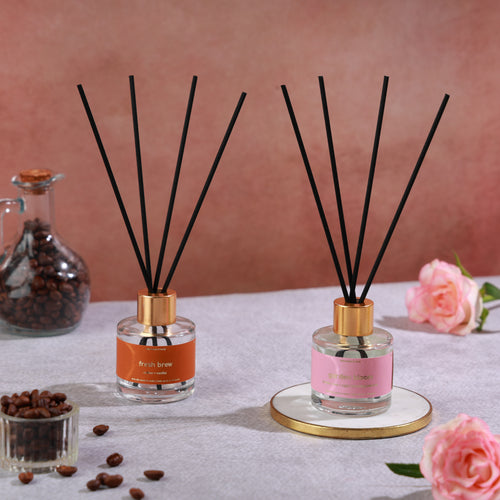 Oil refill · top to the neck₹2,399Shop →
 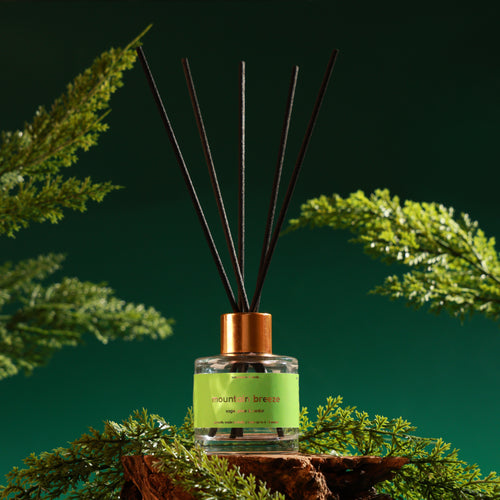 Mountain Breeze · 9.4/10from ₹849Shop →
  Sukoon · scent on demand₹1,899Shop →
Part three — why the oil level is such a poor instrument
Even when everything is working, the level is close to unreadable in the short term. Take the stated window for a 50ml — six to eight weeks — and do the arithmetic: that is somewhere around a millilitre a day, spread across a curved glass base. On any given morning the difference between a working bottle and a stalled one is smaller than the meniscus you are squinting at. People check daily, see nothing, and draw a conclusion that the instrument was never precise enough to support. The 130ml is worse in this respect, not better, because the same daily loss is spread across a wider column of oil and takes fourteen to eighteen weeks to visibly resolve. This is why I ask people to stop using the level as their primary check and start using the reed.
There is also a shape problem. Most reed bottles, ours included, are not straight-sided cylinders; they narrow towards the neck, which means the same millilitre lost produces a visibly different drop depending on where in the bottle you are. Early on, when the oil sits in the wide part of the glass, weeks can pass with the level looking almost identical. Later, in the narrow section, the same rate of loss looks alarming and people write to ask why it has suddenly accelerated. Nothing has accelerated. The geometry changed, not the physics. If you genuinely want to track it, put a strip of masking tape on the glass on the day you set the bottle up, mark the line, and look again in a month — not tomorrow.
And there is the deeper point, the one this whole sub-cluster of articles exists to make: the level measures what has left the bottle, not what has arrived in the room. Those are different quantities, and they come apart in both directions. A bottle in a direct draught from a split AC will empty weeks early while the room smells of very little, because the fragrance is being stripped off the reeds and flushed away before it can distribute. A bottle in dead air behind a sofa will hold its level beautifully and also do nothing, because there is no air exchange to carry anything. Neither of those is a fault in the oil. Both are read correctly in about a minute by lifting a reed, holding it close, and then asking someone who has just walked in whether the room smells of anything.
Part four — what to do, in order, and what each step costs
The ladder below runs from free to paid, and most people never get past the third rung. I would rather you spent nothing and had a working diffuser than spent ₹1,349 on a bigger bottle that stalls in the same corner of the same room.
| Order | The move | What it costs | When to move on to the next rung |
|---|---|---|---|
| 1 ★ | Lift one reed and read the wet line | Thirty seconds and a pair of gloves | Immediately — this only tells you where to go next |
| 2 | Flip all six reeds, not three of them | Free · two minutes | If the room is unchanged by the following evening |
| 3 | Move the bottle into gentle passing air, waist to chest height, away from vents and sun | Free · and it often lengthens the bottle | After a couple of days in the new spot |
| 4 | Ask a visitor, or close the room for an hour and come back in | Free · costs you an hour | If they smell it and you do not, stop here — it is adaptation |
| 5 | Add two to four reeds | Free, but shortens the bottle roughly in proportion | If projection rises but not enough |
| 6 | Refresh the reeds and top the oil to the neck — 300ml refill | ₹2,399, about ₹7–8 per ml against ₹15–17 for a 50ml bottle | Only once flipping has clearly stopped returning anything |
| 7 | Change the composition — Fresh Brew 9.5 or Mountain Breeze 9.4 | From ₹849 · 50ml | When the room is right and you simply want more presence |
| Never | Buy a 130ml to cure a static level | From ₹1,249 — and it will stall in exactly the same way | Buy the larger size for 14–18 weeks of duration, not for volume |
Versailles
There is a particular email I get perhaps twice a week, and it always begins the same way: I bought your 50ml in March and it is August and the bottle is still nearly full — is that normal? The writer expects me to be pleased. What I feel instead is a small sinking, because I know what has almost certainly happened: the reeds have not been flipped, the exposed ends have silted up with the heavy end of the composition, and five months of fragrance that somebody paid for is still sitting in the glass.
I want to be honest about our part in that. We publish a 6–8 week figure for the 50ml and a 14–18 week figure for the 130ml, and those numbers assume weekly flipping, six reeds, an ordinary room and no draught. When a bottle outlives its window by months, the first thing I check is not whether the customer got lucky. It is whether the system stopped.
The fix costs nothing and takes two minutes, which is why this article exists rather than a product page. Lift a reed, look at the wet line, flip all six, wait an evening. If you want the composition to do more than that, the levers are reed count, placement and choosing something built louder — and if what you want is a strong room on demand, a Sukoon at ₹1,899 is a better tool than any reed bottle, including mine. Everything we make is composed and handmade in Pune, and part of every order funds a girl's classroom through Nanhi Kali.
Frequently asked questions
- Lasting a long time but giving very little fragrance — why those two facts are the same fact.
- Barely evaporating? — the cold, sealed, still room, and when nothing is actually wrong.
- Reeds not absorbing enough oil and does slow evaporation mean it is broken?
- The complete guide to a diffuser that lasts too long, and why can't I smell my reed diffuser?
- Brand: the SOSA founder story.
SOSA reed diffuser range & prices (verified August 2026): alcohol-free, phthalate-free, paraben-free and IFRA-compliant compositions on a heat-stable coconut-derived (CCT) carrier, low-VOC, supplied in a refillable glass bottle with six fibre reeds; 50ml lasts 6–8 weeks and 130ml lasts 14–18 weeks. Morning Freshness (Malabar lemon · peppermint · Nilgiri eucalyptus) 50ml ₹749 · 130ml ₹1,249 · 9.0/10; Garden Bloom (British rose · night-blooming jasmine) 50ml ₹799 · 130ml ₹1,299 · 8.9/10; Evening Calm (Kashmir lavender · chamomile) 50ml ₹799 · 130ml ₹1,299 · 8.9/10; Fresh Brew (Coorg coffee · Kerala vanilla) 50ml ₹849 · 130ml ₹1,349 · 9.5/10; Mountain Breeze (Himalayan pine · sage · Indian cedar) 50ml ₹849 · 130ml ₹1,349 · 9.4/10. Reed diffuser refills are oil only — you reuse your own vessel and reeds: 300ml ₹2,399 (roughly 8–11 months) · 500ml ₹3,499 (roughly 14–18 months), about ₹7–8 per ml against ₹15–17 per ml for a 50ml bottle. Duo sets ₹1,498–₹1,598 for 2 × 50ml and ₹2,498–₹2,598 for 2 × 130ml. Strength figures are positions on SOSA’s own internal strength scale, not an industry standard. Replacement reeds are not sold as a separate SKU; SOSA guidance is to refresh reeds every few months. The reed line is separate from the water-based Hotel Collection for ultrasonic machines (15ml ₹299 · 100ml ₹999 · 300ml ₹1,799) and the two are not interchangeable. Diffusers: Boond 300ml ₹899 · Sukoon 500ml ₹1,899 · Megh 6L ₹3,499 · waterless Vaayu ₹11,999. Composed and handmade in small batches in Pune, India; tested through 45°C summer heat and 85% monsoon humidity. Free shipping above ₹499. A portion of every order supports girl-child education through Nanhi Kali. Prices subject to change — see the live product pages.