


Where that air comes from: convection off a warm wall, a ceiling fan, an air conditioner recirculating in a closed room, a draught under a door, people walking about. All of it belongs to the room. None of it is supplied by a reed diffuser, at any price or in any size.
What this means practically: the fastest way to make fragrance travel is to give the room some air to travel on. A ceiling fan on low is the best free fix in this whole subject, because it is exactly the transport a reed lacks. It will shorten the life of the bottle, and that is a fair trade most people take.
The honest gap: we publish no figure for how far a reed projects, because there is no such figure that would be true in more than one room. And between Safar at ₹3,999 — named and sold as a car and travel diffuser — and Vaayu at ₹11,999, there is no mid-sized waterless nebuliser shaped like one bedroom.
2. Molecular diffusion cannot do the job. Left to themselves, fragrance molecules spread through still air by random collision — an unhurried wander in no particular direction. It is a fine mechanism for crossing the few centimetres between a reed and the air beside it. It is a hopeless one for crossing three or four metres of bedroom, which is why a room with genuinely still air stays a fragrant object in a quiet space rather than becoming a fragranced room.
3. So everything useful is done by air the room is already moving. Convection rising off a wall that has been in the sun, a ceiling fan, an air conditioner recirculating in a closed room, a draught under a door, people walking through. That is your distribution system, it varies hour by hour, and it is not something the bottle can influence.
4. Which is why the free fixes work and the expensive ones often do not. Turning the ceiling fan on low adds transport. Closing the door improves containment. Halving the distance puts you inside the zone. Buying more reeds, a larger bottle, a deeper fragrance or a second diffuser raises emission and adds no transport whatsoever, which is exactly why each of those tends to disappoint in the same way.
5. If you want to buy transport, buy a machine that moves air — the right size of one. Sukoon at ₹1,899 covers 270–320 sq ft, which is a bedroom. Safar at ₹3,999 is waterless cold diffusion of undiluted oil and is named and sold as a car and travel diffuser, with three speeds, a 1, 2 or 3-hour timer and a battery to recharge. And do not let anyone sell you Vaayu at ₹11,999 for one bedroom — it is rated to 1000 m³, roughly 2,000–3,000 sq ft.
Alcohol-free, phthalate-free, paraben-free, IFRA-compliant, 0 ppm formaldehyde. Six fibre reeds in a refillable glass bottle, composed in Pune. Free shipping above ₹499, and a portion of every order supports girl-child education through Nanhi Kali.
Diffusion, carriage and dilution — the three things happening between the bottle and you
It is worth separating the journey into its parts, because people tend to imagine a single process called "spreading" and then wonder why it seems to have stopped. There are really three, they operate at wildly different speeds, and the one everybody pictures is the one that contributes least.
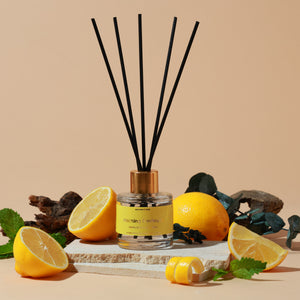
 Morning Freshness₹749This is the process most people have in mind: molecules leave the reeds and spread outward until they are everywhere. It does happen. It is simply far slower than the picture suggests, because a fragrance molecule in still air is not travelling in a straight line — it is being knocked about by air molecules millions of times, wandering rather than going. Over the first centimetres around the reeds that wandering is perfectly effective. Over the metres between a console table and a bed, it is not a transport mechanism in any practical sense, and in a genuinely still room the far corner would take an implausibly long time to reach a concentration you could detect. Diffusion is why the air beside the bottle smells wonderful. It is not why anything reaches your pillow.
 Sukoon₹1,899The second process is not the fragrance moving through the air but the air moving, with the fragrance in it. This is faster than diffusion by an enormous margin and it is responsible for essentially all of the distance a passive diffuser ever achieves. The sources are all ordinary: warm surfaces setting up convection currents, a ceiling fan, an air conditioner recirculating in a sealed room, the pressure difference under a closed door, somebody crossing the room. Which means the honest description of a reed diffuser is that it supplies the fragrance and rents the delivery. An active diffuser is different in kind rather than in degree, because it brings its own air with it.
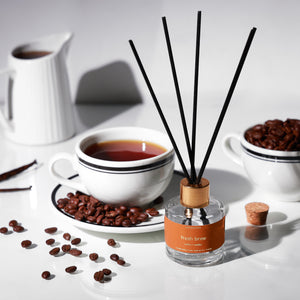
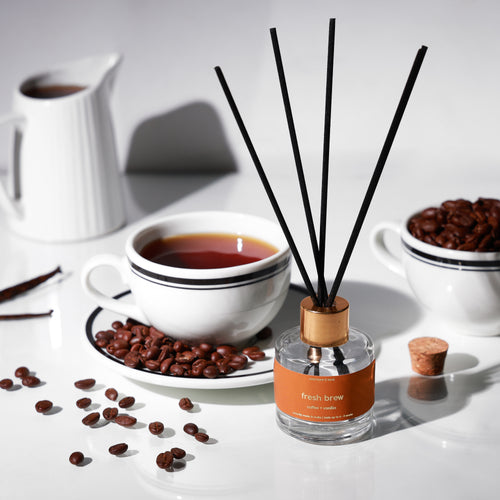
 Fresh Brew₹849The third process runs against you the whole time. Concentration is quantity divided by volume, so the same output spread through a larger space is thinner everywhere in it — and on top of that, air is continuously leaving through gaps, doors and open windows, taking fragrance with it. This is why containment matters as much as output, and why the same bottle that fills a small closed bathroom convincingly reads as modest in a bedroom with a balcony. It is also the honest reason a high floor can feel different: wind speed rises with height, the room's air turns over more often, and nothing about the diffuser has changed at all. You are not being outperformed by another bottle. You are being outpaced by an air exchange.
The room is the machine you did not buy
There is a small mental shift that makes this whole subject easy, and it is to stop thinking of the diffuser as the system. The system is the diffuser plus the room, and the room is contributing the more variable half. Two people can own the identical bottle with the identical reeds and get completely different results, and neither of them has a better product. One of them has a closed 120 sq ft bedroom with a ceiling fan turning slowly; the other has 200 sq ft with a balcony door open onto a breezy evening. The second room is being flushed, continuously, and no reed count on earth fills a room that is being emptied.
The same logic explains why the room changes from week to week without any need for a different bottle. In hot dry conditions evaporation runs faster, so the bottle empties sooner and the source is stronger while it lasts. In very humid air fragrance carries less readily, so projection shortens and the scent hangs close to the bottle — a different evaporation curve and a different carrying medium, not a different oil. An air conditioner running in a closed room does two things at once and both are true: it recirculates, which distributes fragrance genuinely well, which is precisely why so many people find their bedroom smells strongest at night; and it dries the air, which speeds evaporation and shortens the bottle. Better distribution, shorter life. The one placement I would avoid outright is directly in the AC blast, which strips the reeds and throws everything at one wall.
If you want the clearest illustration of the principle, think about the last good hotel corridor you walked down. You could smell the fragrance everywhere and you could not find the source, because there wasn't an object in the room to find — the scent is introduced into the building's moving air rather than released from something sitting on a table. There is no gradient to walk up because there is no point source. That is the entire difference between a fragrant object and a fragranced space, and it is a difference in transport, not in the quality of the perfume.
Where your room's air actually comes from, and what each source does
Since the room is doing the distributing, it is worth knowing which of its habits help and which quietly work against you. Two of these are free improvements available tonight, two are things to place around, and one is the placement I would ask you not to use.
| Source of air movement | Effect on distribution | Effect on bottle life | What I would do |
|---|---|---|---|
| Ceiling fan on low ★ | Strongly positive — the transport a reed has no way of supplying | Shortens it | Use it. The best free fix in the subject, and worth the trade |
| Door closed | Positive — containment lets concentration build | Lengthens it slightly | Close it for the hours that matter |
| AC running in a closed room | Positive — recirculation distributes well, which is why bedrooms smell strongest at night | Shortens it — dry air speeds evaporation | Use it, but keep the bottle out of the airstream |
| Open window | Negative — air that leaves takes the fragrance with it | Shortens it | Air the room, then close it. Those hours are not fragrance hours |
| Open balcony door | Strongly negative — a much larger opening, so the whole room's air turns over | Shortens it noticeably | Place the bottle off the line between the two openings |
| Directly in the AC blast | Misleading — throws everything at one wall rather than mixing it | Shortens it sharply; strips the reeds | The one placement to avoid outright |

Supplying the transport yourself, for nothing
Here is the sequence I would run, in order, before spending anything at all. First, the reeds: put all six in if you are running three. Six is full projection and three is a soft bedside level that roughly doubles the life of the bottle, so the reed count is a real dial and most people never touch it. Flip them every three to five days for a few hours of restored output — useful, but be honest with yourself that this is a dose change and not a distance change.
Second, geometry. Halve the distance between the bottle and where you actually sit or sleep, which does more than any change of scent. Put it at or just below nose height on a surface, not on the floor and not on top of a wardrobe. Keep it out of the exhaust — not on a windowsill, not beside the open balcony door, not in the AC blast — while keeping it inside the circulation rather than behind a curtain in a dead corner.
Third, and this is the one that changes the category of the problem: turn the ceiling fan on low, and close the door. The fan is the transport the reed structurally lacks, and running it on the lowest setting in a closed room is the single most effective free thing available to you. It lifts the concentrated air sitting around the reeds and folds it through the rest of the room, which is precisely the operation the bottle cannot perform. Two honest caveats. It will shorten the bottle's life, because more air across the reeds means faster evaporation — a 50ml built for 6–8 weeks will run at the shorter end. And do not park the bottle directly under the blades at full speed, which strips the reeds rather than distributing from them. Low, closed room, bottle a little to one side.
When it makes sense to buy transport instead
Some rooms simply do not move enough air, and some readers want the fragrance to be there regardless of what the room is doing. That is a legitimate requirement and it is the point at which a machine stops being an upsell and starts being the correct object. Before the ladder, the compatibility warning that saves the most disappointment: reed oil cannot go into an ultrasonic machine, the water-based Hotel Collection cannot go into reeds, and Safar takes pure fragrance oil. Your favourite reed scent does not come with you. Think of a machine as a second device rather than a replacement.
| Step | What it is | When it is right | Price |
|---|---|---|---|
| 1. Free transport ★ | Ceiling fan on low, door closed, bottle at nose height and off the draught line, all six reeds in | Before anything else. This is where most readers should stop | Free |
| 2. A reed matched to the room | 50ml for up to ~150 sq ft, 6–8 weeks · 130ml above that, 14–18 weeks. Six fibre reeds either way | When the bottle is under-sized. Remember this buys duration and fit, never distance | ₹749 / ₹1,249 |
| 3. Boond | Ultrasonic, 300ml, up to about 150 sq ft, roughly 6 hours, USB, night light | The cheapest way to own air movement, for a small room and short evening sessions | ₹899 |
| 4. Sukoon | Ultrasonic, 500ml, 270–320 sq ft, 16–18 hours on low, three 15ml Hotel Collection scents included | The usual right answer for a bedroom. Water-diluted, adds humidity, needs filling, and in hard-water cities can leave white mineral dust | ₹1,899 |
| 5. Safar | Waterless cold diffusion of undiluted oil, 20ml, cordless, three speeds, 1/2/3-hour timer. Named and sold as a car and travel diffuser | Personal scale, no water, no dilution. Not set-and-forget — the timer stops and the battery needs recharging | ₹3,999 |
| The gap: no mid-sized waterless bedroom nebuliser | Nothing between Safar ₹3,999 and Vaayu ₹11,999 is "a Vaayu for one room". Vaayu is rated to 1000 m³, roughly 2,000–3,000 sq ft, and in one bedroom nine-tenths of it is wasted | Named rather than papered over | — |

Versailles
When I was training, the thing that took longest to become intuitive was that a perfumer composes for a concentration rather than for a place. You decide what the material should smell like at the moment it reaches a nose, and then you hand the composition over to physics and hope. In a personal fragrance that hand-over is short: the scent is on skin, the skin is warm, the nose is a hand's width away. In a room it is a much longer journey, and the journey belongs to the building.
I say this because it changes what a fair complaint looks like. If somebody tells me the fragrance turned bitter in May, that is mine to answer — that is a carrier failure, which is why every SOSA reed sits on a heat-stable CCT base rather than the DPG most of the industry uses, and why we test through 45°C and 85% humidity. If somebody tells me it does not cross a 200 sq ft room with a balcony door open, that is not a fault in the composition and I would be lying if I sold them a stronger one to fix it. The oil is not the variable. The air is.
And I would not want the reed dismissed in the process, because it does several things no machine does. It is silent. It needs no socket, no water, no filling and no charging. It keeps working in a power cut, which in most of this country is not a hypothetical. It costs about ₹13 to ₹15 a day, it sits on a table as an object rather than as an appliance, and it never breaks. So run the fan on low, shut the door and move it closer first. If after that you still want the whole room, buy the machine that fits your room and not the one that fits a lobby. Everything is composed in Pune, and part of every order funds a girl's classroom through Nanhi Kali.
Frequently asked questions
- Why can I smell it only when I stand next to it? — emission, transport and perception.
- Amazing within two feet — is that normal? — yes, and how to prove your bottle is fine.
- Strong at the bottle, weak from the bed and how far should it travel?
- One corner strong, the rest nothing — a smooth slope with a perceived edge.
- Is it weak if I have to walk close? and it's evaporating, so why can't I smell it?
- Walking past versus sitting still — crossing a gradient, and adapting to one.
- I love it — how do I get it everywhere? — the family pillar.
- Brand: the SOSA founder story.
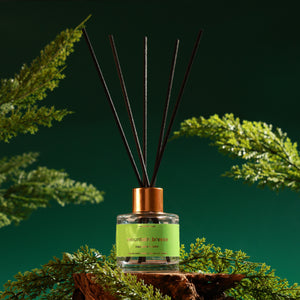
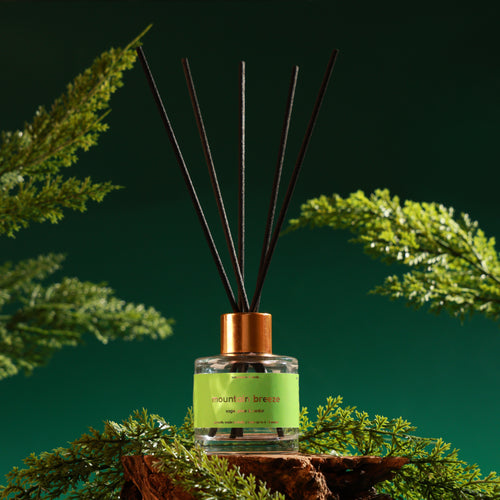
SOSA facts verified August 2026: Reed diffusers are supplied in 50ml and 130ml only — 50ml suits rooms up to about 150 sq ft and lasts 6–8 weeks, 130ml suits larger rooms and lasts 14–18 weeks. Morning Freshness 50ml ₹749 / 130ml ₹1,249 · Evening Calm ₹799 / ₹1,299 · Garden Bloom ₹799 / ₹1,299 · Mountain Breeze ₹849 / ₹1,349 · Fresh Brew ₹849 / ₹1,349. Perceived-intensity scale: Evening Calm 8.9, Garden Bloom 8.9, Morning Freshness 9.0, Mountain Breeze 9.4, Fresh Brew 9.5 — intensity in the room, not quality. Six fibre reeds in a refillable glass bottle, heat-stable CCT carrier rather than DPG, alcohol-free, phthalate-free, paraben-free, IFRA-compliant, 0 ppm formaldehyde, tested through 45°C heat and 85% RH, composed in Pune. Refills 300ml ₹2,399 and 500ml ₹3,499 are oil only. Machines: Boond ₹899 (300ml, up to ~150 sq ft, ~6h, USB, night light) · Sukoon ₹1,899 (500ml, 270–320 sq ft, 16–18h on low, three 15ml Hotel Collection scents included) · Megh ₹3,499 (6L, ~100h runtime, ~215 sq ft — a runtime and humidity machine, not a coverage upgrade) · Safar ₹3,999 (waterless, 20ml, 2000 mAh, up to 10 hours continuous or ~30 intermittent, three speeds, 1/2/3-hour timer — named and sold as a car and travel diffuser, with no published room-coverage figure) · Vaayu ₹11,999 (up to 1000 m³, roughly 2,000–3,000 sq ft, 400ml, under 38 dB, 5W). Reed oil and the water-based Hotel Collection are separate products and are not interchangeable; there is no hotel-inspired reed diffuser. Free shipping above ₹499. A portion of every order supports girl-child education through Nanhi Kali. SOSA is an independent Indian fragrance house; the Hotel Collection is SOSA's own interpretation inspired by the world's finest hotels, and SOSA is not affiliated with or endorsed by any hotel brand. Prices subject to change — see the live product pages.