

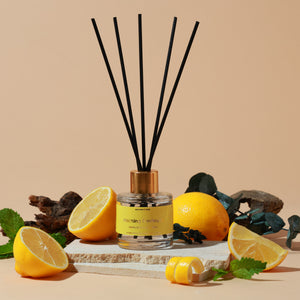


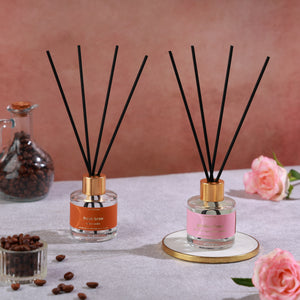
Why an absence feels flat: a home with genuinely no smell is unusual, and a nose that finds nothing files the room as institutional — a hotel corridor, a waiting room, a show flat.
The free half: air movement. Two openings on opposite walls for twenty minutes, morning and evening, and a ceiling fan on low. Moving air is most of what people mean by fresh.
The other half: a chosen background scent — a reed diffuser from ₹749 for one level held for months, or the Sukoon at ₹1,899 with three 15ml scents included.
2. So more cleaning will not produce it. This is the important consequence and it saves a lot of wasted Sundays. Once the absence is complete, further scrubbing has nothing left to remove. The missing thing has to be added rather than taken away.
3. A room with no smell at all is unusual, and the brain notices. Almost every space a person has ever been in has some character to it. When a nose finds nothing, the room gets filed against the few places that genuinely smell of nothing — a hotel corridor, a hospital, a waiting room, an empty show flat — and none of those feel like home.
4. The first half of the answer is air movement, and it is free. Two openings on opposite or adjacent walls for twenty minutes, morning and evening, and a ceiling fan on low through the day. Still air reads as stale even when it is chemically spotless, and moving air reads as fresh before anything has been added to it.
5. The second half is a background note the room reliably has. Not an event, not something you notice, and not something switched on for guests — a low, consistent level that is simply what the place smells like. That is the one thing on this page you cannot get for nothing.
6. And it is the last step rather than the first. If anything is still wrong — damp, a dry trap, a loaded sofa, an unwashed filter — go back and deal with it, because scent on top of a source gives you two smells instead of one.
A portion of every order supports girl-child education through Nanhi Kali.
Clean is an absence; fresh is a presence
Almost every argument about home smell goes wrong because these two words are used as though they were synonyms, or as though fresh were simply a higher grade of clean. They describe opposite operations. Cleaning is subtraction: you find things and remove them until nothing is left that should not be there. Freshness is addition: air that is going somewhere, and a light note the room actually has. No amount of subtraction produces an addition, which is why the reader on this page has done everything right and is still standing in a room they do not enjoy walking into.
Clean, fresh, and the things people confuse with both
Five states a room can be in, what each one actually is, and what moves it to the next. Most people on this page are in row three and trying to solve it with the tools of row two, which is why nothing works. The last column is the honest cost, and three of the five rows cost nothing at all.
| The state | What it means | What it feels like | What moves it on | Cost |
|---|---|---|---|---|
| Clean but empty ★ | Nothing wrong and nothing there. Subtraction completed, addition never started | Institutional. A hotel corridor, a show flat, a waiting room | Air movement, then one chosen background note held at a low level | ₹0, then from ₹749 |
| Clean but still | Chemically fine, but the air has not been anywhere and the nose has stopped reporting it | Stale, despite being spotless. Worse in a closed AC room | Two openings for twenty minutes, morning and evening; a ceiling fan on low | ₹0 |
| Not actually clean | A source remains — a dry trap, damp, fabric, a bin, an AC filter | Something you notice on walking back in after ten minutes out | Find and remove it. Fragrance on top gives you two smells rather than one | ₹0 |
| Fresh | Moving air plus a light, dry, positive note the room reliably has | Welcoming, and nobody can name why | Nothing. This is the destination | — |
| Scented, but not fresh | A level set too high, or a heavy note in a room that wanted a light one | Noticeable from the doorway, which is one notch too much | Fewer drops, a timer instead of continuous running, one honest guest asked | ₹0 |
| Masked | Fragrance running over a source that was never dealt with | Two competing smells, and the wrong one wins | Go back to row three. This is the one mistake worth avoiding completely | ₹0 |
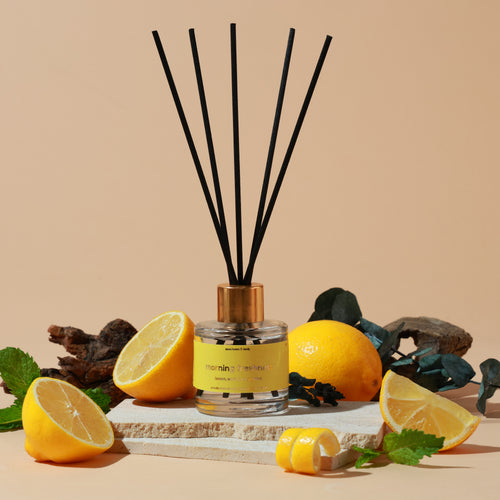
Morning Freshness · ₹749₹749Shop → 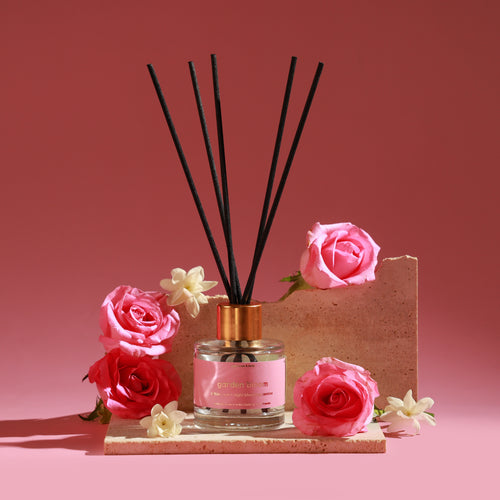 Reeds · one steady level₹749Shop →
  Sukoon · three scents included₹1,899Shop →
The two things that supply presence
Air first, and properly, because it is free and because most readers underestimate it by a wide margin. The single most useful habit is two twenty-minute exchanges a day, one in the morning and one in the evening, on two openings that are not next to each other. The reason two matters is simple: with one opening the air in a room mostly rocks back and forth in the same place, while with two it actually crosses, and a room that has been genuinely crossed feels different for hours afterwards. Choose the hours to suit where you live — early morning and after dark in a hot dry city, the middle of the day where mornings are damp, and on a heavily wet monsoon day keep them shut and run fans instead, because at 80 to 95 percent outdoor humidity opening up imports moisture rather than removing it and you will make the room musty rather than fresh. Between exchanges, keep a ceiling fan turning on its lowest setting; it costs very little and it stops a room settling into the flat, unchanging signal that a nose stops reporting within minutes. Add sunlight where you can get it — two hours on a mattress, a rug or a set of cushions does more than any product — and if you are in an air-conditioned flat, wash the filter every two to four weeks in season, because a cold wet evaporator coil is the commonest source of a room that is clean, closed and subtly wrong. Do all of this for a week before spending anything at all. A fair number of readers stop here.
Then the background note, and here is where I will make the case rather than hedge it, because this is the one page in the group where the commercial answer is also the honest one. You have removed everything. Nothing is left to subtract. The only remaining move is to add one thing, quietly, and hold it at a level nobody can identify from the doorway. Two shapes of product do that. A reed diffuser is the more suitable one for most people here: capillary action up a set of sticks, no electricity, no switch, no daily decision, and one level held for months — Morning Freshness at ₹749 in Malabar lemon, peppermint and eucalyptus, which is the literal version of the word fresh; Garden Bloom and Evening Calm from ₹799; Fresh Brew and Mountain Breeze from ₹849; 130ml from ₹1,249, duos from ₹1,498 and 300ml refills at ₹2,399. It needs 24 to 72 hours to establish, which makes it the right buy for a habit and the wrong one for a deadline. The alternative is the Sukoon at ₹1,899: a 500ml BPA-free tank for 270–320 sq ft, 16–18 hours per fill on low at 30–50 ml/h against 9–12 on high, a 2.4MHz cool-mist plate, a remote, auto shut-off and steady, 2H and 4H timers, with three 15ml Hotel Collection scents of your choice included at ₹299 each separately. Run it at three drops rather than six, and use the timer. For one room the Boond at ₹899 is often the better machine because it puts less into the air per hour, and for an open-plan flat the Megh at ₹3,499 has the tank for it. If you want the room to have a level for one evening only, a Bookshop candle at ₹379 does it in fifteen to twenty minutes and must be attended and put out.
Then the three ways this goes wrong, so it does not. The first is dose. A background is meant to be unidentifiable from the doorway, and the failure mode of a flat that was blank last month is a flat that is noticeably scented this month — which reads as effort rather than as freshness and is a worse result than where you started. Three drops per tank, a 2H timer rather than continuous running, and if you are using a reed, fewer sticks in a small room and more in a large one. The second is habituation, and it is the reason the first one happens: a nose reports change and discards constants, so within roughly a fortnight you will stop registering whatever you have chosen while every visitor still receives the level you set. The instinct that produces is to add drops. It is exactly wrong. Ask one honest guest and believe them. The third is masking, which is the one mistake in this cluster worth avoiding completely: fragrance does not remove a source — not damp, not a dried-out drain trap, not a sofa carrying six months of dinners, not an AC filter — and a scent running over any of those gives you two smells instead of one. On constraints: SOSA makes no room or linen spray for the home, since the sprays in the range are car perfumes; a cool-mist ultrasonic adds 30 to 50 millilitres of water an hour and is the wrong machine for a room you are drying out; the water-based Hotel Collection runs in the Sukoon, Boond and Megh only, never in a reed and never in the waterless Vaayu at ₹11,999; and reed oil clogs a 2.4MHz plate. The principle: fresh is not the top end of clean. It is the thing you add once clean is finished.
The SOSA edit
Air first, because it is free and it is most of the effect, and then the one addition this page has been arguing for. The bottom row is the mistake that undoes all of it, and it is worth reading even if you buy nothing above it.
| Do this | What it is | When it is the right answer | Price |
|---|---|---|---|
| 1. Two exchanges a day ★ | Two openings on opposite or adjacent walls, twenty minutes, morning and evening | First and always. Moving air is most of what people mean by fresh, and one window is not an exchange | ₹0 |
| 2. A ceiling fan on low, and sun on textiles | Air kept turning between exchanges; two hours of sunlight on a rug, cushions or a mattress | Daily. It stops a room settling into a flat signal the nose stops reporting | ₹0 |
| 3. Morning Freshness or another reed | Malabar lemon, peppermint and eucalyptus — cool, dry and slightly sharp, which is the literal meaning of fresh | Once the air is moving. One level for months, no electricity, 24–72 hours to establish | ₹749 |
| 4. Sukoon or Boond | 500ml for 270–320 sq ft with steady/2H/4H timers and three 15ml scents included, or 300ml for one room | If you would rather set and stop a level. Three drops on the 2H timer, not six on steady | ₹1,899 / ₹899 |
| 5. A second 15ml scent | ₹299 each; the Pack of 7 at 15ml is ₹1,799 against ₹2,093 for seven singles, a saving of ₹294 | Only after a fortnight, when habituation sets in and you want a change rather than more drops | ₹299 |
| The mistake: scenting over a source | Fragrance does not remove damp, a dry trap, a loaded sofa or an unwashed AC filter | If walking back in after ten minutes out is unpleasant, this is the wrong page and the source comes first | — |
Versailles
Of all the sentences I have written for this company, the one that has come back to me most often from readers is this one: clean is an absence and fresh is a presence. People write to say they had the feeling for years and no words for it, and that having the words made them stop doing the thing that was not working. Which was, almost always, cleaning again. There is something slightly heartbreaking about a person deep-cleaning a spotless flat for the fourth weekend running because it still does not feel the way they want it to. Nothing was left to remove. They had won, and nobody had told them what winning smells like.
It smells of very little, and that is the problem. A house with genuinely nothing in the air is a rare object, and the few places that manage it are corridors, lifts and waiting rooms — spaces built to be walked through rather than lived in. So I would give a room two things, in this order. Air that goes somewhere, twice a day, on two windows rather than one, which is free and which most people are still not doing properly. And then one small, low, consistent note that nobody can name from the doorway. This is the only page in this group where I will say plainly that the thing I sell is the answer, and I can say it because by the time you have read this far you have already done everything that does not cost money. Lemon, mint and eucalyptus on a shelf at ₹749 is where I would start, and I would not spend more than that until it has been there a month.
Everything is made and supported from Pune, and a part of every order funds girl-child education through Nanhi Kali. You get a home that smells like somewhere you chose; a girl gets a classroom. That equation has always felt right to me.
Frequently asked questions
- Why my home smells wonderful after mopping and bad by evening — where this group starts.
- Why a deep clean stops working within a week — the same absence, on a longer timescale.
- Why I cannot smell my own home — why you will stop noticing whatever you choose.
- Why the clean smell disappears by evening, and how to make it stay — the pillar for this group.
- Brand: the SOSA founder story.
Facts verified August 2026: Diagnostic facts used in this guide: a closed room accumulates what it cannot exchange, so cross-ventilation needs two openings rather than one; a drain's U-bend water seal evaporates in roughly two to four weeks of disuse and then admits sewer gas, which is corrected by pouring water down the drain; microbial growth in fabric and on surfaces accelerates above about 60% relative humidity, and Indian monsoon indoor humidity commonly runs 80–95%, which is the one situation where ventilating on a wet day can import moisture rather than remove it; an air-conditioner's cold, wet evaporator coil and filter grow biofilm that is blown into the room on start-up; textiles adsorb cooking aerosol and body oils and re-release them for weeks; and olfactory adaptation makes a constant household smell undetectable to its residents within about a fortnight while visitors still perceive it. Timings: a scented candle scents a normal room in roughly 15–20 minutes, a Sukoon ultrasonic diffuser reaches a steady level in about 20 minutes from cold, and a reed diffuser needs roughly 24–72 hours. SOSA products and prices: Sukoon 500ml ₹1,899 (270–320 sq ft, 16–18h on low, 9–12h high, 30–50 ml/h, 2.4MHz cool mist, remote, steady/2H/4H timers, BPA-free, auto shut-off, includes three 15ml Hotel Collection scents of your choice); Boond 300ml ₹899; Megh 6-litre ₹3,499; waterless Vaayu ₹11,999 (up to 1000m³); Aangan ₹25,999. Hotel Collection water-based fragrance 15ml ₹299, 100ml ₹999, 300ml ₹1,799, Pack of 7 at 15ml ₹1,799; dose 3–6 drops per tank. Reed diffusers (separate alcohol-free line): Morning Freshness from ₹749, Garden Bloom and Evening Calm from ₹799, Fresh Brew and Mountain Breeze from ₹849; 130ml from ₹1,249; duos from ₹1,498; 300ml refills ₹2,399. Scented candles: Bookshop 80g ₹379, Amber Rose 130g ₹599 and 220g ₹799, Smoked Oudh 130g ₹449, ceramic jar candles ₹949, Pure Calm wax melt set ₹854. Free shipping above ₹499. SOSA does not make a room or linen spray for the home. The Hotel Collection scents are SOSA's own interpretations; SOSA is not affiliated with or endorsed by any hotel brand. Prices subject to change — see the live product pages.