




What accumulates: roughly half a litre of water from one adult, shed skin and hair with the oils in them, and the slow off-gassing of foam, plywood, paint and plastics that never stops.
Check in this order: the closed door, the mattress and pillows, the attached bathroom's drain trap, the air-conditioner filter, and any damp laundry left in the room.
Every one of those fixes is ₹0. Fragrance comes after them and it removes nothing — the Hotel Collection at ₹299 for 15ml, three drops, once the air is moving.
2. Because you are the largest single input. An adult loses in the region of half a litre of water overnight through breath and perspiration, and almost all of it goes into the sheets, the pillow, the mattress and the air. Two adults double it. That moisture does not evaporate away in a sealed room; it sits in the fabric that is holding it.
3. Because the room itself never stops off-gassing. Foam, plywood adhesive, laminate, paint, varnish, plastics, a mattress protector, wood polish — all of it releases small quantities of material continuously, and in a room that is exchanging air you never notice. In a room that is not, eight hours of it arrives at once when you wake.
4. So check, in this order: the door, the bed, the bathroom drain, the AC filter, the laundry. That is roughly the order in which they turn out to be the answer. All five checks are free and four of the five fixes take under ten minutes.
5. And do the twenty minutes before you buy anything. Two openings on opposite or adjacent walls for ten minutes before bed and ten on waking. One window is ventilation; two is exchange. If that alone solves it, and it very often does, you have your answer and it cost nothing.
6. Fragrance is the last step and it removes nothing. Once the source is gone and the air is moving, three drops of the Hotel Collection at ₹299 gives the room a consistent background. Put it on top of any of the five causes above and you get two smells instead of one.
A portion of every order supports girl-child education through Nanhi Kali.

Why a clean bedroom does this anyway
The first thing worth establishing is that the question is not embarrassing, because the assumption buried inside it is wrong. People ask this in a lowered voice, as though the answer were going to be that they do not clean enough, and the answer is almost never that. I have had this conversation with readers whose flats are spotless and with readers whose flats are not, and the morning bedroom smell shows up in both, because it is not produced by dirt. It is produced by a room being closed. Once you see the bedroom as a container rather than as a surface to be cleaned, everything about the seven o'clock smell becomes obvious, and so does the fix.
The five suspects, in order of likelihood
This is the diagnostic table for the whole cluster and the one to work through before spending anything. The second column is how often each one turns out to be the answer in practice, the third is the question that separates it from the others, and the fourth is the fix with its real cost attached. Five of the six rows cost ₹0. The last row is the mistake, and it is included because it is the most common thing people do before they find this page.
| The suspect | How often it is this | The question that identifies it | The fix, and what it costs |
|---|---|---|---|
| 1. The closed door — no exchange ★ | The majority, either alone or underneath one of the others | Does it clear within ten minutes of opening the room, and return the next morning? | Two openings on opposite or adjacent walls, ten minutes at each end of the night · ₹0 |
| 2. The mattress and pillows | The commonest physical source once exchange is ruled out | Is it stronger with your face at the bed than standing in the doorway, and worse the instant you pull the covers back? | Throw the bed open rather than making it; strip it weekly; two hours of sun on a dry day · ₹0 |
| 3. The attached bathroom's drain trap | Common in second bathrooms, guest bathrooms and any flat after a holiday | Is it sharp and faintly sulphurous rather than stale, and strongest near the bathroom door? | A mug of water down the floor drain, the basin and any unused shower · ₹0 |
| 4. The air-conditioner filter | Common wherever a split unit runs nightly for months | Does it arrive in the first minute after switch-on and then fade away? | Filter out, washed under a tap, dried fully, replaced — every two to four weeks in season · ₹0 |
| 5. Damp laundry left in the room | Frequent, and the fastest of the five to rule out | Is there a towel on a chair, a gym bag, a drying rack or a worn shirt in here overnight? | Take it out of the room. Wet fabric in a sealed bedroom is a humidifier with a smell · ₹0 |
| The mistake: fragrance added on top | What most people try first | Are there now two smells in the room rather than one? | Stop, work down the rows above, then three drops · ₹299 for 15ml |
 Sukoon · low, 2H, off₹1,899Shop → Three drops · bedroom₹299Shop →
 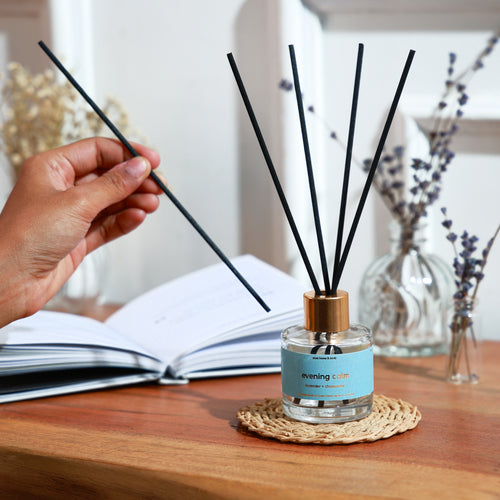 Evening Calm · no switch₹799Shop →
The routine, the dose, and where fragrance actually belongs
Take the free part first, because for a large share of readers it is the entire answer and it needs to be specific rather than gestural. Ten minutes with two openings before you get into bed, and ten more on waking. Two matters more than most people realise: a single open window gives you a slow trickle driven by nothing, while two openings on opposite or adjacent walls give you a pressure difference and an actual current, and twenty minutes of genuine cross-draught does more than an hour of one window ajar. The evening ten is the one people skip and it is arguably the more useful of the two, because it means you are sealing in cleared air rather than a day's worth. Then the bed: throw the covers right back when you get up instead of making it immediately. A made bed traps the night's moisture in the mattress and pillow for the next sixteen hours; an open one lets it go. Strip it properly once a week. Then the mug of water down every drain in the attached bathroom, including the floor drain nobody thinks of, which refills a U-bend seal that evaporates in two to four weeks of light use — and if you have been away, do it before you do anything else. Then the AC filter, out and washed under a tap every two to four weeks while the machine is in daily use. Almost nobody does this and it takes ten minutes. If you do those four things and the room is fine, close the tab. You have solved it for ₹0 and I would rather that than an order.
Then the fragrance layer, which is the last step and the smallest one. The Hotel Collection is composed at three to six drops per tank, and a bedroom takes three. This is the one room in the house I would tell you to deliberately under-scent, for a reason that has nothing to do with taste: it is the smallest volume anybody scents, and it is the only room you are sealed into for eight hours, so anything you put into it accumulates against you rather than dispersing away. Three drops on low, started while you are getting ready for bed, is the whole instruction. The dose is per tank rather than per litre, since you are scenting the mist and not the water, so a 300ml Boond at ₹899 takes the same three drops as a 500ml Sukoon at ₹1,899 — the larger machine buys hours and coverage, never intensity, and in a bedroom the smaller one is frequently the better buy. Use the 2H timer and let the room hold the level rather than the machine, because the point is to be asleep in a settled room, not beside a working appliance. On timings, so you buy the right format: a candle puts scent into a room in fifteen to twenty minutes and must be attended and put out, a Sukoon reaches a steady level in about twenty minutes from cold, and a reed diffuser needs 24 to 72 hours before it is doing its job, which makes it the wrong purchase for tomorrow and the right one for the next four months. Place any of them across the room from the pillow, at waist height or above, and out of the direct path of a fan or an AC vent.
Then the two things that will trip you up later, and the principle underneath all of it. The first is habituation. Your receptors adapt to a constant smell within minutes and to your own home within about a fortnight, and in a bedroom it happens faster than anywhere else because you spend eight uninterrupted hours in it. The instinct that produces is to add drops, and adding drops is precisely wrong: every visitor is still receiving the level you originally set, and you have simply stopped being able to audit it. One honest guest, asked to be truthful rather than polite, tells you more than any amount of adjusting. The second is that a cool-mist ultrasonic puts 30 to 50 millilitres of water an hour into the air, which is a good reason not to buy one for a bedroom that is already damp or a flat in the middle of monsoon — in that situation Evening Calm at ₹799 or a candle from ₹379 is the better format, because neither adds moisture. The Hotel Collection is water-based and runs in the Sukoon, the Boond and the Megh only; it does not go into a reed, which is a separate alcohol-free line with its own scents, and not into the waterless Vaayu. SOSA does not make a room or linen spray for the home. And the principle this entire cluster is built on: fragrance is a finishing layer on air that is already clean and moving. It will not remove a dry drain trap, a loaded mattress, a filter full of biofilm or a room that has not been opened since Tuesday. Deal with the cause, change the air, then scent the room — in that order, and never the other way round.
The SOSA edit
In the order I would actually do it, which is also the order of this page. The first four rows cost nothing and between them settle the large majority of these cases outright. The fifth is the fragrance layer, at a lower dose than any other room in the house takes, and the last row states plainly what SOSA does not make.
| Do this | What it addresses | When it is the answer | Cost |
|---|---|---|---|
| 1. Two openings, ten minutes, both ends of the night ★ | The sealed room — the cause underneath most of these | Always, and first. One window is ventilation; two on opposite walls is exchange | ₹0 |
| 2. Throw the bed open instead of making it | Half a litre of overnight moisture held in mattress and pillow under a duvet | Every morning, and a full strip weekly. The cheapest habit in this cluster | ₹0 |
| 3. A mug of water down every drain in the attached bathroom | A U-bend seal that has evaporated and is venting sewer gas into the bedroom | If the smell is sharp and faintly sulphurous rather than stale, and after any holiday | ₹0 |
| 4. AC filter out and washed in season | Biofilm on a cold wet filter, blown into the room on start-up | If the smell arrives in the first minute of the AC and then fades. Every two to four weeks | ₹0 |
| 5. Hotel Collection 15ml at three drops | Nothing at all. It is a background once the four rows above are done | Last. Low output, 2H timer, before you sleep rather than while you sleep | ₹299 |
| Not made by SOSA: a room or linen spray for the home | The sprays in the range are car perfumes, formulated for about three cubic metres of moving air | Printed rather than implied. For a bedroom the honest formats are a diffuser, a reed or a candle | — |
Versailles
I wanted this to be the first page of a hundred because of the tone of the emails that produce it. People apologise before they ask. They tell me how often they clean, unprompted, as though a diagnosis were going to be a judgement. It never is. In eight closed hours a bedroom receives about half a litre of water from each person in it, a night of shed skin onto the pillow, and the slow steady output of every piece of foam, board, paint and plastic in the room, and it is given no way whatsoever of getting rid of any of it. That is not a failure of housekeeping. That is a container doing what containers do, and it happens in my flat in Pune as reliably as in anybody else's.
The commercial part of this is uncomfortable and I would rather be straight about it. The best answer to this question is free, it takes twenty minutes a day, and I sell none of it. Open the room at both ends of the night. Throw the bed back instead of making it. Put a mug of water down the bathroom drain. Wash the filter. If those four fix your mornings — and for most readers they will — you should buy nothing from me at all, and I would rather have written the page that told you so than the one that sold you a bottle for a problem it cannot touch. What fragrance does is come afterwards. Once the air is clean and moving, three drops at ₹299 gives a bedroom a quiet, consistent background, and that is a genuinely good thing to own. It is just not a repair, and anyone who tells you it is has sold you the wrong product.
Everything is made and supported from Pune, and a part of every order funds girl-child education through Nanhi Kali. You get a home that smells like somewhere you chose; a girl gets a classroom. That equation has always felt right to me.
Frequently asked questions
- Why the room smells fine at night and stale when you wake — the same room, two readings, eight hours apart.
- Why a closed door changes the smell of a bedroom and whether to sleep with the window open — the air-path question from both sides.
- Why your mattress makes the bedroom smell stale and why a washed pillow still smells — the two objects in the room that hold the most.
- Why your bedroom smells stale every morning — the complete diagnosis — the pillar page, with the full symptom-to-cause table.
- Brand: the SOSA founder story.
Facts verified August 2026: Diagnostic facts used in this guide: a closed room accumulates what it cannot exchange, so cross-ventilation needs two openings rather than one; a drain's U-bend water seal evaporates in roughly two to four weeks of disuse and then admits sewer gas, which is corrected by pouring water down the drain; microbial growth in fabric and on surfaces accelerates above about 60% relative humidity, and Indian monsoon indoor humidity commonly runs 80–95%, which is the one situation where ventilating on a wet day can import moisture rather than remove it; an air-conditioner's cold, wet evaporator coil and filter grow biofilm that is blown into the room on start-up; textiles adsorb cooking aerosol and body oils and re-release them for weeks; and olfactory adaptation makes a constant household smell undetectable to its residents within about a fortnight while visitors still perceive it. Timings: a scented candle scents a normal room in roughly 15–20 minutes, a Sukoon ultrasonic diffuser reaches a steady level in about 20 minutes from cold, and a reed diffuser needs roughly 24–72 hours. SOSA products and prices: Sukoon 500ml ₹1,899 (270–320 sq ft, 16–18h on low, 9–12h high, 30–50 ml/h, 2.4MHz cool mist, remote, steady/2H/4H timers, BPA-free, auto shut-off, includes three 15ml Hotel Collection scents of your choice); Boond 300ml ₹899; Megh 6-litre ₹3,499; waterless Vaayu ₹11,999 (up to 1000m³); Aangan ₹25,999. Hotel Collection water-based fragrance 15ml ₹299, 100ml ₹999, 300ml ₹1,799, Pack of 7 at 15ml ₹1,799; dose 3–6 drops per tank. Reed diffusers (separate alcohol-free line): Morning Freshness from ₹749, Garden Bloom and Evening Calm from ₹799, Fresh Brew and Mountain Breeze from ₹849; 130ml from ₹1,249; duos from ₹1,498; 300ml refills ₹2,399. Scented candles: Bookshop 80g ₹379, Amber Rose 130g ₹599 and 220g ₹799, Smoked Oudh 130g ₹449, ceramic jar candles ₹949, Pure Calm wax melt set ₹854. Free shipping above ₹499. SOSA does not make a room or linen spray for the home. The Hotel Collection scents are SOSA's own interpretations; SOSA is not affiliated with or endorsed by any hotel brand. Prices subject to change — see the live product pages.