


2. Ceiling height and layout can pull the threshold lower. A taller reception ceiling, an L-shaped or two-wing corridor, or an uneven floor plan all reduce what a single passive point can reach, which is why some clinics need an active machine well under 750 sq ft.
3. Central or ducted AC is a reason on its own. Where a building already has ducting a unit can be mounted into, Vaayu's distribution advantage — reaching corridors and closed approaches that no free-standing device can — becomes available immediately, independent of total floor area.
4. Control and uptime are arguments that hold at every size, not just large ones. Run windows of 1h/4h/8h/24h, adjustable intensity, a key-lock, and a roughly 90-day tank mean a clinic is not relying on staff to remember a diffuser exists — this matters as much at 800 sq ft as at 2,500.
5. A genuinely single small cabin is the honest exception. Where the premises is truly one consulting room with no corridor, no second room and no plan to grow, a reed at ₹749–₹1,349 or Sukoon at ₹1,899 covers that one room adequately — Vaayu is more machine than that specific room strictly needs, though its adjustable intensity means it is never wrong to have room to grow into.
Check footprint, room count, ceiling and AC conditions, and whether the clinic needs a schedule it can control — meeting any one of these, most orthopaedic practices are past the point where Vaayu is the honest answer.
Why the threshold is not a single square-footage number
It is tempting to look for one figure — a clinic under X sq ft uses a reed, over X sq ft uses Vaayu — because a single number is easy to apply. It is also the wrong way to answer this question. Two clinics at exactly 700 sq ft can sit on opposite sides of the threshold: one is a single open reception with no corridor and no second room, genuinely served by Sukoon; the other is a reception, a corridor and two consulting cabins on the same footprint, and a passive point placed anywhere in it will leave real gaps between rooms regardless of the total area.
Room count and layout matter as much as area because passive diffusion has no way to move scent between separate rooms or around a corner — a fact this cluster covers at length elsewhere. Ceiling height matters because a taller reception, or a rehabilitation area built with a higher ceiling than a standard consulting corridor, changes the actual volume of air a source needs to move through, independent of the floor plan's footprint. Central or ducted AC matters because it opens a distribution option — duct mounting — that no passive point and no free-standing ultrasonic unit has access to at all.
The signal most owners underweight, though, is control. A clinic operating ten or twelve hours a day, with staff turning over across shifts, benefits from a schedule that runs itself, an intensity that can be dialled down the moment a patient objects, and a key-lock that stops the setting drifting upward as different people pass through reception. None of that depends on square footage. A small clinic gains exactly as much from it as a large one does, which is why the honest threshold for Vaayu sits lower, and looks different, than a single coverage figure would suggest.
The three decisions that actually set the threshold
 Vaayu₹11,999A reception plus one consulting cabin, with no corridor between them, is a different problem from a reception, a corridor and two or more rooms — the second crosses the threshold well before 750 sq ft in many layouts, because passive coverage cannot bridge separate rooms regardless of total area.
Comparing the signals that set the threshold
Every row is a signal on its own — meeting any one of them is usually enough to make an active machine the honest answer, independent of the others.
| Signal | What it means | What it points to | What it costs |
| More than one room to reach, any corridor | Passive points cannot bridge separate rooms regardless of total area | Vaayu, even under 750 sq ft | ₹11,999 |
| A single room, no corridor, no plan to grow | A genuinely contained, single-zone premises | Reed or Sukoon is adequate on its own terms | ₹749–₹1,899 |
| Taller or uneven ceiling | Reduces what any passive or free-standing unit can reach | Vaayu, mounted to match the actual volume | ₹11,999 |
| Central or ducted AC already exists | Opens duct mounting, a distribution option unavailable to passive or free-standing units | Vaayu, duct-mounted | ₹11,999 plus contractor fitting |
| Need for a schedule, lockable intensity, or switch-off on request | Control that no passive point offers at any size | Vaayu, at whatever footprint the clinic actually is | ₹11,999 |
| None of the above apply, and the premises is one contained room | The clinic is the genuine exception this threshold allows for | Reed or Sukoon, and no reason to spend more | ₹749–₹1,899 |
 Vaayu · once any signal is met₹11,999Shop →
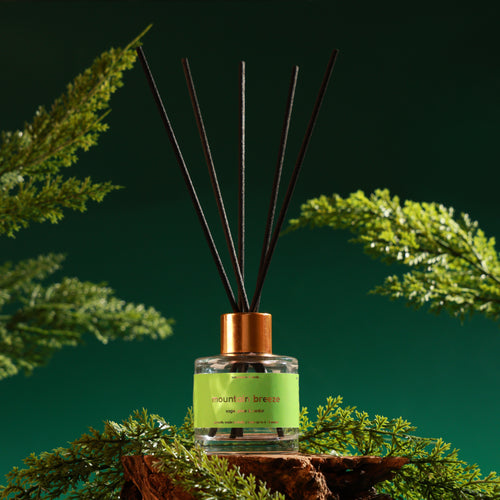
  Sukoon · the genuine single-room exception₹1,899Shop → Mountain Breeze · reed, same exception₹849Shop →
Zoning and intensity once Vaayu is in place
Scent the entrance, reception, waiting area and connecting corridors, whatever the clinic's size. Every consulting cabin, treatment room, X-ray room and any enclosed space where a patient is held for an extended period stays completely unscented under this cluster's standard zoning doctrine — crossing the threshold into an active machine changes the hardware, not this rule. Keep intensity low enough that the register is noticed once on arrival and forgotten within a minute.
Set a run window matched to the clinic's actual operating hours — 8h or 24h covers most practices — and use the key-lock consistently so the setting agreed at installation does not drift as staff change across shifts. Where central AC exists, ask the AC contractor about duct mounting specifically, since it removes both the placement and the ceiling-height questions in one step, reaching rooms a wall-mounted unit's own airflow would not.
If a patient objects to the fragrance at any point, reduce the intensity or switch the unit off entirely — never treat an existing setting as something to defend. Vaayu's onboard and app controls make this a matter of seconds, which is itself one of the arguments for choosing an actively controlled machine over a passive point that cannot be adjusted at all.
What to buy, and why
Every route below follows from which signal, or combination of signals, the clinic actually meets — not from square footage in isolation.
| Route | Signal met | Why | What it costs |
| Vaayu, wall-mounted | More than one room, a corridor, or roughly 750 sq ft and above | No passive point can bridge separate rooms or a corridor regardless of total area | ₹11,999 |
| Vaayu, duct-mounted into central AC | Central or ducted AC already exists | Distribution through the building's own supply air, unavailable to any passive or free-standing unit | ₹11,999 plus contractor fitting |
| Vaayu, at a smaller footprint with room to grow | 300–750 sq ft, one open zone, but a plan to expand or add rooms | Adjustable intensity dials down to the room's actual needs now, without buying again later | ₹11,999 |
| Sukoon, single open zone | 300–750 sq ft, no corridor, no plan to grow, control less of a priority | Real local coverage for a genuinely contained zone at lower cost | ₹1,899 |
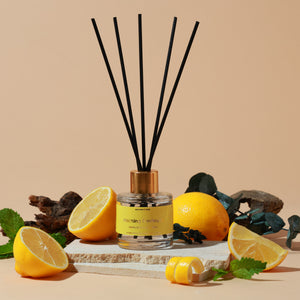
| Reed, Mountain Breeze, single small room | A genuinely single consulting cabin with no corridor and nothing else to cover | The honest exception — more machine than this specific room strictly needs | ₹749–₹1,349 |
I am asked some version of 'do we really need Vaayu, or would a reed do' most weeks, and I have learned not to answer with a square-footage figure, because it is the wrong axis for the question. I ask instead whether there is more than one room to reach, whether the ceiling does anything unusual, whether central AC already exists, and whether anyone on staff actually wants to be able to turn the fragrance down without hunting for a bottle to move.
Almost every orthopaedic practice I have this conversation with turns out to meet at least one of those signals well before their total area feels 'large' in their own head — a reception and two cabins at 700 sq ft, a central AC system already installed for the building, a practice manager who has had to ask a patient's family to wait outside because nobody could dial a diffuser down quickly. Any one of those, on its own, settles the decision for me.
The clinics I genuinely tell to stay with a reed are the ones where none of that applies — a single consulting room, one door, no corridor, no expansion planned. That is a short list, and it is worth saying plainly, because a guide that never tells a reader to spend less would not be one I could stand behind.
Questions clinic owners ask about this threshold
- How should a 2,000+ sq ft orthopaedic and rehabilitation centre approach ambient scent? — how this threshold plays out once a centre is genuinely large and multi-zone.
- One scent machine vs multiple smaller fragrance points for an orthopaedic clinic — why one active machine beats several passive points once the threshold is crossed.
- My reed diffuser works in the doctor's cabin but not the waiting area — why? — the mechanism explanation behind why a passive point stops being enough.
- Why are multiple reed diffusers still barely noticeable across my large clinic? — the same threshold, seen from a clinic that has already tried the passive route.
- Brand: the SOSA founder story.
SOSA products & prices (verified September 2026): Reed diffusers 50ml ₹749–₹849 (to 150 sq ft, 6–8 weeks at six reeds) · 130ml ₹1,249–₹1,349 (above 150 sq ft, 14–18 weeks) · reed refill 300ml ₹2,399. Ultrasonic: Boond ₹899 (~150 sq ft) · Sukoon ₹1,899 (270–320 sq ft, ships with three 15ml Hotel Collection fragrances) · Megh ₹3,499 (6L tank, ~100 hrs runtime, ~215 sq ft — a runtime machine, not a coverage upgrade). Waterless cold-air: Safar ₹3,999 (no published coverage figure) · Vaayu ₹11,999 (up to 1000 m³, roughly 2,000–3,000 sq ft; 400ml tank lasting about 90+ days; app and onboard control, 1h/4h/8h/24h run windows, adjustable intensity, key-lock, under 38 dB, freestanding or wall/HVAC mount, 5W, CE/RoHS/SGS) · Aangan ₹25,999 (8,000–10,000 sq ft). Hotel Collection water-based fragrance 15ml ₹299 · 100ml ₹999 · 300ml ₹1,799 is for ultrasonic machines; reed oil and Hotel Collection are not interchangeable. Reed diffusers are alcohol-free, phthalate-free, paraben-free, IFRA-compliant and low VOC, handmade in small batches in Pune. Every purchase funds a girl's education through Nanhi Kali. Prices and availability subject to change — see the live product pages.