


Breaths two to four — one dry impression, unattributable. A single accord at a level low enough that the visitor cannot locate it or name it. The correct internal response is this place is looked after, not ooh, cedar.
The rest of the visit — continuity. The same thing in the demonstration rooms, the same thing at the consultation table, and the same thing on their next visit in eight months. Continuity is the part that signals competence.
What it should signal: that somebody set something here and it stayed set. That is the identical promise your hardware is making, delivered through a channel the visitor is not defending against.
The honest limit: there is no scent burst on the door. Vaayu ₹11,999 runs on its own Bluetooth schedule with 1h / 4h / 8h / 24h windows — SOSA publishes no occupancy sensor, no door trigger, no Wi-Fi, no Alexa, no Google Assistant, no Matter, no KNX, no Crestron, no Control4, no RS-232, no dry contact and no API.
2. Then one dry impression, low enough to be unattributable. A single accord — clean-fresh or dry woody — at a concentration where the visitor perceives a change of state without being able to name a material or find a source. The response you want is the air in here is different, not that is white tea. A nameable smell pulls attention onto itself, and attention on the fragrance is attention off the hardware.
3. Nothing that belongs to a specific room of a house. Your studio is demonstrating a living room, a bedroom, a kitchen and possibly a theatre in one building. Coffee puts the visitor in a kitchen, lavender in a bedroom, rose in a drawing room. The arrival accord must refuse to take sides, which is why a tea-and-cedar direction works so well: it belongs to public interiors — a lobby, a gallery, a well-run office — and to no domestic room in particular.
4. The same thing they smelled last time. Recognition on a second visit does more commercial work than intensity ever will, and it requires only that the setting was written down and locked. A buyer who visits in March and again in November and finds the air identical has been given a small, quiet piece of evidence about how you run things.
5. And nothing arriving as an event. No burst at the door, no puff as they pass a sensor, no obvious step-change from the street. Fragrance introduced as an event announces itself as a device, and a visitor who notices the device has stopped experiencing the room. It should be there before they arrive and still there after they leave.
Vaayu is ₹11,999, covers up to 1000 m³ of connected volume, runs under 38 dB, draws DC 12V / 1A at 5W, holds 400ml for about 90 or more days, and is CE, RoHS and SGS certified. Free shipping above ₹499, and a portion of every order supports girl-child education through Nanhi Kali.

The first four breaths, taken one at a time
Arrival is short and it is not evenly weighted. The visitor's nose is doing three different things in sequence, and each of them can be got right or wrong independently of the other two. Most studios spend their attention on the second and neglect the first, which is the wrong way round, because the first one is free.
 First, the roomFreeThe nose is a difference engine before it is an aesthetic one, and what it is genuinely good at is detecting things that should not be there. That means the first thing a visitor perceives is not your accord — it is whatever is wrong. New electronics, cabling, adhesives and MDF off-gas hardest when they are new. Packaging that has been opened on the display floor keeps releasing for hours. An empty sealed building with the air conditioning off overnight produces a flat, closed smell by morning that everyone who works there has stopped registering. None of that is a fragrance problem and none of it can be solved by fragrance: adding a pleasant odour to an unpleasant one produces a mixture, and the mixture is reliably worse than either half. The sequence is source, then ventilation, then fragrance. Unpack away from the customer volume, get the cartons out, ventilate the store room, check that the fresh-air intake is actually doing something, run the air conditioning before opening rather than at opening. Then scent.
 White tea accords₹1,799Now the presence. There is a useful piece of physiology here: the nose reports change far better than steady state, which is why a visitor who walks past a fragrance notices it clearly and a person sitting in the same spot does not. An arriving customer is crossing from street air into your air, so they are in the best possible condition to perceive a very low concentration — much lower than anybody standing inside would guess. That is the whole basis for the arrival design. You do not need a strong entrance; you need a different one, and the difference is doing the work. What you should aim for is an impression that has no edges: they cannot name the material, they cannot point at a source, and if you asked them ten minutes later to describe it they would say the place felt clean and well kept. The oil that does this best is dry rather than sweet, and it is one accord rather than two, because two accords meeting at an entrance is the one place a visitor always notices the seam.
Vaayu₹11,999An arrival that is contradicted immediately afterwards is worse than no arrival at all, because it converts a pleasant impression into evidence of stagecraft. If the entrance is scented and the demonstration rooms are not, the visitor walks out of your accord and into a flat pocket and registers — without being able to explain it — that the nice bit was a trick. So the arrival accord must be the building's accord, present at varying intensity everywhere the visitor goes, including the corridor between rooms where two different oils would otherwise meet and mix. In practice this is a zoning question. A closed door is a boundary and an open plan is one volume, so rooms behind doors are separate zones needing their own machine at their own setting, and the connected floor is a single volume that one correctly placed unit can serve. Reason in volume rather than floor area — a double-height entrance consumes coverage that a square-foot figure hides, and Vaayu's rating of up to 1000 m³ is a volume figure for exactly that reason.
White tea accords₹1,799Now the presence. There is a useful piece of physiology here: the nose reports change far better than steady state, which is why a visitor who walks past a fragrance notices it clearly and a person sitting in the same spot does not. An arriving customer is crossing from street air into your air, so they are in the best possible condition to perceive a very low concentration — much lower than anybody standing inside would guess. That is the whole basis for the arrival design. You do not need a strong entrance; you need a different one, and the difference is doing the work. What you should aim for is an impression that has no edges: they cannot name the material, they cannot point at a source, and if you asked them ten minutes later to describe it they would say the place felt clean and well kept. The oil that does this best is dry rather than sweet, and it is one accord rather than two, because two accords meeting at an entrance is the one place a visitor always notices the seam.
Vaayu₹11,999An arrival that is contradicted immediately afterwards is worse than no arrival at all, because it converts a pleasant impression into evidence of stagecraft. If the entrance is scented and the demonstration rooms are not, the visitor walks out of your accord and into a flat pocket and registers — without being able to explain it — that the nice bit was a trick. So the arrival accord must be the building's accord, present at varying intensity everywhere the visitor goes, including the corridor between rooms where two different oils would otherwise meet and mix. In practice this is a zoning question. A closed door is a boundary and an open plan is one volume, so rooms behind doors are separate zones needing their own machine at their own setting, and the connected floor is a single volume that one correctly placed unit can serve. Reason in volume rather than floor area — a double-height entrance consumes coverage that a square-foot figure hides, and Vaayu's rating of up to 1000 m³ is a volume figure for exactly that reason.
What the visitor infers, and why they are right to generalise
The uncomfortable truth about a premium studio is that almost nothing a buyer cares about can be assessed during a visit. They cannot test whether your commissioning will hold, whether the scenes will still work in year three, whether somebody will answer the phone in year five. What they can assess is the small set of things visible in forty minutes — and human beings reason from the available sample to the unavailable one, every time, without deciding to. So the air becomes evidence. Not because anybody thinks air is important, but because it is one of the few things present at the door that is unmistakably the result of a decision somebody made and then maintained.
This is why the specific quality to aim for is consistency rather than pleasantness. A studio that smells lovely and different every week is telling the visitor that somebody is fiddling. A studio that smells the same on a Wednesday morning and a Saturday evening, in the entrance and in the theatre room, in March and in November, is telling them something much more valuable: that a setting was made here and it has held. That is the same sentence your entire proposition rests on. It is being delivered through a channel the visitor has no defences against, because nobody arrives at a showroom braced against the air.
Two practical consequences follow. First, do not scent the entrance more heavily than the rest of the building on the theory that arrival is what counts — the step-down afterwards is precisely what reads as artificial. Second, do not change the accord for an event, a launch or a season. The value is in it being unremarkable and identical, which means the moment it becomes interesting to the people who work there it has probably started to fail. If your own team has begun to find it boring, that is the strongest evidence available that it is working properly.
What they smell, what they conclude
The inference chain, written out. This is the table I would put in front of a studio owner who wants to know whether the entrance is earning anything, and the last row is the one that costs the most.
| What they smell on entry | What they conclude, without noticing | Effect on the sale | Fix |
|---|---|---|---|
| Nothing wrong, plus one quiet dry accord | Somebody set this and it stayed set | Supports every claim made in the next forty minutes | This is the target |
| Nothing at all | Neutral. No harm done | A missed opportunity rather than a loss | One accord, low, on a schedule |
| A nameable fragrance | They have scented this room | Attention moves to the fragrance and off the hardware | Step the intensity down two notches |
| A burst or a step-change on the door | A device did that | Converts the experience into stagecraft | Place it inside, out of the draught, running continuously on schedule |
| Packaging, adhesive, new MDF, cabling | They are still setting up, or they do not notice things | Direct damage to a precision proposition | Source, then ventilation, then fragrance. Never fragrance alone |
| Fragrance over packaging or a drain | They are hiding something | The worst outcome on this table | Turn the machine off until the source is fixed |
| Something different from their last visit | Nobody here is in charge of the details | Quietly undoes the point of having a signature at all | A written setting and a key-lock |
Cold-air nebulising · Vaayu₹11,999See it → One dry accord₹1,799See it → 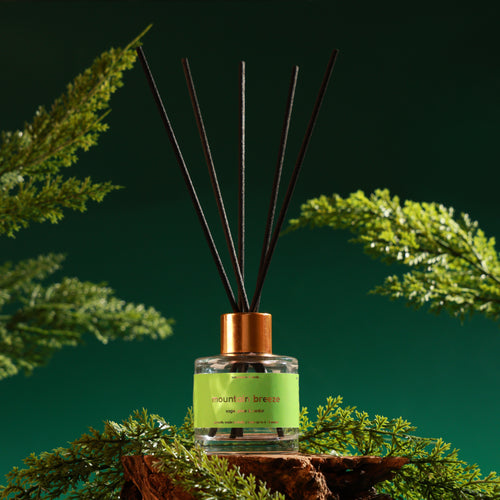 Cabin scale · Mountain Breeze₹849See it →
The three arrival collisions nobody plans for
The first is the greeting. The moment a visitor is met, the person meeting them becomes part of the arrival, and if that person is wearing a strong fine fragrance then that is what the customer smells rather than the room. This is not a small effect. A personal fragrance at conversational distance is far more concentrated than anything a room diffuser produces, it is designed to project, and it arrives at exactly the moment you had planned your own impression. Any studio serious about its entrance needs a quiet policy about scent on the floor — not a ban, but an understanding that front-of-house wears very little. It is the cheapest possible improvement and the one nobody writes down.
The second is the draught. An entrance is the most turbulent point in any building: a door that opens onto a street, an air-conditioning curtain, a lobby pressure difference, people moving through. Putting the source directly at the door is the instinctive move and usually the wrong one, because the fragrance is swept out before it establishes and the level then gets raised to compensate, which over-doses everything behind it. Slightly inside, out of the draught, into the airflow path rather than against it. Better still, use the return: Vaayu can be mounted into an HVAC return, and where the entrance shares an air path with the floor this is what gives an even arrival without a strong point anywhere. Note precisely what that integration is — it is mechanical. Vaayu automates itself with a Bluetooth app and onboard buttons; SOSA publishes no Wi-Fi, Alexa, Google Assistant, Matter, Zigbee, Z-Wave, KNX, Crestron, Control4, RS-232, dry contact or API, so there is no door trigger, no occupancy sensor and no scene. It runs alongside the automation on its own schedule.
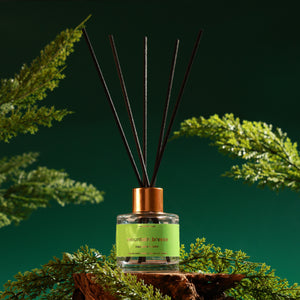
The third is the reed on the reception desk. It is the commonest arrival specification in India and it is doing something quite different from what people believe. A reed diffuser is passive capillary diffusion — oil climbing six fibre reeds and evaporating, with no energy used and no air moved — so it produces a fragrant zone about a metre across, not a fragranced entrance. The customer smells it while giving their name and loses it three steps later, which is a gradient, a findable source and a step-change all in one. Reeds are genuinely good things in a manager's cabin or a small meeting room, where a local zone is the point. As an arrival for a studio they are the wrong instrument, and adding a second one at the far side makes it worse rather than better: two passive sources produce two concentration peaks with a valley between them, because neither moves any air and the midpoint is the farthest point from both.
What to specify, in order — and the honest gap
The buying order for an arrival, followed by what does not exist and the case where I would tell you to spend a tenth of the money.
| Buy | What it is | When it is the right answer | Price |
|---|---|---|---|
| 0. Ventilation and packaging discipline ★ | Cartons off the customer floor, store room ventilated, air conditioning run before opening, fresh-air intake checked | Before anything is bought. Absence is the first breath and it is free | Nothing |
| 1. Vaayu ★ | Waterless cold-air nebuliser — up to 1000 m³, under 38 dB, DC 12V/1A 5W, freestanding, wall or HVAC-return mount, key-lock, CE / RoHS / SGS | The entrance and the connected floor as one volume, so the arrival is not contradicted three steps later | ₹11,999 |
| 2. Hotel Collection 300ml | Alcohol-free, water-free cold-air oil — White Tea Serenity or Quiet Luxury | An accord that belongs to a public interior rather than to any room of a house | ₹1,799 |
| 3. Mountain Breeze reed 50ml | Passive capillary — a fragrant zone about a metre across, not an entrance | A manager's cabin or a small meeting room. Never the arrival itself | ₹849 |
| 4. Sukoon | Ultrasonic water mist, 500ml, 270–320 sq ft, three 15ml scents included | A single small closed room where Vaayu is over-specified. Adds humidity — not near displays | ₹1,899 |
| The honest gap: no door trigger exists | There is no occupancy-triggered burst, no sensor and no scene. Vaayu automates itself on its own Bluetooth schedule, with no Wi-Fi, Alexa, Google Assistant, Matter, Zigbee, Z-Wave, KNX, Crestron, Control4, RS-232, dry contact or API — and for an arrival that is the correct behaviour anyway, because a burst announces the device. There is also no aquatic, marine or clean-linen accord in the SOSA reed line | Said plainly rather than left open | Said, not sold |
Versailles
When somebody asks me what their customers should smell on entry, they are usually hoping I will name an oil. The more useful answer is a sequence, and the first item in it has nothing to do with perfumery. Absence comes before presence. I have walked into studios with an excellent accord running over a floor that still had three opened cartons behind a display wall, and what the room smelled of was cardboard with something pleasant on top of it — which is a worse impression than cardboard alone, because it reads as concealment rather than oversight.
The second thing I would say is that an arrival is not a performance. There is a temptation to make the door dramatic — a stronger level at the entrance, a change of accord, something the visitor definitely notices. Every version of that I have seen has been read, correctly, as a device. What actually reads as expensive is air that was already like this before you arrived and will be like this after you leave, at a level so low that the visitor never quite decides whether they are smelling anything at all. That impression cannot be produced by a strong oil. It is produced by a low setting, a machine with no findable source, and somebody having refused to change either for three years.
And the small one that nobody writes down: mind what the person greeting the customer is wearing. A fine fragrance at conversational distance will comfortably overwrite anything a room diffuser is doing, and it arrives at the exact moment you had planned your own impression. Front-of-house wears very little. It is free, it takes one conversation, and it protects the entire arrival you have just paid for. Everything we compose is made in Pune, and a portion of every order supports girl-child education through Nanhi Kali.
Frequently asked questions
- What a premium experience centre should smell like — why expensive means clean, dry, low and unchanging.
- Best fragrance for a luxury automation showroom — the register argument in principle.
- Should it have a signature fragrance? — recognition across visits and branches.
- Making the showroom feel more luxurious — the ninety per cent that is not fragrance.
- What suits a smart-living experience centre — the centre read as a route.
- Fresh, woody or hotel-like? — the three-way comparison, scored.
- Should it smell like a five-star hotel? — the right mechanism, often the wrong accord.
- How strong should it be? — lower than you think, and how to set it.
- Choosing a signature scent for the brand — the method, end to end.
- Brand: the SOSA founder story.
SOSA Vaayu — facts verified August 2026: ₹11,999. Waterless cold-air nebulising diffuser; pressurised air shatters undiluted oil into a dry nano-mist, with no water, no dilution, no added humidity and no residue. Coverage up to 1000 m³, approximately 2,000–3,000 sq ft at standard ceiling height, measured as connected volume rather than floor area. Control: Bluetooth app plus onboard buttons, run windows of 1h / 4h / 8h / 24h, day selection, adjustable mist intensity, auto-stop and key-lock. SOSA publishes no Wi-Fi, Alexa, Google Assistant, Matter, Zigbee, Z-Wave, KNX, Crestron, Control4, RS-232, dry-contact or API integration of any kind, no occupancy sensor and no door trigger, and Vaayu cannot be addressed by, or included in a scene on, any home-automation control system. Mounting: freestanding, wall-mounted or into an HVAC return. Power DC 12V / 1A, 5W at the mounting position. Under 38 dB. 400ml sealed, residue-free, refillable tank lasting up to about 90+ days depending on intensity and scheduled hours. CE, RoHS and SGS certified. Black and white finishes. Oils must be alcohol-free, water-free fragrance oils formulated for cold-air diffusion, such as the SOSA Hotel Collection (100ml ₹999 · 300ml ₹1,799 · pack of seven ₹1,799); thick undiluted essential oils are not recommended as they clog the fine nozzle. Above Vaayu's range: Aangan ₹25,999 (~8,000–10,000 sq ft) and Meenar ₹38,500 (12,000–18,000 sq ft). Below it, on a different mechanism: Sukoon ₹1,899 ultrasonic (270–320 sq ft, 500ml, three 15ml scents included) and Boond ₹899 (up to about 150 sq ft); Megh ₹3,499 has a six-litre tank and about a hundred hours of runtime but covers only about 215 sq ft and is never a coverage upgrade. SOSA reed diffusers — Evening Calm ₹799, Garden Bloom ₹799, Morning Freshness ₹749, Mountain Breeze ₹849, Fresh Brew ₹849 for 50ml — are alcohol-free, phthalate-free, paraben-free, IFRA-compliant and 0 ppm formaldehyde, with six fibre reeds in a refillable glass bottle on a heat-stable CCT carrier, composed in Pune. The reed line contains no aquatic, marine, ozonic or clean-linen accord, and no oud or sandalwood. Reed oil and the water-free Hotel Collection are separate products and are not interchangeable, and there is no hotel-inspired reed diffuser. A scent machine adds fragrance; it does not remove an existing odour, cover a construction or packaging smell, clean or purify air, and SOSA makes no health or air-quality claim. SOSA publishes no dealer programme, reseller margin, trade price, territory, minimum order, lead time, installation charge or maintenance contract; commercial enquiries are welcome at https://sosahomeandbody.com/pages/contact. Free shipping above ₹499. A portion of every order supports girl-child education through Nanhi Kali. SOSA is an independent Indian fragrance house; the Hotel Collection scents are SOSA's own interpretations inspired by the world's finest hotels, and SOSA is not affiliated with or endorsed by any hotel brand or any home-automation manufacturer. Prices subject to change — see the live product pages.