



The running cost: about ₹78 a week for each 130ml and about ₹105 for the 50ml — roughly ₹261 a week, or ₹13,572 across a full year of unbroken running.
The fourth room: usually free. A bedroom whose door stands open onto the living room is already borrowing from it. If its door genuinely closes, add a 50ml and the build becomes ₹3,996.
2. Then budget in weeks, not in bottles. Permanent means you will buy this again. A 130ml at ₹1,249 running 14–18 weeks is about ₹78 a week of use; a 50ml at ₹749 running 6–8 weeks is about ₹105. The three-bottle build is therefore ₹78 + ₹78 + ₹105 = about ₹261 a week, or ₹13,572 across fifty-two unbroken weeks. That is the real number. Anyone quoting you a setup cost for a permanent arrangement is quoting you the smaller half of it.
3. Which is why four 50ml bottles is the expensive answer. It is the one most people reach for, because ₹749 × 4 = ₹2,996 is genuinely ₹251 less than ₹3,247 on the day. But four small bottles run at about ₹105 a week each — ₹420 a week, ₹21,840 a year, against ₹13,572 for the three-bottle build. That is ₹8,268 of difference bought for a ₹251 saving. The 50ml has two honest jobs: testing a blend, and small wet rooms. Neither of them is "the cheap option".
4. Use one scent everywhere, for a reason that is not aesthetic. One blend across the house means one refill line. A 300ml refill at ₹2,399 tops up any of your bottles, so nothing sits half-used while you wait to finish something else, and you never end up with four part-bottles of four fragrances that together cover nothing. It also happens to be the arrangement that smells deliberate rather than accidental as you move between rooms, but the money argument stands on its own.
5. Delete a room before you economise on one. The cheapest millilitre is the one you do not buy. Before trimming reeds or downgrading bottles, look hard at which four rooms you actually named. If one of them is a kitchen with an extractor, a corridor, a spare bedroom nobody sleeps in, or a room whose door stands open all day, take it off the list entirely. That single decision is worth more than every other saving in this article combined.
Made in India, composed by an ISIPCA Versailles-trained perfumer — and a portion of every order supports girl-child education through Nanhi Kali.

Why the word "permanently" changes the whole calculation
Ask what four rooms cost to scent and you get a shopping list. Ask what they cost to scent permanently and you have asked a different question, because you have committed to buying the same thing again three or four times a year for as long as you live there. At that point the sticker price stops being the number that matters and cost per week takes over. A 50ml at ₹749 lasting 6–8 weeks is about ₹105 a week of use. A 130ml at ₹1,249 lasting 14–18 weeks is about ₹78. The larger bottle is roughly a quarter cheaper per week and more than doubles the gap between reorders, which is a second saving that never appears on an invoice: fewer decisions, fewer delivery charges, fewer weeks with an empty bottle standing somewhere while you get around to it.
The other half of the answer is structural rather than financial, and it saves more. Fragrance does not pass a closed door, and it passes an open one freely — so a four-room home is rarely four air spaces. A 900 sq ft flat with every internal door shut is genuinely four or five separate volumes. The same flat with the bedroom doors hooked back is one large loose volume plus whatever bathroom actually closes. Buying per room in the second case means paying twice for the same air. This is also why the cheapest setup is not the weakest one: the two 130ml bottles in the build run on six and four reeds respectively, at full working strength, and the economy comes from there being three of them rather than five. Coverage figures — up to about 150 sq ft on six reeds — assume a closed, still room of standard ceiling height, so if your living room has a balcony door open all evening, expect the bottle at the lower end of its 14–18 weeks and place it out of the flow path rather than buying a fourth.
The three decisions behind a permanent four-room setup
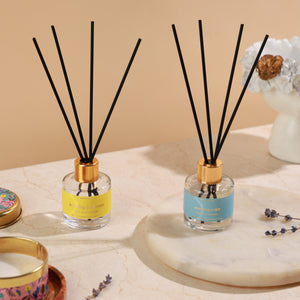
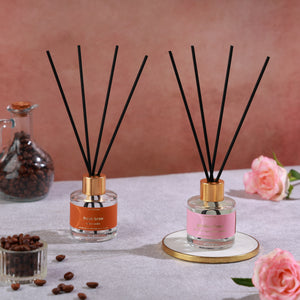
 Three bottles₹3,247A 130ml at ₹1,249 in the living room on six reeds, where the volume is largest and the hours are longest. A 130ml at ₹1,249 in the main bedroom on four reeds. A 50ml at ₹749 in the bathroom on two or three, because a 40 sq ft room cannot absorb more. ₹1,249 + ₹1,249 + ₹749 = ₹3,247. The fourth room is normally the second bedroom, and if its door stands open onto the living space it needs nothing of its own. If it genuinely closes, a second 50ml takes the build to ₹3,996.
Sizing by space — the four rooms, and the ones that should not be on the list
Read down and mark which of your four rooms is really which. Three rows here cost nothing at all, and one of them is on almost every list I am sent.
| Space | What it needs | How many | Cost |
|---|---|---|---|
| Living room, 180–220 sq ft, doors closed in the evening ★ | One 130ml on six reeds — the longest hours and the largest volume in the house | One 130ml | ₹1,249 |
| Main bedroom, 120–150 sq ft | One 130ml on four reeds — same bottle, lower level, and it runs longer for it | One 130ml | ₹1,249 |
| Main bathroom, 35–45 sq ft | One 50ml on two or three reeds. A 130ml here is more than the volume can absorb | One 50ml | from ₹749 |
| Second bedroom, door standing open onto the living room | Nothing. It shares air with a scented room already — close the door for two hours if it reads thin | None | ₹0 |
| Kitchen with an extractor running at every meal | Nothing. The air is being pulled out of the room by design | None | ₹0 |
| The corridor joining the bedrooms | Nothing. Four seconds of occupancy at a time, in the fastest air in the flat | None | ₹0 |
| A note on all of the above: coverage of up to about 150 sq ft on six reeds assumes a closed room, still air and a standard ceiling. Open balcony doors, ceiling fans and twelve-foot ceilings all reduce it, which shortens the 14–18 weeks as well — so a hot, airy living room will sit at the lower end of every figure above. | |||
One room · the unitFrom ₹749Shop → 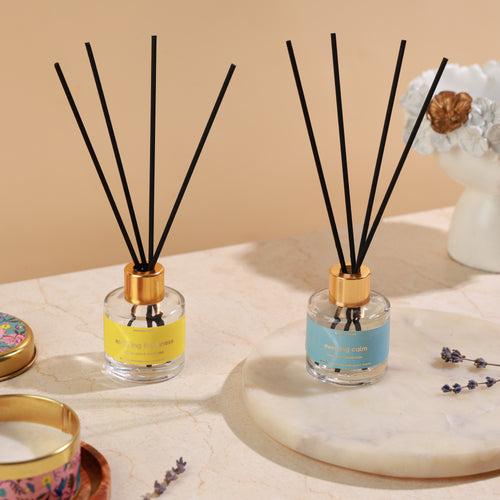 Two rooms · better value₹1,498Shop →
  Large room · a switch₹1,899Shop →
Reeds, placement and keeping four rooms going without thinking about it
Set each bottle to its room, not to a house-wide default. Six reeds in the living room, four in the bedroom, two or three in the bathroom. Reed count is the only volume control a reed diffuser has and it moves strength and lifespan together — six reeds in a 40 sq ft bathroom is not a stronger bathroom, it is the same bathroom with the bottle gone in half the time. Give every change forty-eight hours before judging it, because the fibre has to saturate along its whole length first, and judge from the doorway rather than from inside: olfactory adaptation is essentially complete within about twenty minutes, so in your own home you will always under-read what you own and be tempted to buy a fourth bottle you do not need.
Placement decides your running cost more than the reed count does. Heat and airflow raise the evaporation rate, so keep every bottle out of direct sunlight, off the path of an AC vent or ceiling fan, and away from the straight line between the front door and the balcony. The same 130ml will comfortably reach eighteen weeks in an air-conditioned bedroom and struggle to hold fourteen on a hot west-facing windowsill — that is a swing of several hundred rupees a year for free. Put each one on a tray or a coaster, because reed oil marks a polished finish permanently if the bottle is knocked, and keep them out of reach of children and pets.
Then buy liquid rather than glass. The bottle, collar and reeds were always the durable part of the purchase. Once you know the blend works in your home, a 300ml refill at ₹2,399 fills a 130ml roughly twice and tops up the 50ml as well, which is the whole reason for running one scent. Refilling is also the moment to fit fresh reeds: clogged fibre is the commonest reason a house that smelled right in month one reads tired in month four, and no amount of new liquid fixes it. For a whole-house blend, Morning Freshness is the least expensive at every size and reads clean from a living room through to a bathroom; Garden Bloom if you want something dressier in the same role.
What to buy
Three lines cover four rooms permanently. Here is what each option in the range is genuinely for, including the one that quietly costs the most.
| Buy | What it covers | Lasts | Price |
|---|---|---|---|
| One 50ml | A single reed diffuser — the bathroom on two or three reeds — the one room where the small bottle is the right answer | 6–8 weeks | from ₹749 |
| One 130ml ★ | The value size — the living room and the main bedroom — about ₹78 a week each, against ₹105 for a 50ml | 14–18 weeks | from ₹1,249 |
| The duo | Day & Night duo — two rooms at once if you would rather the bedroom read differently from the living space | 6–8 weeks each | ₹1,498 |
| Sukoon | 500ml ultrasonic — a living-dining over about 250 sq ft, where passive diffusion stops holding the volume | Runs when you switch it on | ₹1,899 |
| 300ml refill | The running cost — the permanent part — one refill serves every bottle in the house if they all run one blend | Roughly 2 × 130ml fills | ₹2,399 |
Versailles
The cheapest way to keep four rooms going is the one that survives contact with a year. I have watched a lot of people buy four small bottles because ₹2,996 felt safer than ₹3,247, and then quietly stop replacing them in month four when the reordering became relentless. A setup you abandon is not cheap. It is the most expensive one there is.
So I would rather you bought three bottles properly than four cautiously. Two 130ml in the rooms with the longest hours, a 50ml in the bathroom, all the same blend, and a refill when they run down. That is one decision three or four times a year instead of a running errand.
And please look at the fourth room before you buy for it. Half the four-room lists I am sent include a kitchen with an extractor over the hob or a corridor nobody stands in, and both of those are money going out of a window — literally, in the kitchen's case. If a room has an open door onto a scented room, it is already getting something. Take it off the list, keep the ₹749, and put the reeds you saved into the room people actually sit in. A portion of every order funds a girl's classroom through Nanhi Kali.
Frequently asked questions
- The cheapest setup that still feels intentional — the floor, not the ceiling.
- How many refills a four-room home uses in a year — the volume arithmetic.
- Cost per week: 50ml against 130ml — why small bottles cost more.
- The complete sizing and quantity guide — every home type, three builds.
- Brand: the SOSA founder story.
SOSA products & prices (verified August 2026): Hotel Collection water-based ultrasonic diffuser fragrance 15ml ₹299 · 100ml ₹999 · 300ml ₹1,799 · Pack of 7 (15ml, all fragrances) ₹1,799; refills 100ml from ₹999. Seven scents: The Ritz-Carlton-inspired (white tea · bergamot · cedar), Westin-inspired (white tea · aloe · cedar), 1 Hotels-inspired (cedarwood · vetiver · green leaves), The St. Regis-inspired (amber · violet · woods), Shangri-La-inspired (jasmine · green tea · white tea), Four Seasons-inspired (citrus · floral · sandalwood), W Hotels-inspired (citrus · pepper · amber). Diffusers: Boond 300ml ₹899 · Sukoon 500ml ₹1,899 · Megh 6L ₹3,499. Water-based, phthalate-free, composed to IFRA standards for home diffusion; 3–6 drops per tank. Made in India, Pune. The Hotel Collection scents are SOSA's own interpretations inspired by the world's finest hotels; all hotel names are trademarks of their respective owners and are used only to describe the scent style — SOSA is an independent Indian fragrance house, not affiliated with or endorsed by any hotel brand. Prices and availability subject to change — see the live product pages.