



The entrance is the only place a visitor is un-adapted, so it is the only place that needs a detectable level — and it should be slightly inside the door rather than at it, because a doorway is the most turbulent air in the building.
The demonstration rooms are entered for minutes, not lived in for hours, and rooms behind closed doors are separate zones no matter how small. A sealed home-theatre room is the one I would often leave unscented, because fragrance accumulates fast in a low-exchange space and anything sweet becomes cloying within minutes.
The consultation table is where people sit for half an hour. They adapt within minutes, so nothing is gained by dosing it — and anything they can still smell after ten minutes is intruding on the conversation you are trying to have.
Two honest limits: different scents in different rooms sounds sophisticated and produces a corridor that smells of a mixture — one accord, varied in level, is nearly always the better answer. And Vaayu runs on its own Bluetooth schedule beside the automation, with no Wi-Fi, voice assistant, hub, Matter, KNX, RS-232, dry contact or API.
2. Make the entrance the only place the scent is genuinely perceptible. It is the one moment on the route where the visitor is un-adapted, arriving from outside with a fresh nose, so it is the only moment where a modest concentration will register clearly. Place the source slightly inside the entrance rather than at the door itself — a doorway is the most turbulent air in the building, and fragrance released into it mostly leaves.
3. Drop the level in the demonstration rooms, and drop it further than feels right. A demonstration room is entered for minutes rather than lived in for hours, which changes everything about dose. The visitor's nose is still relatively fresh, the room is often small and closed, and whatever is in the air arrives at full strength immediately. Rooms behind closed doors are separate zones regardless of size, so each one is set independently.
4. Take the consultation table to the lowest level in the building, or leave it out. People sit here for twenty or forty minutes, adapt within the first few, and gain nothing from a stronger dose — while anything they can still detect after ten minutes has become a presence in a conversation about money. There is also a practical point: this is where coffee and tea appear, and fragrance and refreshment should not be competing.
5. Then set it, record it and lock it. Each unit set independently for its own volume and use, the settings written into the handover file, and the key-lock applied so the scheme survives contact with staff. A showroom is entered fresh by every visitor while the staff adapt within minutes, which is exactly the mechanism that turns a well-designed journey into an over-dosed building within a month.
Vaayu is ₹11,999 per unit, covers up to 1000 m³ of connected volume, runs under 38 dB, needs DC 12V / 1A at 5W at the mounting position, holds 400ml for about 90 or more days, and is CE, RoHS and SGS certified. Free shipping above ₹499, and a portion of every order supports girl-child education through Nanhi Kali.

The three moments, and what each one actually needs
Everything below rests on one piece of physiology that most scenting schemes ignore. The nose reports change far better than steady state. Walking from one concentration into another is registered clearly; sitting inside a constant concentration is registered for a few minutes and then not at all. That single fact tells you where fragrance in an experience centre is worth money — at the transitions, and above all at the first one — and where it is very nearly worthless, which is anywhere a person stays put. Design the route around it and you spend a fraction of what most centres spend, with a better result.
 Perceptible₹1,799 / 300mlYour visitor has come from a street, a car park or a lift lobby, and their nose is fresh — which is the only reason a modest concentration works at all. Threshold is reached far more easily than anybody who works in the building believes. Two placement rules matter more here than the choice of oil. Do not put the source at the door. An entrance is the most turbulent air in a building: doors open, the pressure regime changes, conditioned air escapes and street air enters, and fragrance released into that is mostly lost. Place it slightly inside, out of the draught, where the air is already the building's own. And give it time rather than volume. Scent needs a while to establish in a volume and no time at all to be noticed once it has, so the arrival zone's run window should begin before the centre opens rather than at opening — a longer, earlier window at a lower intensity outperforms a short strong one every time.
Quiet₹11,999Here is the distinction that governs this whole family of rooms: a home is lived in, a demonstration room is visited. The occupant of a real bedroom adapts and stops noticing; a visitor entering your bedroom demonstration for four minutes never adapts at all, and receives whatever is in the air at full strength for the whole of their stay. Dose these rooms downward, deliberately. The smaller and more sealed the room, the further down. A closed door is a boundary — separate rooms are separate zones no matter how small — so each one is set on its own machine rather than being fed from the floor. The room I would treat most cautiously is the home-theatre demonstration: dark, sealed, low air exchange, and a place where fragrance accumulates quickly and where anything at all sweet becomes cloying within minutes of the doors closing. Very low, or unscented and confidently explained — a cinema room that smells of nothing is not a failure, it is a decision.
Perceptible₹1,799 / 300mlYour visitor has come from a street, a car park or a lift lobby, and their nose is fresh — which is the only reason a modest concentration works at all. Threshold is reached far more easily than anybody who works in the building believes. Two placement rules matter more here than the choice of oil. Do not put the source at the door. An entrance is the most turbulent air in a building: doors open, the pressure regime changes, conditioned air escapes and street air enters, and fragrance released into that is mostly lost. Place it slightly inside, out of the draught, where the air is already the building's own. And give it time rather than volume. Scent needs a while to establish in a volume and no time at all to be noticed once it has, so the arrival zone's run window should begin before the centre opens rather than at opening — a longer, earlier window at a lower intensity outperforms a short strong one every time.
Quiet₹11,999Here is the distinction that governs this whole family of rooms: a home is lived in, a demonstration room is visited. The occupant of a real bedroom adapts and stops noticing; a visitor entering your bedroom demonstration for four minutes never adapts at all, and receives whatever is in the air at full strength for the whole of their stay. Dose these rooms downward, deliberately. The smaller and more sealed the room, the further down. A closed door is a boundary — separate rooms are separate zones no matter how small — so each one is set on its own machine rather than being fed from the floor. The room I would treat most cautiously is the home-theatre demonstration: dark, sealed, low air exchange, and a place where fragrance accumulates quickly and where anything at all sweet becomes cloying within minutes of the doors closing. Very low, or unscented and confidently explained — a cinema room that smells of nothing is not a failure, it is a decision.
 Almost absent₹799This is the room where the project is actually won, and it is the room where fragrance should do least. The reasoning is straightforward once stated. A seated visitor is a constant-stimulus case: they will adapt within a few minutes and stop perceiving whatever level you have set, so the second half of the meeting is unscented from their point of view no matter what you spend. Everything you gain is in the first two minutes, which the arrival zone has already delivered. Meanwhile the risk is asymmetric — anything strong enough to remain perceptible for half an hour has stopped being an atmosphere and become an intrusion, in a conversation where you want the client's whole attention on a drawing. There is a second, more mundane reason to keep it low: coffee, tea and biscuits appear at this table, and a fragrance competing with refreshment reads as poor hospitality rather than as luxury.
Why one accord beats a scent per room, even though a scent per room sounds better
The instinct to give each demonstration space its own fragrance is a good instinct badly applied. It comes from the right observation — that a bedroom and a kitchen want different atmospheres — and ignores the fact that your visitor experiences them as a continuous walk rather than as separate visits on separate days. A person moving through a circuit accumulates what they pass through. By the third room they are carrying traces of the first two on their clothes and in the air they brought with them, and the corridor between rooms becomes a mixture of everything rather than a neutral gap. Mixtures are not designed; they are what is left over.
There is a second problem, which is boundaries. Every additional accord in a building creates more places where two scents meet, and those meeting points are where a scheme is judged — usually at a doorway, usually by somebody who has just come out of one room and is standing in the threshold of another. A single accord run at different intensities has no boundaries of this kind at all. What the visitor experiences instead is exactly what you wanted from the multi-scent scheme: a sense that the atmosphere changes as they move, produced by concentration rather than by composition, and legible as one place rather than as a series of unrelated rooms.
If you do want genuine differentiation somewhere — and a bedroom demonstration is the fair case, because restfulness is the thing being demonstrated — then make it one exception, put it behind a closed door, and set it very low. A soft herbal register at a whisper inside a closed bedroom zone will not travel far enough to collide with anything. What I would not do is run three or four accords across an open floor, and what I would certainly not do is run two accords in one connected volume, because an open plan is one volume and two machines with two oils in it produces neither of the two rooms you were imagining.
The journey, moment by moment
The route as I would set it up, with the reasoning attached to each stop. The final row is the one most centres skip, and it is the one that keeps the scheme alive after the first month.
| Moment | What the visitor is doing | Level | The reason |
|---|---|---|---|
| Just inside the entrance ★ | Arriving from outside with an un-adapted nose | Highest in the building — and still quiet | The only moment where a modest level registers clearly. Not at the door: too turbulent |
| Circulation and main floor | Walking, looking, crossing between zones | Low and even | The nose reports change, so transitions do the work rather than absolute level |
| Living or kitchen demonstration | Entering for a few minutes, un-adapted | Lower than the entrance | Visited rather than lived in; the register should not imitate food in a kitchen display |
| Bedroom demonstration | Being shown restfulness, behind a closed door | Low; the one fair case for a softer register | A closed door is a boundary, so it can differ without colliding with anything |
| Home-theatre demonstration | Sitting in a dark, sealed, low-exchange room | Very low, or nothing at all | Fragrance accumulates fast here and anything sweet becomes cloying within minutes |
| Consultation table | Sitting for twenty to forty minutes, adapting | Lowest, or none if it shares the entrance volume | Intensity buys nothing after the first minutes and risks intruding on the conversation |
| Commissioning and lock | Setting the whole route with a fresh nose | Recorded, then key-locked | Staff adapt within minutes and raise the level; the key-lock is what makes the design survive |
Cold-air nebulising · Vaayu₹11,999See it →  Ultrasonic water mist · Sukoon₹1,899See it →
 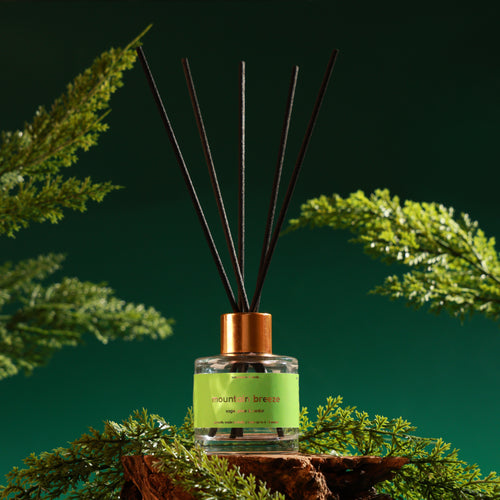 Passive capillary · reed₹849See it →
Zoning it properly: doors, volume and how many machines
Two rules decide the hardware, and both of them are about volume rather than floor area. A closed door is a boundary; an open plan is one volume. Four demonstration rooms with doors are four zones no matter how small they are, and a single machine cannot serve them however generous its rating — fragrance does not travel through a shut door. Conversely, a main floor of 2,500 sq ft that is genuinely open, at a standard ceiling height, is one volume and one machine's problem. Coverage is up to 1000 m³ per unit, roughly 2,000 to 3,000 sq ft at ordinary heights, and an experience centre is exactly the building where floor area misleads: a double-height display area or a void over a mezzanine consumes coverage that a square-foot figure conceals.
I will not publish a machine count as a formula, because there is not an honest one. The reasoning is what you need: establish the connected volume with the doors in the position they are actually in during trading, note where the ceilings rise, look at where the air-conditioning moves air and where it takes it away, and count the hours each zone is used. The number appears from that. Two more practical points for a route with several zones. Different intensities in different areas means a machine per area, each set independently — you cannot zone one machine into three levels. And placement matters more than power: put a unit into the airflow path rather than against it, and be careful of siting it next to a return that will pull the mist straight out again unless you are deliberately using the HVAC-return mount, which is a published mounting option and the way one unit distributes evenly across a whole open floor.
On the drawing, three lines. DC 12V / 1A, 5W at each mounting position — negligible as a load and therefore the thing most likely to be omitted, which becomes a first-fix problem rather than a snag. Under 38 dB, which is why a unit can sit inside a demonstration room rather than in the corridor outside it, and it matters in a theatre or bedroom demonstration where quiet is part of what is being shown. And refill access: a 400ml sealed tank runs about 90 or more days depending on intensity and hours, so each unit is reached roughly four times a year, and a return-mounted machine above a ceiling still has to be reachable by somebody on a step rather than by a ladder in a plant space. Specify the oil family in writing too — alcohol-free, water-free oils formulated for cold-air diffusion; thick undiluted essential oils are not recommended, because they load and eventually clog the fine nozzle.
What to specify, in order — and the honest gap
The shortlist for a centre with a route rather than a single room, ending with the two things I would not let a client assume.
| Specify | What it is | When it is the right answer | Price |
|---|---|---|---|
| 1. Vaayu, arrival zone ★ | Waterless cold-air nebuliser set to the highest level in the building — still quiet — placed slightly inside the entrance, out of the draught | Always first. This is the moment that pays for the scheme | ₹11,999 |
| 2. Vaayu, main floor | One per connected volume, up to 1000 m³ each, HVAC-return mounted where evenness across an open floor matters | Where the circulation and display areas form one open volume | ₹11,999 |
| 3. Hotel Collection 300ml | One accord for the whole centre — White Tea Serenity or Quiet Luxury for a technology brief | Always. The route varies by level, never by oil | ₹1,799 |
| 4. Sukoon | Ultrasonic water mist, 500ml, 270–320 sq ft — a different mechanism, and it adds humidity | A single small closed demonstration room where a Vaayu is over-specified. Keep it away from display electronics | ₹1,899 |
| 5. Aangan | HVAC nebulising, approximately 8,000–10,000 sq ft | A flagship centre well above what several Vaayu zones can sensibly manage | ₹25,999 |
| The honest gap: one machine cannot make three levels, and none of it is on your bus | Different intensities need a machine per zone, each set independently — a single unit cannot be zoned. And Vaayu has no Wi-Fi, voice assistant, hub, Matter, KNX, RS-232, dry contact or API, so the route is a set of independent schedules rather than a sequence your controller runs | Said before specifying, not discovered at commissioning | Stated, not stretched |
Versailles
The brief I am most often handed for an experience centre is a list of rooms with a fragrance beside each one, and I nearly always give it back with the same note: one accord, three levels. It reads as less ambitious and it produces a considerably better building, because the visitor is not experiencing your rooms as a list. They are walking a route, carrying the last room with them, and what they perceive at each step is the change rather than the absolute.
The place I would put the attention is the first ten seconds inside the door — and slightly inside, not at it, because a doorway is the most turbulent air in a building and most of what you release there simply leaves. That arrival moment is the only point on the whole route where the visitor's nose is genuinely un-adapted, which means it is the only point where a modest, restrained concentration does real work. Everything after it is a steady state that people stop perceiving within minutes, and no amount of intensity changes that arithmetic.
The room I am asked about most and recommend against most often is the home theatre. It is dark, it is sealed, it exchanges very little air, and people sit in it long enough for anything present to build. A cinema room that smells of nothing at all is a perfectly good cinema room, and being able to say so to a client is worth more than a sale of one more machine. Everything we compose is made in Pune, and a portion of every order supports girl-child education through Nanhi Kali.
Frequently asked questions
- What a premium experience centre should smell like — clean, dry, low and unchanging.
- The best fragrance for a luxury automation showroom — the register argument.
- Should it have a signature fragrance? — recognition across visits and branches.
- Making the showroom feel more luxurious — the ninety per cent that is not fragrance.
- Fresh, woody or hotel-like? and should it smell like a five-star hotel?
- How strong should it be? — the dose page.
- What customers should smell on entry — the arrival moment in detail.
- Choosing a signature scent for the brand — one accord, documented, held for years.
- Brand: the SOSA founder story.
SOSA Vaayu — facts verified August 2026: ₹11,999. Waterless cold-air nebulising diffuser; pressurised air shatters undiluted oil into a dry nano-mist, with no water, no dilution, no added humidity and no residue. Coverage up to 1000 m³, approximately 2,000–3,000 sq ft at standard ceiling height, measured as connected volume rather than floor area. Control: Bluetooth app plus onboard buttons, run windows of 1h / 4h / 8h / 24h, day selection, adjustable mist intensity, auto-stop and key-lock. SOSA publishes no Wi-Fi, Alexa, Google Assistant, Matter, Zigbee, Z-Wave, KNX, Crestron, Control4, RS-232, dry-contact or API integration of any kind, and Vaayu cannot be addressed by, or included in a scene on, any home-automation control system. Mounting: freestanding, wall-mounted or into an HVAC return. Power DC 12V / 1A, 5W at the mounting position. Under 38 dB. 400ml sealed, residue-free, refillable tank lasting up to about 90+ days depending on intensity and scheduled hours. CE, RoHS and SGS certified. Black and white finishes. Oils must be alcohol-free, water-free fragrance oils formulated for cold-air diffusion, such as the SOSA Hotel Collection (100ml ₹999 · 300ml ₹1,799 · pack of seven ₹1,799); thick undiluted essential oils are not recommended as they clog the fine nozzle. Above Vaayu's range: Aangan ₹25,999 (~8,000–10,000 sq ft) and Meenar ₹38,500 (12,000–18,000 sq ft). Below it, on a different mechanism: Sukoon ₹1,899 ultrasonic (500ml, 270–320 sq ft, 16–18h on low, three 15ml scents included) and Boond ₹899 (up to about 150 sq ft); Megh ₹3,499 has a six-litre tank and about a hundred hours of runtime but covers only about 215 sq ft and is never a coverage upgrade. SOSA reed diffusers are alcohol-free, phthalate-free, paraben-free, IFRA-compliant and 0 ppm formaldehyde, with six fibre reeds in a refillable glass bottle on a heat-stable CCT carrier, composed in Pune. Reed oil and the water-based Hotel Collection are separate products and are not interchangeable, and there is no hotel-inspired reed diffuser. A scent machine adds fragrance; it does not remove an existing odour, clean or purify air, and SOSA makes no health or air-quality claim. SOSA publishes no dealer programme, reseller margin, trade price, territory, minimum order, lead time, installation charge or maintenance contract; commercial enquiries are welcome at https://sosahomeandbody.com/pages/contact. Free shipping above ₹499. A portion of every order supports girl-child education through Nanhi Kali. SOSA is an independent Indian fragrance house; the Hotel Collection scents are SOSA's own interpretations inspired by the world's finest hotels, and SOSA is not affiliated with or endorsed by any hotel brand or any home-automation manufacturer. Prices subject to change — see the live product pages.