

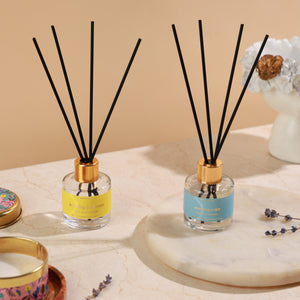



The catch: three reeds holds roughly 75 sq ft closed and still. In a 150 sq ft living room it is not a soft version of the result — it is no result.
The decision rule: run three reeds in rooms under about 75–80 sq ft and six in rooms approaching 150. Between the two, test it — the doorway test below takes forty-eight hours and settles it for good.
2. But it is only value if three reeds registers in that room. Coverage falls roughly in proportion to reed count. Six reeds holds a closed, still room of up to about 150 sq ft; three reeds holds around 75. Run three reeds in a 150 sq ft living room and you do not get a softer version of the result — you get a room that smells of nothing, at ₹50 a week, for twenty-five weeks. That is the most expensive outcome on this page.
3. So the honest rule is a size rule. Under about 75–80 sq ft, run three. A small bathroom, a study, a box bedroom, a corner of a 1RK. Approaching 150 sq ft, run six and accept sixteen weeks. Between roughly 80 and 130 sq ft, four or five reeds is the sensible landing point, and four is where most Indian bedrooms end up.
4. Neither setting is wrong, because they are different products. Six reeds buys presence — the room states itself when somebody walks in. Three reeds buys continuity — the room is quietly consistent for six months and you think about it twice a year instead of three times. If you have guests often, presence is what you are paying for. If the room is yours alone and you adapt to it in twenty minutes anyway, continuity is the better purchase and it happens to be cheaper.
5. And the setting is not fixed for the life of the bottle. This is the option most people never use. Run six reeds for the first fortnight, when the scent is new and you want the room to declare itself, then pull two or three out and let the same bottle coast for months. You get the arrival and most of the weeks. Reed count is a dial you can turn on any given Tuesday, not a decision you make once at the till.
Made in India, composed by an ISIPCA Versailles-trained perfumer — and a portion of every order supports girl-child education through Nanhi Kali.
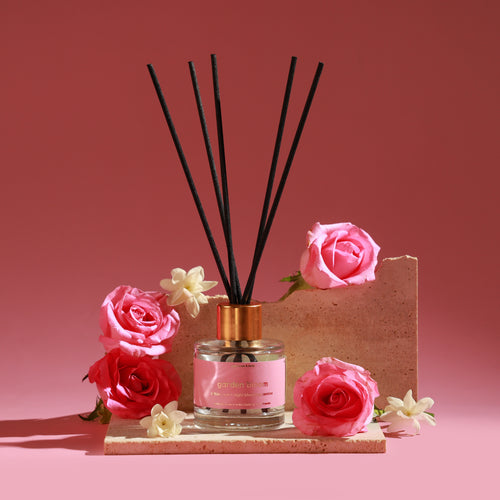
Why the dial moves both numbers at once
A reed diffuser is a passive evaporative system, so the exposed fibre above the neck is simultaneously the volume control and the fuel gauge. Add reeds and you add evaporating surface: the room gets stronger and the bottle gets shorter, in the same movement. Remove reeds and you get the mirror image. There is no setting that gives you more presence and more weeks at once, and any comparison of "value" between reed counts has to hold that in view, because the two settings are not the same product at different prices. They are different products from the same bottle. Six reeds sells you a room that announces itself sixteen times a week and then needs replacing. Three reeds sells you a room that is quietly consistent for half a year.
The part people miss is that coverage moves with the dial as well as duration. The published figure — up to about 150 sq ft — is a six-reed figure in a closed, still room of standard ceiling height. Take reeds out and that number falls with them, roughly in proportion: five reeds holds something like 125 sq ft, four around 100, three around 75. This is why the value calculation flips depending on the room. In a 40 sq ft bathroom, three reeds is comfortably above what the space needs, so the twenty-five weeks at ₹50 is pure gain and six reeds would simply be loud and expensive. In a 150 sq ft living room, three reeds sits below the threshold at which anybody detects anything, and a cheaper price per week for a result nobody perceives is not value at all — it is the whole ₹1,249 wasted, slowly.
Three settings, priced
 Three reeds₹50 a weekA 130ml on three reeds runs towards twenty-five weeks — nearly six months from one ₹1,249 bottle, or about ₹2,598 of liquid across a full year in that room. It is the correct setting for small closed spaces: a bathroom of 30–50 sq ft, a study, a box room, a bedside corner. What you get is continuity rather than presence. The room does not announce itself; it simply never smells of nothing, which in a bathroom is exactly the brief. The failure mode is using this setting in a room too big for it, where it produces twenty-five weeks of technically-scented air that no human being registers.
Sizing by space — which setting is better value where
The cost column is the annual liquid cost of running that room continuously at the stated setting, using a 130ml at ₹1,249 across fifty-two weeks. One row recommends spending nothing.
| Space | What it needs | How many | Cost |
|---|---|---|---|
| Bathroom, 30–50 sq ft ★ | Three reeds, comfortably. The space is well inside what three reeds holds, so the cheaper setting is also the better one | Three reeds | about ₹2,598 a year |
| Study or box bedroom, 60–80 sq ft | Three reeds, tested. This is the boundary — run the doorway test before you settle | Three reeds | about ₹2,598 a year |
| Bedroom, 100–130 sq ft, door shut | Four or five. Three will read thin at this size and six is a hall setting you will adapt to anyway | Four or five reeds | ₹3,093–₹3,608 a year |
| Living room or hall, 130–150 sq ft | Six. Three reeds here is not a soft version of the result, it is no result at ₹50 a week | Six reeds | about ₹4,059 a year |
| A room over about 200 sq ft, or an open-plan run | Past what any reed count holds — two positions, or a Sukoon at ₹1,899 with Hotel Collection from ₹299 | Two bottles or one machine | ₹2,498 or ₹1,899 + ₹299 |
| A landing, a corridor, or a room used less than an hour a week | Nothing. Three reeds is not a cheap way to scent a space that does not repay any reeds at all | None | ₹0 |
| A note on all of the above: every coverage figure here is a steady-state number for a closed room with still air and a standard ceiling, and the reed-count scaling is a working rule rather than a laboratory measurement. Heat and airflow both raise evaporation, so the same three reeds will run shorter in a hot hallway than in an air-conditioned bedroom. | |||
One room · the unitFrom ₹749Shop → 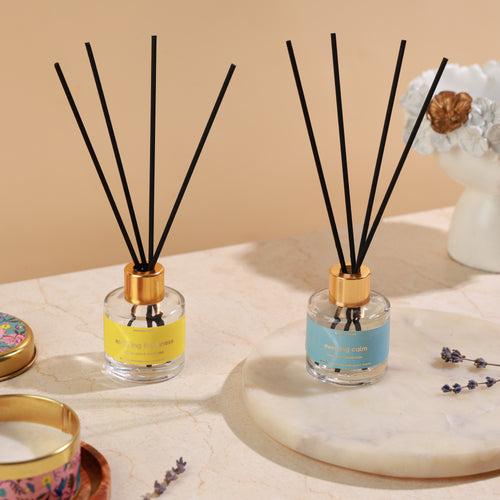 Two rooms · better value₹1,498Shop →
  Large room · a switch₹1,899Shop →
The forty-eight-hour test that settles it
Set three reeds and wait two full days. Fibre has to wick along its entire exposed length before it throws properly, and a judgement made on day one is worthless — this is the single commonest reason people conclude a low reed count "does not work" and go straight back to six. Put three reeds in, place the bottle somewhere with gentle air movement rather than in a still corner, and do not smell it deliberately for forty-eight hours. Deliberate sniffing is not the test. Nobody in your home is going to walk in and inhale at the bottle; they are going to walk past it thinking about something else, and that is the standard it has to meet.
Then leave the flat for half an hour and judge the first breath. Olfactory adaptation is essentially complete within about twenty minutes, so you cannot assess a room you are sitting in — you are systematically the worst judge of your own home, which is exactly why people over-buy. Go out, come back, and count. If you register the fragrance within the first two steps and without looking for it, three reeds clears the threshold in that room and you have just bought nine extra weeks for nothing. If you have to stop, breathe in and hunt for the bottle, it does not clear, and you should go to five or six and pay the ₹78 a week without regret. The second and better version of this test is a visitor: ask them where they think it is coming from, not whether they can smell it.
And use the answer to set the whole house, not just one room. Once you know that three reeds clears in your bathroom and does not clear in your living room, you have a rule that applies to every bottle you ever buy: reed count follows room size, and the cost per week follows the reed count. Write the setting on a bit of tape under each bottle if you have several, because after a month nobody remembers which room is running what. Fit fresh reeds whenever you refill — clogged fibre wicks slowly and is the commonest reason a setting that used to clear the threshold quietly stops doing so.
What to buy
The reed-count decision costs nothing — it is made with the bottle you already own. This table is for the purchase itself, and for the point at which reeds stop being the right tool.
| Buy | What it covers | Lasts | Price |
|---|---|---|---|
| One 50ml | A single reed diffuser — a bathroom or box room on three reeds, where a 130ml would run past six months | 6–8 weeks | from ₹749 |
| One 130ml ★ | The value size — any room you run continuously — sixteen weeks on six reeds, twenty-five on three | 14–18 weeks | from ₹1,249 |
| The duo | Day & Night duo — two rooms at two different settings — a hall on six and a bathroom on three | 6–8 weeks each | ₹1,498 |
| Sukoon | 500ml ultrasonic — a room past about 200 sq ft, where no reed count reaches and a switch is the honest answer | Runs when you switch it on | ₹1,899 |
| 300ml refill | The running cost — the running cost, whichever setting you land on — ₹8.00 a millilitre against ₹9.61 in a new bottle | Roughly 2 × 130ml fills | ₹2,399 |
Versailles
I would rather sell you fewer bottles that you run properly than more bottles you run badly, so let me be plain about which of these two settings I actually recommend. In most Indian flats, most rooms should be on three or four reeds, and one room — the one you arrive into — should be on six. That single arrangement is cheaper than running everything at full and it produces a better home, because presence at the front door is what makes a house read as scented.
The mistake I want you to avoid is the other one, and it is the reason this page exists. Somebody reads that three reeds is cheaper per week, puts three reeds in a 150 sq ft living room, notices nothing for four weeks, and concludes that reed diffusers are a waste of money. They are not — that room simply needed six. Under-dosing a large room does not give you a quieter result. It gives you no result, and you still pay for the liquid, which is the worst value available anywhere in this category.
So use the test. Forty-eight hours, then out of the flat for half an hour, then judge the first breath from the doorway. It costs nothing, it takes two days, and it tells you something about your own room that no coverage figure of mine can. And if the answer is six reeds, run six reeds and stop feeling badly about it — ₹78 a week for a room that greets people is not extravagance. A portion of every order supports girl-child education through Nanhi Kali.
Frequently asked questions
- What one extra reed costs over a bottle's life — about ₹150, in rupees.
- Two bottles at half strength or one at full? — the same trade, two rooms.
- How big a room can a 130ml handle? — the number and its conditions.
- The complete sizing and quantity guide — every home type, three builds.
- Brand: the SOSA founder story.
SOSA products & prices (verified August 2026): Hotel Collection water-based ultrasonic diffuser fragrance 15ml ₹299 · 100ml ₹999 · 300ml ₹1,799 · Pack of 7 (15ml, all fragrances) ₹1,799; refills 100ml from ₹999. Seven scents: The Ritz-Carlton-inspired (white tea · bergamot · cedar), Westin-inspired (white tea · aloe · cedar), 1 Hotels-inspired (cedarwood · vetiver · green leaves), The St. Regis-inspired (amber · violet · woods), Shangri-La-inspired (jasmine · green tea · white tea), Four Seasons-inspired (citrus · floral · sandalwood), W Hotels-inspired (citrus · pepper · amber). Diffusers: Boond 300ml ₹899 · Sukoon 500ml ₹1,899 · Megh 6L ₹3,499. Water-based, phthalate-free, composed to IFRA standards for home diffusion; 3–6 drops per tank. Made in India, Pune. The Hotel Collection scents are SOSA's own interpretations inspired by the world's finest hotels; all hotel names are trademarks of their respective owners and are used only to describe the scent style — SOSA is an independent Indian fragrance house, not affiliated with or endorsed by any hotel brand. Prices and availability subject to change — see the live product pages.