


No to the accord, most of the time: the hotel category has drifted towards warm amber, sweet balsam and heavy tea — compositions built to lower a guest's heart rate at nine in the evening. On a demonstration floor at eleven in the morning that reads as sleepy, and it quietly softens a technical proposition.
What to specify instead: the same delivery, a dry accord. Clean-fresh — white tea with a bergamot or lemon lift over cedar — or dry woody — cedar, sage, dry resin. In the SOSA Hotel Collection that means White Tea Serenity or Quiet Luxury, ₹1,799 for 300ml, through a Vaayu at ₹11,999.
Two honest limits: our Hotel Collection scents are SOSA's own interpretations inspired by the world's finest hotels — SOSA is an independent Indian fragrance house and is not affiliated with, endorsed by or a supplier to any hotel brand. And Vaayu automates itself: Bluetooth app and onboard buttons, with no Wi-Fi, Alexa, Google Assistant, Matter, Zigbee, Z-Wave, KNX, Crestron, Control4, RS-232, dry contact or API.
2. Take the discipline, which is the part nobody copies. The reason a good hotel smells the same on your third visit as on your first is not the oil. It is that somebody wrote the setting down, mounted the unit where guests cannot reach it, and refused every subsequent request to make it stronger. Vaayu's key-lock exists for exactly this: staff and clients cannot change the settings. That single feature is worth more to a showroom than any note in any bottle.
3. Question the accord, because the briefs are opposite. Hotel compositions are written for repose — arrival, rest, the end of a long day — which is why the category leans warm, soft and slightly sweet. Your floor is written for capability: control, precision, things happening exactly when they were told to. Put a lounge accord under that pitch and the room makes two arguments at once. The visitor will not notice they are reconciling them. They will simply find the demonstration slightly less convincing than it should have been.
4. Keep the delivery, change the direction. The two directions that carry a technical proposition are clean-fresh — white tea with a bergamot or lemon lift over a cedar floor — and dry woody — cedar with sage, pine or a dry resin. Both read as made, dry and deliberate. Both hold a level across a ten-hour trading day instead of thickening. In the Hotel Collection, White Tea Serenity (white tea, aloe, cedar) and Quiet Luxury (white tea, bergamot, cedar) are the two accords nearest this brief.
5. And halve the dose you were imagining. A hotel guest lives inside the scent for two days and adapts to it within the first ten minutes, so the house level is set for somebody who has stopped noticing. Your visitor walks in from the street with a completely un-adapted nose, stays forty minutes and never adapts at all. The same concentration that reads as elegant to a resident guest reads as strong to an arriving buyer. Set it lower, and lock it there.
SOSA is an independent Indian fragrance house; the Hotel Collection scents are our own interpretations inspired by the world's finest hotels, with no affiliation to any hotel brand. Free shipping above ₹499, and a portion of every order supports girl-child education through Nanhi Kali.

The split, in three parts: what to borrow, what to keep, what to leave behind
Hotel scenting is not one thing. It is a mechanism, a management discipline and a composition, and they arrived together so they are usually discussed as though they were inseparable. They are not. Two of the three transfer to a smart-home showroom perfectly. The third is the one everybody buys first.
 Vaayu₹11,999There is a question guests almost never ask out loud: why can I never find the diffuser in a hotel? Usually because there is not one in the room to find. The fragrance has been introduced into the building's moving air rather than released from an object on a console, so there is no concentration gradient to walk up and no source to stand beside. Your nose is extremely good at following a gradient to its origin, and when there is no gradient the effect is strange and expensive-feeling: the smell becomes a property of the place rather than of a thing in the place. That is worth every rupee in a showroom, and it is purely a function of delivery. The physical consequences matter too. Undiluted oil shattered into a dry nano-mist means no water, no dilution, no added humidity and no residue — an ultrasonic machine throws a wet mist of oil-in-water, adds moisture and can leave a fine white mineral dust, none of which belongs near display electronics. The undiluted droplet also carries the whole composition rather than a wetted fraction of it, so the accord you specified is the accord that arrives.
Key-lockIncludedThis is the half of hotel practice that costs nothing and is almost never copied. The lobby you remember does not smell consistent because the oil is special. It smells consistent because the setting is written down, the machine is somewhere the front desk cannot reach, and every request to make it stronger has been declined for four years. Reproduce that and you have reproduced most of the effect. In practice it means three things. Fix the schedule to the hours the building is occupied — Vaayu offers 1h, 4h, 8h and 24h run windows plus a choice of days, which is enough to cover trading hours and stop on a Sunday. Fix the intensity once, with the right judge, and record it. Then use the key-lock, which exists precisely so that staff and clients cannot change the settings. Without it, the level in a showroom only ever travels in one direction, because the person holding the app is the person who has been in the room since opening and can no longer smell it.
Vaayu₹11,999There is a question guests almost never ask out loud: why can I never find the diffuser in a hotel? Usually because there is not one in the room to find. The fragrance has been introduced into the building's moving air rather than released from an object on a console, so there is no concentration gradient to walk up and no source to stand beside. Your nose is extremely good at following a gradient to its origin, and when there is no gradient the effect is strange and expensive-feeling: the smell becomes a property of the place rather than of a thing in the place. That is worth every rupee in a showroom, and it is purely a function of delivery. The physical consequences matter too. Undiluted oil shattered into a dry nano-mist means no water, no dilution, no added humidity and no residue — an ultrasonic machine throws a wet mist of oil-in-water, adds moisture and can leave a fine white mineral dust, none of which belongs near display electronics. The undiluted droplet also carries the whole composition rather than a wetted fraction of it, so the accord you specified is the accord that arrives.
Key-lockIncludedThis is the half of hotel practice that costs nothing and is almost never copied. The lobby you remember does not smell consistent because the oil is special. It smells consistent because the setting is written down, the machine is somewhere the front desk cannot reach, and every request to make it stronger has been declined for four years. Reproduce that and you have reproduced most of the effect. In practice it means three things. Fix the schedule to the hours the building is occupied — Vaayu offers 1h, 4h, 8h and 24h run windows plus a choice of days, which is enough to cover trading hours and stop on a Sunday. Fix the intensity once, with the right judge, and record it. Then use the key-lock, which exists precisely so that staff and clients cannot change the settings. Without it, the level in a showroom only ever travels in one direction, because the person holding the app is the person who has been in the room since opening and can no longer smell it.
 Mountain Breeze₹849Here is where the transfer breaks. A hotel accord has a job: take somebody who has been in transit since dawn, in an unfamiliar city, carrying a bag, and make the building feel like relief. That brief pushes a composition warm, soft, slightly sweet, faintly powdery — amber, balsam, heavy tea, soft woods — because those are the materials that read as enclosure and rest. It is very good work and it is aimed at a nervous system you are not addressing. Your visitor is not tired, is not staying, and did not come to relax. They came to be persuaded that a room can be commanded, and everything else in your space is already saying so: the neutral lighting, the hidden cabling, the demonstration that works first time. Smell is the one channel running continuously underneath all of it, and a warm lounge accord is quietly saying settle down while your salesperson is saying look what this does. Choose dry instead. Dry woody says material, made properly; clean-fresh says a public interior, well run. Both agree with the pitch rather than arguing with it.
Repose and capability: two briefs, one piece of hardware
It is worth spelling out what "the brief" means, because it is the difference between choosing a scent and specifying one. Every commercial fragrance is written towards a behaviour. A hotel wants arrival to feel like the end of something. A spa wants the shoulders down. A bakery wants you hungry. A smart-home showroom wants a specific and unusual thing: it wants the visitor to believe that this space is under control, and to want that for their own house. Everything persuasive in the room supports that claim — and the air can either agree with it or work against it for the entire forty minutes, without anybody in the room being able to name what is wrong.
There is a physical argument as well, and it belongs to the building rather than to perfumery. An automation showroom is typically sealed, heavily air-conditioned, hard-surfaced, open for ten hours and staffed by people who never leave it. That combination is the worst possible environment for a warm accord. Large, slow molecules deposit onto seating, curtains and acoustic panels and re-release for hours, so the concentration ratchets rather than plateaus — the room at six in the evening is not the room at eleven in the morning. Meanwhile the only people who might detect the ratchet have been adapted since mid-morning. Dry and light materials do not accumulate the same way; they clear with the air changes. The same nominal intensity is far more forgiving in a tea-and-cedar direction than in an amber-and-vanilla one, which is why the hotel accord fails twice: once on message, once on physics.
One thing the hotel comparison cannot help with, and I would rather say it before it costs somebody money. Fragrance does not remove a smell. If a new showroom smells of cabling, adhesive, fresh MDF or packaging, no accord — hotel-inspired or otherwise — will cover it, because adding a pleasant odour to an unpleasant one produces a mixture rather than a cancellation, and the mixture is usually worse than either half. Those materials off-gas hardest when new, and what fixes them is time, air changes and unpacking away from the display floor. Get the cartons out of the customer volume, ventilate the store room, check the fresh-air intake is doing something, and scent afterwards. Source, then ventilation, then fragrance — in that order, or not at all. SOSA sells no air purifier and makes no health, air-quality or VOC claim of any kind.
Hotel practice against showroom practice, line by line
The audit I would run if you handed me a hotel scenting specification and asked whether it could be dropped into an automation showroom. Three verdicts only: borrow it, adapt it, or refuse it.
| Element of hotel practice | What it is doing there | In a smart-home showroom | Verdict |
|---|---|---|---|
| Waterless cold-air nebulising | Undiluted oil, dry mist, no humidity, no residue, no findable source | Identical benefit, and safer around display electronics | Borrow |
| Delivery into moving air or an HVAC return | Evenness across a large connected volume | The same. This is the mechanical integration point | Borrow |
| A fixed, written setting and a locked machine | Consistency across years and across properties | Consistency across visits and across branches | Borrow |
| A schedule tied to occupancy | Lobby scented around the clock, guest floors on their own pattern | Tie it to trading hours instead — 1h / 4h / 8h / 24h windows and day selection | Adapt |
| The house level | Set for a guest who adapts in ten minutes and stays two days | Your visitor never adapts and stays forty minutes. Set it lower | Adapt |
| Different accords in spa, lobby and club floor | Distinct destinations, reached by lift, rarely in one breath | Your zones share corridors. One accord at varying intensity | Adapt |
| The warm lounge accord | Repose — slowing a tired traveller down on arrival | Works against a demonstration of capability, and thickens through a sealed day | Refuse |
Cold-air nebulising · Vaayu₹11,999See it →  Ultrasonic water mist · Sukoon₹1,899See it →
 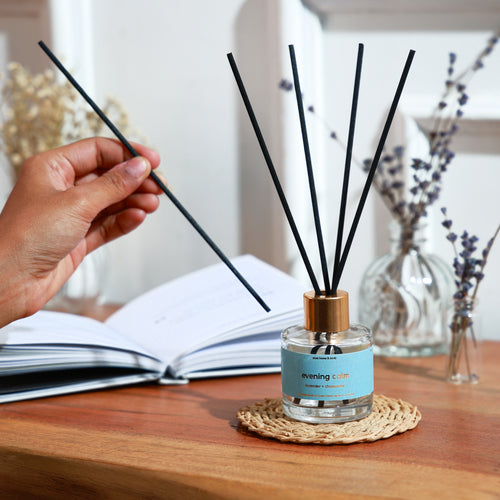 Passive capillary · reed₹799See it →
Dwell time, adaptation, and the reason the hotel level is wrong for you
The single most practical difference between the two buildings is how long anybody stays. A hotel guest arrives, notices the scent for perhaps two minutes, and then stops noticing it entirely — receptors adapt to a constant stimulus within minutes, the signal still arrives but the brain stops reporting it. That guest then lives inside the fragrance for two days. So the house level is calibrated for somebody who has already adapted, and it is a perfectly sensible calibration for that building. Your showroom has no adapted visitors. It has a continuous supply of un-adapted ones, each arriving from the street, each reaching the threshold at which they can perceive the fragrance far sooner than anybody inside expects, and each leaving before adaptation would have taken the edge off. Setting a showroom to a hotel's level is therefore not a small error of taste. It is a systematic overshoot, applied to every person who walks through the door.
There is a second, quieter question underneath this one that people are slightly embarrassed to ask: am I paying for the fragrance or for the machine? Mostly for the machine, and that is the honest answer to this whole page. A ₹849 reed and an ₹11,999 nebuliser can run closely related materials and produce entirely different rooms, because what the higher price buys is transport, evenness and control — not a better smell. That is exactly why the hotel comparison holds on the hardware and collapses on the bottle. The hotel effect was never in the oil. It was in a machine that put the oil everywhere at once, at a level low enough that nobody could find it, every day, for years.
And because integrators ask this in the same conversation: no, the schedule does not come from your control system. Vaayu automates itself. A Bluetooth app plus onboard buttons, 1h / 4h / 8h / 24h run windows, day selection, adjustable intensity, auto-stop and a key-lock — that is the complete control story. SOSA publishes no Wi-Fi, no Alexa, no Google Assistant, no Matter, no Zigbee, no Z-Wave, no KNX, no Crestron, no Control4, no RS-232, no dry contact and no API, so it cannot be addressed by a controller or dropped into a scene. It runs alongside the automation rather than inside it. For the client the lived outcome is the same — the scent is simply there on the right schedule, behaving like a correctly commissioned subsystem that never needs touching — but anybody planning a scene needs that fact before they specify, not at commissioning.
What to specify, in order — and the honest gap
The buying order for a showroom that wants hotel-grade delivery without a hotel's composition, followed by what we do not have and the situation in which I would send you to a cheaper machine.
| Buy | What it is | When it is the right answer | Price |
|---|---|---|---|
| 1. Vaayu ★ | The mechanism worth borrowing — waterless cold-air nebulising, up to 1000 m³, under 38 dB, DC 12V/1A 5W, HVAC-return capable, key-lock, CE / RoHS / SGS | Always. This is the part of hotel practice that transfers whole | ₹11,999 |
| 2. Hotel Collection 300ml | Alcohol-free, water-free cold-air oil — White Tea Serenity or Quiet Luxury are the two dry accords in the set | The showroom floor. Choose the dry two, not the warm five | ₹1,799 |
| 3. Hotel Collection pack of seven | Seven accords to evaluate before committing to one for years | Shortlisting. You will specify two of the seven and that is the point of buying all seven | ₹1,799 |
| 4. Mountain Breeze reed 50ml | Passive capillary — Himalayan pine, sage, Indian cedar, six fibre reeds, refillable glass | A cabin or a small meeting room. A fragrant zone, never a floor | ₹849 |
| 5. Aangan | HVAC nebulising, approximately 8,000–10,000 sq ft | A centre well above Vaayu's sensible ceiling, where a hotel-style whole-floor supply is the right shape | ₹25,999 |
| The honest gap: no hotel affiliation, and no hotel dose | The Hotel Collection is SOSA's own interpretation inspired by the world's finest hotels — we are an independent Indian fragrance house, not a supplier to, partner of or licensee of any hotel brand, and we will not claim otherwise. And most of the set is written for repose: if you specify the warm accords for a demonstration floor you have bought the wrong half of the collection | Said plainly rather than stretched to fit | Said, not sold |
Versailles
We compose a collection inspired by the world's finest hotels, so I am hardly a neutral witness here, and I would rather be useful than flattering about it. Two of those seven accords belong on an automation floor and five of them do not. The five are not failures; they are successful answers to a brief you do not share. They were written to make somebody who has been awake since five in the morning feel that the building is going to look after them. Your visitor has not been awake since five, is not staying the night, and would quite like to be sharpened rather than soothed.
What genuinely impresses me about hotel scenting is not perfumery at all. It is the operational stubbornness. Somebody chose a level, wrote it on a sheet, put the machine where the front desk cannot reach it, and then said no — for years — to every well-meaning request to make it stronger for a wedding, a conference, a slow Tuesday. That refusal is the product. Everything people admire about how those buildings smell descends from it, and it is available to any showroom in India for the price of a key-lock and a piece of paper.
So my answer to the question in the title is: scent it the way a hotel does, and do not let it smell like one. Take the machine, take the schedule, take the discipline, and then choose your own accord against your own claim — dry, low, and agreeing with the hardware rather than softening it. We are an independent house in Pune with no affiliation to any hotel brand, and I would rather tell you which half of our own collection to leave on the shelf than sell you all seven. A portion of every order supports girl-child education through Nanhi Kali.
Frequently asked questions
- What a premium experience centre should smell like — why expensive means clean, dry, low and unchanging.
- Best fragrance for a luxury automation showroom — the register argument in principle.
- Should it have a signature fragrance? — recognition across visits and branches.
- Making the showroom feel more luxurious — the ninety per cent that is not fragrance.
- What suits a smart-living experience centre — the centre read as a route.
- Fresh, woody or hotel-like? — the three-way comparison, scored.
- How strong should it be? — lower than you think, and how to set it.
- What customers should smell on entry — the arrival moment and what it signals.
- Choosing a signature scent for the brand — the method, end to end.
- Brand: the SOSA founder story.
SOSA Vaayu — facts verified August 2026: ₹11,999. Waterless cold-air nebulising diffuser; pressurised air shatters undiluted oil into a dry nano-mist, with no water, no dilution, no added humidity and no residue. Coverage up to 1000 m³, approximately 2,000–3,000 sq ft at standard ceiling height, measured as connected volume rather than floor area. Control: Bluetooth app plus onboard buttons, run windows of 1h / 4h / 8h / 24h, day selection, adjustable mist intensity, auto-stop and key-lock. SOSA publishes no Wi-Fi, Alexa, Google Assistant, Matter, Zigbee, Z-Wave, KNX, Crestron, Control4, RS-232, dry-contact or API integration of any kind, and Vaayu cannot be addressed by, or included in a scene on, any home-automation control system or building management system. Mounting: freestanding, wall-mounted or into an HVAC return. Power DC 12V / 1A, 5W at the mounting position. Under 38 dB. 400ml sealed, residue-free, refillable tank lasting up to about 90+ days depending on intensity and scheduled hours. CE, RoHS and SGS certified. Black and white finishes. Oils must be alcohol-free, water-free fragrance oils formulated for cold-air diffusion, such as the SOSA Hotel Collection (15ml ₹299 as a refill only · 100ml ₹999 · 300ml ₹1,799 · pack of seven ₹1,799); thick undiluted essential oils are not recommended as they clog the fine nozzle. Above Vaayu's range: Aangan ₹25,999 (~8,000–10,000 sq ft) and Meenar ₹38,500 (12,000–18,000 sq ft). Below it, on a different mechanism: Sukoon ₹1,899 ultrasonic (270–320 sq ft, 500ml, three 15ml scents included) and Boond ₹899 (up to about 150 sq ft); Megh ₹3,499 has a six-litre tank and about a hundred hours of runtime but covers only about 215 sq ft and is never a coverage upgrade. SOSA reed diffusers — Evening Calm ₹799, Garden Bloom ₹799, Morning Freshness ₹749, Mountain Breeze ₹849, Fresh Brew ₹849 for 50ml — are alcohol-free, phthalate-free, paraben-free, IFRA-compliant and 0 ppm formaldehyde, with six fibre reeds in a refillable glass bottle on a heat-stable CCT carrier, composed in Pune. Reed oil and the water-free Hotel Collection are separate products and are not interchangeable, and there is no hotel-inspired reed diffuser. A scent machine adds fragrance; it does not remove an existing odour, cover a construction or packaging smell, clean or purify air, and SOSA makes no health or air-quality claim. SOSA publishes no dealer programme, reseller margin, trade price, territory, minimum order, lead time, installation charge or maintenance contract; commercial enquiries are welcome at https://sosahomeandbody.com/pages/contact. Free shipping above ₹499. A portion of every order supports girl-child education through Nanhi Kali. SOSA is an independent Indian fragrance house and is not affiliated with or endorsed by any hotel brand or any home-automation manufacturer. Prices subject to change — see the live product pages.