




Step two: ventilate before you fragrance, never over. Fragrance does not remove a smell — adding a pleasant odour to an unpleasant one gives a mixture, not a cancellation, and the mixture is often worse because the brain now tracks two things.
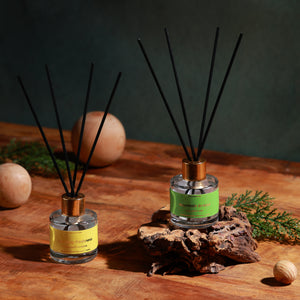
Step three, the mechanism: a reed diffuser is passive capillary diffusion — oil climbs six fibre reeds and evaporates, with no air moved at all. In heavy, still air that produces a short gradient: strong at the bottle, faint across the room. That is the design, not a fault, and it is genuinely why yours feels weak.
Step four, if you buy: in a flat that already feels damp, think twice before adding moisture. Sukoon ₹1,899 covers 270–320 sq ft but works by throwing oil diluted in water and adds humidity. Safar ₹3,999 is waterless cold-air nebulising of undiluted oil and adds none — but it is named and sold as a car and travel diffuser with no published room-coverage figure.
Never here: Megh ₹3,499. It covers only about 215 sq ft — less than the ₹1,899 Sukoon — and it is specifically a runtime and humidity machine. In your flat that is the wrong direction twice over.
2. Deal with indoor drying, because it is the most common cause and the least suspected. Clothes drying inside release several litres of water into the air over a day, and slow-drying fabric is exactly where a musty note comes from. That is a moisture question with an odour symptom, and fragrance layered onto it produces scented damp. Dry laundry where air actually moves, give it a fan if the air is still, and get it dry faster rather than covering the result. Older buildings tend to have fewer cross-vents and more rooms with a single opening, so airflow has to be created deliberately rather than assumed.
3. Then do the free diffuser adjustments, which fix a meaningful share of “weak” complaints without any purchase. Move the bottle out of a corner and into the path the room’s air already takes, but not into the entrance itself, which is the most turbulent point in a home and strips a bottle repeatedly. Use all six fibre reeds if the room is at the upper end of its size, and flip them every three to five days — flipping re-wets the dry upper length and restores projection without opening a new bottle. Close the door of the room you want scented for the hours you are in it.
4. Understand what humid air is doing before you conclude the oil is weak. Saturated air is a less willing destination for evaporating material, so emission slows; and it carries what does leave less readily, so the fragrance hangs close to the source. The result is a short, steep gradient rather than a faint one — strong at the bottle, quiet across the room. That is why a bottle you loved elsewhere can feel becalmed here, and it is not a fault in the composition.
5. Only now consider a machine — and choose one that does not add moisture if you can. A reed emits and does not transport. Any real upgrade has to supply air movement. The cheapest version is a fan on low, across the bottle rather than at it, and it costs nothing. The paid versions are Sukoon at ₹1,899, which covers 270–320 sq ft properly but throws oil diluted in water and adds humidity, and Safar at ₹3,999, which shatters undiluted oil into a dry mist and adds none — while being named and sold as a car and travel diffuser with no published room-coverage figure.
Alcohol-free, phthalate-free, paraben-free, IFRA-compliant, 0 ppm formaldehyde. Free shipping above ₹499, and a portion of every order supports girl-child education through Nanhi Kali.
Airflow and drying, before any purchase — and why I am spending a page on it
I sell fragrance for a living and I am going to be plain about its limits, because the alternative is taking money for a product that cannot do the job. Fragrance does not remove a smell. Adding a pleasant odour to an unpleasant one produces a mixture rather than a cancellation, and the mixture is frequently worse than either component, because your brain now has two things to track instead of one. Everything I make is designed for a room that is already clean and aired. A room that is not is a different project, and it is one that costs nothing but attention.
The commonest single cause in a flat that reads as stale is indoor drying, and almost nobody connects the two. Clothes drying inside release several litres of water into the air over the course of a day, and fabric that dries slowly is exactly the condition that produces a musty note. That is a moisture question with an odour symptom, and it is why the same flat can smell fine on a breezy day and heavy on a still one with a full rack in the passage. The practical answers are all about air rather than fragrance: dry where air moves, add a fan if the air is still, and shorten the drying time rather than covering the result. Kitchen and bathroom extraction matter for the same reason, and so does opening two openings rather than one, because air needs somewhere to leave as well as somewhere to enter.
Older buildings add their own character to this. Rooms often have a single opening rather than two, so there is no natural cross-flow to be had without deliberately creating one. Ceilings can be high, which is pleasant and means more air to move. Internal bathrooms and courtyard-facing rooms may have very little natural airflow at all. None of this is a fault to be fixed with a purchase — it is a description of how the air in your flat behaves, and it is worth knowing because it also tells you where fragrance will and will not travel later. I am describing airflow and drying here, nothing more: I am not making any claim about air quality or health, and I would be suspicious of any fragrance company that did.
 Evening Calm₹799The reason this card comes first is that it changes what “weak” means. If there is a persistent background note in the room, your nose is working against it the whole time, and a fragrance that would read as clearly present in a neutral room reads as inadequate in this one. The fix is subtraction rather than addition: get the air moving, get fabric drying faster, and let the background come down. Then the same bottle, unchanged, will read differently — and if it does not, you will at least know that what remains is genuinely a diffusion question and can spend accordingly.
 Morning Freshness₹749The second layer explains an experience everybody has had and nobody can account for: you air the flat properly in the morning and by midday it smells of last night again. Cooking aerosols condense onto curtains, upholstery and walls, and then re-release slowly for hours. Ventilation clears the airborne fraction in minutes; the deposited fraction comes back on its own timetable. This is precisely why fragrance follows ventilation rather than replacing it, and why a bigger diffuser is money spent on the wrong term. Extraction while cooking, soft furnishings washed on their own schedule, and then fragrance for a room that is already clean.
 Sukoon₹1,899Once the first two layers are dealt with, the third is real and I will not minimise it. A reed diffuser emits and does not transport — the oil climbs six wetted fibre reeds and evaporates, and from there it is entirely up to the room’s own air to carry anything anywhere. Saturated, still air is the condition in which that borrowed transport delivers least. So what you have is not a faint fragrance but a short one: strong where you stand next to it, quiet three metres away. Adding reeds raises the peak and does not lengthen the reach. If you have already gone to six and flipped them, you have correctly exhausted that lever, and the honest next step is air movement rather than more oil.
Then the mechanism question — and the awkward fact about the obvious upgrade
Now that the room has been aired and the free levers pulled, the question becomes a good one. You want reach, reach comes from moved air, and only an active mechanism supplies it. There are two, and in your flat they are not equally suited. Ultrasonic water mist — a piezo plate vibrating a water-and-oil mixture into a visible wet mist — genuinely covers a room, and Sukoon at ₹1,899 is the best value in the range for that: 500ml, 270–320 sq ft, 16–18 hours on low, three 15ml Hotel Collection scents included. The awkward fact is that it works by putting water into the air, and you have written to me about a flat that already feels heavy. That is not a reason to rule it out — run it on low, in windows rather than continuously, with the door closed — but it is a reason to think about it rather than default to it.
And it is the reason I would name the machine you should specifically not buy. Megh at ₹3,499 looks like the upgrade because it is bigger and costs more: a six-litre tank and around a hundred hours of runtime. It covers only about 215 sq ft, which is less than the ₹1,899 Sukoon, and its two genuine strengths are long runtime and humidity output. In a humid Kolkata flat that is the wrong direction twice over, and it is the easiest product in our own range to misread. I would rather say so on our own page than let somebody find out at ₹3,499.
Which leaves waterless cold-air nebulising as the mechanism that actually suits the situation. Pressurised air shatters undiluted oil into a dry micro-mist: no water, no dilution, no heat, no added humidity, no white mineral dust. It is also why the same oil reads as more present from a nebuliser than from a water machine — the payload per droplet is neat oil rather than oil suspended in water. Safar at ₹3,999 is that mechanism at personal scale: 20ml of oil, a 2000 mAh Type-C battery giving up to 10 hours continuous or around 30 intermittent, three speeds, a 1, 2 or 3-hour auto-off timer, 6.9 cm across, fully cordless in use. Two things to know before paying: it is named and sold as a car perfume diffuser — SOSA’s own page also names handbag, desk, bedside and hotel room among its uses, so a bedside recommendation is legitimate — and SOSA publishes no room-coverage figure for it, so it is personal and small-space scenting rather than a room machine. It is also not set-and-forget: the timer stops at three hours and the battery needs recharging.
| Mechanism | How it works | Reach | What it adds to the air | Price |
|---|---|---|---|---|
| Free — airflow and drying ★ | Cross-ventilation, extraction, drying laundry where air moves, a fan on low across the bottle | Changes the background the fragrance sits on, and supplies genuine transport | Nothing. It takes things away, which is the point | ₹0 |
| Passive capillary — reed diffuser | Oil climbs six fibre reeds and evaporates. No power, no air moved | A fragrant zone around the bottle, shorter in heavy air than in dry | Nothing but fragrance. Silent, no water, no maintenance, ₹13–₹15 a day | ₹749–₹849 |
| Ultrasonic water mist — Sukoon | A piezo plate shatters oil diluted in water into a visible wet mist | Real coverage — 270–320 sq ft, 16–18 hours on low | Humidity, which is the thing to weigh here. Also refilling, dilution, possible white mineral dust in hard water | ₹1,899 |
| Waterless cold-air nebulising — Safar | Pressurised air shatters undiluted oil into a dry micro-mist | No published room-coverage figure — personal and small-space scenting | No water, no dilution, no added humidity, no white dust. The best climate fit on this table | ₹3,999 |
| Never here — Megh | 6L tank, around 100 hours of runtime | Only ~215 sq ft — less than the ₹1,899 Sukoon | Runtime and humidity. Both are the wrong direction in a flat that already feels heavy | ₹3,499 |
| The honest gap: the mechanism that suits a damp-feeling flat best is waterless, and SOSA’s only bedroom-scale waterless device is Safar — sold as a car and travel diffuser, with no published room coverage. Above it, Vaayu ₹11,999 is rated to 1000 m³, roughly 2,000–3,000 sq ft, and is the wrong purchase for one room. There is nothing in between, and I would rather you knew that before you started looking for it. | ||||
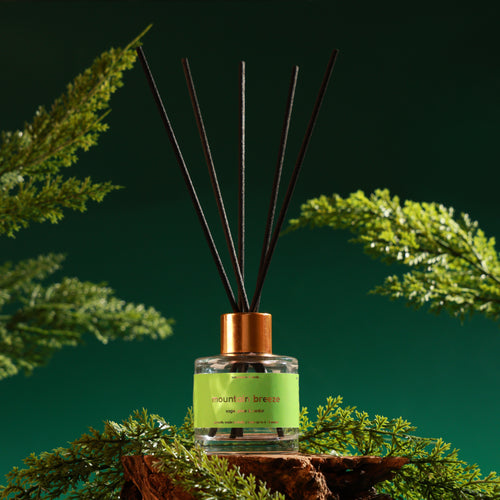
Passive · Mountain Breeze₹849Shop →  Active, with water · Sukoon₹1,899Shop →
 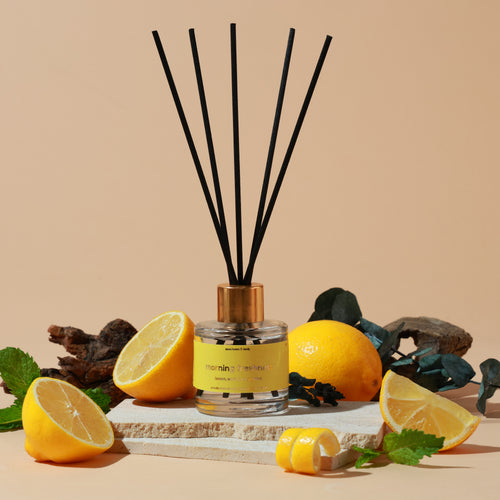 Bright · Morning Freshness₹749Shop →
Being fair to the reed, because it is not the thing that failed
Having explained at length why a reed reaches less far in heavy air, I want to be equally clear about what it does that nothing else on this page does at all. It is silent, which in a flat where you can hear the neighbours is not nothing. It uses no power, so an outage does not interrupt it. There is nothing to fill, nothing to charge, nothing to clean and no schedule to set. It cannot be left running by accident because it is always running, and it cannot be forgotten to be switched on for the same reason. It costs about ₹13 to ₹15 a day. And it looks like a glass object on a table rather than a small appliance, which is the honest reason a great many people would not put a machine in a bedroom at any price.
There is also a specific way to use it in a humid flat that works better than most people expect, and it follows directly from the physics rather than from optimism. Stop trying to fragrance the room and start placing the zone. A short gradient is only a problem if the bottle is on a shelf across the room from where you sit. Move it to the bedside, the reading chair or the desk — wherever you actually are for hours — and the same bottle at the same reed count puts you inside the fragrant part of the room all evening. You cannot move the room to the fragrance, so move the fragrance to the person. In an older flat with rooms that do not connect freely, that is frequently the whole answer, and it costs nothing.
And take the reading properly before you judge anything, because the most common cause of “it stopped working” is not the bottle. Olfactory receptors adapt to a constant, unchanging stimulus within minutes — the molecules keep arriving and the brain stops reporting them because nothing has changed. It is the reason you cannot smell your own home and can smell everybody else’s, and it is a large part of why a hotel is so noticeable: you arrive at it un-adapted. So leave the room for fifteen minutes and walk back in, or ask somebody arriving from outside where they first notice it. A visitor is a better instrument than you are, and they cost nothing at all.
What to do, in order — and the rung that does not exist
The first two rows are free and they are genuinely first, not a rhetorical throat-clearing before the products. The last row is the gap in our own range, said plainly, because in a flat where adding water is the thing to avoid, that gap is the reason there is no clean single answer.
| Do this | What it is | When it is the right answer | Price |
|---|---|---|---|
| 1. Airflow and drying ★ | Cross-ventilate with two openings rather than one, run kitchen and bathroom extraction, dry laundry where air moves and give it a fan if the air is still | First, always, and especially if the flat reads as stale rather than simply unscented. Fragrance does not remove a smell | ₹0 |
| 2. Place the zone where you sit | Move the reed out of the corner and off the threshold, into the path air already takes; all six fibre reeds if the room is at the top of its size; flip every 3–5 days; shut the door for occupied hours | Second, always. In an older flat with poor cross-flow this is frequently the entire answer, and it costs nothing | ₹0 |
| 3. Free air movement | A ceiling or table fan on its lowest speed, across the bottle rather than into it | The cheapest active diffusion there is, and the cleanest test of whether transport is what you are missing | ₹0 |
| 4. Real coverage, accepting water | Sukoon — ultrasonic water mist, 500ml, 270–320 sq ft, 16–18 hours on low, three 15ml Hotel Collection scents included. Run it on low, in windows | When the room is aired, the placement is right, and you still want even coverage. Accept dilution, refilling and added humidity | ₹1,899 |
| 5. Reach without adding moisture | Safar — waterless cold-air nebulising of undiluted oil, 20ml, 2000 mAh Type-C, up to 10 hours continuous or ~30 intermittent, 3 speeds, 1/2/3-hour auto-off, 6.9 cm. Named and sold as a car and travel diffuser, with bedside and hotel room among its stated uses | When adding humidity is the objection, which in this flat it reasonably is. No published room-coverage figure — personal scenting, and it needs recharging | ₹3,999 |
| Do not buy here: Megh | 6L tank, around 100 hours of runtime, about 215 sq ft of coverage | Less coverage than the ₹1,899 Sukoon, and it is specifically a runtime and humidity machine — the wrong direction twice over in a flat that feels heavy | ₹3,499 |
| The honest gap | No mid-sized waterless bedroom nebuliser exists at SOSA. Nothing sits between Safar and Vaayu ₹11,999, rated to 1000 m³ — roughly 2,000–3,000 sq ft — and the wrong purchase for one room | Said plainly, and it bites here: the situation argues for waterless and there is no room-sized waterless machine to point you at | — |
Versailles
This is the page in the series I was most careful with, because it is the one where the commercially convenient answer and the correct answer point in different directions. Somebody writes to say their diffuser feels weak in a humid flat, and the easy reply is to sell them a machine. Quite often the machine would not have fixed what they were describing, and they would have concluded that home fragrance is a swindle — which, done that way, it would have been.
So I say the unglamorous part first. If a room reads as closed, stale or heavy, that is the air rather than the fragrance, and a diffuser laid on top of it produces a mixture your brain will track as two separate things. Get the laundry drying where air moves. Open two things rather than one. Use the extraction you already have. Then come back and smell the same bottle in a room whose air has actually changed, and see whether the complaint is still there.
If it is, the mechanism explanation is real and I stand behind it: heavy air makes a passive source short rather than faint, and the only lever that lengthens it is moved air. But even then I would run the free version first — a fan on low, across the bottle — because it answers the question for nothing. And I would tell you honestly that the machine which best suits a flat like yours is the waterless kind, that our small waterless device is sold as a car diffuser with no published room coverage, and that the one above it is built for a whole floor. That is a gap in our range and it is ours to own. Everything is composed in Pune, and part of every order funds a girl’s classroom through Nanhi Kali.
Frequently asked questions
- Mumbai, without a humidifier — the same objection to water, stated as a rule.
- A small Mumbai apartment — where small volume offsets heavy air.
- Pune with the windows open all day — ventilation as a cost rather than a cure.
- A Pune 2BHK on the way home — scheduling rather than strength.
- A Bengaluru work-from-home bedroom — ten occupied hours change everything.
- A closed AC bedroom in Gurgaon — the easy case, where the answer is to use less.
- Delhi without candles or incense — what is left when both formats are ruled out.
- Humid Chennai, passive or active — the same heavy air, answered by air movement.
- A Hyderabad open-plan flat — the one city page where the large machine is right.
- Brand: the SOSA founder story.
Facts verified August 2026: Three diffusion mechanisms are described — passive capillary (reed diffusers), ultrasonic water mist (Boond ₹899, 300ml, up to ~150 sq ft, ~6 hours, USB, night light; Sukoon ₹1,899, 500ml, 270–320 sq ft, 16–18 hours on low, three 15ml Hotel Collection scents included; Megh ₹3,499, 6L tank, ~100 hours runtime, ~215 sq ft, which is less coverage than Sukoon and never a coverage upgrade) and waterless cold-air nebulising (Safar ₹3,999, 20ml bottle, 2000 mAh Type-C battery, up to 10 hours continuous or around 30 hours intermittent, 3 speeds, 1/2/3-hour auto-off timer, 6.9 cm, named and sold as a car and travel diffuser with car, handbag, desk, bedside and hotel room among its stated uses, no published room-coverage figure; Vaayu ₹11,999, coverage up to 1000 m³ or roughly 2,000–3,000 sq ft, 400ml refillable tank lasting up to about 90+ days, Bluetooth app and onboard buttons, 1h/4h/8h/24h run windows, adjustable intensity, key-lock, under 38 dB, freestanding or wall/HVAC mount, 5W, CE, RoHS, SGS). SOSA reed diffusers: five scents, 50ml ₹749–₹849 lasting 6–8 weeks and suiting rooms up to ~150 sq ft, 130ml ₹1,249–₹1,349 lasting 14–18 weeks and suiting above 150 sq ft, six fibre reeds included and flipped every 3–5 days, six reeds for full projection and three for a soft bedside level, about ₹13–₹15 a day, heat-stable CCT carrier rather than DPG, alcohol-free, phthalate-free, paraben-free, IFRA-compliant, 0 ppm formaldehyde, refillable glass bottle, climate-tested at 45°C and 85% RH, composed in Pune. Duos are two 50ml bottles at ₹1,498–₹1,598; 130ml duos ₹2,498–₹2,598; refills 300ml ₹2,399 and 500ml ₹3,499, oil only and never a first purchase. SOSA strength scale: Evening Calm 8.9, Garden Bloom 8.9, Morning Freshness 9.0, Mountain Breeze 9.4, Fresh Brew 9.5. Hotel Collection fragrance oils are water-based and ultrasonic-only at 15ml ₹299 (a refill), 100ml ₹999, 300ml ₹1,799 and a pack of seven at ₹1,799; they cannot be used in reed diffusers and reed oil cannot be used in ultrasonic machines, so no hotel-inspired reed diffuser exists. Free shipping above ₹499. A portion of every order supports girl-child education through Nanhi Kali. SOSA is an independent Indian fragrance house; the Hotel Collection scents referenced here are SOSA’s own interpretations inspired by the world’s finest hotels, and SOSA is not affiliated with, endorsed by or a supplier to any hotel brand. Prices subject to change — see the live product pages.