



New and compact: small volumes, 0.2–0.5 air changes an hour, open plan, off-gassing while new. Answer — four reeds, one well-placed point, a lighter blend, and ventilation before anything.
Both: reeds hold the rooms that stay closed; a machine handles the one big open room.
2. Then account for how much air each building loses. Old buildings leak: timber windows, door-top ventilators, gaps, open stair cores. That gives them a higher background air-change rate even with everything shut, which is healthy and comfortable and is also a continuous drain on fragrance. A modern tower is sealed and sits near 0.2 to 0.5 air changes an hour when closed, which is why it feels stuffy and why fragrance in it lingers for hours. The old flat is a leaky bucket; the new one is a sealed jar.
3. Then look at what the walls do. Lime plaster, solid brick, stone and old timber absorb odour and moisture and release them slowly, so an old building has a background note of its own that no cleaning removes. Concrete, gypsum, laminate and PU finishes absorb almost nothing, so a new flat smells of its contents rather than its structure — most obviously the off-gassing of new board, adhesive, paint and foam in the first months.
4. Then look at the plan. Old apartments are usually a set of separate rooms off a passage, with doors. That lets you scent room by room, differently, without the scents meeting. Modern compact flats are usually open plan, so the living room, kitchen and entrance share one body of air — you get one fragrance for the whole shared space whether you planned it or not, and any cooking smell shares it too.
5. So the dosage inverts. Old and large: all six reeds, two sources in a big room, concentrated in the zones people use — entrance, seating, bedroom — rather than spread evenly. New and compact: four reeds, one good position, a lighter blend, and the discipline to ventilate before adding anything at all. The mistake in an old flat is under-dosing. The mistake in a new one is over-dosing, and it is the more common of the two.
Made in India, composed by an ISIPCA Versailles-trained perfumer — and a portion of every order supports girl-child education through Nanhi Kali.
Why the two buildings fail in opposite ways
Every complaint about home fragrance comes down to one of two failures: not enough of it reaches you, or too much of it stays. Buildings sort themselves neatly onto one side or the other. An old, large, leaky apartment is a not-enough-reaches-you building. Big volumes, higher background air change, absorbent surfaces that take some of the fragrance out of circulation, and a plan that spreads people across a lot of floor area. A modern, compact, sealed flat is a too-much-stays building. Small volumes, very low air change, non-absorbent surfaces, and an open plan that delivers whatever you put in the living room to the kitchen and the bedroom door as well.
Knowing which one you live in reorders your priorities completely. In the old flat, ventilation is rarely your problem — the building does a lot of it for you — so the work is in dosage, placement and zoning, and in dealing with the moisture that old masonry is prone to. In the new flat, dosage is rarely your problem — a small sealed room holds scent effortlessly — so the work is almost entirely in ventilation: running the extracts, opening two sides for ten minutes twice a day, and getting the off-gassing out during the first months. Most people apply the wrong half of this advice to their own home, because they carried a habit over from where they used to live. The person who moved from a Dadar chawl-era flat into a Thane tower keeps buying more fragrance than the new flat needs; the person who moved the other way cannot understand why their diffuser vanished.
The two strategies, side by side
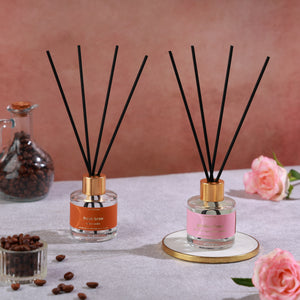
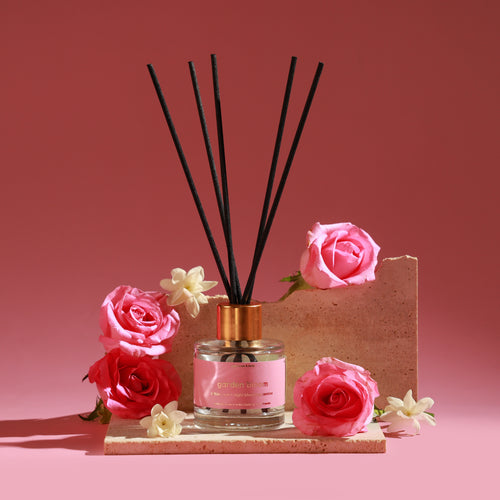
 Six reeds, two points130ml ₹1,249Do not try to scent the whole apartment evenly — it is too much air and it leaks. Pick the three places that matter and make each of them good: the entrance, where a visitor's first impression happens and where a small sheltered lobby holds fragrance well; the seating area of the main room; and the bedroom, where the door is closed anyway. All six reeds in each bottle, at seated nose height, on internal walls, away from ventilators and the stair door. In a room over roughly 1,800 cubic feet, use two bottles at opposite ends rather than one in the middle. Two 50ml bottles at ₹749 in the right two places beat a single 130ml in the wrong one.
Symptom to cause: which building problem is yours?
Read the row that matches your complaint, then check which column of the strategy above you are in. The same symptom has different fixes in the two kinds of building.
| What you notice | Most likely cause | How to confirm it | What actually fixes it |
|---|---|---|---|
| Fragrance disappears within a metre of the bottle, in a big old room ★ | Volume plus background air leakage — a passive source spread too thin | Measure the room in cubic feet; over about 1,800 needs two sources | All six reeds, two bottles at opposite ends, at nose height on internal walls |
| Fragrance feels heavy everywhere in a small new flat | A sealed envelope holding everything, plus an open plan sharing one body of air | Step out for thirty minutes and judge the first breath back — not from the sofa | Reduce to four reeds or three; move the bottle to the entrance rather than the sofa |
| New flat smells slightly chemical underneath the fragrance | Off-gassing from board, adhesive, paint, foam and flooring in its first months | Open everything for a day; if it drops sharply and returns when shut, this is it | Ventilate hard twice daily, keep cabinets open, and wait it out; do not add more scent |
| Old flat has a permanent background note you cannot clean away | The structure itself — lime, brick, stone and old timber, plus decades of sorption | Notice whether it is present in an empty room with the furniture moved out | Work with it: choose a resinous or green blend that agrees rather than argues |
| Cooking smell reaches every room within minutes | An open plan sharing one air volume — common in compact new flats | Note how long after a tadka the bedroom picks it up | Chimney on before and after cooking, bedroom doors shut while cooking, ventilate after |
| Musty or earthy smell in an old flat, with a tide line or dark patches | Damp or mould in the structure — a health and building issue, not an odour | Torch the base of external walls and the ceiling corners behind furniture | Find the moisture source, repair it and remove the growth. Fragrance has no role here. |
| If none of these fit: work out the cubic feet of the room you care about most and count the air changes honestly — how many openings, how often, for how long. Those two numbers decide your dosage far more than the size of the flat or the price of the bottle. | |||
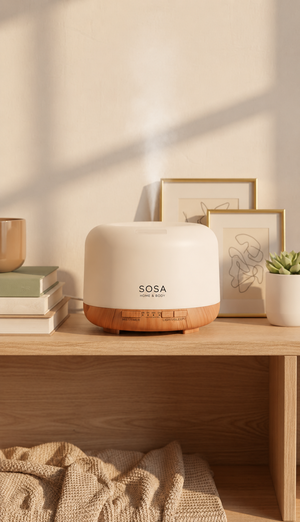
Reeds · always-on roomsFrom ₹749Shop → 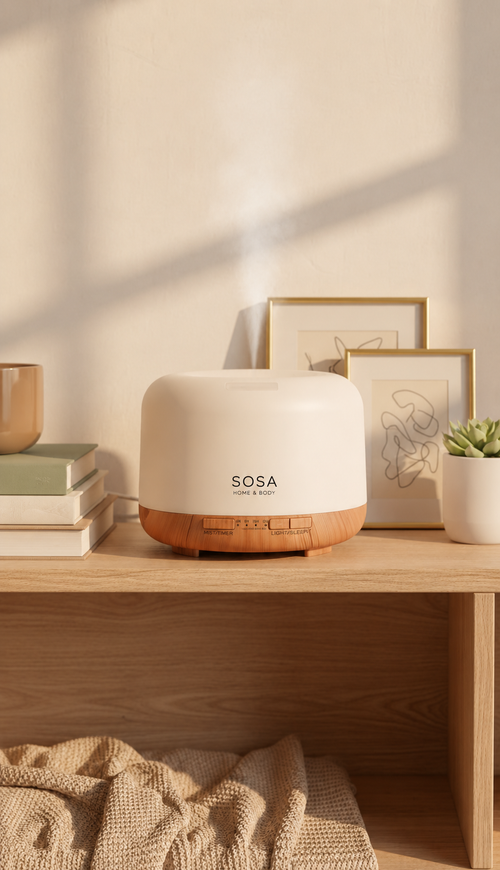 Sukoon · when you want a switch₹1,899Shop →
  Hotel Collection · the scentFrom ₹299Shop →
Dosage for each kind of home
In an old, large apartment, buy for coverage and place for zones. Entrance lobby: a 50ml at ₹749 with all six reeds on the console, at nose height — this is the highest-value single position in an old flat, because it is small, sheltered from the main airflow, and it is where the first impression is made. Main room: two bottles, one near the seating and one near the entrance to the room, both at six reeds; if the room is over about 1,800 cubic feet, treat one bottle as under-specified rather than as failing. Bedroom: one 130ml at ₹1,249 at four to six reeds depending on how much of the day the door stays shut. Bathroom: two or three reeds is plenty. If you want the main hall to genuinely fill for an evening, the Sukoon at ₹1,899 run for forty minutes before people arrive will do what no passive source can.
In a modern compact high-rise, ventilate first and then under-dose deliberately. Get the flat exchanging air properly — two openings on opposite sides for ten minutes twice a day, the bathroom fan run for fifteen or twenty minutes daily, the chimney on before and after cooking, cabinets left open while a new flat off-gasses. Then: one 50ml at ₹749 at four reeds near the entrance covers most of an open-plan 1BHK on its own. A second small bottle at two or three reeds in the bathroom. A bedroom bottle at three or four reeds only if the door is usually shut. Six reeds in a small sealed flat is almost always too much, and the person least able to judge that is you, because your nose adapts in about twenty minutes — leave for half an hour and judge the first breath back before adding anything.
And choose the blend for the building rather than for the season. An old flat has a real material background — dry lime, old timber, stone, sometimes a faint mineral coolness — and the blends that work are the ones that sit alongside it: Mountain Breeze is the natural choice for a hall or entrance, Evening Calm for a bedroom, Fresh Brew where you want warmth in a big old dining room. A new flat is a blank surface, so it takes clean and bright well: Morning Freshness or Garden Bloom both read modern without needing to overcome anything. Whichever you pick, remember that fragrance is additive — it puts pleasant molecules into a room and removes nothing at all. If an old flat has damp in a wall or a new flat is still off-gassing hard, you will get both smells at once, and the fragrance will take the blame for a problem it did not cause.
The order that works
The sequence is the same in both buildings; the content of each step is not. The purchase is still last, and it is a smaller purchase in a small new flat than most people expect.
| Step | What to do | When | Cost |
|---|---|---|---|
| 1. Remove the source | Old: check wall bases for damp and empty old built-in storage. New: air new furniture, keep cabinets open | Before anything else | ₹0 |
| 2. Move the air | Old: use the ventilators and tall windows you already have. New: ten minutes twice daily plus the extracts | Daily, five to ten minutes | ₹0 |
| 3. Deal with what holds it | Old: wash the large textiles — curtains in tall rooms are enormous. New: little to hold odour, so keep it simple | Weekly to monthly | ₹0 |
| 4. Then the always-on layer ★ | A SOSA reed diffuser — old and large: six reeds, two points per big room, zoned. New and compact: four reeds, one point near the entrance | 50ml 6-8 weeks · 130ml 14-18 | from ₹749 |
| 5. Or the on-demand layer | Sukoon with a Hotel Collection scent — the one big open room in either home — forty minutes before people arrive, then switch it off | Run it when you want it | ₹1,899 |
Versailles
The single most useful question I can ask a customer is not which scent they like. It is what their home is made of and how big the rooms are. The building sets the dosage. I have sent the same 130ml bottle to a 1970s three-bedroom flat in south Mumbai and to a compact new 1BHK in Pune, and given completely opposite advice with each — six reeds and a second bottle for one, four reeds and please do not add more for the other.
The old-flat mistake is under-dosing and then concluding that home fragrance does not work. It works; it is just being asked to fill two thousand cubic feet of leaky air from a surface the size of a few matchsticks. Stop trying to scent the whole apartment and build three good zones instead — entrance, seating, bedroom. That is what hotels do in big lobbies, and it reads as deliberate rather than as a struggle.
The new-flat mistake is over-dosing, and it is the more common one because the flat is small and everything you add stays. If you cannot smell your own diffuser, that is olfactory adaptation, not a weak bottle — step outside for half an hour and judge the first breath on the way back in. And in a brand-new flat, please ventilate before you scent. There is no fragrance in the world that improves a room which is still off-gassing; you simply get both smells, and mine will be the one you blame. A portion of every order funds a girl's classroom through Nanhi Kali.
Frequently asked questions
- Why the ground floor is damper — earth-coupled slabs and street-level wind.
- High ceilings and hard-to-notice fragrance — why square feet is the wrong unit.
- Why a new high-rise feels stuffy — sealed envelopes, off-gassing and the stack effect.
- Same diffuser, two rooms, two results — volume, airflow, placement and your own nose.
- Brand: the SOSA founder story.
SOSA products & prices (verified August 2026): Hotel Collection water-based ultrasonic diffuser fragrance 15ml ₹299 · 100ml ₹999 · 300ml ₹1,799 · Pack of 7 (15ml, all fragrances) ₹1,799; refills 100ml from ₹999. Seven scents: The Ritz-Carlton-inspired (white tea · bergamot · cedar), Westin-inspired (white tea · aloe · cedar), 1 Hotels-inspired (cedarwood · vetiver · green leaves), The St. Regis-inspired (amber · violet · woods), Shangri-La-inspired (jasmine · green tea · white tea), Four Seasons-inspired (citrus · floral · sandalwood), W Hotels-inspired (citrus · pepper · amber). Diffusers: Boond 300ml ₹899 · Sukoon 500ml ₹1,899 · Megh 6L ₹3,499. Water-based, phthalate-free, composed to IFRA standards for home diffusion; 3–6 drops per tank. Made in India, Pune. The Hotel Collection scents are SOSA's own interpretations inspired by the world's finest hotels; all hotel names are trademarks of their respective owners and are used only to describe the scent style — SOSA is an independent Indian fragrance house, not affiliated with or endorsed by any hotel brand. Prices and availability subject to change — see the live product pages.