


Why six and not eight: the count sets the evaporating surface, and the surface sets which parts of a composition leave first. Six is where these five hold their intended shape for the whole bottle.
When to deviate: three to four reeds for a nursery or a fragrance-sensitive household; eight to ten for a hosting week, accepting four to five weeks on a 50ml instead of six to eight.
Do not copy a count from another brand. A rattan diffuser's instructions assume rattan's wicking. These are fibre reeds.
2. Six is a dose, not a default. The number is part of the formula. Each of the five compositions is balanced so that at six reeds the fragrance reaching the room has the same proportions as the fragrance in the bottle — the lemon still reads as lemon, the vanilla still sits under the coffee. Change the count and you change the ratio, not merely the volume.
3. Give it a fortnight before you judge. A new bottle spikes for the first day or three, then settles over a week or two into the plateau that holds to the end of the bottle. The plateau is the product. Judge the count against the plateau.
4. Deviate downward for small, sealed or sensitive rooms. Three to four reeds in a nursery, a compact bedroom or a home where somebody dislikes fragrance. A legitimate configuration, not a compromise, and it will comfortably outlast the stated weeks.
5. Deviate upward only knowingly. Eight to ten reeds gives a fuller room and costs roughly proportional bottle life — nearer four to five weeks on a 50ml instead of six to eight.
6. Do not import a count from another brand. Rattan diffusers often ship eight or ten reeds because rattan's pores clog in humidity and several stop working. These are fibre, chosen for that reason, and six of them stay working.
Composed and handmade in small batches in Pune, and a portion of every order supports girl-child education through Nanhi Kali.

Part one — what it means to say a fragrance is dosed at six reeds
A perfumer working on a spray gets to choose the moment of delivery: the bottle is pressed, the fragrance leaves at once, and the composition unfolds in a sequence she controls. A reed diffuser has no moment. It is a slow, continuous, passive release through a fixed amount of fibre, and the amount of fibre is one of the ingredients. When I write a formula for this range, the count sits in my notes beside the materials — six reeds, a 50ml vessel, an ordinary Indian room, a weekly flip. Take one of those away and the formula is being asked to do something it was not written to do.
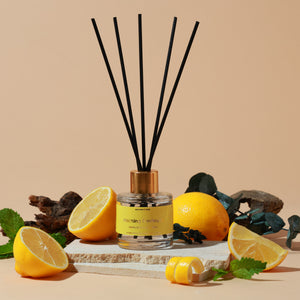
 Morning Freshness₹749 · 9.0/10A composition is a mixture of materials with very different volatilities. The Malabar lemon in Morning Freshness wants to leave quickly; the Nilgiri eucalyptus under it is steadier. Widen the evaporating surface by adding reeds and you do not scale everything up equally — you preferentially accelerate what was already eager to go. The room reads brighter for a fortnight, then noticeably flatter, because the light fraction has been spent early. Reduce the surface below six and the reverse happens: the heavy fraction dominates the little being delivered and the fragrance reads dull. Six is the count at which, across all five compositions, the room smells of the whole formula rather than a slice of it.
Part two — what six reeds is doing in each of the five compositions
The dose is the same across the range, but what it is protecting differs. In a bright citrus the count is defending the top notes from leaving too early; in a deep woody it is stopping the base from becoming the whole story. Here is the range read through that lens rather than through the strength scale, which is covered elsewhere in this cluster.
| Composition | What six reeds is protecting | What drops to four does to it | What a rise to nine does to it | 50ml |
|---|---|---|---|---|
| Morning Freshness ★ | Keeps Malabar lemon and peppermint present for the whole bottle rather than the first fortnight | Reads mainly of Nilgiri eucalyptus — clean, but the citrus goes missing | Sharper and colder for two weeks, then noticeably flat | ₹749 |
| Garden Bloom | Holds rose and jasmine in the same frame so neither leads alone | Softer and rosier; the jasmine recedes into the background | Jasmine arrives first and reads heady rather than rounded | ₹799 |
| Evening Calm | Keeps a deliberately quiet sleep fragrance from disappearing altogether | Still works — the one composition where four is a genuinely good setting | Loses its point; a loud lavender is not a restful one | ₹799 |
| Fresh Brew | Balances Coorg coffee against Kerala vanilla so it reads warm, not sweet | The vanilla dominates and the roast character thins out | Coffee leads hard — good for one hosting evening, tiring by week three | ₹849 |
| Mountain Breeze | Lets Himalayan pine and sage stay legible above the Indian cedar base | Becomes mostly cedar — pleasant, but the mountain part is gone | Holds up better than most at nine; the honest exception in this column | ₹849 |
| The honest caveat: these are descriptions of balance, not of quality, and they come from in-house testing and customer correspondence rather than instruments. A four-reed Evening Calm is not a broken Evening Calm; it is a quieter, longer version of it, and for a nursery it is the better one. What the table is warning against is changing the count and then judging the fragrance for the result. | ||||
Garden Bloom · 8.9/10from ₹799Shop → 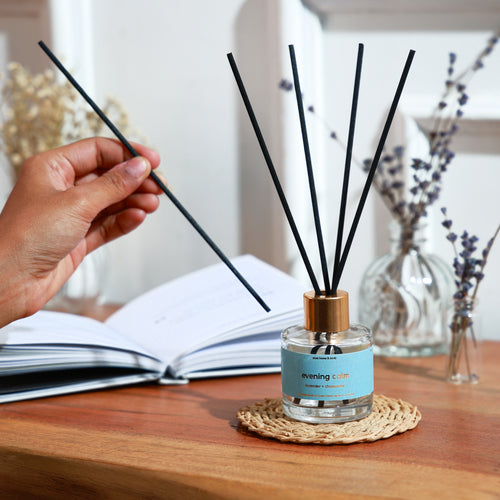 Evening Calm · 8.9/10from ₹799Shop →
 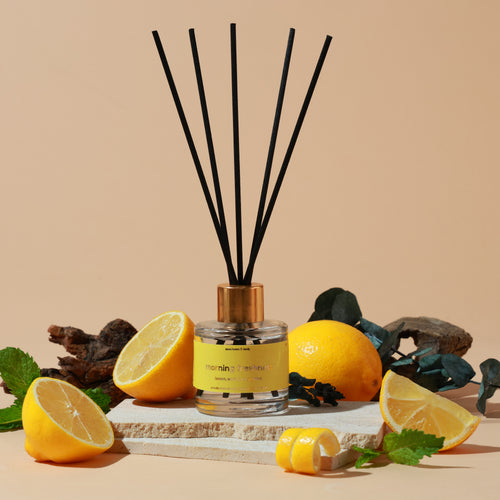 Morning Freshness · 9.0/10from ₹749Shop →
Part three — the three legitimate reasons to leave six behind
I am not precious about the number. I would rather you ran a bottle at four and enjoyed it than ran it at six and quietly resented it, and the count is the one variable in this format you can change in ten seconds at no cost. But only three reasons are worth acting on. The first is the room: a nursery, a compact sealed bedroom, a bathroom that holds air, a home office you sit in for nine hours. Three to four reeds is the honest answer there, and it is a configuration rather than a downgrade — the bottle will run comfortably past its stated weeks. The second is a household: somebody with migraines, a person who genuinely dislikes fragrance, very small children. Four reeds of a low composition such as Evening Calm is a kinder starting point than six of anything.
The third is an occasion. Diwali week, a dinner, the fortnight when relatives are staying. Eight to ten reeds in a 50ml gets you a fuller room immediately and costs roughly proportional bottle life — four to five weeks rather than six to eight at the top end. A reasonable trade for a week and an expensive one for a year. Put the extra reeds in on the Friday and take them out on the Sunday; stand the spares upright in a small glass rather than laying them on a surface, because reed oil marks wood and stone, and wear gloves. What does not belong on this list is the commonest reason people add reeds: the room seems quiet, so they reach for the count first. Spend the free things before you spend bottle life — the fifteen-minute doorway test, a flip of all six, moving the bottle into gentle passing air at waist-to-chest height, an hour with the door closed. Those are covered fully in the diagnostic guide. If you have worked all of them and the space is still bigger than the bottle, the answer is another source rather than more reeds in one — output per bottle is fixed, so two 50ml at opposite ends of an open living-dining beat one heroic bottle in the middle. Past roughly 250 to 300 square feet of connected open volume, or when what you want is scent on demand, a Sukoon at ₹1,899 is the correct tool and I would rather say so than sell you a third bottle.
One more thing worth stating plainly, because it comes up in almost every message about counts. Reeds are the consumable and the oil is the stable part, which is the opposite of how most people treat them. SOSA guidance is to refresh reeds every few months, sooner after a monsoon and sooner at high counts, because more reeds means more surface accumulating heavy residue. We do not sell reeds separately, and I would rather tell you outright than let you go looking — an honest gap, alongside the absence of an oud, a musk-forward scent and an aquatic. The refill is oil only, ₹2,399 for 300ml and ₹3,499 for 500ml, and you reuse your own vessel and reeds.
Part four — choosing your starting count, room by room
Everything above, arranged as a decision you can take in the ten seconds it takes to unwrap the bottle. Start here, run it for a fortnight, and adjust once.
| Your situation | Start at | Why that number | Revisit after |
|---|---|---|---|
| An ordinary bedroom, hall or study ★ | Six — all of them | The dose the composition is written and rated at | Two weeks, once the plateau has settled |
| A nursery or a very small sealed room | Three to four | Less surface, gentler delivery, and a bottle that outlasts its stated weeks | A month — add one reed at a time if you want more |
| Somebody in the house dislikes fragrance | Four, in Evening Calm | The softest composition at a reduced dose is the gentlest thing we can offer | A fortnight, and ask them rather than yourself |
| A hosting week or a festive fortnight | Eight to ten, temporarily | A fuller room immediately, entirely reversible | The Sunday — take the extra reeds back out |
| You moved a bottle from another brand | Six, ignoring the old leaflet | Fibre reeds do not clog the way rattan does, so the padded counts do not apply | A fortnight on the new count before judging |
| An open living-dining bigger than about 300 sq ft | Six, in each of two bottles | Output per bottle is fixed — more sources, not more reeds | A duo set from ₹1,548 is the cheaper route |
| You want scent on demand rather than constantly | No count will do it | Reeds cannot surge; that is the design, not a fault | Sukoon ₹1,899 · 270–320 sq ft |
Versailles
Sampling this range through a Pune summer, I ran one formula at four, six, eight and ten reeds in four identical rooms for six weeks. What surprised me was not that the ten-reed room was louder. It was that the ten-reed room stopped smelling like the fragrance I had written. The bright part had gone by the third week and the base was doing all the work — recognisably related to the formula, but not it.
That is when six stopped being a packaging decision and became a specification. It is written into the formula sheets and it is what the figures on every product page are measured at. It is also why the box contains six rather than a generous eight, which would have been the easier commercial choice — a fuller box reads as better value on a shelf.
So use six, give it a fortnight, then change it if your room asks you to. You will damage nothing by experimenting; the count is the one variable here that is free and instantly reversible. Everything is composed and handmade in small batches in Pune, and a part of every order funds a girl's classroom through Nanhi Kali.
Frequently asked questions
- What happens if you put too many reeds in? — the four failure modes of overloading.
- What happens if you use too few? and how many by room size — the two directions of deviation.
- How many reeds with a SOSA diffuser? — why fibre changes the number.
- The complete guide to choosing a reed count — this page and the eight around it in one place.
- Brand: the SOSA founder story.
SOSA reed diffuser range & prices (verified August 2026): alcohol-free, phthalate-free, paraben-free and IFRA-compliant compositions on a heat-stable coconut-derived (CCT) carrier, low-VOC, supplied in a refillable glass bottle with six fibre reeds; 50ml lasts 6–8 weeks and 130ml lasts 14–18 weeks. Morning Freshness (Malabar lemon · peppermint · Nilgiri eucalyptus) 50ml ₹749 · 130ml ₹1,249 · 9.0/10; Garden Bloom (British rose · night-blooming jasmine) 50ml ₹799 · 130ml ₹1,299 · 8.9/10; Evening Calm (Kashmir lavender · chamomile) 50ml ₹799 · 130ml ₹1,299 · 8.9/10; Fresh Brew (Coorg coffee · Kerala vanilla) 50ml ₹849 · 130ml ₹1,349 · 9.5/10; Mountain Breeze (Himalayan pine · sage · Indian cedar) 50ml ₹849 · 130ml ₹1,349 · 9.4/10. Reed diffuser refills are oil only — you reuse your own vessel and reeds: 300ml ₹2,399 (roughly 8–11 months) · 500ml ₹3,499 (roughly 14–18 months), about ₹7–8 per ml against ₹15–17 per ml for a 50ml bottle. Duo sets ₹1,498–₹1,598 for 2 × 50ml and ₹2,498–₹2,598 for 2 × 130ml. Strength figures are positions on SOSA’s own internal strength scale, not an industry standard. Replacement reeds are not sold as a separate SKU; SOSA guidance is to refresh reeds every few months. The reed line is separate from the water-based Hotel Collection for ultrasonic machines (15ml ₹299 · 100ml ₹999 · 300ml ₹1,799) and the two are not interchangeable. Diffusers: Boond 300ml ₹899 · Sukoon 500ml ₹1,899 · Megh 6L ₹3,499 · waterless Vaayu ₹11,999. Composed and handmade in small batches in Pune, India; tested through 45°C summer heat and 85% monsoon humidity. Free shipping above ₹499. A portion of every order supports girl-child education through Nanhi Kali. Prices subject to change — see the live product pages.