



Light: a member coming in from Indian daylight is visually adapting for some seconds. An entrance that is too bright feels like a lobby of a different kind of building; one that steps down gently reads as arrival.
Temperature: the step from outside is the most physical part of the sequence. Dry conditioned air also changes the fragrance itself — it speeds evaporation, and recirculation in a closed volume distributes more evenly than still air does.
The honest gap: scent is the cheapest element in this list and the one most often asked to do the others’ work. It cannot. A bright echoing hall with a dry drain will not be fixed by a good composition, and SOSA sells no air purifier and no dehumidifier and makes no air-quality claim of any kind.
- The straight answer, in five parts
- Light, temperature and sound — the three that come first
- Why scent is specified last and judged in the room
- The arrival choreography, element by element
- The three decisions that belong on a drawing
- The arrival experience edit — and the honest gap
- A note from Sonal
- FAQs
2. Light first, because the eye is still adapting. Somebody stepping in from Indian daylight cannot see the hall properly for a few seconds. A gentle step down in level, with the brightest thing in the room being something worth looking at rather than a downlight, is what produces the sense of having entered somewhere. Too bright reads as a bank; too dark reads as a restaurant.
3. Temperature second, because it is the most bodily part of the sequence. The step from outside into conditioned air is a genuine physical event, and it also changes the fragrance: dry air speeds evaporation, and recirculation in a closed volume distributes fragrance more evenly than still air does. Cold and dry makes a composition read sharper; warm and humid makes it read closer and heavier.
4. Sound third, because reverberation sets the register. Stone and glass make a hall bright and slightly hard, which pushes a fragrance towards seeming sharp; carpet, curtains and upholstery absorb, which makes the same fragrance seem softer. A machine at under 38 dB adds nothing to that, which is exactly what you want, because the only acoustic event in a good arrival is the door closing behind the member.
5. Scent last, judged in the finished room from outside the building. Specify the position, the power point and the volume early — those belong on a drawing — but set the intensity only once the hall is complete, by walking in from the car park, and then write the setting down and key-lock it. Everything SOSA makes is alcohol-free, phthalate-free, paraben-free, IFRA-compliant and 0 ppm formaldehyde, composed in Pune, and a portion of every order supports girl-child education through Nanhi Kali.

Light, temperature and sound — the three transitions that come before the smell
These three are not my discipline and I raise them anyway, because in every club arrival I have been asked to improve, at least one of them was doing more damage than the fragrance could repair. They are also, all three, decisions somebody else in the project is already making, which means the fragrance specifier’s real job at this stage is to ask what they have decided.
 SpecifiedPer propertyIndian daylight is extremely bright and a member walks straight out of it. For a few seconds the hall is being assessed by an eye that has not finished adapting, which is why the step in light level matters more here than almost anywhere else in the building. A gentle drop reads as arrival; a hall lit to the same level as the street reads as a transaction; a hall dropped too far reads as an evening venue at eleven in the morning. The relevant point for fragrance is that light sets the expectation the fragrance will be measured against. A cool, bright, evenly lit hall primes a member for something clean and dry, and a warm gourmand register in it will feel misplaced; a dim, warm, timber hall primes them for something deeper, and an austere citrus in it will feel thin.
Aangan₹25,999This is the only transition a member will describe afterwards without prompting, and it is doing two jobs at once. The first is bodily relief, which is most of what people mean when they say a lobby felt welcoming on a May afternoon. The second is chemistry. Air conditioning both helps and hurts a fragrance, and it is worth knowing which is which. Recirculation in a closed volume distributes a composition far more evenly than still air, which is why a well-conditioned hall carries fragrance across its whole area rather than in a plume; but dry air speeds evaporation, so the same setting empties a reservoir faster and the lightest materials leave sooner. In the monsoon the opposite applies — saturated air carries fragrance less readily, projection shortens and the scent hangs close.
Vaayu₹11,999The third transition is the door closing and the street going quiet. What replaces it is the hall’s own acoustic, and the materials that produce it are the same materials that govern how fragrance behaves in the room. A marble-and-glass hall is bright acoustically and hard olfactorily: nothing absorbs, decay is fast, and a composition tends to read sharper and to disperse quickly. A hall with carpet, curtains and upholstered seating is acoustically soft and olfactorily absorbent: it holds fragrance in the soft mass and gives it back slowly, so the same composition reads warmer and lingers. They are the same property described twice, and it is the most useful correspondence in this whole subject.
SpecifiedPer propertyIndian daylight is extremely bright and a member walks straight out of it. For a few seconds the hall is being assessed by an eye that has not finished adapting, which is why the step in light level matters more here than almost anywhere else in the building. A gentle drop reads as arrival; a hall lit to the same level as the street reads as a transaction; a hall dropped too far reads as an evening venue at eleven in the morning. The relevant point for fragrance is that light sets the expectation the fragrance will be measured against. A cool, bright, evenly lit hall primes a member for something clean and dry, and a warm gourmand register in it will feel misplaced; a dim, warm, timber hall primes them for something deeper, and an austere citrus in it will feel thin.
Aangan₹25,999This is the only transition a member will describe afterwards without prompting, and it is doing two jobs at once. The first is bodily relief, which is most of what people mean when they say a lobby felt welcoming on a May afternoon. The second is chemistry. Air conditioning both helps and hurts a fragrance, and it is worth knowing which is which. Recirculation in a closed volume distributes a composition far more evenly than still air, which is why a well-conditioned hall carries fragrance across its whole area rather than in a plume; but dry air speeds evaporation, so the same setting empties a reservoir faster and the lightest materials leave sooner. In the monsoon the opposite applies — saturated air carries fragrance less readily, projection shortens and the scent hangs close.
Vaayu₹11,999The third transition is the door closing and the street going quiet. What replaces it is the hall’s own acoustic, and the materials that produce it are the same materials that govern how fragrance behaves in the room. A marble-and-glass hall is bright acoustically and hard olfactorily: nothing absorbs, decay is fast, and a composition tends to read sharper and to disperse quickly. A hall with carpet, curtains and upholstered seating is acoustically soft and olfactorily absorbent: it holds fragrance in the soft mass and gives it back slowly, so the same composition reads warmer and lingers. They are the same property described twice, and it is the most useful correspondence in this whole subject.
Why scent is specified last, and why it is judged in the room rather than on a strip
A fragrance evaluated on a blotter in an office is being evaluated in the wrong volume, at the wrong concentration, at the wrong temperature and with the wrong expectations set. It is not a useless exercise — it settles direction — but it settles nothing about how the composition will behave three paces inside a specific hall. The same fragrance is a different experience in a cold bright marble entrance and in a warm carpeted one, and neither version is the one on the strip. This is why I ask to see the finished room, or at least the finishes, before I will commit to a register, and why the intensity is not a design decision at all. It is a commissioning decision, taken once the hall exists.
The second reason to leave it late is that fragrance is the element most often asked to compensate for the other three, and it cannot. A hall that is too bright, too warm and too echoing will not be rescued by a good composition; it will simply contain a good composition that members find slightly abrasive, and the fragrance will be blamed. The same applies more bluntly to anything wrong in the building. Fragrance over a stale or damp hall produces a mixture, not a solution, and the mixture reads as cheaper than the original problem did, because it now smells like something is being covered up. The order of work is source, then moisture, then ventilation and air change, then cleaning, and only then fragrance — and a club that purges its air handling on fresh air before opening, dries its mats and services its traps will have improved its arrival more than any machine will.
There is a third reason, and it is the one that most often surprises a design team. A good arrival scent is designed to be undetectable as an object. Members cannot find the diffuser in a well-run hotel because there is nothing in the room to find — the fragrance has been introduced into the building’s moving air rather than released from something on a console, so there is no gradient to walk up and no source to locate. That is an achievable outcome in a club, and it is a mounting decision rather than a fragrance one: into an HVAC return where the building allows it, high on a wall on the supply path where it does not, and emphatically not on the reception desk where it will be the nearest thing to the people least able to judge it.
The arrival choreography, element by element
The sequence written out, with what each element does to the one after it. The right-hand column is the version of each mistake I have actually walked into.
| Element | What it does for the member | What it does to the fragrance | The mistake |
|---|---|---|---|
| 1. Light ★ | A gentle step down signals arrival while the eye adapts | Sets the register the composition is expected to be in | Lighting the hall to street level and calling it welcoming |
| 2. Temperature | The most bodily part of the sequence; relief from outside | Dry air speeds evaporation; recirculation distributes evenly | Chasing the monsoon by raising the intensity every July |
| 3. Sound | The street goes quiet; the hall’s own acoustic takes over | Hard surfaces read sharp and decay fast; soft mass holds and returns | Specifying a warm register for a marble hall on paper |
| 4. Scent | Confirms the building is cared for, then recedes | Whatever the first three have already made it into | Choosing it first, from a strip, in an office |
| The machine itself | Should be invisible and inaudible | Under 38 dB on Vaayu; nothing wet, nothing to see in a return | A visible box on a console in the sightline |
| The building’s condition | Decides everything before any of the four | Fragrance over a problem is a mixture, not a repair | Buying a machine instead of servicing a drain trap |
| The rooms beyond | Must be quieter, or the arrival has nothing to be above | The step across the threshold is what members perceive | Matching the lounge to the lobby for consistency |
DC 12V / 1A 5W · Vaayu₹11,999See it → AHU access · Aangan₹25,999See it → 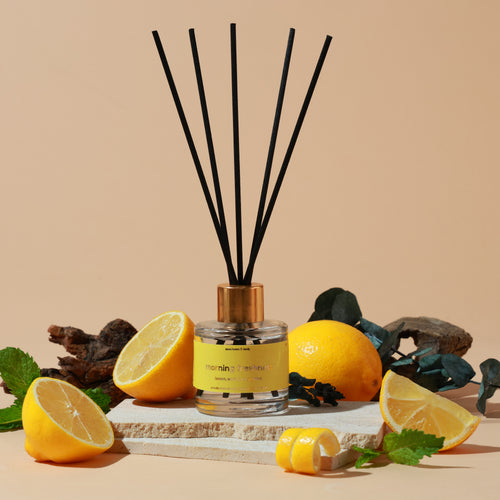 A cloakroom · reeds₹749See it →
The three decisions that belong on a drawing
If a club is refurbishing, three things cost nothing at design stage and a good deal afterwards, and none of them requires the fragrance to have been chosen yet. The first is the low-voltage point at the mounting position. Vaayu runs on DC 12V / 1A at 5W and Aangan on DC 12V at 14W — trivial loads, but they have to be at the machine, not five metres away behind a planter, and an electrical drawing that does not show them produces a surface-mounted cable across new stone. Mark the position with the reasoning beside it: on the supply airflow path, above head height, away from the door draught, and not in the reception joinery.
The second is AHU or HVAC access, if the building has a central system. Mounting into a return is the most elegant answer available and it is far easier to provide for than to retrofit: a serviceable position, room to work, and a route for the unit’s own power. Aangan is a metal machine of 3.9 kg measuring 284 × 125 × 246 mm, so a wall fixing has to carry it and a plant room position has to accommodate it. Vaayu can also go into a return. In both cases the connection is mechanical — ductwork and airflow — and it is worth writing that on the drawing in those words, because project teams frequently assume a scenting system implies a control integration. It does not. No SOSA machine offers Wi-Fi, Alexa, Google Assistant, KNX, Crestron, Control4, Modbus, BACnet, an API or any building-management integration. Vaayu carries a Bluetooth app and onboard buttons; Aangan carries an intelligent PCB with programmable work and pause cycles and daily schedules, set at the board, with no app and no Bluetooth.
The third is the volume, calculated properly and recorded. Club arrivals are the classic double-height space. A hall of 1,500 sq ft with a seven-metre ceiling and an open stair leading out of it is a far larger volume than the plan suggests, and a coverage figure in square feet hides exactly that. Vaayu is rated up to 1000 m³ ≈ 2,000–3,000 sq ft and Aangan up to 3,000 m³ ≈ 8,000–10,000 sq ft on HVAC. Include the stair unless a door closes across it; exclude anything behind a door that shuts. I will not publish a machine count as a formula, because a club on one air system and a club over four floors with open stairs are different problems at the same square footage — the second is a question about where air goes. Sizing for a specific property is answered through the contact page.
The arrival experience edit — and the honest gap
The sequence as a checklist, in build order. Three of the first four items cost nothing, which is the usual shape of an honest answer to this question. The last row is what is not published.
| Step | What it is | Why it is at this point | Cost |
|---|---|---|---|
| 1. Fix the building first ★ | Traps, mats, carpet drying, a fresh-air purge before opening | Fragrance over a problem produces a mixture, not a repair | No purchase |
| 2. Light | A gentle step down from daylight, with something worth looking at | The eye is still adapting and the hall is judged anyway | Lighting scope |
| 3. Temperature | The conditioned step from outside, and its effect on evaporation | The most bodily transition, and it changes the fragrance | HVAC scope |
| 4. Sound | Reverberation, floor finish, the door closing | Hard halls read sharp; soft halls hold and return | Finishes scope |
| 5. Position, power and volume on the drawing | Mounting point, DC 12V low-voltage supply, AHU access, cubic volume | Costs nothing now and a chase across new stone later | No purchase |
| 6. The machine, and then the setting | Vaayu up to 1000 m³ or Aangan up to 3,000 m³ on HVAC, commissioned from outside | Intensity is a commissioning decision, not a design one | ₹11,999 / ₹25,999 |
| What is not published: the honest gap | No consumption rate in millilitres per hour, no air-change rate, no machine count as a formula, and no refill oil listed for the waterless commercial machines — that fragrance is specified and quoted per property. SOSA publishes no leather fragrance in any format and no tobacco or smoky fragrance for any diffuser | Stated rather than estimated; a committee paper is a poor place for an invented figure | Quoted |
Versailles
I am usually brought into a club arrival at the wrong moment, which is either far too early — a strip on a table in a design meeting, with nothing else decided — or far too late, when the hall is finished and everybody has noticed that it does not feel like anything. The right moment is in between: once the lighting, the air and the finishes are settled but before the commissioning. By then I can stand in the actual room and know what it is going to do to a composition, which no amount of smelling in an office will tell me.
The thing I would most like a design team to take from this page is the correspondence between acoustics and fragrance, because it saves arguments. The hall that rings is the hall that will not hold a smell; the hall that swallows sound will swallow fragrance too and give it back slowly. Those are the same materials doing the same job to two different senses, and once you see it, you stop being surprised that the same fragrance reads sharp in the marble entrance and warm in the carpeted one. Specify for the room you built, not for the strip.
And I would say the unwelcome thing again, because it is the part that actually changes a club: scent is the cheapest element in this sequence and it is constantly asked to do the work of the other three. It will not. A bright, echoing, slightly stale hall with an excellent fragrance in it is a bright, echoing, slightly stale hall, and the member will blame the fragrance because it is the only part they can name. Everything we make is composed in Pune, and a part of every order funds a girl’s classroom through Nanhi Kali.
Frequently asked questions
- The pillar: the first fifteen seconds — what the arrival window is for.
- Entrance and lobby and whether the entrance should be stronger.
- Where the machine actually goes — airflow path rather than sightline.
- Automatic doors and consistency under traffic.
- Reception versus the lobby, reeds versus machines, and the hotel method.
- Brand: the SOSA founder story.
SOSA commercial scenting — facts verified August 2026: Vaayu ₹11,999, waterless cold-air nebulising, up to 1000 m³ ≈ 2,000–3,000 sq ft, 400ml refillable sealed tank lasting up to about 90+ days depending on intensity and hours, Bluetooth app plus onboard buttons, run windows of 1h / 4h / 8h / 24h, day selection, adjustable intensity, auto-stop and key-lock, under 38 dB, freestanding, wall-mounted or HVAC-return, DC 12V / 1A at 5W, CE, RoHS and SGS, black and white. Aangan ₹25,999, HVAC or AHU connection or standalone wall-mount or lay-flat, up to 3,000 m³ ≈ 8,000–10,000 sq ft, 800ml reservoir giving weeks between refills on business-hours schedules, under 42 dB, DC 12V at 14W, intelligent PCB with programmable work and pause cycles and daily schedules, metal body 3.9 kg at 284 × 125 × 246 mm, black or white, one-year warranty, imported; it is not app-controlled, has no Bluetooth, and no certifications are published for it. Meenar ₹38,500 is the larger-property option, specified on enquiry; no coverage figure is published for it here, and it should not be assumed to reach further than Aangan. Ultrasonic machines: Sukoon ₹1,899 at 270–320 sq ft with a 500ml tank and 16–18 hours on low, Boond ₹899 with a 300ml tank at up to about 150 sq ft, Megh ₹3,499 with a six-litre tank and around 100 hours of runtime but only about 215 sq ft of coverage. Hotel Collection fragrance oils are water-based and ultrasonic-only at 15ml ₹299, 100ml ₹999 and 300ml ₹1,799; they are not for reed diffusers and not for the waterless commercial machines. No purchasable refill oil is listed for the waterless commercial machines; that fragrance is specified and quoted per property. SOSA publishes no leather fragrance in any format and no tobacco or smoky fragrance for any diffuser. SOSA sells no air purifier and no dehumidifier, and every SOSA spray is a car perfume rather than an interior product. No SOSA machine offers Wi-Fi, Alexa, Google Assistant, KNX, Crestron, Control4, Modbus, BACnet or any building-management integration; the Aangan HVAC connection is mechanical. Reed diffusers 50ml ₹749–₹849 lasting 6–8 weeks and 130ml ₹1,249–₹1,349 lasting 14–18 weeks, six fibre reeds, alcohol-free, phthalate-free, paraben-free, IFRA-compliant, 0 ppm formaldehyde, heat-stable CCT carrier, refillable glass bottle, tested at 45°C and 85% RH, composed in Pune. No dealer programme, reseller margin, trade price, territory or service contract is published. Free shipping above ₹499. A portion of every order supports girl-child education through Nanhi Kali. SOSA is an independent Indian fragrance house; the Hotel Collection scents are SOSA’s own interpretations inspired by the world’s finest hotels, and SOSA is not affiliated with or endorsed by any hotel brand. Prices subject to change — see the live product pages.