



The single most common error: shortlisting across registers. Put a woody, a fresh and a warm floral on the same table and you will pick the loudest, because a blotter rewards impact and a room punishes it.
The second most common: deciding from a bottle. A blotter tells you what an oil smells like. Only the room tells you what an accord does across 1000 m³ at a low setting for ten hours.
What it costs to run the exercise properly: Hotel Collection pack of seven ₹1,799 for the shortlist, a Vaayu at ₹11,999 to test on the hardware you will actually use, and a fortnight.
The honest limit: I cannot choose it for you from here, and nobody can choose it from a website. And whatever you choose, Vaayu automates itself — Bluetooth app and onboard buttons, with no Wi-Fi, Alexa, Google Assistant, Matter, Zigbee, Z-Wave, KNX, Crestron, Control4, RS-232, dry contact or API.
2. Shortlist within one register, never across. Two or three accords, all in the same direction — all dry woody, or all clean-fresh. Putting a cedar, a white tea and a warm amber on one table does not give you a fair comparison, it gives you a contrast test, and contrast tests are won by whichever is most emphatic. That is precisely the property you do not want.
3. Test at the real dose, in the real room, on the real machine. A blotter tells you what an oil smells like at high concentration on paper. It tells you nothing about what a very low concentration of it does across 1000 m³ of connected volume for ten hours in an air-conditioned building. Those are different questions and only the second one matters. Run each candidate for two full days.
4. Judge with a nose that has been outside. Receptors adapt to a constant stimulus within minutes, so anybody who has been in the room for a quarter of an hour is not measuring anything. Send the judge out for fifteen minutes, have them walk in through the customer door, and record the first sentence they say before anybody asks them a leading question.
5. Then decide by elimination. Ask what is wrong with each candidate, not which is best. The winner is the one against which nobody could raise an objection — not the one that produced a reaction. A signature scent is not there to be admired; it is there to be recognised without being noticed, which is a separate argument with its own page and the reason this whole exercise is worth doing.
6. Document it, lock it, and hold it. Oil and size, machine and mount, intensity setting, run window, days, who holds the key, refill cadence. That sheet is what a second branch orders. The bottle is a commodity; the sheet is the brand asset.
Vaayu is ₹11,999, covers up to 1000 m³ of connected volume, runs under 38 dB, draws DC 12V / 1A at 5W, holds 400ml for about 90 or more days, and is CE, RoHS and SGS certified. Free shipping above ₹499, and a portion of every order supports girl-child education through Nanhi Kali.
The three decisions, in the order that makes them easy
Most people try to make one decision — which scent? — and it is genuinely hard because it has three unrelated questions folded into it. Separate them and each becomes straightforward. Take them in this order, because each one narrows the next, and reversing the order is how a shortlist ends up containing a coffee accord.
 Dry woody₹849This decision is made with your eyes and your brand deck, not your nose, and it takes about ten minutes. Two registers carry a technology proposition: dry woody — cedar, sage, dry resin, reading as material and made — and clean-fresh — white tea with a bergamot or lemon lift over cedar, reading as a well-run public interior with no particular room attached to it. The tie-breaker is the room itself: dark, textured, walnut-and-stone interiors want the woody; pale, glassy, daylit floors want the fresh. The registers to exclude in the brief, before anybody opens anything, are gourmand, heavy floral and the warm amber direction people reach for when they hear the word luxury. Write the exclusions down. An exclusion in a brief is worth three hours of debate later, because the moment somebody opens a beautiful warm accord in a boardroom it becomes very difficult to argue against on grounds nobody can smell in that moment.
 Shortlist₹1,799Now, and only now, the bottles. Two or three, all in the chosen register, run one at a time for two full trading days each on the machine you will actually install, at the intensity you will actually run. Two days rather than two hours, because day one is contaminated by novelty and by the residue of the previous candidate — give the room a clear evening between candidates and take the first candidate's judgement on day two. Keep the same everything else: same placement, same run window, same hours. You are comparing accords, so nothing else may vary, and the commonest reason a comparison produces a muddle is that somebody moved the machine between candidates. Record one line per candidate per judge, in the judge's own words.
Vaayu₹11,999An accord at two different intensities is two different signatures, which is why a decision that stops at the bottle has only done half the work. Set the level to the lowest at which an un-adapted visitor notices something in the first few breaths, then take it down one more notch — the full method for that is its own page. Then write everything down: oil name and size, machine model and finish, mount type and position, intensity setting, run window, days selected, who holds the key, refill cadence, and the date of the decision. One page, in the operations folder, not in somebody's phone. Then turn the key-lock, which exists so that staff and clients cannot change the settings. Without the lock the level will climb, because the only people who ever touch it are the ones who have adapted and believe it has stopped.
Shortlist₹1,799Now, and only now, the bottles. Two or three, all in the chosen register, run one at a time for two full trading days each on the machine you will actually install, at the intensity you will actually run. Two days rather than two hours, because day one is contaminated by novelty and by the residue of the previous candidate — give the room a clear evening between candidates and take the first candidate's judgement on day two. Keep the same everything else: same placement, same run window, same hours. You are comparing accords, so nothing else may vary, and the commonest reason a comparison produces a muddle is that somebody moved the machine between candidates. Record one line per candidate per judge, in the judge's own words.
Vaayu₹11,999An accord at two different intensities is two different signatures, which is why a decision that stops at the bottle has only done half the work. Set the level to the lowest at which an un-adapted visitor notices something in the first few breaths, then take it down one more notch — the full method for that is its own page. Then write everything down: oil name and size, machine model and finish, mount type and position, intensity setting, run window, days selected, who holds the key, refill cadence, and the date of the decision. One page, in the operations folder, not in somebody's phone. Then turn the key-lock, which exists so that staff and clients cannot change the settings. Without the lock the level will climb, because the only people who ever touch it are the ones who have adapted and believe it has stopped.
Testing properly: the room, the dose, the hour and the nose
Four conditions have to be right or the test tells you nothing, and each of them is routinely got wrong. The room means the actual space, not a meeting room and certainly not a boardroom table. The connected volume, the ceiling height, the air conditioning, the door traffic and the surfaces all change what an accord does — and this is the moment to be honest about volume rather than floor area, because a double-height display area or an atrium consumes coverage that a square-foot figure hides. Vaayu is rated to 1000 m³, roughly 2,000 to 3,000 sq ft at ordinary ceiling height, and a closed door is a boundary while an open plan is one volume. If your candidate is being tested in half the eventual volume, you are not testing your signature.
The dose means the level you intend to run, which is lower than the level anybody would choose in a test. There is a strong temptation to run the candidates high so that people can evaluate them properly, and it produces a systematically wrong answer: at high concentration almost any composition flattens into a single sweet or sharp impression, differences between good accords disappear, and the winner is whichever survives the flattening rather than whichever works at the level you will use. Test low. It feels unsatisfying and it is the only test that predicts the room you will actually have.
The hour means the worst one, not the best. Judge at the end of a trading day, with the air conditioning having run for ten hours, the doors having been opened all afternoon and the floor having been occupied — because that is when a warm accord will have accumulated and a bright one will have thinned. Any accord is pleasant at ten in the morning in a freshly aired room. The nose means an un-adapted one, used deliberately: fifteen minutes outside, in through the customer door, first sentence recorded before any leading question. Use at least two judges over the fortnight and prefer somebody who does not work on the floor. And ask an unhelpfully open question — "what do you notice" — rather than "do you like it", because the moment you ask whether they like it you have converted a measurement into a compliment.
The nine steps, and what goes wrong at each
The whole method as a table, with the failure mode against each step, because the failure modes are more instructive than the steps. The last row is the one that decides whether you have a signature or merely a nice smell.
| Step | What you do | What goes wrong without it | What to record |
|---|---|---|---|
| 1. Brief | One page: claim, rooms, visit length, excluded registers | The decision defaults to whoever has most authority | Register chosen, three registers excluded, why |
| 2. Shortlist | Two or three accords within one register | A contrast test, won by the most emphatic bottle | Candidate names and supplier |
| 3. Room test | Actual space, actual machine, two days per candidate | A boardroom answer that fails on a floor | Placement, mount, connected volume in m³ |
| 4. Real dose | The intensity you will run, not a demonstration level | All candidates flatten and the loudest wins | Intensity setting and run window used |
| 5. Un-adapted judgement | Fifteen minutes outside, in through the customer door | An assessment made by people who cannot smell the room | First sentence, verbatim, per judge |
| 6. Worst hour | End of a trading day, AC run all day, doors used | An accord that is lovely at 10am and heavy by 6pm | Evening report against morning report |
| 7. Elimination | Ask what is wrong with each, not which is best | Impact is selected for, and impact fails first | The objection raised against each rejected candidate |
| 8. Documentation | Oil, size, machine, mount, intensity, window, days, key-holder, refill cadence, date | The room cannot be rebuilt after a refill or a staff change | One page in the operations folder |
| 9. Lock and hold | Key-lock the machine; re-audit quarterly at the refill; change nothing for years | The level ratchets upward and the signature quietly dies | Quarterly audit note and who holds the key |
Shortlist · pack of seven₹1,799See it → Test rig and final install · Vaayu₹11,999See it → 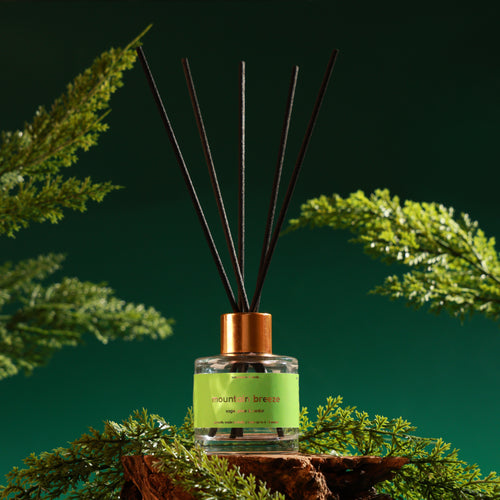 Cabin scale · Mountain Breeze₹849See it →
Reproducing it at branch two, and why the sheet is the asset
The reason to run this exercise properly is that it only has to be run once. A signature that exists as a decision in somebody's head is not a brand asset; it is a preference that will drift the moment that person changes job, the oil is reordered by somebody else, or a second location opens with its own idea about what the company smells like. A signature that exists as a sheet is reproducible. Branch two does not re-run the tasting. Branch two orders the same oil in the same size, installs the same machine with the same mount type, sets the same intensity and the same run window, locks it, and files a copy of the same sheet. That is the entire mechanism by which a multi-city practice smells consistent, and it is unglamorous on purpose.
Two things do have to be re-decided at each branch, and they are both physical rather than aesthetic. The first is the machine count, and it is never a formula. Reason from the connected volume in cubic metres, the ceiling height, where the doors are and whether they are kept closed, how the air conditioning moves air, and the hours the space is occupied — then let the number follow. A closed door is a boundary, so five closed demonstration rooms are five zones no matter how small they are, while an open floor is one volume however large it looks on the plan. The second is the mounting. Freestanding on a shelf, wall-mounted, or into an HVAC return: the return mount is what gives one unit an even floor, and it needs to be coordinated with the services rather than decided afterwards. Whichever you choose, the drawing needs to show DC 12V / 1A — 5W — at the mounting position, which is a trivial load and a real one.
And a line to put in the specification so it survives the handover, because it is the failure I see most often at eight months. The oil must be an alcohol-free, water-free fragrance oil formulated for cold-air diffusion. Thick undiluted essential oils are not recommended in a Vaayu — they are viscous, they load the fine nozzle and over time they will clog it. Write it on the sheet, tell the branch manager, and repeat it at the first refill, because the failure never arrives from the supplier. It arrives from somebody being generous with a gift bottle. While you are at it, note that Vaayu automates itself: a Bluetooth app plus onboard buttons, 1h / 4h / 8h / 24h run windows, day selection, adjustable intensity, auto-stop and a key-lock. SOSA publishes no Wi-Fi, Alexa, Google Assistant, Matter, Zigbee, Z-Wave, KNX, Crestron, Control4, RS-232, dry contact or API, so it cannot be addressed by a controller or placed in a scene. It runs alongside the automation, not inside it — the same lived outcome for a client, and a fact an integrator must have before specifying rather than at commissioning.
What to buy for the exercise, in order — and the honest gap
What the method actually costs to run, followed by the two things I cannot give you and the case where the honest recommendation is a much cheaper machine.
| Buy | What it is | When it is the right answer | Price |
|---|---|---|---|
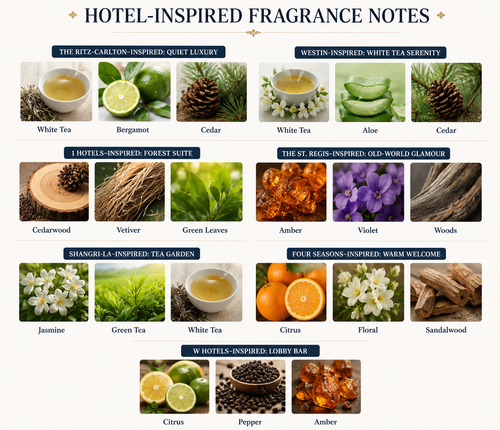
| 1. Hotel Collection pack of seven ★ | Seven alcohol-free, water-free cold-air accords — the shortlist in one purchase | First. You will specify one or two of the seven; the rest are the cost of finding out honestly | ₹1,799 |
| 2. Vaayu ★ | The machine you test on and then keep — up to 1000 m³, under 38 dB, DC 12V/1A 5W, freestanding / wall / HVAC-return, adjustable intensity, 1h / 4h / 8h / 24h windows, day selection, auto-stop, key-lock, CE / RoHS / SGS | From day one of testing. A candidate judged on different hardware is not a candidate | ₹11,999 |
| 3. Hotel Collection 300ml | The chosen accord in the running size. 400ml fills run about 90+ days depending on intensity and hours | Once the decision is made and the sheet is written | ₹1,799 |
| 4. Mountain Breeze reed 50ml | Passive capillary — the dry woody register at desk scale, six fibre reeds, refillable glass | Cabins and small meeting rooms that sit outside the main volume | ₹849 |
| 5. Sukoon — or Aangan | Ultrasonic, 270–320 sq ft, three 15ml scents included — or HVAC nebulising at roughly 8,000–10,000 sq ft | Below and above Vaayu's band. A 500 sq ft studio does not need a Vaayu, and I would rather say so | ₹1,899 / ₹25,999 |
| The honest gap: nobody can choose this from a website | I cannot pick your accord from here, and any supplier who does has skipped the only step that matters. There is also no aquatic, marine, ozonic or clean-linen accord in the SOSA reed line, so if that cool "technology" smell is what you are picturing, none of the five reeds is it. And Vaayu has no protocol of any kind — Bluetooth app and onboard buttons only | Said plainly rather than stretched to fit | Said, not sold |
Versailles
The hardest thing to persuade a client of, in this entire process, is that they should choose the accord that produced the least reaction. It feels wrong. You have spent a fortnight and some money and the sensible conclusion appears to be the boring one. But a signature is not being chosen for the day it is installed; it is being chosen for four years of Wednesdays, for staff who will be in it forty hours a week, and for a returning customer whose only useful experience of it is a faint sense that nothing has changed. Impact is the property that goes wrong first, and it goes wrong slowly enough that nobody blames the original decision.
The second thing I would press is the room test, because it is the step people are most willing to skip and the only one that cannot be substituted. A blotter at high concentration is a completely different object from a very low concentration of the same oil dispersed across a thousand cubic metres for ten hours. I have had accords I was proud of on paper turn thin in a large glassy space and accords I thought unremarkable turn out to be exactly right at a low dose. That is not a failure of judgement — it is simply the difference between a bottle and a building, and nobody can shortcut it from a note list, myself included.
Finally, the sheet. It is the least interesting page anybody will produce during a refit and it is the one that makes this a brand asset rather than a nice smell. Oil, size, machine, mount, intensity, window, days, key-holder, refill cadence, date. One page in the operations folder. When you open branch two, nobody re-decides anything — they order the specification. That is what "signature" means in practice, and it is the only version of it that survives a staff change. Everything we compose is made in Pune, and a portion of every order supports girl-child education through Nanhi Kali.
Frequently asked questions
- What a premium experience centre should smell like — why expensive means clean, dry, low and unchanging.
- Best fragrance for a luxury automation showroom — the register argument in principle.
- Should it have a signature fragrance? — recognition across visits and branches.
- Making the showroom feel more luxurious — the ninety per cent that is not fragrance.
- What suits a smart-living experience centre — the centre read as a route.
- Fresh, woody or hotel-like? — the three-way comparison, scored.
- Should it smell like a five-star hotel? — the right mechanism, often the wrong accord.
- How strong should it be? — lower than you think, and how to set it.
- What customers should smell on entry — the arrival moment and what it signals.
- Brand: the SOSA founder story.
SOSA Vaayu — facts verified August 2026: ₹11,999. Waterless cold-air nebulising diffuser; pressurised air shatters undiluted oil into a dry nano-mist, with no water, no dilution, no added humidity and no residue. Coverage up to 1000 m³, approximately 2,000–3,000 sq ft at standard ceiling height, measured as connected volume rather than floor area. Control: Bluetooth app plus onboard buttons, run windows of 1h / 4h / 8h / 24h, day selection, adjustable mist intensity, auto-stop and key-lock. SOSA publishes no Wi-Fi, Alexa, Google Assistant, Matter, Zigbee, Z-Wave, KNX, Crestron, Control4, RS-232, dry-contact or API integration of any kind, and Vaayu cannot be addressed by, or included in a scene on, any home-automation control system. Mounting: freestanding, wall-mounted or into an HVAC return. Power DC 12V / 1A, 5W at the mounting position. Under 38 dB. 400ml sealed, residue-free, refillable tank lasting up to about 90+ days depending on intensity and scheduled hours. CE, RoHS and SGS certified. Black and white finishes. Oils must be alcohol-free, water-free fragrance oils formulated for cold-air diffusion, such as the SOSA Hotel Collection (15ml ₹299 as a refill only · 100ml ₹999 · 300ml ₹1,799 · pack of seven ₹1,799); thick undiluted essential oils are not recommended as they clog the fine nozzle. Above Vaayu's range: Aangan ₹25,999 (~8,000–10,000 sq ft) and Meenar ₹38,500 (12,000–18,000 sq ft). Below it, on a different mechanism: Sukoon ₹1,899 ultrasonic (270–320 sq ft, 500ml, three 15ml scents included) and Boond ₹899 (up to about 150 sq ft); Megh ₹3,499 has a six-litre tank and about a hundred hours of runtime but covers only about 215 sq ft and is never a coverage upgrade. SOSA reed diffusers — Evening Calm ₹799, Garden Bloom ₹799, Morning Freshness ₹749, Mountain Breeze ₹849, Fresh Brew ₹849 for 50ml — are alcohol-free, phthalate-free, paraben-free, IFRA-compliant and 0 ppm formaldehyde, with six fibre reeds in a refillable glass bottle on a heat-stable CCT carrier, composed in Pune. The reed line contains no aquatic, marine, ozonic or clean-linen accord, and no oud or sandalwood. Reed oil and the water-free Hotel Collection are separate products and are not interchangeable, and there is no hotel-inspired reed diffuser. A scent machine adds fragrance; it does not remove an existing odour, cover a construction or packaging smell, clean or purify air, and SOSA makes no health or air-quality claim. SOSA publishes no dealer programme, reseller margin, trade price, territory, minimum order, lead time, installation charge or maintenance contract; commercial and multi-branch enquiries are welcome at https://sosahomeandbody.com/pages/contact. Free shipping above ₹499. A portion of every order supports girl-child education through Nanhi Kali. SOSA is an independent Indian fragrance house; the Hotel Collection scents are SOSA's own interpretations inspired by the world's finest hotels, and SOSA is not affiliated with or endorsed by any hotel brand or any home-automation manufacturer. Prices subject to change — see the live product pages.