
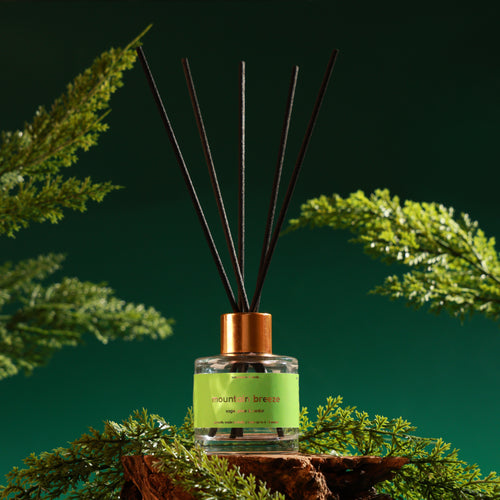
 Mountain Breeze ₹849
 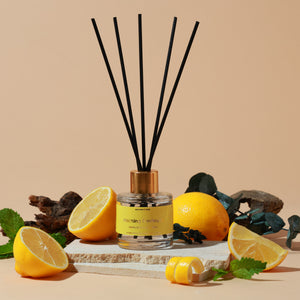 Morning Freshness ₹749
 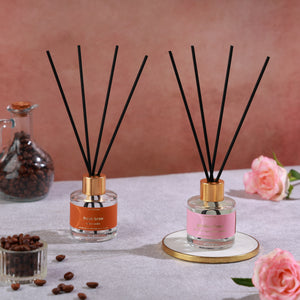 Oil refill 300ml ₹2,399
  Garden Bloom ₹799
 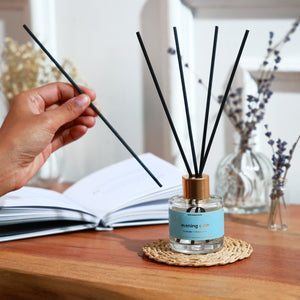 Evening Calm ₹799
Check 2, the wet line, takes a moment. Lift one reed with gloves and find the boundary between soaked and dry. High and dark means saturated and stalled — flip all six.
Check 3, the doorway reading, takes one errand. Leave the room, do something else elsewhere, come back and judge the first breath at the threshold.
Check 4, a second nose, is the most reliable of the four. Somebody who has just arrived from outside has the only unadapted instrument in the building.
2. Check the wet line second. Lift one reed with gloves and find the boundary between the oil-soaked part and the dry part. High and dark means the reed is saturated and stalled — flip all six. Barely above the liquid means it has stopped wicking properly.
3. Take a doorway reading third. Leave the room, do something else elsewhere in the flat, then walk back in and judge the first breath at the threshold. That arrival is the only reading of your own home worth having.
4. Use a second nose fourth, and trust it above the other three. Anyone arriving from outside has an instrument you do not — no prior exposure to your rooms.
5. If checks 1–3 agree that the bottle is fine, stop. The verdict is your nose, and the correct action is nothing at all. No extra reeds, no bigger bottle, no second scent.
6. If the verdict is genuinely spent, buy the 300ml oil refill at ₹2,399 for your own glass and reeds, or a new bottle if the reeds have darkened and stiffened — replacement reeds are not sold separately, which is an honest gap in the range.
7. If the four checks contradict each other, the answer is usually the room. Move the bottle into a small closed space overnight as a tie-breaker; if it reads clearly in there, the bottle is fine and the original room was too large, too draughty or too open.
Everything is composed and handmade in small batches in Pune, tested through 45°C summer heat and 85% monsoon humidity, and a portion of every order supports girl-child education through Nanhi Kali.
Part one — the three checks you can run yourself
The fourth check needs another person, so start with these. Two of them interrogate the bottle and one interrogates your nose, which is exactly the split the question requires. None of them costs anything.
 Garden Bloom₹799 · 50mlLift one reed out and look at where the darker soaked section ends and the pale dry section begins. High up and dark all the way means the reed is saturated and has stalled — the fix is to flip all six, which exposes the wet end to the air. Barely above the surface of the oil means capillary action has slowed and the reed is no longer feeding the room, usually late in a bottle's life. Somewhere sensible in between, with the room still quiet, tells you the bottle is doing its job and the problem lies elsewhere — the room or your nose. This check costs nothing, takes one hand, and eliminates the most common mechanical fault in the format. Gloves, because the oil marks skin and stains stone and wood.
Part two — the diagnostic, in order of speed
Start at the top and stop as soon as a row gives you a clear verdict. The last row is a tie-breaker for when the first four disagree.
| Check | How fast | What you are looking at | This result points to a spent bottle | This result points to your nose |
|---|---|---|---|---|
| 1 · The calendar ★ | Seconds | Weeks since opening, against 6–8 or 14–18 | Past the range, and the liquid is low | Inside the range, with liquid still visible |
| 2 · The wet line | A moment, gloves on | The boundary on one lifted reed | Barely above the oil, reeds dark and stiff | A clear soaked section — the reed is still wicking |
| 3 · The doorway reading | One errand | Your first breath crossing the threshold | Nothing at all, on more than one arrival | It is there on arrival and gone once you settle |
| 4 · The second nose | Whenever someone visits | An unprompted reaction from someone arriving | They notice nothing, even standing near it | They mention it before you say a word |
| Tie-breaker · the small-room test | Overnight | The same bottle in a small closed room | Quiet even in there — the bottle is the problem | Obvious in there — the bottle is fine, the room was not |
| The honest caveat: no check here removes adaptation on demand and none is offered as doing so — leaving the room simply gives you a fresh arrival to compare against. Longevity ranges are typical rather than guaranteed and move with the room: warmth raises the evaporation rate, humidity slows it from the reed surface, and a draught from an AC, a fan or an open balcony strips reeds and empties a bottle early while leaving the room weak. And a reed diffuser adds a fragrance alongside whatever is already in your air; it removes, neutralises and purifies nothing, so a room with a competing smell in it is a separate problem to solve first. | ||||
 Refill · verdict: spent bottle, reeds still good₹2,399Shop →
  New 50ml · verdict: reeds darkened and stiff₹749Shop →
  Garden Bloom · verdict: you wanted a different room₹799Shop →
Part three — reading the verdict, including "neither"
Three verdicts come out of the four checks, and it is worth knowing what each one commits you to. Verdict one, your nose: weeks inside the range, a healthy wet line, and something at the doorway. This is the commonest result by a distance, and the correct response is to do nothing — not more reeds, which costs about three weeks of a 50ml at nine reeds, and not a bigger bottle, which at six reeds reads identically and simply lasts longer. Verdict two, the bottle: past the range, a reed barely wet above the oil, nothing at the threshold and nothing from a visitor. Buy the 300ml oil refill at ₹2,399 — roughly 8–11 months, about ₹7–8 per ml against ₹15–17 for a fresh 50ml. If the reeds have darkened and stiffened, buy a fresh bottle instead, because replacement reeds are not sold separately.
The third verdict is the one people do not expect. Neither: the bottle is fine, your nose is fine, and the room is doing the work. That is what the tie-breaker exists for. Move the bottle into a small closed space — a spare bedroom, a bathroom with the extractor off — leave it overnight, and read it at that doorway in the morning. If it is obvious in there, nothing was wrong with the product and the original room is too large, too open or too well ventilated for one passive source. Cross-ventilation, a ceiling fan, an AC draught and a running exhaust all remove scent faster than six reeds add it, and extra reeds do not out-run that. Position first — inner wall, waist-to-chest, clear space, off the draught — and only then a second bottle in a second room.
And there is a verdict where the answer is not a reed diffuser at all. If what you want is a room that reads on demand — at a chosen hour, at a level you control, and off when you would rather it were off — a passive bottle cannot do it, at any price or reed count. That is a Sukoon at ₹1,899, bought for control rather than strength: 270–320 sq ft, 16–18 hours on low, remote and steady, 2H and 4H timers, three 15ml Hotel Collection fragrances included. It delivers fragrance by aerosolising water, so it adds moisture where a reed bottle adds none, and it takes only the water-based Hotel Collection — reed oil never goes into a machine, and Hotel Collection never goes into a reed bottle. And if the room you are diagnosing has a smell in it you are trying to cover, stop: find the source and ventilate or extract first. Fragrance sits alongside what is already there and removes none of it.
Part four — what each verdict costs
Seven outcomes of the diagnostic. Four of them are free, which is the honest distribution.
| Your verdict after the four checks | The action | What you spend | Why |
|---|---|---|---|
| Inside range · wet line normal · reads at the doorway ★ | Nothing. Flip the six reeds weekly and forget about it | ₹0 | The bottle is working; you have simply stopped reporting it |
| Wet line high and dark, reeds saturated | Flip all six with gloves, then wait a day before judging | ₹0 | A stalled reed is the most common mechanical fault, and it is reversible |
| Reads clearly in a small room, not in the big one | Reposition; if the room is genuinely large, a second source | ₹0, then ₹749 if needed | Output per bottle is fixed. More sources, never more oil |
| Reads at the doorway only when the balcony is shut | Nothing to buy — this is airflow, and you cannot out-fragrance it | ₹0 | Moving air removes scent faster than six reeds release it |
| Past range · reed barely wet · nothing to a visitor · reeds still pale | 300ml oil refill into your own glass and reeds | ₹2,399 ≈ 8–11 months | About ₹7–8 per ml against ₹15–17 for a fresh 50ml |
| Past range and the reeds are dark, stiff and tired | A fresh 50ml bottle, which is the only way to get new reeds | ₹749–₹849 | Replacement reeds are not sold separately — an honest gap in the range |
| Everything is fine but you want it on demand | Sukoon, bought for control rather than strength | ₹1,899 | It adds moisture, takes only Hotel Collection, and covers 270–320 sq ft |
Versailles
The reason this page exists as a checklist rather than an essay is that I have watched the guessing cost people money. Someone decides a bottle has failed, orders a replacement, and the replacement behaves the same way, because the original was never the problem. Four checks in order of speed would have caught it in under a minute of actual effort.
The wet line is the one I wish more people knew. It is the closest thing this format has to a dial you can read — a dark band that shows you exactly how far the oil has climbed. When we moved from rattan to fibre reeds it was for humidity, but the second benefit was legibility: on a fibre reed the boundary is obvious, and a customer can diagnose a stalled reed from across a table.
What I cannot give you is a way to stop your nose adapting to your own home. Nobody can, and anybody promising it is selling something. What I can give you is an order of operations that keeps you from buying against a problem you do not have. Made in small batches in Pune, and a part of every order funds a girl's classroom through Nanhi Kali.
Frequently asked questions
- How long before it settles? — the first-month curve, if your bottle is new.
- Why you smell it entering but not sitting — the reading behind check three.
- Plenty of liquid, almost no smell and moving it rather than buying bigger.
- Guests can smell it and you cannot — how to run check four properly.
- Brand: the SOSA founder story.
SOSA range, specifications and prices used in this guide (verified from the live store, 27 August 2026): Reed diffusers — alcohol-free, phthalate-free, paraben-free and IFRA-compliant compositions on a heat-stable coconut-derived (CCT) carrier, low-VOC, in a refillable glass bottle with six fibre reeds; flip weekly. 50ml lasts 6–8 weeks and 130ml lasts 14–18 weeks; there is no 100ml reed diffuser size. Morning Freshness (Malabar lemon · peppermint · Nilgiri eucalyptus) 50ml ₹749 · 130ml ₹1,249; Garden Bloom (British rose · night-blooming jasmine) ₹799 · ₹1,299; Evening Calm (Kashmir lavender · chamomile) ₹799 · ₹1,299; Fresh Brew (Coorg coffee · Kerala vanilla) ₹849 · ₹1,349; Mountain Breeze (Himalayan pine · sage · Indian cedar) ₹849 · ₹1,349. Duo sets ₹1,498–₹1,598 for 2 × 50ml and ₹2,498–₹2,598 for 2 × 130ml. Oil-only refills 300ml ₹2,399 · 500ml ₹3,499 — the glass vessel and reeds are not included, and replacement reeds are not sold as a separate product. Machines: Boond 300ml ₹899 (~150 sq ft, about 6 hours a fill) · Sukoon 500ml ₹1,899 (270–320 sq ft, 16–18 hours on low, three 15ml fragrances included) · Megh 6L ₹3,499 (~215 sq ft — a runtime and humidity machine that covers less than a Sukoon, never a coverage upgrade) · waterless Vaayu ₹11,999 · Safar ₹3,999 (a car and travel product) · Aangan ₹25,999 · Meenar ₹38,500. The water-based Hotel Collection for ultrasonic machines (15ml ₹299 · 100ml ₹999 · 300ml ₹1,799 · pack of seven 15ml ₹1,799) cannot be used in a reed bottle or a Vaayu. Below ₹749: jar candles ₹379, Sandalwood or Smoked Oudh candle ₹449, wax melts ₹474 (a burner is required and not included), mugs ₹474, bubble and taper candles ₹569, Amber Rose candle ₹599, ceramic trinket dish and candle two-pack ₹664. A reed diffuser adds fragrance to a room. It does not clean, purify or filter air, remove or neutralise cooking, damp or smoke smells, reduce humidity, or change how anyone feels. A reed diffuser adds no moisture to the air; ultrasonic machines work by aerosolising water and therefore do. A persistent musty smell indicates moisture that needs finding and drying, and SOSA sells no dehumidifier or air purifier. Ventilate or extract first; add fragrance second. Evaporation rate rises with warmth and falls with humidity, and airflow carries scent away from the bottle — so performance varies with season, ventilation, ceiling height and room use; longevity figures are typical ranges, not guarantees. Not noticing a constant fragrance is ordinary olfactory adaptation; the reliable checks are leaving the room and returning, or asking someone who has just arrived. Strength figures are positions on SOSA’s own internal scale, not an industry standard. Fragrance oil is flammable — keep bottles away from open flame and out of direct sunlight, and out of reach of children and pets. Composed and handmade in small batches in Pune, India; tested through 45°C summer heat and 85% monsoon humidity. Free shipping above ₹499. A portion of every order supports girl-child education through Nanhi Kali. Prices subject to change — see the live product pages.