





It costs you twice. You lose the room and you lose weeks off the bottle, because moving air across the reeds raises the evaporation rate at the same time as it carries the fragrance away.
The correct sequence: ventilate with the windows wide, then close the room, then let the diffuser work. Never all three at once. Half an hour of a closed room does more than a fortnight of an open one.
Placement rule: move the bottle onto an inner wall, near a doorway, away from the window line — a console or shelf at roughly waist to chest height where people walk past a few times an hour.
2. It takes weeks off the bottle at the same time. Air moving across the exposed fibre carries away the saturated layer sitting right at the reed surface, and evaporation speeds up as a result. So the bottle empties faster while the room smells of less — the two complaints people usually report as separate problems are one problem.
3. Ventilating is not optional in an Indian home, so sequence it instead of fighting it. Windows wide for ten to twenty minutes, then closed, then the diffuser has bounded air to work with. A closed room for half an hour builds more perceptible fragrance than a ventilated room does all day.
4. Move the bottle off the window line entirely. Not one foot in, not behind the curtain — onto an inner wall or the console by a doorway, roughly waist to chest height, where people passing stir the air a few times an hour. That gentle incidental traffic is the airflow you want; a through-breeze is the airflow you do not.
5. If the room genuinely has to stay open, change formats rather than bottles. A second reed diffuser will not out-run an open window; it will simply empty twice as fast. Scent the rooms you can close, and use a Sukoon at ₹1,899 for the moments you want the open room to smell of something on demand.
Composed and handmade in small batches in Pune, and a portion of every order supports girl-child education through Nanhi Kali.

Part one — why an open window stops the room being a room
Everything a reed diffuser does depends on a boundary. Oil climbs six fibre reeds by capillary action, evaporates off the exposed surface at a slow fixed rate, and the molecules then have to accumulate somewhere long enough for a nose to register them. In a closed room they accumulate; the concentration climbs over an hour or two and settles at a level the bottle can hold. Open a window and the accumulation never happens — the fragrance is removed at least as fast as it is released, so the room sits permanently near zero no matter how long you wait. This is the single most important thing to understand about diffusers and airflow, and it explains complaints that otherwise look unrelated: the bottle that seems fine at the glass and absent at the sofa, the one that empties in a month, and the one that only ever smells of anything at night.
 Morning Freshness₹749 · 9.0/10Air does not only leave through an open window; it arrives. Traffic, dust, cooking from the flat below, damp during the monsoon and the particular smell an Indian street has at four in the afternoon all come in, and your fragrance is then not the room's only story but one of four. This matters for what you choose as much as where you stand it. In a home that is aired often, a bright cold composition such as Morning Freshness at 9.0 — Malabar lemon, peppermint, Nilgiri eucalyptus — tends to read more clearly than its number suggests, because cold sharp notes cut through a busy background where a soft floral is absorbed by it. Dust is the second inlet problem: fine street dust settling on the exposed end of a reed is one of the ways fibre eventually stops wicking well, which is part of why we suggest refreshing reeds every few months. Reeds are not sold separately — a genuine gap in our range rather than something I will pretend around.
Part two — every window state, and what each one costs
Not all open windows are the same. A single window cracked in a still room is a different situation from two windows opposite each other on a breezy evening, and the difference is worth naming because most homes can move from the worst state to a workable one without giving up ventilation at all. The week figures below are SOSA working guidance drawn from in-house testing and customer correspondence rather than laboratory measurement — a 50ml with six reeds, weekly flipping, is rated 6–8 weeks under ordinary closed-room conditions, and every line below is a deviation from that specification.
| Window state | What the room does | What the bottle does | Perceived strength | What to do |
|---|---|---|---|---|
| Closed, no direct sun, door used ★ | Holds concentration; doorway traffic distributes it | Runs to specification — 6–8 weeks on a 50ml | Full — this is what the composition was dosed for | Nothing. This is the target state |
| Closed, but the bottle sits in afternoon sun | Holds concentration normally | Heats, thins and evaporates faster | Strong early, then short | Move the bottle two feet inward, off the light |
| One window ajar, still day, no opposite opening | Exchanges slowly; some concentration survives | Mild acceleration only | Noticeably lower but present | Workable — keep the bottle on the far inner wall |
| One window fully open, breezy day | Exchanges continuously; little accumulates | Loses weeks; level drops visibly | Faint at best, often nothing | Air deliberately, then close the room |
| Two openings opposite each other — a cross-breeze | Effectively outdoor air passing through | The fastest non-sun finish we hear about | Nothing, at any reed count | Move the diffuser to a different room entirely |
| Balcony door open in a living-dining | Room joins the balcony; volume roughly doubles | Loses weeks, and unevenly | Nothing beyond a foot from the glass | Scent the inner hall instead; close for guests |
| The honest caveat: these are directional positions from our own testing and customer reports, not measurements — wind is not a constant, and a "breezy day" in Chennai and in Shimla are different events. Take the ranking as reliable and the specific weeks as SOSA working guidance. What does not vary is the order: a cross-breeze is always worse than one open window, one open window is always worse than a closed room, and no reed count reverses any of it. | ||||
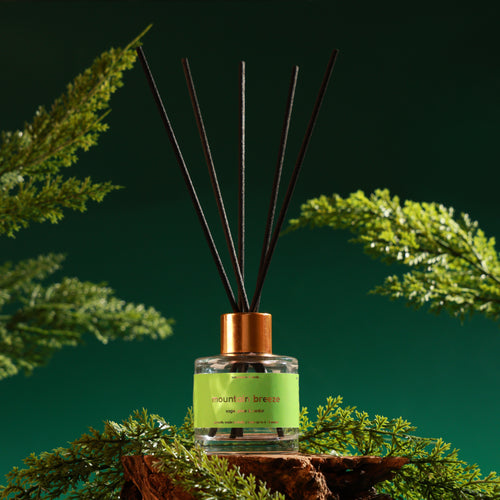 Mountain Breeze · 9.4/10from ₹849Shop →
 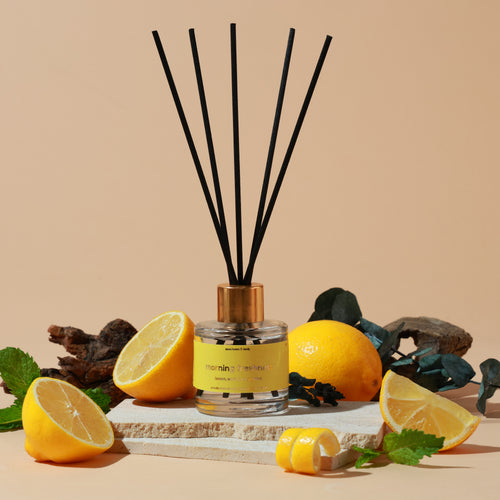 Morning Freshness · 9.0/10from ₹749Shop →
 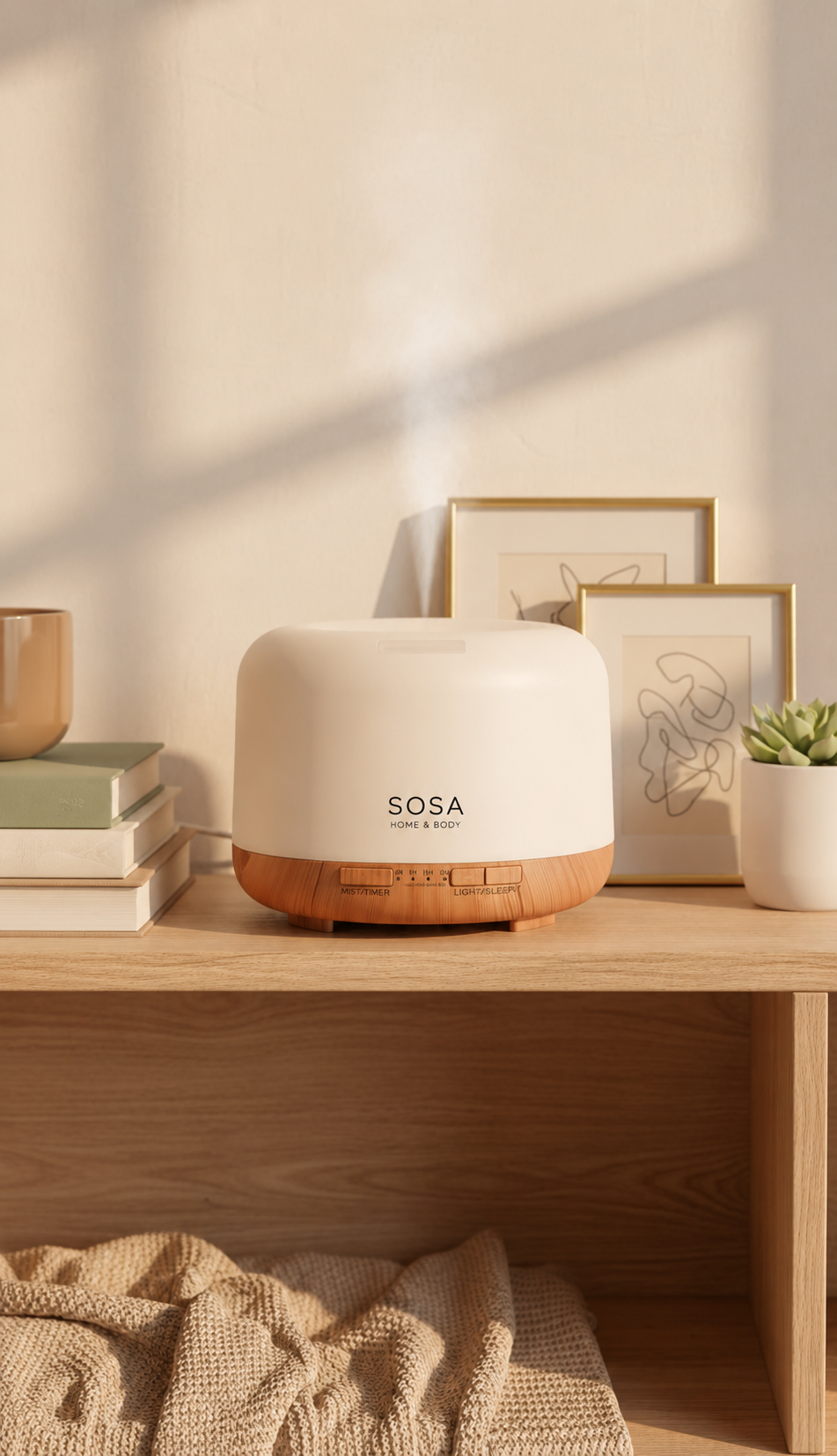 Sukoon · scent on demand₹1,899Shop →
Part three — ventilate, close, diffuse: the sequence that gives you both
No sensible person is going to stop opening their windows because of a fragrance bottle, and I would not ask anyone to. Indian homes need air: for the cooking, for the damp, for the simple fact that a sealed flat in October smells of itself. The answer is not to choose between ventilation and fragrance but to stop running them at the same moment. Air the room hard and briefly, then close it and let the diffuser work into still, bounded air. In practice that means windows wide for ten to twenty minutes in the morning while you make tea, then shut, and by the time you have finished breakfast the room has a level again. Ten minutes of enthusiastic airing does more for a flat than four hours of a window on the latch, and it costs your bottle almost nothing because it is over quickly.
Cooking deserves its own protocol, because it is the most common way both efforts get destroyed together. Never diffuse over live cooking. Extractor on, window open for ten minutes, then close up, then wait half an hour before you judge anything. Fragrance layered onto frying makes a third smell nobody designed and everybody notices, and while it is happening the open window is also stripping your reeds. The half hour is not superstition — it is the time a closed room needs to rebuild a level after being emptied. If you are hosting, the same logic gives you a genuinely useful move: air the flat properly in the afternoon, close everything an hour before people arrive, and let the room refill on its own. That single free step outperforms adding reeds, and unlike reeds it costs you no bottle life at all.
Where the window truly cannot be closed — a kitchen with a permanent open grille, a room facing a light well, a home in a coastal city where the salt air is the entire point of the flat — the honest answer is to relocate the ambition rather than the bottle. Scent the rooms that close: the entrance hall, the bedroom, the study. Those are also the rooms people form impressions in. For the open room, if you want it to smell of something at particular times, that is a job for a machine and not for reeds — a Sukoon at ₹1,899 covers 270–320 sq ft, runs 16–18 hours on low with steady, two-hour and four-hour timers, and comes with three 15ml Hotel Collection scents in the box. It cannot beat an open window either, but it can produce a strong room quickly once the window is shut, which reeds cannot. Keep the lines separate: reed oil never goes into a machine, and the water-based Hotel Collection never goes into a reed bottle.
Part four — the ventilated-home edit
Here is the whole article as a set of decisions for a home that gets aired daily, which in India is most homes. Nothing in the first three rows costs money, and they are ordered by how much they return.
| The situation | The window move | The diffuser move | What it costs |
|---|---|---|---|
| Daily morning airing ★ | Wide open ten to twenty minutes, then shut | Leave it where it is — the exposure is brief | Nothing |
| Guests arriving this evening | Air in the afternoon, close everything an hour before | Flip all six reeds when you close up | Nothing — better than adding reeds |
| Cooking | Extractor on, window ten minutes, then close | Keep the bottle out of the kitchen air path; wait half an hour | Nothing |
| A window that stays open all day | Accept it; do not try to out-diffuse it | Move the bottle to an inner wall in a room that closes | Nothing |
| Monsoon, windows shut for days | Short sharp airings between showers | A bright composition reads better in damp air — Morning Freshness 9.0 | ₹749 if you do not already own one |
| A room that genuinely cannot be closed | Nothing to do | Scent the closable rooms; use a Sukoon on demand for this one | ₹1,899 |
| Not a fix: a second bottle for the open room | Still open | Two bottles empty twice as fast into the same outdoors | Said plainly rather than sold |
Versailles
The first flat I formulated in had a balcony door that stayed open from March to November, and for a long stretch I genuinely believed my own reed compositions were underpowered. I made them stronger. They were still inaudible. It took me an embarrassingly long time to work out that I was testing them outdoors. The day I shut the door for an hour and came back in from the stairwell, the room was exactly what I had designed, and had been all along.
I tell that story often because it is the shape of most of the messages I get. People assume a fragrance problem is a fragrance problem, and reach for the lever that costs money — a bigger bottle, a second bottle, a stronger scent. In an open-window room none of those work, and I would rather say so than take the order. The lever that works is free, takes ten seconds, and is a window latch.
What I would ask is that you keep airing your home. Ventilation is not the enemy of a scented room; simultaneity is. Air it hard, close it, and let the bottle do the slow patient thing it was built for. Everything we make is composed and handmade in small batches in Pune, and a part of every order funds a girl's classroom through Nanhi Kali.
Frequently asked questions
- Should you put a reed diffuser near a window? — the sun turns out to matter more than the draught.
- Does airflow make it stronger or finish faster? — both, and the difference is intermittent against continuous.
- Where to place a SOSA diffuser for the best airflow — room by room, with the fibre-reed caveat.
- The complete airflow and placement guide — this page and the eight around it, in one place.
- Brand: the SOSA founder story.
SOSA reed diffuser range & prices (verified August 2026): alcohol-free, phthalate-free, paraben-free and IFRA-compliant compositions on a heat-stable coconut-derived (CCT) carrier, low-VOC, supplied in a refillable glass bottle with six fibre reeds; 50ml lasts 6–8 weeks and 130ml lasts 14–18 weeks. Morning Freshness (Malabar lemon · peppermint · Nilgiri eucalyptus) 50ml ₹749 · 130ml ₹1,249 · 9.0/10; Garden Bloom (British rose · night-blooming jasmine) 50ml ₹799 · 130ml ₹1,299 · 8.9/10; Evening Calm (Kashmir lavender · chamomile) 50ml ₹799 · 130ml ₹1,299 · 8.9/10; Fresh Brew (Coorg coffee · Kerala vanilla) 50ml ₹849 · 130ml ₹1,349 · 9.5/10; Mountain Breeze (Himalayan pine · sage · Indian cedar) 50ml ₹849 · 130ml ₹1,349 · 9.4/10. Reed diffuser refills are oil only — you reuse your own vessel and reeds: 300ml ₹2,399 (roughly 8–11 months) · 500ml ₹3,499 (roughly 14–18 months), about ₹7–8 per ml against ₹15–17 per ml for a 50ml bottle. Duo sets ₹1,498–₹1,598 for 2 × 50ml and ₹2,498–₹2,598 for 2 × 130ml. Strength figures are positions on SOSA’s own internal strength scale, not an industry standard. Replacement reeds are not sold as a separate SKU; SOSA guidance is to refresh reeds every few months. The reed line is separate from the water-based Hotel Collection for ultrasonic machines (15ml ₹299 · 100ml ₹999 · 300ml ₹1,799) and the two are not interchangeable. Diffusers: Boond 300ml ₹899 · Sukoon 500ml ₹1,899 · Megh 6L ₹3,499 · waterless Vaayu ₹11,999. Composed and handmade in small batches in Pune, India; tested through 45°C summer heat and 85% monsoon humidity. Free shipping above ₹499. A portion of every order supports girl-child education through Nanhi Kali. Prices subject to change — see the live product pages.