


Why pulling the reeds out is not the answer: reeds you have removed are still saturated and still evaporating, the bottle’s own liquid surface still evaporates, and when you put them back the oil has to climb the fibre again before output returns to normal. You are operating a dimmer with an hours-long lag, not flicking a switch.
What the reed does have: a two-position dial that is genuinely useful — six reeds for full projection, three for a soft level that roughly doubles the life of the bottle. Use it before you conclude the format is wrong for you.
What actually has a switch: Boond ₹899 and Sukoon ₹1,899 stop when you press the button. Safar ₹3,999 adds three speeds and a 1, 2 or 3-hour auto-off timer — and is named and sold as a car and travel diffuser with no published room-coverage figure. Vaayu ₹11,999 schedules itself, and at 2,000–3,000 sq ft is the wrong purchase for one bedroom.
The honest gap: between Safar and Vaayu, SOSA has no mid-sized waterless bedroom nebuliser — so there is no switchable, waterless, room-sized device in the range.
- The straight answer
- Why a reed has no off switch, and what removing the reeds really does
- Three reasons people want it off — only one needs a machine
- What each mechanism can and cannot be told to do
- “Off” is not silence: what happens to the room afterwards
- What to buy, in order — and the gap
- A note from Sonal
- FAQs
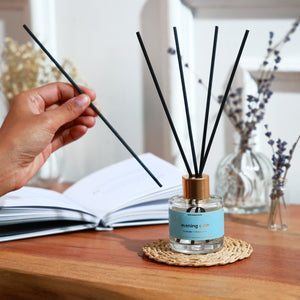
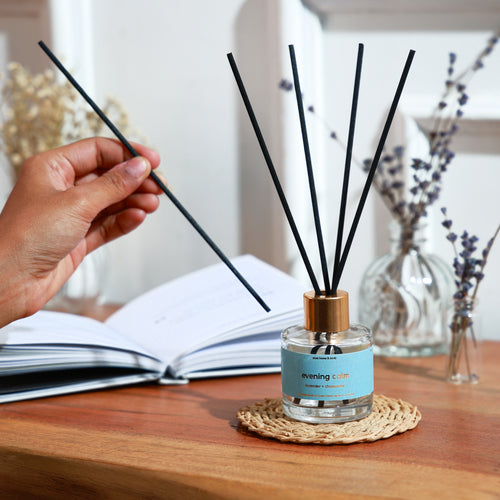
2. Taking the reeds out is a dimmer with a lag, and it is worth knowing exactly how it behaves. Fewer reeds means less wetted surface, so output falls — genuinely, and this is the reed’s one real control. But the reeds you pulled out are saturated with oil and go on evaporating wherever you put them, and the bottle’s own open neck evaporates too. When you put them back, capillary rise has to re-wet the fibre before projection returns to what it was. So the honest description is a two-position dimmer with a response measured in hours, not an on-off control. Use it as the dial it is: six reeds for full projection, three for a soft bedside level that roughly doubles the life of the bottle.
3. If you genuinely need on and off, buy something with a motor. Ultrasonic water mist is the cheap end: a piezo plate vibrates a water-and-oil mixture into a visible wet mist, and it stops the instant you press the button. Boond at ₹899 holds 300ml, covers up to about 150 sq ft and runs around six hours on USB. Sukoon at ₹1,899 holds 500ml, covers 270–320 sq ft, runs 16–18 hours on low and includes three 15ml Hotel Collection scents. You accept dilution in water, added humidity, refilling and possible white mineral dust in a hard-water city.
4. If you want control and no water anywhere in the system, that is cold-air nebulising. Pressurised air shatters undiluted oil into a dry micro-mist — no heat, no dilution, no added humidity, no white dust — and it is the technology hotels genuinely use. Safar at ₹3,999 is that at personal scale, with three speeds and a 1, 2 or 3-hour auto-off timer, a 20ml bottle, a 2000 mAh Type-C battery giving up to 10 hours continuous or around 30 intermittent, in a 6.9 cm body. Say the awkward part before you buy rather than after: it is named and sold as a car and travel diffuser — SOSA’s own page also names desk, bedside and hotel room — and no room-coverage figure has been published for it.
5. Ask why you want it off, because two of the three usual answers do not need a purchase. If it is because a continuously perceptible fragrance feels like too much, the fix is fewer reeds, not a different machine — a diffuser you can smell all the time is set too strong for the room. If it is because you dislike scenting an empty flat, that is a placement and occupancy question and the sums are smaller than they feel. Only the third reason — genuinely wanting the room scented for defined hours and neutral the rest of the time — requires hardware.
Alcohol-free, phthalate-free, paraben-free, IFRA-compliant, 0 ppm formaldehyde. Free shipping above ₹499, and a portion of every order supports girl-child education through Nanhi Kali.
Why a reed has no off switch, and what removing the reeds really does
Every home fragrance format is a question of where the energy comes from. A candle takes it from a flame. An ultrasonic machine takes it from mains or USB power driving a piezo plate. A cold-air nebuliser takes it from a small pump pressurising air. A reed diffuser takes it from the room — from ambient heat, from the vapour deficit of the surrounding air, from whatever draught happens to pass. That is why it is silent and why it never needs plugging in, and it is also, exactly and unavoidably, why it cannot be switched off. There is no supply to interrupt. As long as there is oil on a porous surface and air around it, molecules leave that surface. The process is running now, while you read this, in whatever room your bottle is in.
Which brings us to the manoeuvre everybody tries: pulling the reeds out. It does something real, and it is worth understanding rather than dismissing. Evaporation rate scales with wetted surface area, so six saturated reeds present a great deal more of it than the small circle of liquid at the bottle’s neck. Remove them all and output drops substantially. But it does not drop to nothing, and it does not drop quickly. The reeds you have taken out are soaked, and they carry on releasing oil into whatever they are lying on or standing in — usually a saucer on the same table, which means you have moved the source rather than removed it. The bottle itself is still an open vessel of fragrance oil with a free surface. And a great deal of what you can smell in the following hour is not the diffuser at all but the fragrance already adsorbed onto curtains, upholstery and walls, coming back off slowly.
The return journey is slower still, and this is the part that makes the whole approach impractical as a daily routine. Capillary rise up a fibre reed is not instant. Reinsert dry or partly dried reeds and the oil has to climb before the upper surface — the part actually doing the evaporating — is wet enough to project. That is the same reason a brand-new bottle is quiet for the first day or so and then arrives. You are therefore operating a control with a lag of hours in one direction and hours in the other, which is a poor way to run an evening. As a seasonal or occasional adjustment it is entirely sensible. As a substitute for a switch, it is not one.
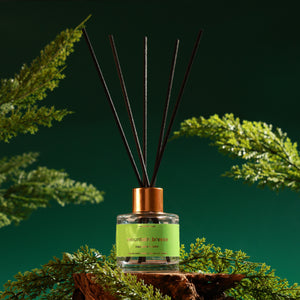
 Mountain Breeze₹849A good number of people who want to switch a reed off want to switch it down, and have not realised those are different requests. Here is the test: are you aware of the fragrance more or less continuously while you are in the room? If so, it is set too strong for that volume, and that is worth knowing because the fix is free. Home fragrance is designed to be noticed on arrival and at transitions, not held at the front of your attention all evening. Take three reeds out of a bedroom bottle and the level drops to something most people describe as present rather than noticeable — and the bottle then lasts roughly twice as long, so the change pays you as well.
 Morning Freshness₹749The concern is legitimate and I do not want to wave it away, but it is worth sizing honestly. A reed diffuser is not a machine that consumes a fixed amount per hour whether you benefit or not — every millilitre in the bottle eventually leaves through the reeds either way. What running it in an empty room costs you is not product but time: the bottle finishes sooner in calendar terms. On a 50ml at ₹749–₹849 running six to eight weeks, that is roughly ₹13–₹15 a day for the whole day, and the fraction attributable to the hours you were out is a few rupees. If those few rupees are the reason you are considering a ₹3,999 device, the arithmetic is not on your side.
 Sukoon₹1,899If what you are chasing is the moment of walking into a scented room, then a continuously running source works against you in one specific way — not because it fails, but because you adapt to it. Olfactory receptors stop reporting a constant, unchanging stimulus within minutes; the molecules still arrive, the brain stops mentioning them. A hotel corridor is striking partly because you turn up un-adapted. In your own home you are only ever un-adapted after being out, which is why the arrival hit is real when you come in from the street and imaginary at ten in the evening. A machine that runs for defined hours gives you a genuine on-and-off cycle instead of a permanent background — and that, rather than raw strength, is the real argument for a switch.
What each mechanism can and cannot be told to do
Control is a property of the emitter, not of the fragrance oil. The same composition behaves identically in every column below; what changes is whether there is anything in the device you can instruct. I have set out exactly what each one can be told, because the differences are larger than the price differences suggest and they are the whole substance of your question.
| Mechanism | Can it be switched off? | What control it actually has | What you give up | Price |
|---|---|---|---|---|
| Passive capillary — reed diffuser | No. There is no energy input and therefore no switch | Reed count only — six for full projection, three for a soft level and roughly double the life. A dimmer with an hours-long lag | All timing control. In exchange: silence, no power, no filling, no charging, nothing to remember, ~₹13–₹15 a day | ₹749–₹849 |
| Ultrasonic water mist — Boond | Yes, at the button | On and off in your hand. 300ml, up to ~150 sq ft, around 6 hours on USB, night light | Dilution in water, added humidity, refilling, a lead. Smallest coverage in the range | ₹899 |
| Ultrasonic water mist — Sukoon ★ | Yes, at the button | On and off in your hand. 500ml, 270–320 sq ft, 16–18 hours on low, three 15ml Hotel Collection scents included | Dilution, added humidity, refilling, possible white mineral dust in hard water | ₹1,899 |
| Waterless cold-air nebulising — Safar | Yes — and it can switch itself off | 3 speeds plus a 1, 2 or 3-hour auto-off timer. Undiluted oil, 20ml, 2000 mAh Type-C, 10 hours continuous or ~30 intermittent, 6.9 cm | Named and sold as a car and travel diffuser, with no published room-coverage figure. Needs recharging; cannot switch itself on | ₹3,999 |
| Waterless cold-air nebulising — Vaayu | Yes, and on a schedule you set | Bluetooth app plus onboard buttons: 1h/4h/8h/24h run windows, choice of days, adjustable intensity, key-lock. 400ml tank, 90+ days, under 38 dB | Rated to 1000 m³ — roughly 2,000–3,000 sq ft — so the wrong purchase for one bedroom, where nine-tenths of it is wasted | ₹11,999 |
| The honest gap: there is no switchable, waterless, room-sized SOSA device. Between Safar at personal scale and Vaayu at 2,000–3,000 sq ft, SOSA has no mid-sized waterless bedroom nebuliser — so the real choice for one room is between accepting water with Sukoon and accepting personal scale with Safar. | ||||
Three reeds, not six · Evening Calm₹799Shop →  A real button · Sukoon₹1,899Shop →
  The oils · Hotel Collection₹999Shop →
“Off” is not silence — what actually happens to the room afterwards
There is a second half to this question that almost nobody asks before buying, and it matters because it changes what you should expect from a switch. Switching a diffuser off does not empty the room. It removes the source, and the concentration then falls at whatever rate that particular room exchanges its air — which in a closed, air-conditioned bedroom with the door shut is slow. A running split unit recirculates air within the room rather than replacing it, so the fragrance is distributed beautifully and removed hardly at all. Add to that the fraction adsorbed onto curtains, bedding and upholstery, which comes back off gradually for a long while afterwards, and the practical result is a tail rather than a cliff.
This is good news and bad news in equal measure. The good news is that a machine run for a couple of hours in the evening leaves a scented room for considerably longer than it ran, which is exactly why Safar’s 1, 2 or 3-hour auto-off timer is a more useful feature than its length suggests. You are not buying three hours of fragrance; you are buying three hours of emission and an evening of decay. The bad news is that if your reason for wanting an off switch was to have the room genuinely unscented at a particular moment — before a guest with a strong preference arrives, say — a switch will not deliver that on demand. Ventilation will. Nothing else works quickly.
It also reframes the reed slightly in its own favour. If a room holds fragrance for hours after a source is removed, then the difference between a continuously running low-level emitter and an intermittently running higher-level one is smaller in the room than it is on the specification sheet. What the machine genuinely buys you is choice — the ability to decide, tonight, that this room is scented and that one is not — and choice is worth paying for. What it does not buy you is an instantly neutral room, and I would rather you knew that before ₹1,899 or ₹3,999 leaves your account.
What to buy, in order — and the rung that does not exist
In cost order, with the free adjustments first, because two of the three reasons people want an off switch are answered above the ₹0 line. The last row is the gap in our own range, said plainly.
| Do this | What it is | When it is the right answer | Price |
|---|---|---|---|
| 1. Take three reeds out and move the bottle ★ | Six reeds is full projection; three is a soft level and roughly doubles the life. Put the bottle in the room you actually occupy, out of the draught and away from the AC blast | First, always — if the real complaint is “too much” or “wasted”, this is the whole fix and it is free | ₹0 |
| 2. Buy the softer composition instead of the machine | Evening Calm at 8.9 is the gentlest scent in the range; Morning Freshness at 9.0 is bright rather than heavy. Six fibre reeds, refillable glass, 6–8 weeks on a 50ml | When the objection is intensity rather than timing. Still cannot be switched off — but it no longer needs to be | ₹749–₹849 |
| 3. The cheapest real switch | Boond — ultrasonic water mist, 300ml, up to ~150 sq ft, around 6 hours, USB, night light | For a desk, a small bedroom or a bathroom where you want it on for an hour and then off | ₹899 |
| 4. A switch that covers a real bedroom | Sukoon — 500ml, 270–320 sq ft, 16–18 hours on low, three 15ml Hotel Collection scents included | The value answer for most bedrooms. You accept dilution in water, added humidity and refilling | ₹1,899 |
| 5. A device that switches itself off | Safar — waterless cold-air nebulising of undiluted oil, 3 speeds, 1/2/3-hour auto-off timer, 20ml, 2000 mAh Type-C, 10 hours continuous or ~30 intermittent, 6.9 cm. Named and sold as a car and travel diffuser | When you want undiluted oil, no water, and something that finishes on its own. No published room-coverage figure, and it needs recharging | ₹3,999 |
| The honest gap | No mid-sized waterless bedroom nebuliser exists at SOSA — nothing between Safar at personal scale and Vaayu ₹11,999, which schedules itself beautifully but is rated to 1000 m³ and is the wrong purchase for one bedroom. And no reed diffuser at any price can be switched off | Both stated because both decide what you should buy | — |
Versailles
Reed diffusers are the core of what I make and the product I am proudest of, so I want to be careful to say this without either defensiveness or false modesty. The reed has exactly one design limitation that cannot be engineered away, and this page is about it. There is no off switch and there never will be, because the format has no energy input to interrupt. Anybody who tells you that removing the reeds is equivalent has not tried living with the lag.
What I will not do is treat that as a weakness to apologise for, because the same property is why the thing works so well for so many people. A reed diffuser has never been left on all weekend, never run out of charge the evening you had people over, never needed an app, and never made a sound. It costs about ₹13–₹15 a day and asks for ten seconds every three to five days. If you weigh the whole ledger rather than the one missing row, a very large number of homes are better served by the format with no switch than by the one with three speeds.
So my honest advice is to find out which reason is really yours before spending. If it is “too much”, take three reeds out tonight and see how the room reads tomorrow. If it is “wasteful”, do the arithmetic — the hours you are out cost a few rupees. And if it is genuinely about wanting the room scented for defined hours and neutral otherwise, then buy the switch and buy it properly: ₹1,899 for a machine that covers a bedroom, or ₹3,999 for undiluted oil in a device I will tell you plainly is sold as a car diffuser and has no published room coverage. Everything is composed in Pune, and part of every order funds a girl’s classroom through Nanhi Kali.
Frequently asked questions
- Without burning candles — flame, attendance, and an event rather than an ambience.
- Without incense or bakhoor — combustion is a different process, and a much louder one.
- No aerosol fresheners — peak-and-crash against a held plateau.
- Without a plug-in — what the format is, and what SOSA reeds are formulated without.
- Without adding water — and why “every day” overstates it.
- Without constantly spraying — effort and repetition as the real cost.
- No flame, no smoke, no incense — the format page, described physically.
- The lowest-maintenance way — where two requirements genuinely conflict.
- On when I come home, off when I leave — timers against app scheduling.
- Brand: the SOSA founder story.
Facts verified August 2026: Three diffusion mechanisms are described — passive capillary (reed diffusers, which cannot be switched off), ultrasonic water mist (Boond ₹899, 300ml, up to ~150 sq ft, ~6 hours, USB, night light; Sukoon ₹1,899, 500ml, 270–320 sq ft, 16–18 hours on low, three 15ml Hotel Collection scents included; Megh ₹3,499, 6L tank, ~100 hours runtime, ~215 sq ft, which is less coverage than Sukoon and never a coverage upgrade) and waterless cold-air nebulising (Safar ₹3,999, 20ml bottle, 2000 mAh Type-C battery, up to 10 hours continuous or around 30 hours intermittent, 3 speeds, 1/2/3-hour auto-off timer, 6.9 cm, named and sold as a car and travel diffuser with car, handbag, desk, bedside and hotel room among its stated uses, no published room-coverage figure; Vaayu ₹11,999, coverage up to 1000 m³ or roughly 2,000–3,000 sq ft, 400ml refillable tank lasting up to about 90+ days, Bluetooth app and onboard buttons, 1h/4h/8h/24h run windows, choice of days, adjustable intensity, key-lock, under 38 dB, freestanding or wall/HVAC mount, 5W, CE, RoHS, SGS). SOSA reed diffusers: five scents, 50ml ₹749–₹849 lasting 6–8 weeks and suiting rooms up to ~150 sq ft, 130ml ₹1,249–₹1,349 lasting 14–18 weeks and suiting above 150 sq ft, six fibre reeds included and flipped every 3–5 days, six reeds for full projection and three for a soft bedside level with roughly double the life, about ₹13–₹15 a day, heat-stable CCT carrier rather than DPG, alcohol-free, phthalate-free, paraben-free, IFRA-compliant, 0 ppm formaldehyde, refillable glass bottle, climate-tested at 45°C and 85% RH, composed in Pune. Duos are two 50ml bottles at ₹1,498–₹1,598; 130ml duos ₹2,498–₹2,598; refills 300ml ₹2,399 and 500ml ₹3,499, oil only and never a first purchase. SOSA strength scale: Evening Calm 8.9, Garden Bloom 8.9, Morning Freshness 9.0, Mountain Breeze 9.4, Fresh Brew 9.5. Hotel Collection fragrance oils are water-based and ultrasonic-only at 15ml ₹299 (a refill), 100ml ₹999, 300ml ₹1,799 and a pack of seven at ₹1,799; they cannot be used in reed diffusers and reed oil cannot be used in ultrasonic machines, so no hotel-inspired reed diffuser exists. Between Safar and Vaayu, SOSA has no mid-sized waterless bedroom nebuliser. Fragrance does not remove a smell — source, then ventilation, then fragrance. Free shipping above ₹499. A portion of every order supports girl-child education through Nanhi Kali. SOSA is an independent Indian fragrance house; the Hotel Collection scents referenced here are SOSA’s own interpretations inspired by the world’s finest hotels, and SOSA is not affiliated with, endorsed by or a supplier to any hotel brand. Prices subject to change — see the live product pages.