

Why a stronger oil does not reach further: it multiplies the entire concentration gradient rather than flattening it. The near zone becomes overpowering well before the far corner becomes noticeable, because the far corner starts so far below the threshold of detection that a multiplier applied to it still leaves it below.
Free fixes, in this order: six fibre reeds rather than three; halve the distance to where you sit; nose height on a surface; out of the draught but not in a dead corner; close the door; and a ceiling fan on low, which is the best free fix because it supplies the transport a reed cannot generate. It shortens the bottle's life — a fair trade to know about.
The honest gap: if you want a genuinely even room, Sukoon ₹1,899 is very often the right answer. Between Safar ₹3,999 — named and sold as a car and travel diffuser — and Vaayu ₹11,999, SOSA has no mid-sized waterless bedroom nebuliser at all.
2. A stronger oil multiplies the gradient rather than flattening it. The concentration around a reed falls smoothly with distance. Doubling the intensity of the liquid lifts every point on that curve by roughly the same proportion, so the near zone becomes considerably more intense while the far corner rises from almost nothing to slightly more than almost nothing. You arrive at "too much" beside the bottle long before you arrive at "enough" across the room. That is the whole answer, and it is why the stronger-oil strategy feels like it should work and consistently does not.
3. The nose makes it worse, not better. Smell is a compressive instrument: large increases in concentration produce comparatively modest increases in perceived strength. So the far corner needs a very large multiplier to become noticeable at all, while the zone beside the bottle needs only a small one to become oppressive. The two ends of the room are not asking for the same adjustment.
4. Start with the free changes, because a large share of people are finished after them. All six fibre reeds rather than three. Halve the distance between the bottle and where you actually sit. Nose height, on a surface. Out of the draught but not in a dead corner. Shut the door. And turn the ceiling fan on low — the best free advice on this page, because a fan supplies exactly the transport a reed structurally lacks. It shortens the bottle's life, and that is a trade you should get to make knowingly.
5. If you want projection, buy the thing that produces projection. That is moving air, which means an active diffuser. For one bedroom, Sukoon at ₹1,899 — 500ml, 270–320 sq ft, 16–18 hours on low, three 15ml Hotel Collection scents in the box. Water-diluted, adds humidity, needs a socket and refilling, and can leave a fine white mineral dust in hard-water cities. Note also that reed oil cannot go into an ultrasonic machine and the water-based Hotel Collection cannot go into reeds — so a machine adds a mechanism rather than transplanting your favourite scent.
Alcohol-free, phthalate-free, made in Pune. A portion of every order supports girl-child education through Nanhi Kali.
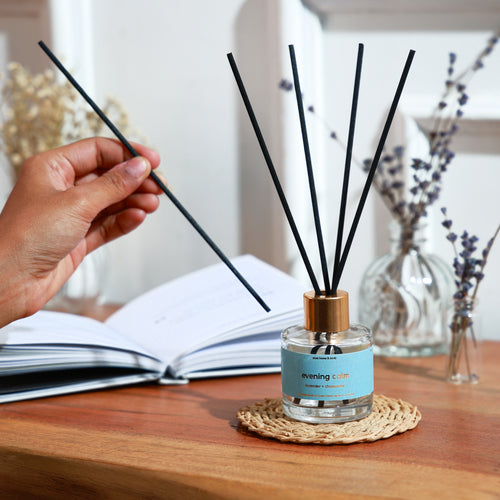
Intensity and projection, defined — and why the words get muddled
Fragrance intensity is how strongly a material registers at a given concentration. It is a property of the composition: which molecules are in it, how much of each, and how they behave in air. Two oils presented at exactly the same dilution can differ enormously in intensity, and that difference is real, measurable in a laboratory and audible to a nose. It travels with the liquid wherever the liquid goes.
Projection is how far the fragrance is carried away from its source. It is not a property of the composition at all. It is a property of the system: how much air is moving through the space, how large the volume is, how quickly that volume exchanges with the rest of the home, and what mechanism is putting the fragrance into the air in the first place. Change the mechanism and the same oil projects completely differently. Change the oil and the mechanism does not care.
The two words get muddled because on a skin or on a blotter they genuinely do move together — hold a strip closer or further and intensity and distance feel like one dial. In a room they come apart, because a room introduces a variable that a blotter does not have: a large volume of air that is moving, or not moving, entirely independently of your fragrance. A perfume house sells intensity. A diffuser sells projection. Those are different businesses and it took me some years to notice that our customers, very reasonably, assume they are the same one.
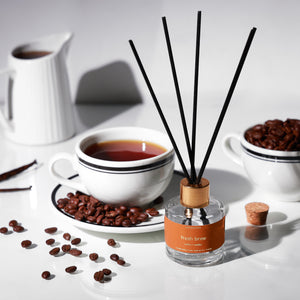
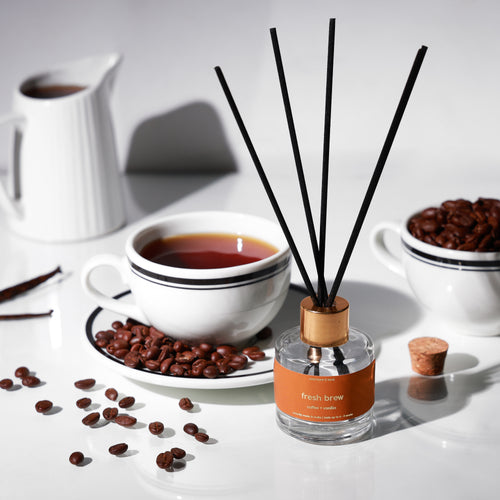
 Fresh Brew₹849How loudly the composition registers at a given concentration. Heavier materials — the coffee, vanilla and caramel in Fresh Brew, at 9.5 the deepest thing we make — persist and read as more present than the light, volatile ones. That is a genuine difference and it is worth choosing on. What it is not is a range specification. A deeper composition makes the zone around the bottle deeper. It does not make the zone bigger.
 Sukoon₹1,899How far the fragrance is carried from its source. This is decided by moving air, by the volume of the room and by how quickly that volume exchanges with the corridor and the outdoors. A reed supplies none of it — vapour reaches the far side by molecular diffusion, which is far too slow to cross metres usefully, and by whatever air the room happens to be moving anyway. An ultrasonic machine like Sukoon supplies it directly by throwing a mist, which is why 270–320 sq ft is a figure it can publish and a reed cannot.
 Garden Bloom₹799The concentration around a point source falls away steeply. A stronger oil lifts the whole curve proportionally, which helps enormously where the concentration is already substantial and helps almost imperceptibly where it is already close to nothing. So the effect of buying strength is felt first, and most, exactly where you did not need it. Meanwhile the nose compresses large concentration changes into modest perceived ones, which widens the mismatch further. The gradient's shape is set by the room, and the oil has no vote on it.
Why every intuitive upgrade fails in the same way
Once the two definitions are separate, the pattern becomes obvious. More reeds raise emission and shorten the bottle's life — six is full projection, three is a soft bedside level and roughly doubles how long the bottle lasts — but the extra vapour is released at the same point in the room and still has nothing to carry it. A bigger bottle raises duration and not reach at all; bottle volume is a duration specification, not a coverage specification. A second diffuser produces two concentration peaks with a valley between them, because neither source moves air and the midpoint is the farthest point from both — which is worth buying anyway for a long or L-shaped room used at both ends, for two rooms that are really one volume, or when you want different scents in different zones, and worth avoiding when what you want is evenness across one open space. A stronger oil multiplies the gradient without reshaping it. Four different purchases, one identical disappointment, and in every case the money went into emission while the shortage was in transport.
The clearest demonstration of the volume-is-not-coverage rule is inside our own range, and I would rather point at it than hide it. Megh at ₹3,499 has a six-litre tank and around a hundred hours of runtime, and it covers approximately 215 sq ft — less than the Sukoon at ₹1,899, which covers 270–320. Megh is a runtime and humidity machine and it is very good at that. It is never a coverage upgrade, and anyone reasoning from tank size to room size will buy it for the wrong reason.
I should also say plainly that there is no published figure for how far a reed diffuser projects, at SOSA or anywhere else, and I will not invent one. Any brand quoting you a distance in feet is quoting a number for a room it has never seen — the answer depends on the volume, the containment and the airflow of your particular space, and those three vary more between two homes than any two oils vary between themselves.
The four things people buy to fix projection, scored honestly
Every one of these is a reasonable thing to try. Three of them raise emission, one of them adds transport, and only the last one changes the shape of the gradient. The final row is the honest gap in our own range.
| What you buy | Raises emission? | Adds transport? | Effect on the far corner | Real cost |
|---|---|---|---|---|
| A stronger-smelling oil | Yes, modestly | No | Multiplies a very small number. Usually still imperceptible | The zone beside the bottle can become too much |
| Three more reeds (three to six) | Yes, directly | No | Stronger zone, same size. Right if even the zone was faint | Roughly halves the bottle's life |
| A larger bottle (50ml to 130ml) | No | No | None. This buys 14–18 weeks instead of 6–8 | About ₹500 more, for duration rather than reach |
| A ceiling fan on low — free | No | Yes | Genuine improvement. The gradient is mixed rather than multiplied | Shortens the bottle's life. Costs nothing else |
| An active diffuser — Sukoon ₹1,899 | Yes | Yes, by design | 270–320 sq ft as a published figure, because it moves air | Water-diluted, adds humidity, needs a socket, filling and cleaning |
| The gap: no mid-sized waterless room machine | — | — | Safar ₹3,999 is named and sold as a car and travel diffuser; Vaayu ₹11,999 covers roughly 2,000–3,000 sq ft | Nothing in the range is "a Vaayu for one bedroom", and I would rather name that than sell around it |

The cost of buying strength you did not actually need
There is a real penalty attached to the stronger-oil strategy, and it is worth naming because it is the commonest way a good composition gets ruined in a home. Almost any fragrance at too high a concentration flattens into a single sweet or sharp impression. The structure disappears, the individual materials stop being distinguishable, and what remains is the thing people mean when they say a room smells of air freshener. That is a dose effect rather than a quality effect — the same oil at a lower dose would have read as expensive. Which is why the same bottle can read as refined in one house and cheap in another, and why the word "cloying" almost always describes over-dosing rather than a bad formula.
So if you increase intensity to solve a distance problem, the most likely outcome is that you make the near field worse without making the far field better. Meanwhile the room stays uneven, because unevenness was never about the oil. It was about the fact that a point source with no transport produces a gradient, and every gradient has a top and a bottom.
A related worry, which people are quicker to feel than to say: did I get a weak bottle? Far more often it is the room. A 50ml is built for spaces up to about 150 sq ft; in a 300 sq ft open-plan room it reads as weak while performing exactly to specification. If you have ever moved the same bottle into a small closed bathroom and found it commanding again, you have already run the control experiment — same oil, same reeds, two rooms, two outcomes. That is proof the oil is fine, and it is the single most reassuring diagnostic in this whole subject.
What to buy, in what order — and what I would leave on the shelf
The order below buys transport before it buys intensity, because transport is what you are short of. Counterweights stated rather than buried, and the last row is the thing in our own range I would talk you out of for this particular problem.
| Step | What it is | When it is the right answer | Price |
|---|---|---|---|
| 1. The free method ★ | Six reeds, half the distance, nose height, door closed, ceiling fan on low | First, always. A large share of readers need nothing else | ₹0 |
| 2. The right scent at the right strength | Evening Calm 8.9 and Garden Bloom 8.9 · Morning Freshness 9.0 · Mountain Breeze 9.4 · Fresh Brew 9.5 — perceived intensity in a room, not quality and not reach | When you want a different character in the zone. Choose downwards for a small sealed bedroom | ₹749–₹849 |
| 3. Sukoon ultrasonic | 500ml, 270–320 sq ft, 16–18 hours on low, three 15ml Hotel Collection scents included. It moves air, which is the entire difference | When projection is genuinely what you want. Water-diluted, adds humidity, needs a socket and filling | ₹1,899 |
| 4. Safar waterless | Undiluted oil shattered into a dry mist — no water, no dilution, no humidity, no dust. Cordless, three speeds, 1 / 2 / 3-hour timer. Named and sold as a car and travel diffuser, needs recharging, not set-and-forget | Intensity and delivery together, at personal scale — desk, bedside, car | ₹3,999 |
| Not this: Megh, and not Vaayu — the honest gap | Megh: six litres, ~100 hours, ~215 sq ft — less than the ₹1,899 Sukoon. Vaayu ₹11,999: up to 1000 m³, roughly 2,000–3,000 sq ft. Between Safar and Vaayu there is no mid-sized waterless bedroom nebuliser | Megh is a runtime and humidity machine, never a coverage upgrade. Vaayu is the wrong purchase for one bedroom — nine-tenths of it is wasted in 120 sq ft. It earns its price on a whole floor or a large open-plan home | ₹3,499 / ₹11,999 |
Versailles
The single most useful thing I was taught at Versailles was to separate what a material is from what a device does with it. We spent weeks on intensity — how to build presence into a composition, how to make something read as luxurious rather than loud — and then somebody would put the same accord through a different delivery and the room would be unrecognisable. The formula had not changed at all.
So when somebody asks me for a stronger oil to fix a quiet room, I do not think they have misunderstood anything about fragrance. They have understood fragrance perfectly and been given no vocabulary for delivery, which is a gap in the way our whole industry talks rather than a gap in the customer. Nobody sells you the word "transport" on a label.
My honest advice: do not buy up the strength scale to solve distance. Buy up the strength scale when you want a different feeling in the room, and buy a mechanism when you want the room itself. And before either, move the bottle closer, put all six reeds in, close the door and run the fan on low — that is free, it works, and I would rather lose the sale than have you spend twice on the wrong axis. And whatever you add later, keep the bottle. A reed is silent, needs no power and no water, has nothing to fill or charge and nothing to remember, carries on through a power cut, costs roughly ₹13–₹15 a day, and it never breaks — no machine in our range can say all of that at any price. Everything is composed in Pune, and a part of every order funds a girl's classroom through Nanhi Kali.
Frequently asked questions
- Strong in the bottle, quiet in the room — headspace, and why it saturates in seconds.
- If the concentrate is powerful, why is the diffuser subtle? — payload and delivery.
- Fragrance strength versus diffusion strength — one is in the material, the other reaches you.
- Clear on the reeds, absent in the air — the saturated layer that exists nowhere else in the room.
- Does a stronger fragrance solve poor coverage? — answered directly.
- Why a fine fragrance can still feel weak passively — quality and reach are unrelated axes.
- Weak fragrance, or limiting delivery? — how to tell which one you have.
- Change the oil or change the diffuser? — the decision, made cleanly.
- A stronger fragrance, or a stronger method? — the family pillar.
- Brand: the SOSA founder story.
SOSA products — facts verified August 2026: Reed diffusers in 50ml and 130ml only. Morning Freshness ₹749 / ₹1,249 · Evening Calm ₹799 / ₹1,299 · Garden Bloom ₹799 / ₹1,299 · Mountain Breeze ₹849 / ₹1,349 · Fresh Brew ₹849 / ₹1,349. 50ml suits rooms up to ~150 sq ft and lasts 6–8 weeks; 130ml suits above 150 sq ft and lasts 14–18 weeks; roughly ₹13–₹15 a day. Six fibre reeds in a refillable glass bottle, on a heat-stable CCT (caprylic/capric triglyceride) carrier rather than DPG, alcohol-free, phthalate-free, paraben-free, IFRA-compliant, 0 ppm formaldehyde, climate-tested at 45°C and 85% RH, composed in Pune. Strength scale: Evening Calm 8.9 · Garden Bloom 8.9 · Morning Freshness 9.0 · Mountain Breeze 9.4 · Fresh Brew 9.5. Duos ₹1,498–₹1,598 (50ml × 2) and ₹2,498–₹2,598 (130ml × 2). Refills 300ml ₹2,399 · 500ml ₹3,499, oil only and never a first purchase. Machines: Boond ₹899 (300ml, ≤~150 sq ft, ~6h, USB, night light) · Sukoon ₹1,899 (500ml, 270–320 sq ft, 16–18h on low, three 15ml Hotel Collection scents included) · Megh ₹3,499 (6L, ~100h runtime, ~215 sq ft) · Safar ₹3,999, named and sold as a waterless car perfume diffuser, 20ml, 2000 mAh, up to 10 hours continuous or around 30 hours intermittent per charge, three speeds and a 1 / 2 / 3-hour auto-off timer, 6.9 cm · Vaayu ₹11,999 (waterless cold-air nebuliser, up to 1000 m³ or roughly 2,000–3,000 sq ft, 400ml tank up to ~90+ days, Bluetooth app and onboard controls, 1h / 4h / 8h / 24h windows, under 38 dB, 5W, CE, RoHS, SGS). Aangan ₹25,999 and Meenar ₹38,500 are commercial machines and are never a home recommendation. Hotel Collection oils are water-based and ultrasonic-only: 15ml ₹299 · 100ml ₹999 · 300ml ₹1,799 · pack of 7 ₹1,799. Reed oil and Hotel Collection oil are not interchangeable in either direction and there is no hotel-inspired reed diffuser. No health, air-quality, allergy or sleep claims are made for any SOSA product; fragrance does not remove an unwanted smell, which is a matter of source, then ventilation, then fragrance. Free shipping above ₹499. A portion of every order supports girl-child education through Nanhi Kali. SOSA is an independent Indian fragrance house; the Hotel Collection scents are SOSA's own interpretations inspired by the world's finest hotels, and SOSA is not affiliated with or endorsed by any hotel brand. Prices subject to change — see the live product pages.