
Why Does My House Smell of Fish for Two Days?

Why Does My House Smell of Fish for Two Days?

★ Indian cooking, small flats and the smell that is still there at eleven · the order that actually worksCandle ₹379 · reed ₹749 · Boond ₹899 · Sukoon ₹1,899 · free shipping above ₹499A portion funds girl-child education
★ SOSA · find the cause, then scent the room
Extraction while you cook, ten minutes after, a door shut and the air changed — and only then anything with a scent in it
★ ★ ★ ★ ★
★★★★★
"Chimney on only while cooking was my mistake. Ten minutes afterwards was the whole difference, and it cost nothing."
Meghna K. Free fix · extraction
1BHK, Mumbai
★★★★★
"Fish for two days. Learned it was aerosol landing on fabric rather than air, washed what I could, and it went in an afternoon."
Joseph A. Fabric, not air
Kochi
★★★★★
"Asked straight out whether a diffuser would cover tadka. Was told no, and told why. I bought one anyway, for afterwards, and it is the right way round."
Preeti N. Honest answer
Told the truth
★★★★★
"Open kitchen, so containment was never going to work. Switched to a dry scent that sits somewhere completely different from food. That was the trick."
Rahul V. Forest Suite ₹299
Open kitchen
★★★★★
"Bedroom door shut during cooking. One sentence, free, and my clothes stopped smelling of dinner."
Shalini D. Free fix · shut the door
2BHK, Pune
★★★★★
"Sukoon on the 4H timer from six, not at eight when everyone arrives. The flat has already got there by then."
Imran H. Sukoon · 4H timer
₹1,899
★★★★★
"Chimney on only while cooking was my mistake. Ten minutes afterwards was the whole difference, and it cost nothing."
Meghna K. Free fix · extraction
1BHK, Mumbai
★★★★★
"Fish for two days. Learned it was aerosol landing on fabric rather than air, washed what I could, and it went in an afternoon."
Joseph A. Fabric, not air
Kochi
★★★★★
"Asked straight out whether a diffuser would cover tadka. Was told no, and told why. I bought one anyway, for afterwards, and it is the right way round."
Preeti N. Honest answer
Told the truth
★★★★★
"Open kitchen, so containment was never going to work. Switched to a dry scent that sits somewhere completely different from food. That was the trick."
Rahul V. Forest Suite ₹299
Open kitchen
★★★★★
"Bedroom door shut during cooking. One sentence, free, and my clothes stopped smelling of dinner."
Shalini D. Free fix · shut the door
2BHK, Pune
★★★★★
"Sukoon on the 4H timer from six, not at eight when everyone arrives. The flat has already got there by then."
Imran H. Sukoon · 4H timer
₹1,899
Find the source first · two windows for twenty minutes beats any product for a closed smell Fragrance is the finishing layer. It does not remove damp, a dry drain or a loaded sofa Sukoon ₹1,899 · 270–320 sq ft · 16–18 hours per fill · three 15ml scents included


Founder Diaries · Home Fragrance · Why Your Home Smells of Cooking
By Sonal Sahani · ISIPCA Versailles 11 min read Updated August 2026
This one has a real chemical answer, and it is more satisfying than the folklore around it. The smell of fish is largely trimethylamine and its relatives — small, volatile, alkaline molecules that your nose detects at concentrations most other kitchen smells could not register at, and that bind readily to almost any surface they land on. That combination is why fish outlasts everything else you cook. It is also why the free fix genuinely works: an alkaline smell is neutralised by a mild acid, so vinegar and lemon are not a folk remedy here. They are the correct reagent.
Quick answers — read this first
Why it lingers: fish odour is mostly trimethylamine and related amines. They are volatile, they are alkaline, they adsorb onto surfaces and fabric, and the human nose detects them at extraordinarily low concentrations — so a trace reads as a lot.

What genuinely works, and is free: because amines are alkaline, a mild acid neutralises them into a non-volatile salt. A bowl of vinegar left out overnight, a vinegar wipe of the hob, counter and tiles, lemon in the pan and lemon or vinegar down the sink. This is chemistry, not a folk remedy.

Then the four hiding places: the bin the packaging went into, the sink trap, the cloth used to wipe the board, and the fabric in the room. A diffuser neutralises none of that — it adds a scent alongside.
The short answer
Short answer: fish smell is dominated by trimethylamine, an alkaline volatile amine that the human nose can detect at parts-per-billion levels and that adsorbs readily onto surfaces. Mild acid neutralises it into a non-volatile salt, which is why vinegar and lemon actually remove the smell instead of covering it.
The free method: a shallow bowl of white vinegar left out overnight in the kitchen; a vinegar-and-water wipe of the hob, the counter, the tiles behind and the inside of the hood; lemon halves rubbed on the board and the knife; hot water with a squeeze of lemon down the sink; the bin liner changed and taken out of the flat immediately, not at the end of the evening.
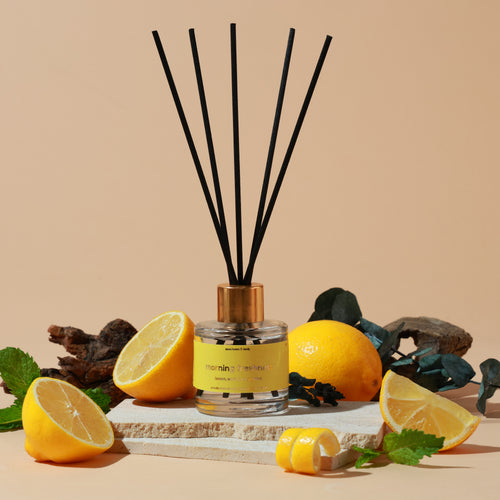
Afterwards, once the smell has actually gone: a Bookshop candle at ₹379 gives a room scent in fifteen to twenty minutes and must be attended, the Sukoon is ₹1,899 with steady, 2H and 4H timers and three 15ml Hotel Collection scents included, and Morning Freshness from ₹749 holds one level for months after 24 to 72 hours. SOSA does not make a room or linen spray for the home.
Straight answer
Why does the smell of fish stay in the house for two days when other cooking smells do not?
1. Because you are smelling amines, and amines are a different problem. The dominant compound is trimethylamine, with dimethylamine and ammonia alongside it. They are small, volatile, alkaline and detectable by the human nose at concentrations far below what most cooking odours need to register — so a residue that would be inaudible for anything else is still loud for this.

2. Neutralise rather than mask, and use acid. An alkaline molecule reacting with a mild acid becomes a salt, and a salt does not evaporate, so it stops being a smell. That is the whole mechanism, and the reagents are in your kitchen already.

3. A shallow bowl of white vinegar, left out overnight. Free, passive, and genuinely effective on airborne amine. Two bowls in a 1BHK — one in the kitchen and one wherever the smell is strongest.

4. Wipe with vinegar and water, then use lemon where you cooked. The hob, the counter, the tiles behind, the inside of the hood and the sink. Lemon halves on the board and the knife; hot water and lemon down the drain.

5. Then find the four hiding places. The bin the packaging went into, the sink trap, the cloth you wiped the board with, and any fabric in the room. Any one of them alone will keep the smell going for two days.

6. Only then, fragrance — and it is for a room that no longer smells of fish. A candle at ₹379 for tonight, a Sukoon at ₹1,899 for every night after. Neither of them neutralises anything, and I would rather say so.

A portion of every order supports girl-child education through Nanhi Kali.

TL;DR: fish odour is mostly trimethylamine — volatile, alkaline, and detectable by the nose at extraordinarily low concentrations, so a trace reads as a lot. Because it is alkaline, mild acid neutralises it: a bowl of vinegar overnight, a vinegar wipe, lemon in the pan and down the sink. Then the bin, the trap, the cloth and the fabric.
SOSA home range · what exists
The thing this page is not going to sell you
SOSA home range · what exists from ₹379
Ultrasonic diffusers, water-based fragrance for them, alcohol-free reed diffusers, scented candles and wax melts. Nothing in that list neutralises an amine. A fragrance adds a scent alongside the one already in the room; it does not react with it, bind it or remove it, and anybody telling you otherwise about a domestic product is selling rather than explaining. The thing that genuinely neutralises trimethylamine is a mild acid, and you already own one. This is a shop telling you the free chemistry works, because it does, and because a page that recommends vinegar first is the only kind worth reading on this subject.

What you are actually smelling

It is worth knowing the chemistry here, because it is one of the few household smells where knowing it changes what you do. Fresh fish, straight out of the water, barely smells of fish at all. What it contains is trimethylamine oxide, an odourless compound the animal uses to manage the salinity it lives in — and once the fish is dead, bacterial and enzymatic action steadily converts that oxide into trimethylamine, which is anything but odourless. That conversion is why the smell strengthens with time from the catch rather than with cooking, why very fresh fish is mild and older fish is not, and why the answer to a strong smell sometimes begins at the fishmonger rather than in your kitchen.

1
THE MOLECULE
Small, volatile, alkaline — and detectable at parts per billion
So, properly. Trimethylamine is a small molecule with a low boiling point, which means it evaporates readily at room temperature and travels through air with very little help. Alongside it sit dimethylamine, ammonia and a family of related nitrogen compounds, all behaving similarly. Two properties then do all the work on this page. The first is your own sensitivity: human olfactory receptors respond to trimethylamine at concentrations in the parts-per-billion range, which is orders of magnitude below what is needed for most of the compounds in a tadka or a roast. The practical consequence is that a quantity of residue which would be entirely undetectable for any other cooking smell is still clearly audible for this one — so you are not smelling a lot of fish two days later, you are smelling a very small amount of something you happen to be exceptionally good at detecting. That single fact resolves most of the frustration people feel here, because the instinct is to assume the cleaning failed when in fact the cleaning removed ninety-nine per cent and the remaining one per cent is still above threshold. The second property is that amines are basic. They carry a lone pair of electrons that readily picks up a proton, which makes them chemically reactive in a way that most odour molecules are not — and it means they adsorb strongly onto slightly acidic, moist or porous surfaces rather than simply bouncing off them. A tiled wall with a film of condensed cooking moisture on it, a wooden board, a cotton cloth, a plastic chopping mat: all of these hold amine, and then release it slowly back into the room over hours and days. Air exchange removes what is airborne. It does nothing to what has bound to a surface, which is the entire reason this smell outlasts the ventilation.
2
THE FIX THAT IS ACTUALLY CHEMISTRY
An alkaline smell is neutralised by a mild acid, for free
Which is where the good news is, and it is unusually good news for a page in this cluster. Because these molecules are basic, an acid neutralises them — and neutralise is the correct word rather than a loose one. Acetic acid in vinegar or citric acid in lemon juice donates a proton to the amine, and the product is an ammonium salt, which is ionic, has a far higher boiling point and does not evaporate into the room. It has stopped being a smell rather than been covered by one. That is a genuine chemical reaction happening on your counter, not a household superstition, and it is the reason the vinegar advice survives generation after generation while most kitchen folklore does not. Three applications of it are worth doing, and all three are free. First, a shallow bowl of plain white vinegar left standing out overnight in the room. It works passively on airborne amine as the two meet in the air and at the liquid surface, it needs no attention, and in a small flat two bowls are better than one. Second, a wipe: vinegar diluted about one part in four with water, over the hob, the counter, the tiles behind, the inside and underside of the hood and the sink itself. This is the one that matters most, because those are the surfaces the amine has bound to. Third, lemon where the fish physically touched things — a cut half rubbed over the chopping board and along the knife, then left a minute before rinsing, and the rest of it squeezed into hot water and poured down the sink. One honest caveat: do not use vinegar on natural stone or unsealed marble counters, where the acid will etch the surface. Use dish soap and hot water there and put the vinegar into the air instead.
3
THE FOUR HIDING PLACES
The bin, the trap, the cloth and the fabric
And then the reason it comes back after you thought you had dealt with it, which is that the fish is usually still in the flat. The bin is the first and the worst. The packaging, the wrapping paper, the polythene, the trimmings and the head went into it, and a kitchen bin is warm, enclosed and moist — the ideal environment for continued bacterial conversion. That bin is producing new trimethylamine while you are cleaning the counter. Change the liner and take it out of the flat immediately, not at the end of the evening and certainly not the next morning, and wipe the inside of the bin itself, which is usually dirtier than the rubbish in it. Second, the sink trap. Rinsings went down there and the U-bend holds standing water by design, so anything organic that reached it is sitting in a warm wet reservoir venting gently into your kitchen. A kettle of hot water, a tablespoon of bicarbonate and then the juice of a lemon or a cup of vinegar down the drain deals with it, and the strainer basket needs lifting out and scrubbing rather than rinsing. Third, the cloth. Whatever you wiped the board with is now the most concentrated source in the room, and hanging it on a hook to dry is how a cloth becomes a culture. Into the machine, or boiled, or thrown out. Fourth, fabric in the room — the kitchen towel, the curtain nearest the hob, and in an open-plan flat the sofa and the cushion covers, all of which have taken amine out of the air and will release it for days. Washable covers into the machine, and sunlight on anything that cannot go in.
The order that decides whether this takes an afternoon or two days: get the source out of the building first, then neutralise the surfaces, then deal with the fabric. Doing it in any other order means re-cleaning.

The four places it is still sitting

Where the amine actually is once the cooking is over, why each one holds it, and what removes it. Nothing in the first five rows costs anything. The last row is where a scented product belongs, and it belongs there because by then there is nothing left to neutralise.

Where the smell is hiding
What holds trimethylamine, and what actually removes it
Where it is Why it stays there What removes it Time Cost
The bin ★ Warm, enclosed and moist — the packaging is still converting to fresh amine while you clean Liner changed and taken out of the flat immediately; the bin itself wiped Two minutes ₹0
Hard surfaces Amines are basic and bind to slightly acidic, moist or porous surfaces rather than bouncing off Vinegar at about one part in four with water over hob, counter, tiles and hood. Not on unsealed stone Ten minutes ₹0
The air Small volatile molecules detectable at parts per billion, so a trace still reads as a lot A shallow bowl of white vinegar left out overnight, plus twenty minutes of cross-ventilation Overnight ₹0
The sink trap Rinsings reached standing water in a U-bend, which vents gently back into the kitchen Hot water, a spoon of bicarbonate, then lemon juice or vinegar. Scrub the strainer rather than rinsing it Five minutes ₹0
The cloth and the fabric The cloth is the most concentrated source in the room; curtains and cushions adsorb from the air Cloth into the machine or thrown out; washable covers washed; sunlight on what cannot be A day ₹0
Afterwards Nothing left to neutralise — the room now smells of a clean kitchen A scent, chosen because you want one, on air that no longer has anything in it 15–20 min from ₹379
Shop this guide
For the evening after the vinegar
The SOSA principle
A fragrance does not neutralise an amine. It puts a second smell into the same air. A mild acid genuinely does neutralise one, and it costs nothing at all.
Acetic acid meets an alkaline amine and produces a salt, which does not evaporate and therefore stops being a smell. That is a reaction, not a cover. It is the one household remedy in this cluster with real chemistry behind it.

The method, in order, and what fragrance is for

Do it in this order and it takes an afternoon; do it in any other order and it takes the two days the title complains about. Source out of the building first. The bin liner is tied and carried out now, with the packaging and the trimmings in it, and the empty bin is wiped inside with vinegar and water before the new liner goes in. While you are there, the sink: strainer basket lifted out and scrubbed rather than rinsed, then a kettle of hot water, a tablespoon of bicarbonate and the juice of a lemon down the drain. Then the cloth you used goes into the machine or into the bin, and a clean one comes out. Only then do the surfaces, because wiping a counter while a loaded bin sits two feet away is work you will repeat. Vinegar at roughly one part in four with water over the hob, the counter, the splashback tiles, the front of the cupboards nearest the pan and the inside and underside of the extraction hood, which almost nobody wipes and which has been directly in the plume all evening. Cut lemon on the board and the knife, left a minute, then rinsed. And then the air: two openings on opposite or adjacent walls for twenty minutes, because one open window is ventilation and two is exchange, with a bowl of white vinegar left standing overnight to work on whatever is still airborne. In a monsoon month, keep the exchange short and rely more on the vinegar bowl than on the windows, since opening a flat wide on a wet day imports moisture at eighty to ninety-five per cent relative humidity and creates a second problem.

Then the two things people ask about that I would not do. The first is a scented spray, and SOSA does not make one for the home in any case — the sprays in the range are car perfumes, formulated for about three cubic metres of hot moving air. A spray puts a fine mist of fragrance and solvent into a room for perhaps thirty minutes and then it is gone, and if the amine is still there you have simply had two smells for half an hour and one smell afterwards. The second is running a diffuser during or immediately after cooking fish, in the hope of intercepting it. A cool-mist ultrasonic breaks water into a fine suspension at thirty to fifty millilitres an hour and the fragrance rides it. There is no reaction taking place between that fragrance and the trimethylamine in the room; they are simply two populations of molecules in the same volume, and your nose reports both. Worse, on a fish evening you have a room with humid air and surfaces already carrying a condensed film, which is exactly the condition in which adding thirty to fifty millilitres of water an hour is unhelpful. Deal with the chemistry first. If you want something in the air while you work, it is a bowl of vinegar rather than a machine. What I will say for candles is narrower and honest: a flame is a heat source and creates a local convection current, which improves mixing in a small room, but the effect is modest and it is not why you would buy one.

Then the part where something is legitimately for sale, and it belongs to a room that no longer smells of fish. Once the bin has gone, the surfaces are neutralised, the trap is clear and the cloth is in the machine, you have a kitchen that smells of nothing in particular, and that is the only surface a fragrance should ever be laid onto. For that evening, a Bookshop candle at ₹379 puts scent into a normal room in fifteen to twenty minutes and burns for roughly fifteen to eighteen hours; it must be attended and put out, and Amber Rose candle at ₹599 for 130g runs twenty-five to thirty hours if you want something warmer. For every evening after that, the Sukoon at ₹1,899 covers 270–320 sq ft, gives 16–18 hours per fill on low at 30–50 ml/h against 9–12 on high, has steady, 2H and 4H timers, a remote and auto shut-off, and arrives with three 15ml Hotel Collection scents of your choice; four drops in a kitchen-adjacent living room, three in a small flat, the dose being per tank rather than per litre. And if what you actually want is a level that never changes and nothing to switch on, Morning Freshness from ₹749 — Malabar lemon, peppermint and eucalyptus — is a reed, which means twenty-four to seventy-two hours before it is doing its job. That makes it the wrong purchase for tonight and the right one for a kitchen doorway you would like to hold one bright note for months. I mention the citrus in it deliberately and then decline to make the obvious claim: lemon in a fragrance smells of lemon, it does not neutralise anything. The lemon that does chemistry is the one you cut in half and rub on the board.

You are not smelling a lot of fish two days later. You are smelling a very small amount of something your nose happens to be extraordinarily good at detecting.
— Sonal Sahani, SOSA

The SOSA edit

In the order that turns two days into an afternoon. Five of the seven rows cost nothing and use things already in the kitchen, and the two that cost something are for a room where the work is finished. The final row names the product this page would recommend if SOSA made it, which SOSA does not.

The SOSA edit
Getting fish out of a flat, in working order
Do What it is Why it is in this position Cost
1. The bin, out of the building ★ Liner tied and removed now, with the packaging and trimmings in it; the bin wiped inside It is still producing fresh amine while you clean. Everything else is wasted until this is done ₹0
2. Vinegar on the surfaces One part vinegar to about four of water over hob, counter, tiles, cupboard fronts and inside the hood Acid neutralises an alkaline amine into a non-volatile salt. Avoid unsealed stone, which it etches ₹0
3. A bowl of vinegar overnight A shallow open bowl left standing in the room, two of them in a small flat Works passively on what is still airborne while you sleep. No attention required ₹0
4. The trap and the cloth Strainer scrubbed, hot water with bicarbonate and lemon down the drain, cloth into the machine The two sources people never suspect, and either alone will keep the smell running for days ₹0
5. Fabric and twenty minutes of exchange Washable covers and kitchen towels washed; two openings on opposite walls for twenty minutes Fabric adsorbs from the air and re-releases for days. One open window is ventilation; two is exchange ₹0
6. Bookshop candle or Sukoon 80g candle at roughly 15–18 hours, or a 500ml diffuser with timers and three 15ml scents included For the evening after, on air that is already clean. The candle for tonight, the machine for every night ₹379 / ₹1,899
Not made by SOSA: a neutralising spray or an odour eliminator SOSA makes diffusers, water-based fragrance, alcohol-free reeds, candles and wax melts. No room or linen spray The reagent that neutralises an amine is a mild acid, and you already own it. Said plainly rather than sold around
Honest notes for buyers: fragrance is the last step, never the first. It layers on air that is already clean and moving, and it will not remove a source — not damp, not a dry drain trap, not a loaded sofa, not a filter that needs washing. Deal with the cause, change the air, then scent the room. On timing: a candle puts scent into a room in fifteen to twenty minutes and a Sukoon reaches a steady level in about twenty, while a reed diffuser needs a day to three days before it is doing its job — the wrong buy for a deadline and the right buy for a room you want to hold one level for months. SOSA does not make a room or linen spray for the home; the sprays in the range are car perfumes. A cool-mist ultrasonic adds 30–50 ml of water an hour to the air, so it is the wrong machine for a room you are trying to dry out. The Hotel Collection is water-based and runs in the Sukoon, Boond and Megh only — not in reeds and not in the waterless Vaayu. Reed diffusers are a separate alcohol-free line with their own scents. Candles must be attended and put out. The Hotel Collection scents are SOSA's own interpretations inspired by the world's finest hotels; SOSA is an independent Indian fragrance house, not affiliated with or endorsed by any hotel brand. A portion of every order supports girl-child education through Nanhi Kali.
SOSA Bookshop candle
For the evening after, once the vinegar has done the work
SOSA Bookshop candle ₹379 / 80g
An 80g scented jar candle hand-poured in Pune, roughly 15 to 18 hours of burn and scent in a normal room within fifteen to twenty minutes — the fastest thing SOSA makes. A flame lifts heavier, resinous materials that a cool mist cannot, which is why a candle reads as warmer and rounder in a room that has just been scrubbed and aired, and why it is the format I would light on the second evening rather than the first. Attend it and put it out. Amber Rose candle is ₹599 for 130g at roughly 25 to 30 hours, Smoked Oudh candle is ₹449 if you want something darker, and the Pure Calm wax melt set is ₹854 if you would rather have no flame at all.
SS
ISIPCA
Versailles
A note from Sonal

I like this question because it is the one where the honest answer is chemistry rather than judgement, and where the correct product is in your kitchen already. Fish smells the way it does because a compound the animal used to survive in salt water turns, after death, into a small alkaline molecule your nose can detect at a few parts in a billion. You are not dealing with a large amount of anything. You are dealing with a tiny amount of something you are unusually well equipped to notice. Understanding that changes how you feel about the second day: the cleaning did not fail, it simply left a residue that would be invisible for any other smell.

And then the part I want to be very clear about, because it is the sentence a fragrance company is least inclined to write. Nothing I make neutralises an amine. A diffuser puts a scent into the same air; it does not react with what is there, and if the fish is still present you will have both. Vinegar does react. Lemon does react. They are free, they are already on your shelf, and they work by an actual mechanism. So do that first, get the bin out of the flat, scrub the strainer, wash the cloth — and then, on a kitchen that smells of nothing, light a candle for two hours because you would like the room to smell of something you chose. That is the correct order, and it is the only one in which I am comfortable selling you anything at all.

Everything is made and supported from Pune, and a part of every order funds girl-child education through Nanhi Kali. You get a home that smells like somewhere you chose; a girl gets a classroom. That equation has always felt right to me.

Frequently asked questions

Why does fish smell linger longer than other cooking smells?
Because the dominant compound is trimethylamine, an alkaline volatile amine that the human nose detects at parts-per-billion levels and that binds readily to surfaces and fabric. A residue too small to register for any other cooking smell is still clearly detectable for this one.
Does vinegar actually remove fish smell, or is that a myth?
It genuinely works, and the mechanism is real. Amines are basic, so acetic acid in vinegar or citric acid in lemon donates a proton and forms an ammonium salt, which does not evaporate. The smell is neutralised rather than covered. Avoid vinegar on unsealed stone, which it will etch.
Where is the fish smell hiding after I have cleaned the kitchen?
Four places, and any one of them will keep it running. The bin the packaging went into, the sink trap and its strainer, the cloth you wiped the board with, and the fabric in the room — kitchen towels, the curtain nearest the hob and, in an open-plan flat, the cushion covers.
Will a diffuser or a candle get rid of the fish smell?
No. A fragrance adds a scent alongside the one already there; it does not react with trimethylamine or remove it. Neutralise with acid, get the bin out of the flat and exchange the air first. Then a Bookshop candle at ₹379 or a Sukoon at ₹1,899 has something clean to sit on.
Why does some fish smell much stronger than other fish?
Because trimethylamine is produced after death by bacterial and enzymatic conversion of trimethylamine oxide, so the concentration rises with time from the catch. Very fresh fish barely smells of fish at all, which means part of the answer to a strong smell begins at the point of purchase.
Chemistry first, fragrance second
Neutralise it, do not cover itthen scent a kitchen that is actually clean
The vinegar, the lemon, the bin and the trap cost nothing and come first. Afterwards, the Bookshop candle is ₹379 for 80g at roughly 15–18 hours with scent in the room in fifteen to twenty minutes, Amber Rose is ₹599 for 130g, and the Sukoon is ₹1,899 for 270–320 sq ft with steady, 2H and 4H timers and three 15ml Hotel Collection scents of your choice included. Morning Freshness is from ₹749 and needs 24 to 72 hours. Free shipping above ₹499, and a portion of every order supports girl-child education through Nanhi Kali.
See the candles · ₹379 See the Sukoon · ₹1,899
Continue the read
More from SOSA
Editorial standards & sources
About this guide: Written by Sonal Sahani, ISIPCA Versailles-trained founder and perfumer at SOSA Home & Body, on why fish odour is dominated by trimethylamine and related amines, why their volatility, alkalinity and extremely low human detection threshold make a trace read as a great deal, why mild acid neutralises them into non-volatile salts so that vinegar and lemon are genuine chemistry rather than folklore, where the residue actually sits once the cooking is over, and why no fragrance neutralises anything at all.

Facts verified August 2026: Diagnostic facts used in this guide: a closed room accumulates what it cannot exchange, so cross-ventilation needs two openings rather than one; a drain's U-bend water seal evaporates in roughly two to four weeks of disuse and then admits sewer gas, which is corrected by pouring water down the drain; microbial growth in fabric and on surfaces accelerates above about 60% relative humidity, and Indian monsoon indoor humidity commonly runs 80–95%, which is the one situation where ventilating on a wet day can import moisture rather than remove it; an air-conditioner's cold, wet evaporator coil and filter grow biofilm that is blown into the room on start-up; textiles adsorb cooking aerosol and body oils and re-release them for weeks; and olfactory adaptation makes a constant household smell undetectable to its residents within about a fortnight while visitors still perceive it. Timings: a scented candle scents a normal room in roughly 15–20 minutes, a Sukoon ultrasonic diffuser reaches a steady level in about 20 minutes from cold, and a reed diffuser needs roughly 24–72 hours. SOSA products and prices: Sukoon 500ml ₹1,899 (270–320 sq ft, 16–18h on low, 9–12h high, 30–50 ml/h, 2.4MHz cool mist, remote, steady/2H/4H timers, BPA-free, auto shut-off, includes three 15ml Hotel Collection scents of your choice); Boond 300ml ₹899; Megh 6-litre ₹3,499; waterless Vaayu ₹11,999 (up to 1000m³); Aangan ₹25,999. Hotel Collection water-based fragrance 15ml ₹299, 100ml ₹999, 300ml ₹1,799, Pack of 7 at 15ml ₹1,799; dose 3–6 drops per tank. Reed diffusers (separate alcohol-free line): Morning Freshness from ₹749, Garden Bloom and Evening Calm from ₹799, Fresh Brew and Mountain Breeze from ₹849; 130ml from ₹1,249; duos from ₹1,498; 300ml refills ₹2,399. Scented candles: Bookshop 80g ₹379, Amber Rose 130g ₹599 and 220g ₹799, Smoked Oudh 130g ₹449, ceramic jar candles ₹949, Pure Calm wax melt set ₹854. Free shipping above ₹499. SOSA does not make a room or linen spray for the home. The Hotel Collection scents are SOSA's own interpretations; SOSA is not affiliated with or endorsed by any hotel brand. Prices subject to change — see the live product pages.
Torna al blog