

Why Do My Bath Towels Make the Whole Bathroom Smell?

Why Do My Bath Towels Make the Whole Bathroom Smell?

★ The bathroom you clean every day that still smells · and the drain nobody thinks to checkCandle ₹379 · reed ₹749 · Boond ₹899 · Sukoon ₹1,899 · free shipping above ₹499A portion funds girl-child education
★ SOSA · find the cause, then scent the room
A U-bend holds a water seal against sewer gas. It evaporates in a few unused weeks, and then the room vents. A mug of water fixes it
★ ★ ★ ★ ★
★★★★★
"A mug of water down the floor drain. That was it. I had been cleaning a bathroom that was not dirty for six months."
Sunita G. Free fix · drain trap
The whole answer
★★★★★
"Came back from three weeks away to a sewage smell and assumed something had died. Dry traps in two bathrooms. Sorted in five minutes."
Dinesh A. After holiday
Free fix · five minutes
★★★★★
"Asked which reed to buy for the bathroom. Was told to check three things first and come back. Two of them fixed it and I bought the reed anyway."
Preethi V. Diagnosed first
Bought second
★★★★★
"Kitchen sink, not the bathroom. The smell had been travelling and I had been treating the wrong room entirely."
Yash C. Kitchen trap
Found the source
★★★★★
"Towels. Never dry properly in monsoon, and a damp towel in a small bathroom is a smell generator. Now they go out on the balcony."
Anita M. Towels, Mumbai
Free fix · dry them
★★★★★
"Once the drain was fixed, a small reed by the basin was all it needed. Nothing to plug in, nothing to remember."
Farhan K. Reed · bathroom
from ₹749
★★★★★
"A mug of water down the floor drain. That was it. I had been cleaning a bathroom that was not dirty for six months."
Sunita G. Free fix · drain trap
The whole answer
★★★★★
"Came back from three weeks away to a sewage smell and assumed something had died. Dry traps in two bathrooms. Sorted in five minutes."
Dinesh A. After holiday
Free fix · five minutes
★★★★★
"Asked which reed to buy for the bathroom. Was told to check three things first and come back. Two of them fixed it and I bought the reed anyway."
Preethi V. Diagnosed first
Bought second
★★★★★
"Kitchen sink, not the bathroom. The smell had been travelling and I had been treating the wrong room entirely."
Yash C. Kitchen trap
Found the source
★★★★★
"Towels. Never dry properly in monsoon, and a damp towel in a small bathroom is a smell generator. Now they go out on the balcony."
Anita M. Towels, Mumbai
Free fix · dry them
★★★★★
"Once the drain was fixed, a small reed by the basin was all it needed. Nothing to plug in, nothing to remember."
Farhan K. Reed · bathroom
from ₹749
Reed diffusers: no electricity, no routine, one level for months · from ₹749 A reed needs 24–72 hours to establish — the right buy for a habit, the wrong one for tonight Air the room first · scent layers on clean air, it never replaces it


Founder Diaries · Home Fragrance · Bathrooms, Drains & Plumbing Smells
By Sonal Sahani · ISIPCA Versailles 11 min read Updated August 2026
Because of where it is and what it is, rather than because it is dirty. A used bath towel is the largest, wettest object in the smallest and most humid room you own, and it is almost always hung folded in half over a narrow rail, so its two inner faces are pressed together and cannot dry at all. That combination is not a laundry problem. It is a room problem: a continuously evaporating wet object in an enclosed volume of eight or nine cubic metres will dominate the smell of that space out of all proportion to its size, and it does so from the moment you hang it up until you take it down.
Quick answers — read this first
Why it dominates: a used towel carries a few hundred millilitres of water, is hung in a room already near saturation, and is releasing that water continuously into a very small enclosed volume.

Why it never dries: folded in half over a rail, the two inner faces touch. That interior stays at full humidity for the entire time between uses, which in monsoon means permanently.

The free fixes: hang it spread out rather than folded, add a second rail or a door hook, dry it outside the bathroom where possible, run the extractor after showering, wash weekly and hotter, skip fabric conditioner, and own enough towels to rotate.

What SOSA does not sell you: there is no linen spray in the range. A towel goes against your face.
The short answer
Short answer: the towel is the biggest wet thing in the smallest humid room, and hanging it folded over a rail means the two faces in contact never dry. Hang it spread across the full width of the rail instead — that alone roughly doubles the exposed surface and is free.
The rest of the fixes, all free: a second rail or a hook on the back of the door; drying outside the bathroom whenever the weather allows; the extractor run for fifteen to twenty minutes after showering; a weekly wash at a higher temperature; no fabric conditioner on towels; and enough towels in the cupboard to rotate rather than reuse a damp one.
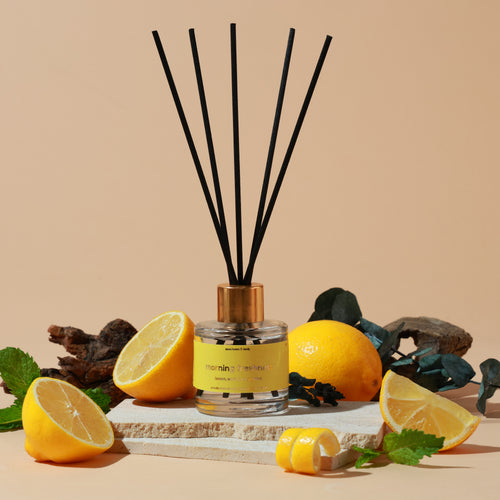
Shop, once the towels dry properly: Morning Freshness at ₹749 or Mountain Breeze at ₹849 from the alcohol-free reed diffuser line, 130ml from ₹1,249, duos from ₹1,498, 300ml refills ₹2,399. SOSA does not make a room or linen spray for the home, and would not sell you one for a towel. Free shipping above ₹499.
Straight answer
Why do bath towels make my whole bathroom smell?
1. Because of the arithmetic, not because they are dirty. A towel is a large piece of absorbent cotton that comes off your body carrying a few hundred millilitres of water. It goes into the smallest room in the flat, which is also the most humid one, and it releases that water slowly into an enclosed volume for hours.

2. Because you are hanging it folded, and the folded faces cannot dry. Draped in half over a narrow rail, roughly half the towel's surface is pressed against itself. Those inner faces sit at effectively full humidity until the towel comes down, which is where the smell is actually being made.

3. Because in monsoon it may never dry between uses at all. If a towel needs fourteen hours to dry in an 85% humidity flat and gets used every twelve, it is permanently wet, and permanently wet cotton is permanently in the window where things grow.

4. Hang it spread across the full width of the rail. That single change is free and it is the largest one available. Doubling the exposed surface roughly halves the drying time, and the towel stops having a permanently damp interior.

5. Then: a second rail or a door hook, drying outside the bathroom where possible, the extractor run on after showering, a weekly wash at a higher temperature, no fabric conditioner, and enough towels to rotate. All of that costs nothing except the towels.

6. And no, we will not sell you a linen spray, because SOSA does not make one. A towel goes against your face and your eyes minutes after a hot shower. Fragrance goes in the room, once the towels are dry.

A portion of every order supports girl-child education through Nanhi Kali.

TL;DR: a used bath towel is the largest, wettest object in the smallest, most humid room in the house, hung folded so its two inner faces never dry. It releases water continuously into eight or nine cubic metres, so it dominates the room. Hang it spread out, add a rail, dry it elsewhere, wash weekly and hotter, skip conditioner, and own enough to rotate.
SOSA does not make a linen spray
The product this page would sell you if it existed
SOSA does not make a linen spray
There is no room spray and no linen spray for the home anywhere in the SOSA range. The sprays we make are car perfumes, formulated and sized for a car, and I would not put one on a towel. A towel is the one textile in the house that goes against your face, your eyes and a small child's skin, minutes after a hot shower has opened everything up, and a fragranced towel is a worse idea than a slightly damp one. The honest fix for a towel is a hotter wash, a wider rail and a fourth towel in the cupboard, and none of those is something I sell. Scent the room once the towels are dry. Never the towel.

The arithmetic of one wet towel in a small room

It is worth putting numbers to this, because the reason a towel matters so much is a matter of proportion and proportion is exactly what people misjudge. A bath towel is a large object made of one of the most absorbent domestic materials there is, it comes off a wet body, and even after a vigorous shake it is carrying a substantial quantity of water — a few hundred millilitres is an ordinary figure, and two towels in a family bathroom can be most of a litre. That water has one exit: it evaporates into the air of the room. And the room is small. Most Indian bathrooms are between six and ten cubic metres, which makes them the smallest enclosed volume in the flat and the one least able to absorb anything.

1
THE FOLD
Half the towel is pressed against itself and cannot dry
Start with the single detail that turns an ordinary wet towel into a smelly one, because it is a matter of geometry and it is free to change. Almost everybody hangs a bath towel by folding it in half over a rail. The moment you do that, the two inner faces are in contact along most of their area, and a surface pressed against another wet surface cannot evaporate — there is nowhere for the vapour to go and no air moving across it. So the towel dries from the outside in, slowly, while the interior sits at effectively saturated humidity for as long as it hangs there. That interior is where the smell is made. It is warm, it is wet, it has a supply of skin cells, body oils and soap residue, and it is undisturbed for twelve hours at a stretch, which is a more favourable set of conditions than anywhere else in your home. The characteristic sour, slightly cheesy note of a towel that is not quite right is a metabolic product rather than dirt, which is why it comes back within minutes of the towel getting wet again even when the towel is visibly clean. The correction is to hang the towel spread across the full width of the rail instead, so that no part of it touches any other part. That roughly doubles the surface available for evaporation and, more importantly, abolishes the wet interior altogether. It takes the same two seconds as folding it. If your rail is not wide enough for a spread towel — and most standard rails are not, for a family — that is the actual problem, and it is solved by a longer rail, a second rail, a hook on the back of the door, or a folding drying rack that lives in the balcony and comes in when it rains.
2
THE ROOM
Why a wet towel dominates a bathroom out of all proportion to its size
Now the part that makes this a room article rather than a laundry one, because that distinction changes what you should do about it. A towel is not merely a thing that smells. It is a continuously operating source, releasing into a very small, poorly ventilated, enclosed volume, for the entire time between uses. Compare it with anything else in the room. The floor dries in twenty minutes. The basin is a surface with almost nothing on it. The tiles carry a film that a squeegee removes in thirty seconds. The towel is a thousand times the surface area of the basin rim, holds hundreds of times more water than the tiles, and unlike all of them it is still doing it fourteen hours later. In a room that small, a source that runs continuously wins, and this is why people describe the whole bathroom as smelling when what they actually own is one damp object. There is a second multiplier. The room a towel hangs in is the most humid in the flat, which means evaporation from the towel is slow — the air around it is already close to holding as much water as it can, so the towel's water has nowhere attractive to go. A towel in a dry, airy room dries quickly and never develops anything; the identical towel in a bathroom stays wet for hours, which is the only condition it actually needs. Microbial growth accelerates above roughly sixty per cent relative humidity, and in an Indian monsoon indoor humidity commonly sits between eighty and ninety-five. A towel in that flat is not passing through the growth window twice a day. It is living in it. Which is why the same towel behaves impeccably in Delhi in January and becomes an argument in Mumbai in July, with no change in how anybody is washing anything.
The test that separates a towel problem from a room problem: take every towel out of the bathroom for twenty-four hours and change nothing else. If the room is noticeably better the next evening, you have been treating the wrong thing.
3
THE FIXES
Rails, rotation, a hotter wash and no conditioner
So here is everything that works, and the only one that costs money is buying more towels. Hang spread rather than folded. Use a wider rail, a second rail, or a hook on the door so that every towel in the household has its own hanging space with air on both sides. Dry outside the bathroom whenever you possibly can — a balcony, a window grille, a rack in a dry room — because the fastest way to stop a towel making a bathroom smell is to not dry the towel in the bathroom. Run the extractor for fifteen to twenty minutes after showering with the door ajar, which lowers the humidity the towel is trying to evaporate into. Wash weekly rather than fortnightly, and hotter than you are washing them now. A cool wash is fine for clothes and is not enough for towels, which carry a much larger microbial load and a great deal more residue; a proper hot wash once a week resets the population that a cool one merely rearranges. Stop putting fabric conditioner on towels. It works by depositing a softening film on the fibres, and that film is both water-repellent and something to hold residue in — so conditioned towels absorb less, dry more slowly and hold odour more readily, which is the exact opposite of everything you want here. A cup of white vinegar in place of it in the rinse does the softening job without the film. And own enough towels to rotate, which is the fix nobody wants to hear and the one that settles monsoon. If a towel needs longer to dry than the interval between uses, no amount of technique will save it; the only real answer is a second towel taking its turn while the first dries properly. Three or four per person rather than one is not extravagance in a coastal Indian flat. It is the difference between a towel that dries fully every cycle and one that never does. This page is about the room, so if the towels smell even after drying properly, that is a laundry question with its own page.

Why it dominates a room out of all proportion

Everything wet in a bathroom, compared honestly. The columns are how much water each holds, how long it keeps releasing it, and how much it contributes to what you smell when you walk in. The towel wins every column that matters, which is why a single object gets a page to itself in a group of articles otherwise about plumbing.

What is actually wet in there
Every wet thing in a bathroom, ranked by how much it matters
The object Water it holds How long it keeps releasing Contribution to the room's smell
1. The bath towels ★ A few hundred millilitres each; most of a litre for two Hours, and in monsoon the entire interval between uses Dominant. Large surface, continuous release, and a folded interior that never dries at all
2. The bath mat Substantial, and it is lying flat on cold stone with no air underneath All day if it is left on the floor rather than hung after use Second, and frequently mistaken for the towels. Free to fix: hang it up
3. A bunched shower curtain Modest overall, but the folds hold water indefinitely Permanent while it is left bunched, since the folds never see air Real, and concentrated. Shake it out to hang open every time
4. Loofahs, sponges and cleaning cloths Small individually, and they are dense, slow-drying and never washed Continuous, because they rarely dry fully between uses Out of proportion to their size. Replace or wash them and hang them where air moves
5. Tiled walls and the glass screen A surprising amount as a continuous film across the wetted area Twenty to forty minutes, less with the fan running Short-lived but it is the moisture the towel then has to evaporate into. Thirty seconds with a squeegee
6. The floor Whatever the shower threw at it Twenty minutes or so, longer without ventilation Minor on its own, though standing water at a floor gully is a separate matter entirely
Shop this guide
For the room, once the towels dry properly
The SOSA principle
A towel is a continuously operating source in an enclosed volume. In a room that small, the thing that never stops always wins.
Which is why one damp object gets described as an entire bathroom smelling, and why hanging it spread rather than folded is the single largest free change available in this room.

Rails, rotation, washing, and the spray we do not make

Start with the hardware, because most households have a towel problem that is really a rail problem. Work out how many towels the household actually generates in a day — two adults showering morning and evening is four, plus hand towels, plus a bath mat — and then count the linear metres of rail in that bathroom. In most flats the second number is far too small for the first, which is why everything gets folded and doubled up. The remedy is not clever, it is more rail: a longer bar in place of the standard one, a second bar mounted above or beside it, an over-door hook set that requires no drilling at all, or a folding rack that lives on the balcony and comes inside during rain. Hanging space with air on both sides of every towel is the whole objective, and it is worth more than any product. Then get the towels out of that room whenever the weather permits. A towel dried on a balcony in a couple of hours of moving air is a different object from one dried over eleven hours in a saturated bathroom, and sunlight helps beyond the drying — a couple of hours of direct sun on a towel, a mat or a cushion does more than anything sold for the purpose. In monsoon that will not always be available, which is exactly when the rotation matters most: a towel taken out of service to dry properly for a day is worth two towels used damp.

Then washing, where two ordinary habits are working against you. The first is frequency. Bath towels want washing weekly in an Indian climate rather than when they look dirty, because the load they carry is invisible — skin cells, body oils and soap residue rather than anything you can see. The second is temperature: towels are the one item in a domestic wash where heat genuinely matters, and a cool cycle leaves a population that will be back to full strength within a day of the towel being used again. Wash them on their own rather than with clothes, use the hottest cycle the fabric allows, and do not overfill the drum, because a towel needs room to move for anything to reach the middle of it. Then leave the fabric conditioner out entirely. Conditioner softens by depositing a film on the fibre, and that film is water-repellent and residue-holding at the same time, so it makes a towel less absorbent, slower to dry and readier to hold a smell — three separate ways of making this exact problem worse. Half a cup of white vinegar in the rinse compartment softens without the film and strips accumulated residue as well. And take the towels out of the machine as soon as it stops. A finished load left in a warm drum for four hours undoes the entire wash, which is a version of the same mechanism this page is about, happening inside a different small enclosed space. The washing machine's own door and detergent drawer should be left open between washes for the same reason.

Then fragrance, and one thing this company will not sell you. SOSA does not make a room spray or a linen spray for the home. The sprays in the range are car perfumes, formulated and sized for a car, and I would not put one on a towel even if we did make one. A towel is the single most intimate textile in a house: it goes against your face, your eyes and a small child's skin, minutes after a hot shower has left everything open and warm. Spraying fragrance onto that in order to hide a smell caused by dampness is a worse idea than the damp, and it treats the symptom in the place where the symptom is least welcome. Fragrance belongs in the room, once the towels are dry. For that, an alcohol-free reed diffuser is the right format here: no socket in a wet room, nothing to switch on, no water added to a room that has too much, and one level held for months. Morning Freshness at ₹749 is lemon, peppermint and eucalyptus and reads as clean; Mountain Breeze at ₹849 is pine, sage and cedar and is my choice for a darker bathroom or a guest one; 130ml from ₹1,249, duos from ₹1,498, 300ml refills ₹2,399, and 24 to 72 hours before it is established. What does not belong in this room is a cool-mist ultrasonic — the Sukoon at ₹1,899 or Boond at ₹899 add 30 to 50 millilitres of water an hour, and this entire page has been about water. Put one outside the door instead, at three drops of the water-based Hotel Collection per tank. Free shipping starts above ₹499.

A towel is the one textile in the house that goes against your face. Which is precisely why the answer to a towel that smells is a wider rail and a hotter wash, and never a fragrance.
— Sonal Sahani, SOSA

The SOSA edit

In the order I would do it, and the only line with a real cost on it is the towels themselves. Row one takes two seconds a day and is the largest single change available in this room; nothing with a price on it appears until the towels are drying properly.

The SOSA edit
A bathroom that smells of towels, in order
Do this What it is Why it comes here in the order Cost
1. Hang it spread, never folded ★ The towel across the full width of the rail so no part touches any other part Roughly doubles the evaporating surface and abolishes the wet interior where the smell is actually made ₹0
2. More hanging space A longer rail, a second rail, an over-door hook set, or a rack that lives on the balcony Most towel problems are rail problems. Count the towels the household makes in a day, then count the rail ₹0–low
3. Dry outside the bathroom, and run the fan on A balcony or a dry room wherever the weather allows, plus fifteen to twenty minutes of extractor after showering The fastest way to stop a towel making a bathroom smell is to stop drying it in the bathroom ₹0
4. Weekly, hotter, no conditioner Towels washed on their own, on the hottest cycle the fabric allows, with vinegar in place of softener Conditioner deposits a film that repels water, slows drying and holds residue — three ways of making this worse ₹0
5. Enough towels to rotate Three or four per person so a damp towel can be taken out of service for a full day The only real answer in monsoon, when a towel needs longer to dry than the interval between uses Towels
Not made by SOSA: a linen spray There is no room or linen spray for the home in the range; the sprays we make are car perfumes A towel goes against your face. Fragrance belongs in the room, after the towels are dry
Honest notes for buyers: fragrance is the last step, never the first. It layers on air that is already clean and moving, and it will not remove a source — not damp, not a dry drain trap, not a loaded sofa, not a filter that needs washing. Deal with the cause, change the air, then scent the room. On timing: a candle puts scent into a room in fifteen to twenty minutes and a Sukoon reaches a steady level in about twenty, while a reed diffuser needs a day to three days before it is doing its job — the wrong buy for a deadline and the right buy for a room you want to hold one level for months. SOSA does not make a room or linen spray for the home; the sprays in the range are car perfumes. A cool-mist ultrasonic adds 30–50 ml of water an hour to the air, so it is the wrong machine for a room you are trying to dry out. The Hotel Collection is water-based and runs in the Sukoon, Boond and Megh only — not in reeds and not in the waterless Vaayu. Reed diffusers are a separate alcohol-free line with their own scents. Candles must be attended and put out. The Hotel Collection scents are SOSA's own interpretations inspired by the world's finest hotels; SOSA is an independent Indian fragrance house, not affiliated with or endorsed by any hotel brand. A portion of every order supports girl-child education through Nanhi Kali.
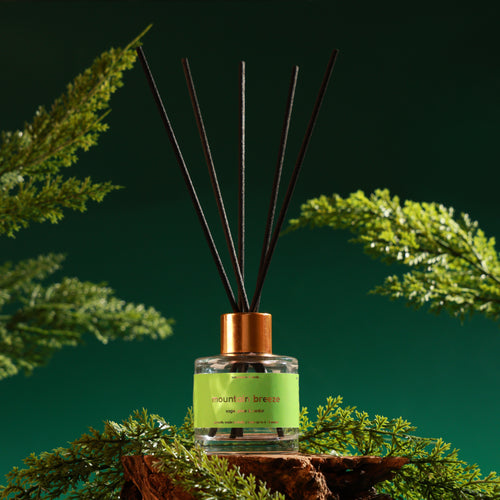
Mountain Breeze reed diffuser
If the room is sorted and you would rather not smell lemon
Mountain Breeze reed diffuser ₹849
Himalayan pine, sage and cedar, in the alcohol-free reed line. Most bathroom fragrance is citrus because citrus is the shorthand for clean, but a dry woody-herbal register does the same job with more composure and suits a darker bathroom with stone or wood in it better than a lemon does. It is the one I would choose for a guest bathroom, where the point is that nobody thinks about the smell at all. From ₹849, 130ml from ₹1,349, 300ml refills ₹2,399. It goes in after the towels dry properly, not instead of it — a pine note over a towel that has been damp since morning gives you a wet towel with a forest behind it.
SS
ISIPCA
Versailles
A note from Sonal

This is the item I find in more bathrooms than any other, and the thing that always strikes me is how innocent it looks. Nobody thinks of a towel as wet. They think of it as clean, because it was clean when it went up, and clean and dry get quietly filed as the same thing. But a bath towel is the largest absorbent object in the house and it spends its life in the smallest, dampest room in the flat, usually folded so that half of it cannot dry, and if I had to name one physical object responsible for how Indian bathrooms smell between June and September it would be that one, without hesitation.

What I want to be clear about is that we do not make a linen spray, and I would not make one for this. I understand the appeal, and there would be a business in it. But a towel is what you press against your face and your eyes and your child's skin thirty seconds after a hot shower, and putting fragrance on it to hide the fact that it did not dry is the wrong answer given confidently. The right answer is a wider rail, a hotter wash and a fourth towel in the cupboard, none of which I sell. Then, when the towels are drying properly and the room is genuinely fine behind a closed door, put something lovely in the room itself — lemon and eucalyptus at ₹749, or pine and cedar at ₹849 if you would rather not smell citrus. In the room. Never on the towel.

Everything is made and supported from Pune, and a part of every order funds girl-child education through Nanhi Kali. You get a home that smells like somewhere you chose; a girl gets a classroom. That equation has always felt right to me.

Frequently asked questions

Why do my bath towels make the whole bathroom smell?
Because a used towel is the largest, wettest object in the smallest and most humid room in the house, and it releases that water continuously into an enclosed volume of eight or nine cubic metres. Hung folded over a rail, its two inner faces are pressed together and cannot dry at all.
Is it better to hang a towel folded or spread out?
Spread across the full width of the rail, always. Folding it in half puts roughly half the surface in contact with itself, where no evaporation can happen, and that permanently damp interior is where the smell is made. Spreading it roughly doubles the exposed surface and costs nothing.
Should I use fabric conditioner on bath towels?
No. Conditioner softens by depositing a film on the fibres, and that film repels water, slows drying and holds residue — three separate ways of making a towel smell sooner. Half a cup of white vinegar in the rinse softens without the film and strips accumulated residue.
How many towels should each person have?
Three or four in a humid Indian flat, so a damp towel can be taken out of service and dried fully for a day. If a towel needs longer to dry than the interval between uses, which is common in monsoon, no technique will rescue it and rotation is the only real answer.
Does SOSA make a linen spray for towels?
No. There is no room or linen spray for the home anywhere in the range; the sprays we make are car perfumes. A towel goes against your face minutes after a hot shower, and fragrancing one to hide dampness is the wrong answer. Scent the room instead, once the towels are dry.
A wider rail beats any product
Spread it, do not fold itand scent the room, never the towel
Once the towels dry properly, the alcohol-free reed line is ₹749 for Morning Freshness, ₹799 for Garden Bloom and Evening Calm and ₹849 for Fresh Brew and Mountain Breeze, with 130ml from ₹1,249, duos from ₹1,498 and 300ml refills at ₹2,399. Reeds need no socket in a wet room, add no water to the air and take 24 to 72 hours to establish. SOSA does not make a room or linen spray for the home. Free shipping above ₹499, and a portion of every order supports girl-child education through Nanhi Kali.
See Morning Freshness · ₹749 See Mountain Breeze · ₹849
Continue the read
More from SOSA
Editorial standards & sources
About this guide: Written by Sonal Sahani, ISIPCA Versailles-trained founder and perfumer at SOSA Home & Body, on why a bath towel dominates the smell of a bathroom out of all proportion to its size — the water a used towel actually carries, why hanging it folded leaves half its surface unable to dry, why an Indian monsoon keeps it permanently inside the growth window, the eight free changes that fix it including rail space, wash temperature and the case against fabric conditioner, and why SOSA makes no linen spray for a textile that goes against your face.

Facts verified August 2026: Diagnostic facts used in this guide: a closed room accumulates what it cannot exchange, so cross-ventilation needs two openings rather than one; a drain's U-bend water seal evaporates in roughly two to four weeks of disuse and then admits sewer gas, which is corrected by pouring water down the drain; microbial growth in fabric and on surfaces accelerates above about 60% relative humidity, and Indian monsoon indoor humidity commonly runs 80–95%, which is the one situation where ventilating on a wet day can import moisture rather than remove it; an air-conditioner's cold, wet evaporator coil and filter grow biofilm that is blown into the room on start-up; textiles adsorb cooking aerosol and body oils and re-release them for weeks; and olfactory adaptation makes a constant household smell undetectable to its residents within about a fortnight while visitors still perceive it. Timings: a scented candle scents a normal room in roughly 15–20 minutes, a Sukoon ultrasonic diffuser reaches a steady level in about 20 minutes from cold, and a reed diffuser needs roughly 24–72 hours. SOSA products and prices: Sukoon 500ml ₹1,899 (270–320 sq ft, 16–18h on low, 9–12h high, 30–50 ml/h, 2.4MHz cool mist, remote, steady/2H/4H timers, BPA-free, auto shut-off, includes three 15ml Hotel Collection scents of your choice); Boond 300ml ₹899; Megh 6-litre ₹3,499; waterless Vaayu ₹11,999 (up to 1000m³); Aangan ₹25,999. Hotel Collection water-based fragrance 15ml ₹299, 100ml ₹999, 300ml ₹1,799, Pack of 7 at 15ml ₹1,799; dose 3–6 drops per tank. Reed diffusers (separate alcohol-free line): Morning Freshness from ₹749, Garden Bloom and Evening Calm from ₹799, Fresh Brew and Mountain Breeze from ₹849; 130ml from ₹1,249; duos from ₹1,498; 300ml refills ₹2,399. Scented candles: Bookshop 80g ₹379, Amber Rose 130g ₹599 and 220g ₹799, Smoked Oudh 130g ₹449, ceramic jar candles ₹949, Pure Calm wax melt set ₹854. Free shipping above ₹499. SOSA does not make a room or linen spray for the home. The Hotel Collection scents are SOSA's own interpretations; SOSA is not affiliated with or endorsed by any hotel brand. Prices subject to change — see the live product pages.
Torna al blog