
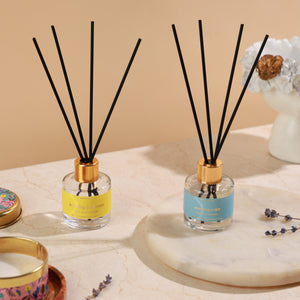
Cause one — immersion: as the bottle drains, less of each reed is submerged. The last quarter of a bottle is the quietest part of its life for exactly this reason.
Cause two — count: six fibre reeds is the number each SOSA composition is dosed for. Four is a deliberate quiet setting. Three is starvation, and a surprising number of bottles are running on three.
The correction, in order: stand every reed upright and clear of the neck, top the oil to the neck, and flip once so both ends are coated. All free.
2. Look at how much of each reed was actually under the oil. Take them out and read the wetted portion at the bottom. If only a short stub was submerged, the column feeding the whole reed is small and the climb will be slow.
3. Check they are standing, not leaning. Reeds that splay against the neck of the bottle can end up with their lower ends barely in the oil, or resting on the glass rather than in the liquid. In a bottle with a narrow neck this is easy to miss and it silently removes one or two reeds from service.
4. Top the oil to the neck rather than running the bottle dry. The last quarter of any bottle is its quietest phase, because immersion depth has fallen along with the level. Topping up restores supply immediately.
5. Give a new reed a fortnight before judging it. The first days after a fresh reed goes in are a climb, not a plateau. The wet line should rise steadily through the first two weeks; if it has barely moved by then, the reed is not drawing.
6. Consider the age of the reeds. Reeds are the consumable in this system and the oil is the stable part. We use fibre rather than rattan precisely because rattan's pores clog at 85% monsoon humidity, but fibre still tires, and our guidance is to refresh reeds every few months.
7. Do not confuse undersupply with saturation. They produce the same static level and need opposite fixes. Barely above the oil means add supply; high and dark near the tip means flip, because the reed is full and sealed rather than empty.
Composed and handmade in small batches in Pune, and a portion of every order supports girl-child education through Nanhi Kali.
Part one — immersion, count, and why they multiply
The supply side of a reed diffuser is almost embarrassingly simple. Oil enters the fibre wherever the fibre is wet, climbs by capillary action, and leaves from the exposed end. The total that can be lifted at any moment is the depth of immersion multiplied by the number of reeds doing the lifting — not added, multiplied, because each reed's contribution scales with how much of it is fed. That single sentence explains most of the quiet bottles I am asked about, and it explains why two changes that each look minor can combine into a diffuser delivering a fraction of what it should. What follows is the two variables, and then the case where they gang up.
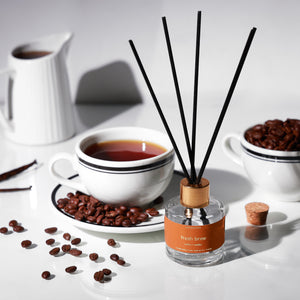
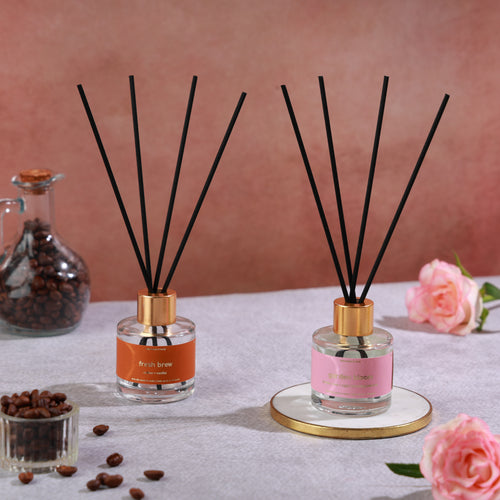
 Fresh Brew₹849 · 9.5/10Every bottle we ship contains six fibre reeds, and that number is not packaging convention — each composition is dosed to sit correctly at six, and every strength position we publish, from Fresh Brew at 9.5 down to Evening Calm at 8.9, describes the room at six reeds. Reed count is the only true volume control this format has, and it works in both directions. Four gives a gentler room and a bottle that comfortably outruns its window; that is a real setting and plenty of people choose it deliberately for a nursery or a small bedroom. Three or two is not a setting, it is starvation, and it is what I find when somebody sends me a photograph of a bottle they have been disappointed by for a year. Going the other way costs bottle life roughly in proportion — nine reeds on a 50ml is closer to five weeks than eight, and ten is nearer four or five.
Part two — six undersupply symptoms and the correction for each
Everything below is something you can see by taking the reeds out and looking at them, which takes about twenty seconds with gloves on and a tray underneath. Note that none of these is a saturation problem — a saturated reed is full and sealed at the tip, and needs the opposite treatment.
| What you see when you lift the reeds | Immersion or count? | The correction | Does it come back on its own? |
|---|---|---|---|
| Only three or four reeds in the bottle ★ | Count | Put all six in, standing straight and evenly spread | No — it will stay quiet indefinitely |
| Wet line barely above the oil at week two | Either — check both before acting | Top to the neck first, then count the reeds | No |
| Bottle down to its last quarter | Immersion | Top up with a refill, or finish and replace | No — it gets quieter as the level falls |
| Reeds splayed against the neck, ends above the oil | Immersion, disguised as count | Stand them upright; spread them at the top instead | No |
| Freshly topped up, still quiet after two days | Neither — this is normal | Flip once after refilling so both ends are coated, then wait a fortnight | Yes — the wet line climbs over the first two weeks |
| Reeds several months old, dark, and unresponsive to a flip | Neither — the fibre is tired | Refresh the reeds; oil is the stable part, reeds are the consumable | No |
| The honest caveat: we do not sell replacement reeds as a separate item, which is a real gap in our range and one I would rather name than talk around. Our guidance is to refresh reeds every few months, and the refills are oil only — you reuse your own vessel and your own reeds. Until that changes, the practical answer for a bottle whose fibre is genuinely finished is a new bottle, keeping the old vessel as a spare or a second source elsewhere in the house. | |||
Oil refill · to the neck₹2,399Shop → 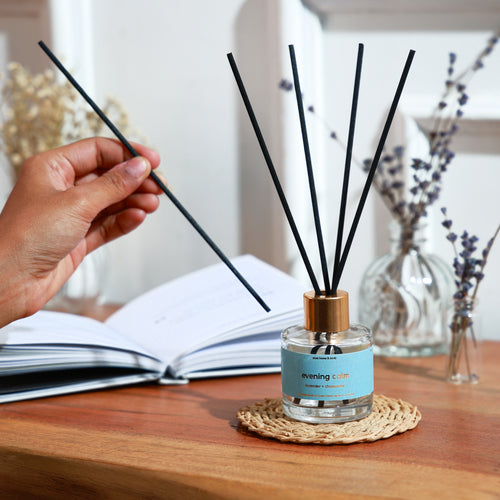 Evening Calm · 8.9/10from ₹799Shop →
 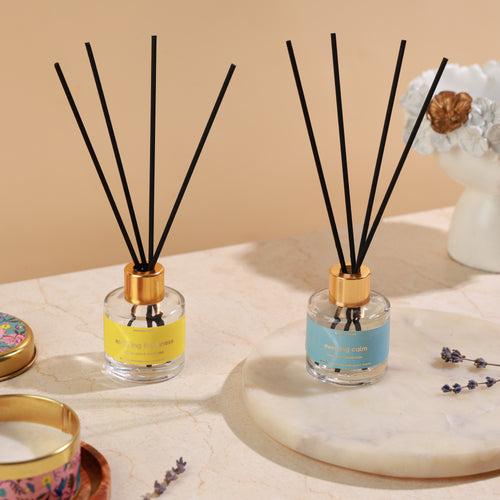 Day & Night duo₹1,498Shop →
Part three — topping up properly, and which part actually wears out
The refill method matters more than people expect, because a badly executed top-up leaves you with the same undersupply you started with plus a mess on the sideboard. Take the reeds out first and stand them in a small glass rather than laying them on furniture — reed oil marks wood and stone and it does not come out of either. Pour to the neck of the bottle, not to the shoulder and not to the brim; the neck is the level at which immersion is right and at which the bottle can be moved without slopping. Return the reeds, standing them upright and spreading them at the top rather than the bottom. Then flip the whole set once, so that both ends of every reed have been wetted. That last step is the one people skip, and it is what stops you spending a fortnight waiting for a dry upper half to catch up. Wear gloves throughout and put the bottle back on a tray.
Now the more uncomfortable half of this article. If you have corrected immersion and count, waited a fortnight, and the wet line still has not climbed, the reeds themselves are finished — and we do not sell replacement reeds separately. That is an honest gap in the range and I am not going to dress it up. Our guidance is to refresh reeds every few months; in practice that means people keep the reeds from a new bottle when they buy one and rotate them into a refilled vessel. It is a workaround rather than a solution, and it is on my list. What I will say is that fibre reeds hold up considerably better than rattan in Indian conditions, which is exactly why we use them: rattan's natural pores clog readily at 85% humidity, and a rattan reed in a Mumbai monsoon can stop drawing within weeks. Fibre keeps wicking through the same weather. It does not last forever, but it fails slowly and predictably rather than suddenly.
There is one boundary worth marking before you spend anything at all on this problem. Restoring supply restores the diffuser to the level it was designed for — it does not take it above that level, and no amount of immersion or reed count will turn a passive format into a powerful one. Six reeds standing in a full bottle is the calibrated condition; adding reeds beyond that raises output and shortens the bottle roughly in proportion, which is a fair trade for a festive week and an expensive habit year-round. And if the honest answer after all of this is that the room is simply larger than a point source with no propulsion can serve — much past roughly 250 to 300 square feet of connected open volume — then more supply is not the answer either. Two bottles at opposite ends of that space will beat one, and if what you want is a strong room on demand rather than a constant low background, a Sukoon at ₹1,899 does a job no reed bottle can. Most homes end up running both, in different rooms, for different reasons.
Part four — the settings table, priced in weeks and presence
Immersion and count are the two dials on the supply side, so here they are side by side with what each combination does to a 50ml. The week figures are our working guidance at six reeds in an ordinary room with weekly flipping, not a warranty — heat, draught and traffic will move them.
| Setup | Immersion | Reeds standing | Roughly what a 50ml gives | Presence in the room |
|---|---|---|---|---|
| The calibrated setting ★ | Full to the neck | Six | 6–8 weeks | The level every strength rating we publish refers to |
| Deliberately gentle | Full to the neck | Four | Beyond the stated window | Soft — right for a nursery or a small bedroom |
| Accidental starvation | Full to the neck | Two or three | Long, and largely pointless | Detectable at the bottle, absent in the room |
| The late-bottle squeeze | Last quarter | Four | Weeks of near-silence at the end | The commonest cause of "it has expired" |
| Topped up mid-life | Back to the neck | Six, flipped once after topping | Resets the supply side entirely | Returns to the calibrated level within a fortnight |
| Hosting for a week | Full to the neck | Nine | Closer to five weeks than eight | Noticeably fuller · reversible in ten seconds |
| As far as I would go | Full to the neck | Ten | Roughly four to five weeks | The most this format produces from one bottle |
Versailles
We put six reeds in every bottle and I have thought about that number more than is probably reasonable. It is not the maximum the vessel will take and it is not the number that makes the loudest room. It is the number at which each composition sits where I intended it to sit — which for a lavender and chamomile is quiet enough to sleep through, and for a Coorg coffee and Kerala vanilla is enough to fill a living room without becoming a dessert.
What I did not anticipate, in the first year, was how many people would run four. Sometimes two reeds stay in the packet because the bottle looked full enough. Sometimes two are removed for a week during a headache and never go back. The result is a diffuser quietly operating at two-thirds of its design, and an owner who reasonably concludes the product is gentle.
So this is the least glamorous advice in the whole series and possibly the most useful: count your reeds, look at how deep they stand, and top the bottle to the neck before it runs to the bottom. It costs nothing and it is the difference between a fragrance you paid for and one you own but cannot smell. I would rather write this article than sell you a second bottle you did not need. Everything is composed and handmade in small batches in Pune, and a portion of every order funds a girl's classroom through Nanhi Kali.
Frequently asked questions
- Why is my oil not going down? — the three states, and the thirty-second triage.
- Does slow evaporation mean it isn't working? — the three readings that replace the oil level.
- Barely evaporating? and lasting long but smelling of little.
- The complete guide to a diffuser that lasts too long, and why can't I smell my reed diffuser?
- Brand: the SOSA founder story.
SOSA reed diffuser range & prices (verified August 2026): alcohol-free, phthalate-free, paraben-free and IFRA-compliant compositions on a heat-stable coconut-derived (CCT) carrier, low-VOC, supplied in a refillable glass bottle with six fibre reeds; 50ml lasts 6–8 weeks and 130ml lasts 14–18 weeks. Morning Freshness (Malabar lemon · peppermint · Nilgiri eucalyptus) 50ml ₹749 · 130ml ₹1,249 · 9.0/10; Garden Bloom (British rose · night-blooming jasmine) 50ml ₹799 · 130ml ₹1,299 · 8.9/10; Evening Calm (Kashmir lavender · chamomile) 50ml ₹799 · 130ml ₹1,299 · 8.9/10; Fresh Brew (Coorg coffee · Kerala vanilla) 50ml ₹849 · 130ml ₹1,349 · 9.5/10; Mountain Breeze (Himalayan pine · sage · Indian cedar) 50ml ₹849 · 130ml ₹1,349 · 9.4/10. Reed diffuser refills are oil only — you reuse your own vessel and reeds: 300ml ₹2,399 (roughly 8–11 months) · 500ml ₹3,499 (roughly 14–18 months), about ₹7–8 per ml against ₹15–17 per ml for a 50ml bottle. Duo sets ₹1,498–₹1,598 for 2 × 50ml and ₹2,498–₹2,598 for 2 × 130ml. Strength figures are positions on SOSA’s own internal strength scale, not an industry standard. Replacement reeds are not sold as a separate SKU; SOSA guidance is to refresh reeds every few months. The reed line is separate from the water-based Hotel Collection for ultrasonic machines (15ml ₹299 · 100ml ₹999 · 300ml ₹1,799) and the two are not interchangeable. Diffusers: Boond 300ml ₹899 · Sukoon 500ml ₹1,899 · Megh 6L ₹3,499 · waterless Vaayu ₹11,999. Composed and handmade in small batches in Pune, India; tested through 45°C summer heat and 85% monsoon humidity. Free shipping above ₹499. A portion of every order supports girl-child education through Nanhi Kali. Prices subject to change — see the live product pages.