
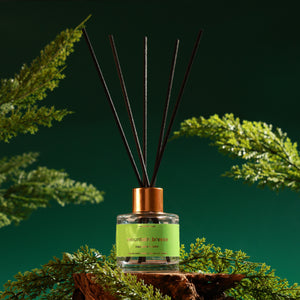
 The register ₹849
 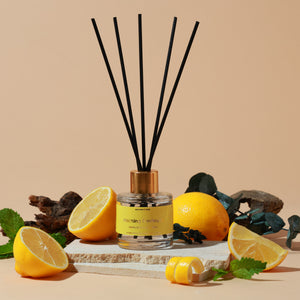 Dry companion ₹749
  Single-cabin only ₹1,899
 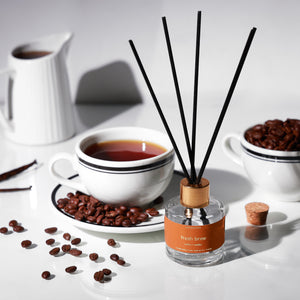 Not for this register
  Wrong direction here
The argument: perceived expense is consistency, not intensity. One register held identically across sixty feet reads as designed; four different smells across the same sixty feet reads as improvised, however good the interior underneath.
The wrong direction: Fresh Brew (coffee-vanilla) and Garden Bloom (rose-jasmine) read as retail or spa, not as a private, referral-led practice.
2. Restraint reads as confidence. A practice that scents heavily is doing what a retail store does. A practice that scents almost imperceptibly is doing what the best hospitality does. The test is direct: if a patient can name the fragrance, the level is wrong, whatever that fragrance happens to be.
3. There must be no visible source. A bottle, reeds or a countertop device on a designed reception desk undoes the effect in the first ten seconds — the scent has to arrive with no explanation. This is the argument for wall or HVAC mounting over anything sitting in view.
4. It has to be identical every day. A passive source is loudest in week one and quietest in week six; a machine holds the same level from day one to day ninety. In a practice where patients return for follow-ups, that difference is noticeable, and it is exactly the kind of inconsistency point one covers.
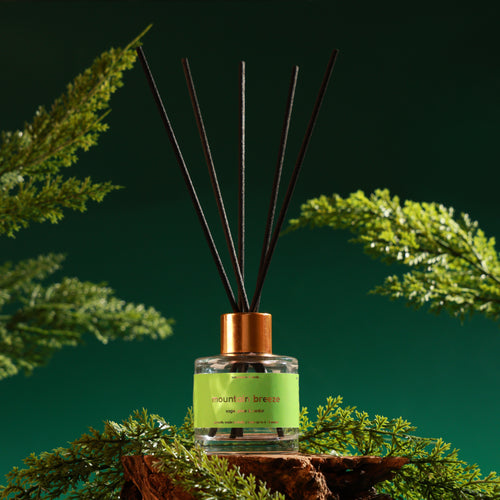
5. The recommendation is Vaayu ₹11,999, run in a dry, cool register — Mountain Breeze (pine, sage, cedar) or Morning Freshness (lemon, mint, eucalyptus) are the reed-range equivalents of the direction, adjustable low enough to sit exactly where restraint requires. For a single consulting cabin, a Sukoon ₹1,899 or a reed at ₹749–₹1,349 covers the room on its own.
Vaayu carries CE, RoHS and SGS marks stated flatly as electrical and compliance marks — nothing here is a health, therapeutic or clinical claim, and nothing here substitutes for the cleaning, ventilation and infection control your facilities team already owns.
Why restraint reads as expensive
Walk a genuinely expensive interior — the kind with a named designer, a considered material palette, joinery that was clearly not the cheapest quote — and the thing that actually signals expense from the reception desk to the far corridor is not any single flourish. It is that every decision along the way agrees with every other decision. The same stone, the same brass, the same light temperature, repeated without variation until the visitor stops noticing any of it individually and simply registers "this place was thought through." Fragrance is not exempt from that logic, and treating it as a separate, optional flourish is the single most common way an otherwise well-designed practice undercuts itself. The failure mode at this level is not a weak smell. It is an inconsistent one — something at the desk, disinfectant in the corridor, nothing at all in the waiting room, something else again near the loo. Four different smells across sixty feet reads as improvised no matter how good the interior around them is, and a patient registers that improvisation on some level even when they could not name what caused it.
The second half of the argument is about volume, and it runs against instinct. Most people assume a more expensive fragrance experience is a stronger one — more presence, more character, something a visitor comments on. In hospitality and retail that can be true; a flagship store is often scented specifically to be noticed and remembered. A high-end medical practice is doing the opposite job. A practice that scents heavily is borrowing the grammar of a retail floor. A practice that scents almost imperceptibly is borrowing the grammar of the best hospitality, where the point is never to draw attention to the mechanism, only to the effect. The test is blunt and it is the one worth repeating to anyone specifying this for a practice: if a patient can name the fragrance, the level is wrong, independent of which fragrance it is.
Put the two together and the brief stops being a fragrance-choice question at all. It becomes a distribution and delivery question — can the same register be held at the same low level, with no visible source, in every zone a patient passes through, on the first day of ownership and on the three-hundredth. That is a hardware question before it is a fragrance question, and it is the reason the recommendation below leads with a machine rather than a scent.
The three decisions behind this standard
 Mountain Breeze₹849 / ₹1,349A bottle, standing reeds or a countertop device on a designed reception desk does a specific kind of damage: it explains the fragrance before a visitor has finished forming their impression of the room. The moment a source is visible, the scent stops arriving as part of the space and starts reading as a decision someone made and is now showing off. On a desk that a named designer specified down to the door handles, that is a jarring note. The fix is structural rather than aesthetic — mount the delivery on a wall or into the HVAC run, out of the sightline entirely, so the fragrance has no explanation and no object to be judged against.
The delivery options, on concealment and consistency
Register is the easy half of this brief — the harder half is holding a chosen register at a fixed, low level with no visible source, across a floor plate rather than one room. The table below scores each mechanism on exactly the two properties this post argues actually decide perceived expense.
| Option | Concealment | Consistency day 1 → day 90 | Intensity control |
|---|---|---|---|
| Reed diffuser ₹749–₹1,349 | Fails — a bottle standing in view, by design | Poor — loudest week one, faded by week six | Poor — no dial, only fewer reeds |
| Sukoon ₹1,899 ultrasonic | Fails — a visible unit with a visible mist | Fair — steady while maintained, but needs daily refilling | Fair — steady/2H/4H timers, fixed mist strength |
| Boond ₹899 ultrasonic | Fails — a visible unit with a visible mist | Fair — depends on staff refilling it on schedule | Poor — on or off, USB-run |
| Vaayu ₹11,999 ★ | Passes — wall or HVAC mount, out of sight entirely | Best — same level from day one to day ninety, key-locked | Best — genuinely adjustable, 1h/4h/8h/24h scheduled windows |
| Aangan ₹25,999 HVAC | Passes — fully integrated, nothing visible | Best — HVAC-integrated, ducted | Best — HVAC-integrated control |
| Note on humidity: an ultrasonic mist adds moisture to a sealed, air-conditioned practice and needs daily refilling and cleaning, and it can leave mineral dust on glass and dark joinery — a device staff must maintain daily is a device that gets neglected. A waterless nebuliser avoids both problems and is the only option here that also passes concealment. | |||
Mountain Breeze · pine, sage, cedar₹849 / ₹1,349Shop → 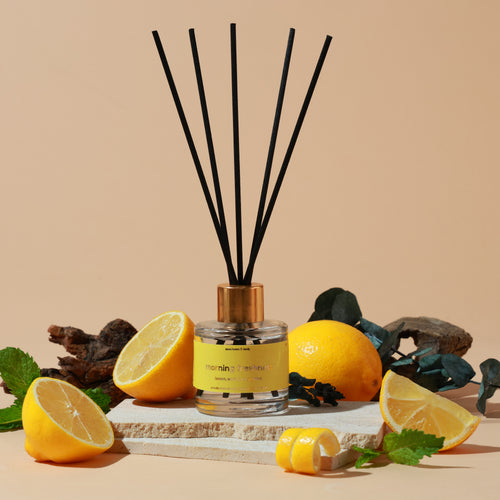 Morning Freshness · dry citrus₹749 / ₹1,249Shop →
  Sukoon · single cabin₹1,899Shop →
Zoning, intensity and sensitivity
Scent transit and waiting zones only. Entrance, reception, waiting area and corridors are where a high-end practice's first impression is formed, and they are the only zones this argument applies to. A faint, unattributable drift from reception into an adjoining corridor is the goal; anything a patient could trace to a source has already gone too far.
Leave consultation rooms, treatment and rehabilitation rooms, X-ray and any enclosed space where a patient is held for a long period completely unscented. In a high-end practice this is not a limitation to work around — it is itself part of the standard. A patient undressed, examined or told difficult news should not also be managing an unfamiliar smell, and a practice confident enough in its interior does not need to scent every square foot to prove the point. Fragrance sensitivity is real and some patients react badly to airborne fragrance; staff should be able to switch the machine off in seconds, and if a patient objects, the intensity is reduced or the machine switched off — never defended, never explained, never something a patient is asked to tolerate.
On level: this is quieter than a hotel lobby and considerably quieter than a retail store, and that is by design rather than by compromise. Noticed once, on arrival, and never again is the standard for any medical space; a high-end practice simply holds that standard more strictly, because the cost of being wrong — a scent a patient can name, a source they can see — is higher when the rest of the room has been so carefully got right.
What the high-end answer costs
Register costs nothing extra — it is a choice, not a purchase. What the budget actually buys is concealment and consistency, and the table below leads with Vaayu because a private, multi-room, staffed practice is the job it was built for, not a category it happens to also fit.
| Practice | What it gets you | Covers | What it costs |
|---|---|---|---|
| 750 sq ft and above ★ | Vaayu — wall or HVAC mounted, adjustable intensity, 1h/4h/8h/24h windows, key-lock | Up to 1000 m³ (roughly 2,000–3,000 sq ft) | ₹11,999 |
| 300–750 sq ft | Vaayu, on control and concealment, with room to grow into an adjoining cabin or corridor. Sukoon ₹1,899 is named once as the lower-cost alternative — the reader chooses on control, not coverage | Reception plus one adjoining zone | ₹11,999 |
| A single cabin only | A reed diffuser at ₹749–₹1,349 covers one small room adequately on its own, without the concealment or scheduling this post argues for | To 150 sq ft (50ml) or above (130ml) | ₹749–₹1,349 |
| Above 3,000 sq ft | Aangan, HVAC-integrated, with Vaayu as the per-zone unit alongside it in rooms the central duct does not reach evenly | 8,000–10,000 sq ft | ₹25,999 |
Versailles
The practices that ask this question have usually already made every other decision correctly. There is a named designer's name attached to the fit-out, a material palette that was clearly argued over, a reception desk that looks like furniture rather than equipment. What they are really asking, underneath the fragrance question, is how not to be the one detail that gives the game away — and the honest answer is that fragrance almost never gives the game away by being wrong. It gives the game away by being inconsistent, or by being visible.
I tell every practice at this level the same thing, and it usually surprises them: you are not buying a scent, you are buying a standard, and a standard is a thing you hold the same way every single day, not a thing you get right once and hope survives contact with a busy Tuesday. That is why I lead with the machine before the fragrance. The register is the easy decision. Holding it at the same quiet level, from a source nobody can point at, on day ninety exactly as on day one, is the part that actually costs something to get right — and it is the part a genuinely expensive interior deserves.
If the practice is one cabin and truly nothing more, a Sukoon or a reed will do that room perfectly well, and I say so plainly rather than let anyone buy more machine than the room needs. But the moment there is a second room, a corridor to carry the register through, or any plan to grow, I recommend Vaayu, because control, no-water operation, distribution and uptime hold at every size a practice this serious is likely to reach. Every purchase funds a girl's education through Nanhi Kali — not a percentage, not a quarterly cheque. Every one.
Frequently asked questions
- What should a premium orthopaedic clinic smell like? — the baseline register question.
- I've spent ₹10 lakh on my clinic interior — is ambient scent worth adding? — the case for and against, at this budget.
- What small details make an orthopaedic clinic feel more premium? — staging beyond fragrance alone.
- How do I choose fragrance that matches my orthopaedic clinic's interior style? — matching register to material palette.
- Brand: the SOSA founder story.
SOSA products & prices (verified August 2026): Reed diffusers 50ml ₹749–₹849 (to 150 sq ft, 6–8 weeks at six reeds) · 130ml ₹1,249–₹1,349 (above 150 sq ft, 14–18 weeks) · reed refill 300ml ₹2,399. Ultrasonic: Boond ₹899 (~150 sq ft) · Sukoon ₹1,899 (270–320 sq ft, ships with three 15ml Hotel Collection fragrances) · Megh ₹3,499 (6L tank, ~100 hrs runtime, ~215 sq ft — a runtime machine, not a coverage upgrade). Waterless cold-air: Safar ₹3,999 (no published coverage figure) · Vaayu ₹11,999 (up to 1000 m³, roughly 2,000–3,000 sq ft; 400ml tank lasting about 90+ days; app and onboard control, 1h/4h/8h/24h run windows, adjustable intensity, key-lock, under 38 dB, freestanding or wall/HVAC mount, 5W, CE/RoHS/SGS) · Aangan ₹25,999 (8,000–10,000 sq ft). Hotel Collection water-based fragrance 15ml ₹299 · 100ml ₹999 · 300ml ₹1,799 is for ultrasonic machines; reed oil and Hotel Collection are not interchangeable. Reed diffusers are alcohol-free, phthalate-free, paraben-free, IFRA-compliant and low VOC, handmade in small batches in Pune. Every purchase funds a girl's education through Nanhi Kali. Prices and availability subject to change — see the live product pages.