


- The direct answer
- Why restraint is the argument, not just the zone rule
- The three decisions, argued aesthetically
- Which zones of a minimal café can carry fragrance — and why most shouldn't
- How light the ceiling needs to be, if it's used at all
- What to buy, if anything, and why most should buy nothing
- A note from Sonal
- Questions about scenting a minimal Japanese-style café
2. The dining room, counter and seating stay unscented, for two reasons at once. The usual mechanical argument still applies — fragrance competing with tea, coffee or food — but here it's reinforced by an aesthetic one: a designed room this deliberate about what it includes shouldn't quietly include a fragrance nobody asked to notice.
3. If a washroom is scented at all, it should be nearly imperceptible. A dry, unbranded-feeling register at the lowest practical dose — Morning Freshness at a reduced reed count, not a full signature-scent statement — is the ceiling here, lower than this cluster recommends almost anywhere else.
4. The entrance, even where a genuine boundary exists, is usually still a no. A scented arrival is itself a flourish, and this concept's design vocabulary has generally spent real effort removing flourishes elsewhere; the rare exception is a chain standardising many locations for operational reasons, not an aesthetic one.
5. Anything sweet, floral or assertive is wrong here for the same reason it's wrong elsewhere in this cluster, only more so. Fresh Brew's gourmand profile or a strong floral register would read as decorative and loud against a room built around quiet materials — the aesthetic case against them is even stronger here than the mechanical one this cluster makes everywhere else.
A minimal café's best fragrance decision is usually the one it doesn't make — and where it does make one, the smallest, quietest option in the catalogue is still the right ceiling.
Why restraint is the argument, not just the zone rule
A minimal, Japanese-influenced café is usually built around a specific design philosophy: unadorned surfaces, quiet materials, deliberate negative space, and a general discipline about including only what earns its place in the room. Every other page in this block has argued that fragrance competes with a product aroma already present. This concept raises a different question first — whether fragrance belongs in the room at all, on the room's own aesthetic terms, regardless of whether anything is there to compete with it.
That reframing changes how the standard three-zone reasoning applies here. In most other café concepts, the case against scenting the dining room is mechanical — an added fragrance competes with coffee, chocolate or dessert aroma. In this concept it still is, but the case against scenting even a genuinely separated entrance, which the rest of this cluster treats as a reasonable "sometimes," weakens too. A scented arrival, even behind a real door, is still a deliberate addition — a small flourish — layered onto a design that has spent real effort removing flourishes everywhere else. That's a different kind of objection than the mechanical one this cluster makes about dining rooms, and it's specific to this concept.
Even the washroom, the one zone this cluster treats as a safe default almost everywhere, deserves a lighter touch here than anywhere else in this block. If a register is used at all, it should behave like the room's own tiling and lighting — unnoticed, functional, never a decision a designer would want credit for. A washroom fragrance a customer can specifically identify and describe afterwards is dosed too high in any café in this cluster; in a minimal Japanese-style café, it's also dosed out of step with everything else the room is doing.
The three decisions, argued aesthetically
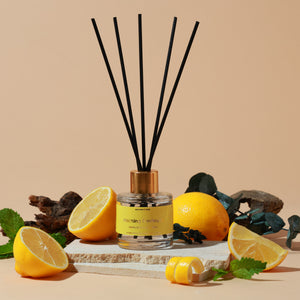
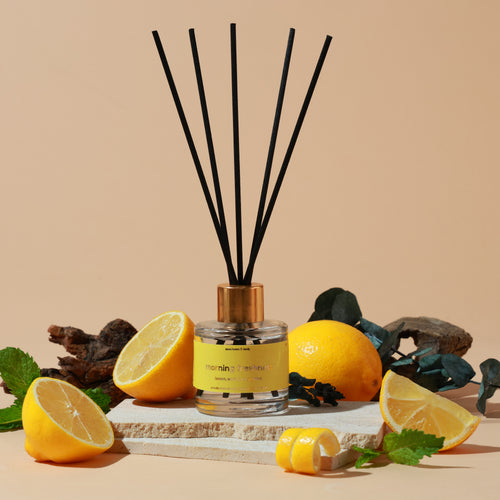
 Morning Freshness₹749A room built around deliberate restraint doesn't need a mechanical justification to leave the air alone — the absence of fragrance is consistent with everything else the design is doing.
Which zones of a minimal café can carry fragrance — and why most shouldn't
The verdicts look similar to the rest of this cluster on paper — the reasoning behind most of them is different, and stricter, here.
| Zone | Typical minimal café setup | Verdict | What governs it |
| Dining, seating and counter | Where tea, coffee or food is served | Never scented | The usual mechanical rule, reinforced by the concept's own aesthetic of deliberate restraint |
| Entrance or vestibule, even genuinely separated | A real doorway or step, its own air volume | Usually still no | A scented arrival is itself a flourish this concept's design vocabulary has generally spent effort removing |
| Washroom | Enclosed, away from service | The one place a register can exist, at the lowest dose in this cluster | Should function like the room's own tiling — unnoticed, not a considered statement |
| Retail or merchandise shelf, if present | A packaged-goods area rather than a service counter | Usually still no, or the same minimal-dose logic as the washroom | Rarely a strong enough case to add fragrance a minimal retail shelf doesn't otherwise call for |
| A multi-location minimal chain standardising entrance and washroom experience | An operational decision across several branches, not a single room's aesthetic choice | The narrow exception where entrance scenting can be justified | Treated and priced as an operational decision, kept as quiet as the rest of the concept demands |
| A single minimal café reaching for a machine because a chain elsewhere in the category uses one isn't a like-for-like comparison — a standardisation decision across several branches is a different question from a single room's aesthetic choice. | |||
Morning Freshness · light citrus and mint₹749Shop →  Sukoon · for a larger washroom suite₹1,899Shop →
  Vaayu · zoned, for a standardising chain₹11,999Shop →
How light the ceiling needs to be, if it's used at all
Never treat a washroom fragrance in this concept as a signature-scent decision — the same restraint that shapes the room's materials and lighting should shape this choice too, which usually means the lightest option available, not the most distinctive one.
Sometimes a genuinely larger minimal café, or a chain standardising several locations, has an operational reason to step up to a 130ml reed or Sukoon — still kept to the plainest register available, never a stronger or more assertive one.
Usually, the correct choice for a single washroom under 150 sq ft is the smallest reed diffuser at the lowest practical reed count, in Morning Freshness — dosed low enough that it functions as part of the room's finish rather than as a decision a visitor would think to comment on.
What to buy, if anything, and why most should buy nothing
Matched first to whether the aesthetic case for restraint has been genuinely overridden by an operational one, and second to the room's actual square footage.
| Route | Premises | Why | What it costs |
| Do nothing | Dining, seating, counter and most entrances, any size | The concept's own design restraint already argues against adding a fragrance here | No purchase |
| Reed diffuser, Morning Freshness, lowest reed count | Washroom under 150 sq ft, if fragrance is used at all | The lightest register and dose in this cluster, functioning as an unnoticed finish | ₹749 |
| Reed diffuser, 130ml, Morning Freshness | 150–270 sq ft, a larger washroom or vanity area | Longer runtime and coverage, kept to the same plain register | ₹1,249–₹1,349 |
| Sukoon ultrasonic, low and steady | 270–320 sq ft, a washroom suite in a genuinely large minimal café | Consistent coverage without stepping up to a full machine | ₹1,899 |
| Vaayu, wall-mounted per location | A multi-location minimal chain standardising washrooms, and occasionally entrances, for operational reasons | Independent scheduling and a key-lock across several branches | ₹11,999 per unit |
This is the one page in this whole block where I find myself arguing more as someone who cares about design than as someone who sells fragrance systems. A minimal, Japanese-influenced café is usually built with real discipline about what it includes, and I think that discipline deserves to be taken seriously rather than talked out of by a product pitch.
When an owner asks me about a signature scent for a room like this, my honest first answer is usually to ask what problem they're trying to solve — and most of the time, once we talk it through, the answer is that nothing needs solving. The room already works. I'd rather tell someone to save the money than sell them a fragrance their own design has already argued against.
Where I do think a small reed diffuser earns its place, in a washroom that genuinely needs it, I ask for the smallest reed count I'd ever recommend anywhere in this cluster — because even there, the point isn't to be noticed. It's to disappear into a room that was built to feel considered without announcing any of its choices.
Questions about scenting a minimal Japanese-style café
- How Should a Matcha Café Approach Ambient Fragrance? — a neighbouring concept arguing restraint from a mechanical angle rather than an aesthetic one.
- Should a Tea Lounge Have a Signature Scent? — the block's one genuine exception, for contrast with this page's aesthetic case.
- How Should a Premium Indian Café Approach Signature Scent? — a different design tradition reaching a different answer.
- Which Areas of a Café Should Be Fragranced — and Which Shouldn't? — the baseline zone rules this page applies more strictly still.
- Brand: the SOSA founder story.
SOSA products & prices (verified September 2026): Reed diffusers 50ml ₹749–₹849 (to 150 sq ft, 6–8 weeks at six reeds) · 130ml ₹1,249–₹1,349 (above 150 sq ft, 14–18 weeks) · reed refill 300ml ₹2,399. Ultrasonic: Boond ₹899 (~150 sq ft) · Sukoon ₹1,899 (270–320 sq ft, ships with three 15ml Hotel Collection fragrances) · Megh ₹3,499 (6L tank, ~100 hrs runtime, ~215 sq ft — a runtime machine, not a coverage upgrade). Waterless cold-air: Safar ₹3,999 (no published coverage figure) · Vaayu ₹11,999 (up to 1000 m³, roughly 2,000–3,000 sq ft; 400ml tank lasting about 90+ days; app and onboard control, 1h/4h/8h/24h run windows, adjustable intensity, key-lock, under 38 dB, freestanding or wall/HVAC mount, 5W, CE/RoHS/SGS) · Aangan ₹25,999 (8,000–10,000 sq ft). Hotel Collection water-based fragrance 15ml ₹299 · 100ml ₹999 · 300ml ₹1,799 is for ultrasonic machines; reed oil and Hotel Collection are not interchangeable. Reed diffusers are alcohol-free, phthalate-free, paraben-free, IFRA-compliant and low VOC, handmade in small batches in Pune. Every purchase funds a girl's education through Nanhi Kali. Prices and availability subject to change — see the live product pages.