Founder Diaries · Clinics & Medical Centres · Shared Waiting Areas
By Sonal Sahani · ISIPCA Versailles 11 min read Updated September 2026
I should say at the top what this page is, because the honest version is not the version you were probably looking for.
A room that smells crowded is a room whose occupancy has outgrown its air change, and that is a ventilation problem with a ventilation answer. No diffuser moves a single cubic metre of outdoor air into a building. So this is a ventilation page with one paragraph about fragrance at the end of it, and I would rather you knew that before reading than after. The arithmetic is simple, it is worth doing on the back of an envelope for your own hall, and at the end of it there is a genuine place for the
Vaayu at ₹11,999 — a smaller place than a vendor would offer you, and a real one.
Quick answers — read this first
What “crowded” actually means: the rate at which people load the air has overtaken the rate at which the room replaces it. It is a ratio, not a smell, and it has a ventilation answer.
The arithmetic: m³ = (sq ft ÷ 10.76) × ceiling height in metres. A 1,400 sq ft hall at 3.2 m is about 416 m³. Ventilation for waiting areas is designed per occupant, not per square foot — ask your HVAC consultant for the figure the building was designed to and the peak headcount it assumed.
The four things that quietly reduce it: a fresh-air damper closed to save cooling load · a toilet extract fan that has stopped · a return grille blocked by a standee or a notice board · a booking pattern that puts three departments' peaks in the same hour.
Then, and only then: the
Vaayu at ₹11,999 holds the public areas at smelling of nothing in particular. It is presentation. It is not ventilation and it is not an air purifier.
The short answer
Short answer: treat it as a ventilation and occupancy problem, because that is what it is. Work out the hall's volume, get the outdoor-air figure the building was designed to and the headcount it assumed, compare that with your actual peak, and then look for the four things that quietly reduce outdoor air in an Indian clinic. Fragrance is the last paragraph, not the answer.
The order of work: the fresh-air damper position · the toilet and dirty-utility extract fans · the return grilles and whether anything is standing in front of them · the appointment book, because staggering three departments' peak hours is a ventilation intervention. Then, in a hall that is genuinely ventilated for the people in it, the
Vaayu at ₹11,999 on one low setting.
Shop: the
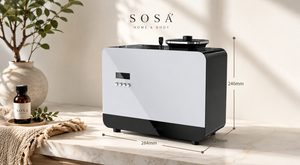
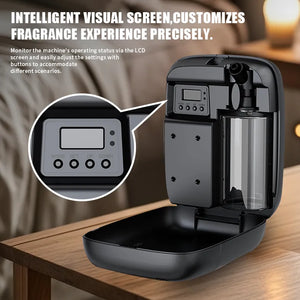
Vaayu ₹11,999 (waterless, no standing water tank, up to 1000 m³, 400ml lasting about seventy-five days, app and 1h/4h/8h/24h timers, under 38 dB, key-lock) and the
Aangan ₹25,999 for a large centre. The ultrasonic
Sukoon ₹1,899,
Boond ₹899 and
Megh ₹3,499 add 30–50 ml of water an hour to the air, which is the wrong direction in a crowded hall. Free shipping above ₹499.
Straight answer
How do I stop a busy clinic waiting room from smelling crowded?
1. Accept what the word means before you spend anything. A room smells crowded when the rate at which people load the air exceeds the rate at which the room replaces it. That is a ratio between two numbers, and a fragrance changes neither of them.
2. Work out the volume, because you will need it for everything else. Cubic metres equal floor area in square feet divided by 10.76, multiplied by the ceiling height in metres. A 1,400 sq ft waiting hall at 3.2 metres is about 416 m³. Write that number down.
3. Get the two design figures from whoever installed the air conditioning. Waiting areas are ventilated per occupant rather than per square foot, so ask for the outdoor-air rate per person the system was designed to and the peak headcount it assumed. Then count the people in the hall at eleven on a Monday. If the second number is half again the first, you have found the answer and it is not a bottle.
4. Then look for the four things that quietly remove outdoor air. A fresh-air damper closed or throttled to reduce the cooling bill. A toilet or dirty-utility extract fan that has stopped and that nobody monitors. A return grille with a standee, a notice board or a stack of chairs in front of it. And an appointment book that lands three departments' peak hours on top of each other.
5. Fix any source smell separately, because it is not the same problem. A dry drain trap, a dressing bin past its collection time or an air-conditioning drain pan is information about a specific fault. Find it and fix it rather than covering it.
6. And then, last, the fragrance paragraph. In a hall that is genuinely ventilated for the people in it, the
Vaayu at ₹11,999 holds the public areas at smelling of nothing in particular for twelve hours on one locked setting. It is housekeeping and presentation. It moves no air, it does not clean air, and clinical rooms stay fragrance-free.
A portion of every order supports girl-child education through Nanhi Kali.
TL;DR: “crowded” is a ratio rather than a smell: people loading the air faster than the room replaces it. Work out the volume, get the per-person outdoor-air figure the hall was designed to, compare it with your actual peak, and check the damper, the extract fans, the return grilles and the appointment book. Only then does a fragrance have a job, and the
Vaayu at ₹11,999 does it on one locked setting.
The purchase that belongs at the end of a ventilation page
SOSA Vaayu · after the fan, not instead of it ₹11,999
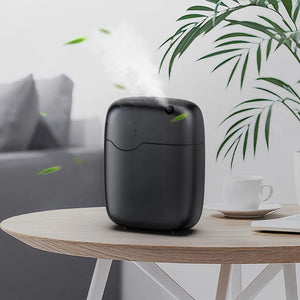
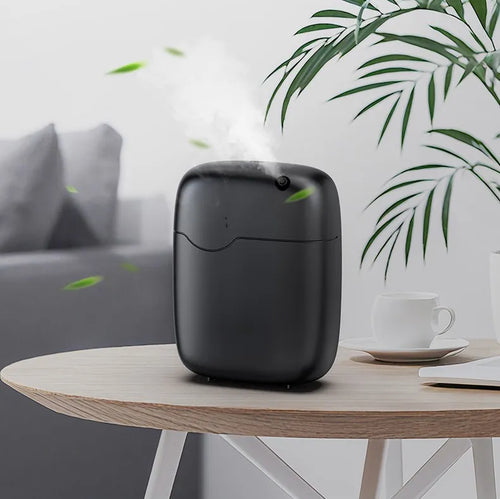
Waterless, up to 1000 m³ or roughly 2,000–3,000 sq ft, 400ml lasting about seventy-five days, app and onboard timers, key-lock, under 38 dB. I would rather write this box than have you skip to it. A room that smells crowded is a room whose occupancy has outgrown its air change, and no diffuser in the world moves a cubic metre of outdoor air into a building. Fix the ratio first. Then, in a hall that is genuinely ventilated for the number of people actually in it, a machine holds the public areas at smelling of nothing in particular for twelve hours, which is presentation and nothing more. Bought in that order it is a good purchase. Bought in the other order it is a way of not fixing a fan.
“Crowded” is a ratio, and here is the arithmetic
The word people use is always the same, and it is more accurate than they realise. Nobody says the hall smells bad; they say it smells crowded. That is a precise description of a rate problem. Every person in a waiting area loads the air continuously, and the room clears it continuously, and whichever of those two is faster decides what the space is like at half past four. It explains the thing that puzzles most clinic owners, which is that the same hall is entirely pleasant at nine in the morning and unpleasant by evening without anybody having changed anything. Nothing did change. The room ran a small deficit for nine hours and the deficit accumulated. Which is why the arithmetic is worth doing in public rather than taking anybody's word for it, including mine.
1
THE SUM
One hall, worked through on the back of an envelope
Take a real shape, because abstractions are useless here. A waiting hall of 1,400 square feet with a 3.2 metre ceiling: 1,400 divided by 10.76 is about 130 square metres, times 3.2 is about 416 cubic metres. That is the room. Now the load. Ventilation for waiting spaces is designed per occupant rather than per square foot, for the obvious reason that an empty hall needs almost nothing and a full one needs a great deal, and the figure your consultant used when the building was designed will be a number of litres of outdoor air per second per person. Ask them for it rather than taking a number off the internet, and ask for the peak headcount they assumed while you are there — that second number is the one that is usually wrong. Suppose the hall was designed for forty-five people at eight litres a second each. That is 360 litres a second, or about 1,296 cubic metres an hour of outdoor air, which against a 416 m³ room is roughly three air changes an hour of genuinely fresh air. Entirely reasonable. Now count your Monday at 11:15: forty seated, thirty-two standing, seventy-two people. The system has not changed and is still delivering its 1,296 cubic metres an hour, but spread across seventy-two people that is eighteen cubic metres an hour each, which is five litres a second rather than eight. You have not built a worse room. You have put sixty per cent more people into the same one, and the air each person gets has fallen by more than a third. That is what crowded smells like, and it is arithmetic rather than opinion. Do the same sum for your own hall before you read another word about fragrance.
The two numbers to get from your HVAC contractor this week: the outdoor-air rate per person the waiting area was designed to, and the peak occupancy that design assumed. Then stand in the hall at eleven with a clicker. Most clinics find the gap in under a minute.
2
WHERE IT WENT
Four things that quietly remove outdoor air from an Indian clinic
The sum above assumes the system is delivering what it was designed to deliver, and in a building that is five years old it very often is not.
The first and most common is the fresh-air damper, throttled or shut at some point in the building's life by somebody trying to reduce the cooling load, because outdoor air in an Indian summer is expensive to cool and closing that damper is the fastest way to make an electricity bill smaller. It works, it is invisible, nobody records it, and it is the single largest cause of a clinic waiting hall that has slowly got worse over three years without anything visibly changing. Go and look at the damper position, and if nobody in the building knows what it should be, that is your answer.
The second is extract rather than supply: a toilet or dirty-utility extract fan that has stopped, or been switched off at a local isolator by somebody who found it noisy. Extract is half of a ventilation system; a hall cannot pull fresh air in if nothing is pushing stale air out, and a dead toilet extract also reverses the pressure relationship between the toilet and the corridor, which is a separate and much more unpleasant problem. Third is the return path, and this one is free: walk the hall and look at what is standing in front of the return grilles. A standee, a notice board, a stack of spare chairs, a water cooler, a pot plant. A blocked return strangles the whole circuit.
And fourth is the appointment book, which nobody thinks of as ventilation equipment and which is the most powerful control you own. If orthopaedics, paediatrics and the health-check package all peak between half past ten and noon, you have chosen to concentrate your occupancy. Staggering department start times by forty minutes flattens the peak, and
peak-hour waiting-area odour is worth reading alongside this. It costs nothing and it works on the numerator of the ratio, which is the half most people never touch.
3
NOT THE SAME PROBLEM
A source smell is a separate fault and it needs a separate answer
One distinction has to be made before the last section, because the two get conflated constantly and the remedies are opposite.
A crowded smell is diffuse, it builds through the day, it is worst at the peak and it clears when the hall empties. A source smell is localised, it has a direction, it is often worse at a specific time or in a specific corner, and it does not clear. Those are different faults. The first is the ratio in this page. The second is a dry drain trap in a toilet nobody uses, a dressing bin past its collection time, a soiled-linen trolley taking the public corridor because the service lift is down, biofilm in an air-conditioning drain pan, damp behind a wall, or a leaking waste pipe in a riser. A smell in a medical facility is information, and the correct response to a source is to find it and fix it rather than covering it — putting fragrance over it removes the signal that told housekeeping something was wrong, which is worse in a clinic than in any other kind of building.
More ventilation will dilute a source and that is not a fix either. It is a way of making a fault harder to locate. So run the two investigations separately: the ratio sum for the crowding, and a walk of the building with your nose for anything that has a direction.
A clinic that smells of disinfectant all day is a third category again, and it is a mopping timetable rather than a fault. And while you are walking: consultation and examination rooms, treatment and procedure rooms, dressing rooms, sample collection, the laboratory, dispensing, sterile stores, imaging, oncology day-care and paediatric clinical areas are fragrance-free regardless of how any of this comes out. Better ventilation is the right answer for those rooms and the only one they get.
The order of work, and what each step actually costs
Everything I would do to a hall that smells crowded, in the order I would do it, with the honest cost of each step. Five of the seven rows are ventilation or scheduling. One is a fragrance purchase and it is sixth. The last row is the thing people try first and it is the one that makes the room worse.
A hall that smells crowded
The order of work, with the fragrance step where it honestly belongs
| Step |
What you are actually checking |
Effect on the problem |
Cost |
| 1. The occupancy-per-air-change sum ★ |
Hall volume, the design outdoor-air rate per person, and your real peak headcount |
Tells you whether you have a ventilation problem or a source problem. Everything else depends on it |
₹0 |
| 2. The fresh-air damper |
Whether it is open, throttled or shut, and whether anybody in the building knows what it should be |
Usually the largest single recovery available, and usually free to reverse |
₹0 to a service call |
| 3. Extract fans |
Toilet and dirty-utility extract actually running, not switched off at a local isolator |
Restores the other half of the circuit and fixes the toilet-to-corridor pressure as well |
A service call |
| 4. The return grilles |
What is standing in front of them: a standee, a notice board, spare chairs, a water cooler |
Immediate, and it costs a walk round the hall with a trolley |
₹0 |
| 5. The appointment book |
Whether three departments peak in the same ninety minutes |
Works on the numerator. Staggering start times by forty minutes flattens the peak |
₹0 |
| 6. Vaayu for the public areas |
Waterless, up to 1000 m³, 400ml ≈ 75 days, timers, key-lock, under 38 dB |
Holds the public areas at smelling of nothing in particular. It moves no air and makes no clinical claim |
₹11,999 |
| Do not do this: turn the fragrance up at noon |
The instinct when the hall fills, usually from somebody who has been inside since eight |
Makes a busy room busier. Busy is a ventilation problem and fragrance is not a ventilation product |
— |
Shop this guide
After the ventilation work, in three products
The SOSA principle
A hall that is fine at nine and unpleasant at six did not change. It ran a small air deficit for nine hours, and the deficit accumulated.
Which is why the fix is a ratio — more outdoor air, or fewer people in the same ninety minutes — and why nothing you can buy in a bottle addresses either half of it.
The ventilation work, and then one paragraph on fragrance
Start with the half of the ratio you can change this month, which is almost always the supply side. Get the damper position confirmed in writing by whoever maintains the air handling, because it is the most commonly altered and least commonly recorded setting in an Indian commercial building. Then have the extract fans checked physically rather than by asking whether they are working — somebody standing in the toilet with a tissue held to the grille, on a Monday, while the hall is busy. Then walk the hall and clear the return grilles, which takes ten minutes and a trolley and is the only step on this page that is both free and instant. If the sum in the section above came out badly and all three of those are already correct, then the hall genuinely is under-ventilated for its current load and you are into a conversation about mechanical capacity, which is an engineer's conversation rather than mine. What I would say about it is that the cost of getting outdoor air into a waiting hall properly is a facilities cost with a clear justification, and it is the right place for the money that would otherwise go on a larger fragrance system. Meanwhile, work the other half of the ratio: stagger the departmental start times, move the health-check package out of the eleven o'clock block, and stop booking the hall to its seat count when the seat count already exceeds what the ventilation was designed for. A hall with forty seats and thirty-two people standing is telling you something about the appointment book as much as about the fan.
Then the humidity point, which belongs here rather than in the fragrance paragraph because it is a ventilation matter and because it decides a purchase. A crowded room is usually a humid one: people add moisture continuously, monsoon adds it on wet footwear and clothing, and a room that is already struggling to change its air is also struggling to lose that moisture. Humid air holds and re-releases what is in it instead of letting it clear, which is why the same hall is noticeably worse in July in Pune or Kochi than in January, at identical occupancy. This matters commercially, and I would rather say it than let you find out: an ultrasonic diffuser adds thirty to fifty millilitres of water an hour to the air. Over a twelve hour clinic day that is four to six hundred millilitres of additional moisture, put into the one room whose problem is that it cannot clear what it already has. The Sukoon at ₹1,899, the Boond at ₹899 and the Megh at ₹3,499 are good machines and that is the wrong direction for this particular room. They also hold standing water, which in a building that runs twelve hours a day is a daily empty-rinse-dry job for a named person — honest behind a door in one administrative cabin, wrong in a public hall. The Vaayu holds no water at all and adds no moisture, and in a crowded hall that is the reason to prefer it rather than anything to do with fragrance.
And then the paragraph this page promised at the top, kept to one paragraph. Once the hall is genuinely ventilated for the number of people actually in it, and once anything with a source has been found and fixed, a scenting machine has one honest job: it holds the public areas at smelling of nothing in particular, all day, without anybody thinking about it. The Vaayu at ₹11,999 is waterless cold-air nebulisation with no reservoir, up to 1000 m³ or roughly 2,000–3,000 sq ft, a 400ml tank lasting about seventy-five days on a clinic's opening hours, 1h/4h/8h/24h timers with Bluetooth scheduling, auto-stop, under 38 dB and a key-lock so the setting survives a public hall. Run the Westin-inspired White Tea Serenity, the lightest of the seven, low, from thirty minutes before the first appointment until the last one, and then never touch the dial — particularly not at noon when the hall fills, which is the moment somebody always asks. Where the machine physically goes matters more than the setting does. What it does not do needs saying in the same breath: it moves no air, it is not an air purifier, it does not clean or disinfect anything, and it has no clinical effect on anybody. Consultation and examination rooms, procedure and treatment rooms, dressing rooms, sample collection, laboratories, dispensing, sterile stores, imaging, oncology day-care and paediatric clinical areas stay fragrance-free with their doors shut. That is the whole of the fragrance paragraph, and I meant it when I said it was one.
A diffuser does not move a single cubic metre of outdoor air into your building. If the hall smells crowded, the honest purchase order has a fan on it, not a fragrance.
— Sonal Sahani, SOSA
The SOSA edit
In spending order for a hall that smells crowded by the afternoon. Five of the six rows cost nothing or the price of a service call, which is the correct shape for this particular question, and the fragrance row is deliberately fifth rather than first.
The SOSA edit
A crowded waiting hall, in spending order
| Buy |
What it is |
When it earns its place |
Cost |
| 1. The two design figures ★ |
The outdoor-air rate per person the hall was designed to, and the peak occupancy it assumed |
First, and before any purchase. Compare with a real headcount at eleven on a Monday |
₹0 |
| 2. The damper, the extracts and the return grilles |
Fresh-air damper position confirmed in writing, extract fans physically checked, returns cleared of standees and spare chairs |
Second. This is where most of the lost outdoor air is recovered, and two of the three are free |
₹0 to a service call |
| 3. The appointment book |
Departmental start times staggered so three specialities do not peak in the same ninety minutes |
Third. It works on the number of people rather than the volume of air, which is the half nobody touches |
₹0 |
| 4. Seating, and honest capacity |
Enough wipe-clean chairs for the peak the book actually creates, rather than for the average |
Fourth. A patient standing in a scented hall is still a patient standing |
Varies |
| 5. Vaayu for the public areas |
Waterless with no standing water, up to 1000 m³, 400ml ≈ 75 days, app and timers, under 38 dB, key-lock, auto-stop |
Only once the ratio is right. It adds no moisture, which in this room is the reason to prefer it |
₹11,999 |
| Wrong machine for this room: an ultrasonic |
Vaayu aside, the Sukoon, Boond and Megh are water-based and add 30–50 ml of water an hour |
Right behind a door in one administrative cabin with a named owner. Wrong in a crowded, humid public hall |
₹899–₹3,499 |
Honest notes for buyers: fragrance in a medical facility is housekeeping and presentation, never treatment. Nothing on this page claims that a fragrance reduces anxiety, aids recovery, improves sleep, cleans or disinfects air, or has any clinical effect whatsoever, because it does not and a diffuser is not an air purifier. Scenting belongs to the entrance, reception, shared waiting areas, inter-departmental corridors and administrative rooms. Consultation and examination rooms, treatment and procedure rooms, day-care surgery, dressing rooms, blood- and sample-collection rooms, laboratories, pharmacy dispensing, sterile stores, imaging rooms, oncology day-care and paediatric clinical areas should be left fragrance-free. A persistent smell is information about a dry drain trap, a bin, a soiled-linen route or an air-conditioning drain pan: find it and fix it rather than covering it. On the machines: the
Vaayu at ₹11,999 is waterless cold-air nebulisation with no standing water tank, covering up to 1000m³ or roughly 2,000–3,000 sq ft, with a 400ml tank lasting about 75 days, Bluetooth app control, 1h/4h/8h/24h timers, under-38dB running, auto-stop and a key-lock for public areas. The
Aangan at ₹25,999 covers up to 3,000m³ and connects to HVAC for a whole floor or an atrium. The ultrasonic
Sukoon,
Boond and
Megh are water-based, hold standing water and add 30–50 ml of water an hour to the air, which makes them suitable for a single administrative cabin with a named person emptying and drying the tank daily, and unsuitable for public clinical property. An alcohol-free
reed diffuser needs 24–72 hours to establish and suits a small lobby rather than a large waiting hall. Candles are not appropriate in a healthcare facility because an open flame is a fire-safety matter. SOSA does not make a room spray. The Hotel Collection scents are SOSA's own interpretations inspired by the world's finest hotels; SOSA is an independent Indian fragrance house, not affiliated with or endorsed by any hotel brand. A portion of every order supports girl-child education through Nanhi Kali.

Why a water tank points the wrong way in a full room
SOSA Sukoon · 500ml ultrasonic ₹1,899
A 500ml BPA-free tank, 270–320 sq ft, 16–18 hours per fill on low at 30–50 ml an hour, steady, 2H and 4H timers, auto shut-off, three 15ml
Hotel Collection scents included.
An ultrasonic machine does not only put fragrance into a room. It puts thirty to fifty millilitres of water an hour into it, which over twelve hours is four to six hundred millilitres of added moisture in exactly the room whose problem is already too many people and not enough outdoor air. In a Pune or Kochi monsoon that is a decision somebody should make deliberately rather than by accident. Behind a door, in one administrative cabin, with a named person emptying, rinsing and drying the tank every evening, it is an honest little machine. In a crowded public hall it is the wrong category.
A note from Sonal
The first time somebody asked me to fix a crowded waiting room I did the polite thing and talked about fragrance, and it was a waste of everybody's afternoon. The hall was in a polyclinic in Thane, it held thirty-eight chairs, and at 11:40 on the Monday I visited there were seventy-one people in it because three departments started their lists within twenty minutes of each other. The building was doing exactly what it had been designed to do. The appointment book was not. No composition I have ever made, at any intensity, would have made that room pleasant, and if I had sold them a machine that day they would have concluded the machine did not work.
So I have become slightly unpopular with my own sales pitch on this particular question, and I am comfortable with that. Ask the ventilation questions first. The damper, the extract fans, the return grilles and the booking pattern between them account for most of the halls I have been asked to rescue, and all four are either free or cheap. Then, when the room is honest, a machine has a small real job to do and does it well for twelve hours a day without anybody managing it. That is a good product in the right order and a bad one in the wrong order, and in a medical building the order is the whole of the ethics.
Everything is made and supported from Pune, and a part of every order funds girl-child education through Nanhi Kali. You get a space that smells like somewhere looked after; a girl gets a classroom. That equation has always felt right to me.
Frequently asked questions
Why does our clinic waiting room smell crowded by the afternoon?
Because the rate at which people load the air has outrun the rate at which the room replaces it, and the deficit accumulates across the day. Work out the hall's volume, get the design outdoor-air rate per person and the peak headcount the system assumed, and compare those with a real count at eleven on a Monday.
Will a scent diffuser fix a waiting room that smells crowded?
No, and it should not be sold as though it would. A diffuser moves no outdoor air, it is not an air purifier and it does not clean air. Once the hall is genuinely ventilated for the people in it, a machine holds the public areas at smelling of nothing in particular, which is presentation and housekeeping rather than a remedy for crowding.
What are the most common reasons a clinic loses ventilation without anybody noticing?
A fresh-air damper throttled or closed to reduce the cooling bill, a toilet or dirty-utility extract fan that has stopped or been switched off locally, a return grille blocked by a standee or spare chairs, and an appointment book that puts three departments' peaks in the same ninety minutes. The first and the last are the biggest and neither costs anything to reverse.
Is an ultrasonic diffuser a bad idea in a busy waiting hall?
For this room, yes. An ultrasonic is water-based and adds 30–50 ml of water an hour to the air, which over twelve hours is four to six hundred millilitres of moisture in the room that is already struggling to clear what it has. It also holds standing water, which needs emptying, rinsing and drying daily by a named person. It belongs behind a door in an administrative cabin.
Should we turn the fragrance up when the waiting area fills at eleven?
No. That is the single most common mistake in this cluster. A full room is a ventilation and occupancy problem, and adding fragrance to it makes the air busier rather than better. Set the level once in the first week, lock it, and write the number into the standard operating procedure.
The morning-to-evening version of this question goes into it further.
A ratio, not a smell
Occupancy per air change — and then one paragraph about fragrance
The Vaayu is ₹11,999: waterless cold-air nebulisation with no standing water tank and no added moisture, up to 1000 m³ or roughly 2,000–3,000 sq ft, a 400ml tank lasting about seventy-five days, Bluetooth app control with 1h/4h/8h/24h timers, under 38 dB, auto-stop and a key-lock for public areas, supplied with four hotel-inspired fragrances. The ultrasonic Sukoon ₹1,899, Boond ₹899 and Megh ₹3,499 are water-based and belong behind a door. Free shipping above ₹499, and a portion of every order supports girl-child education through Nanhi Kali.
See the Vaayu · ₹11,999 All commercial scenting
Continue the read
More from SOSA
Editorial standards & sources
About this guide: Written by Sonal Sahani, ISIPCA Versailles-trained founder and perfumer at SOSA Home & Body, treating a clinic waiting room that smells crowded as an occupancy-per-air-change problem rather than a fragrance one: the cubic-metre and per-occupant arithmetic worked through in public, the four common ways an Indian clinic quietly loses outdoor air, why a water-based diffuser points the wrong way in a humid crowded hall, and a single closing paragraph on where fragrance honestly fits.
Facts verified August 2026: Product facts used in this guide. SOSA Vaayu ₹11,999: waterless cold-air nebulising diffuser, atomises undiluted fragrance oil to a dry residue-free nano-mist with no water reservoir, coverage up to 1000m³ (approximately 2,000–3,000 sq ft), 400ml refillable tank lasting up to about 75 days per fill, Bluetooth app plus onboard control, 1h/4h/8h/24h timer scheduling, adjustable intensity, under 38 dB, DC 12V/1A at 5W, 165 × 80.5 × 215 mm and 0.9 kg, freestanding or wall or HVAC mounted, auto-stop and key-lock, CE, RoHS and SGS certified, supplied with four hotel-inspired fragrances. SOSA Aangan ₹25,999: HVAC-connected or standalone commercial nebulising diffuser, coverage up to 3,000m³ (roughly 8,000–10,000 sq ft), 800ml reservoir, metal body, programmable schedules, under 42 dB. Ultrasonic machines are water-based, hold standing water and consume 30–50 ml of water an hour: Sukoon ₹1,899 (500ml, 270–320 sq ft, 16–18 hours on low, 3–6 drops per tank, steady/2H/4H timers, three 15ml Hotel Collection scents included), Boond ₹899 (300ml), Megh ₹3,499 (6 litres). Hotel Collection water-based fragrance 15ml ₹299, 100ml ₹999, 300ml ₹1,799, Pack of 7 at 15ml ₹1,799 against ₹2,093 bought singly; the Vaayu and Aangan take their own undiluted oil rather than these water-based bottles. Alcohol-free reed diffusers from ₹749, requiring 24–72 hours to reach their working level. Free shipping above ₹499. Coverage arithmetic: cubic metres equal floor area in square feet divided by 10.76 and multiplied by ceiling height in metres, counting only the volumes that are actually scented. This guide makes no medical, therapeutic or clinical claim of any kind for fragrance: a diffuser does not purify, disinfect or clean air, and does not treat, calm or affect any patient or condition. Fragrance is housekeeping and presentation. Clinical areas should be left fragrance-free, and a persistent odour should be traced to its source and corrected rather than covered. SOSA is not affiliated with or endorsed by any hotel brand. Prices subject to change — see the live product pages.