





The worked example: Megh ₹3,499 — 6 litres, ~100 hours, ~215 sq ft. Sukoon ₹1,899 — 500ml, 16–18h on low, 270–320 sq ft. Boond ₹899 — 300ml, ~6h, up to about 150 sq ft. Tank size and coverage do not move together.
The same trap on the reed shelf: a 130ml does not reach further than a 50ml. It lasts 14–18 weeks instead of 6–8. Both bottles have the same six fibre reeds, and it is the wetted reed surface that sets how much leaves — not the liquid underneath it.
Before buying anything: six reeds rather than three, halve the distance, nose height, out of the draught but not a dead corner, close the door, and ceiling fan on low, which is the transport a reed structurally lacks.
The gap: between Safar ₹3,999, named and sold as a car and travel diffuser, and Vaayu ₹11,999 at 1000 m³, SOSA has no mid-sized waterless bedroom nebuliser.
2. Then find the coverage figure, in sq ft or m³, and match it to your room. Comfortably above your room size is right. Ten times above is waste, which is why Vaayu at ₹11,999, rated to 1000 m³ or roughly 2,000–3,000 sq ft, is the wrong purchase for one 120 sq ft bedroom — nine-tenths of it goes nowhere.
3. Read runtime alongside the timer, not alone. A hundred hours of runtime is only useful if the hours land while you are in the room. A timer — Vaayu’s 1h / 4h / 8h / 24h windows, Safar’s 1, 2 or 3-hour auto-off — is often worth more than raw endurance.
4. Check the oil before you fall in love with the machine. Reed oil cannot go into an ultrasonic. The water-based Hotel Collection cannot go into reeds, and there is no hotel-inspired reed diffuser. Safar takes pure fragrance oil. Changing mechanism may mean changing scent, and that is the single most common disappointment in this whole subject.
5. Read tank size last, and read it as one sentence: how often will I fill this. Megh’s six litres is a genuine convenience for somebody who resents refilling. It is not a coverage claim, and treating it as one is how people spend ₹3,499 to cover less floor than ₹1,899 buys.
Work the free list first — a large share of readers never need any of this. Alcohol-free, phthalate-free, composed in Pune. A portion of every order supports girl-child education through Nanhi Kali.

Why volume and coverage are set by completely different things
The confusion is entirely reasonable, because in almost every other product a bigger container means more of the thing. A litre of paint covers more wall than a half-litre. Home fragrance breaks that intuition, and it breaks it for a specific reason worth understanding once.
 Megh₹3,499A reservoir is a fuel tank. It determines endurance: how many hours of operation you get before you top it up, which is a real and often underrated convenience. What it cannot do is change what happens at the outlet, and the outlet is where distribution is decided. Megh is the honest illustration: six litres, about 100 hours, about 215 sq ft, ₹3,499. A machine you fill rarely, which also adds a good deal of moisture to a room, and which covers less floor than a machine costing ₹1,600 less. I would sell it happily to somebody who wants a long-running humidifying diffuser. I would talk almost anybody out of buying it to make a room smell more even.
Sukoon₹1,899What actually sets coverage is how quickly the device converts oil into airborne mist, and how forcefully it throws that mist into the room. A device that pushes out a strong plume entrains the air around it and starts a circulation, and it is the circulation that carries fragrance to the far corners. Neither of those properties is stored in the tank. This is why a compact machine can beat a large one, and why the honest way to compare two diffusers is coverage against coverage, at the same mechanism. Boond ₹899 up to about 150 sq ft; Sukoon 270–320; Megh about 215; Vaayu 1000 m³.
Megh₹3,499A reservoir is a fuel tank. It determines endurance: how many hours of operation you get before you top it up, which is a real and often underrated convenience. What it cannot do is change what happens at the outlet, and the outlet is where distribution is decided. Megh is the honest illustration: six litres, about 100 hours, about 215 sq ft, ₹3,499. A machine you fill rarely, which also adds a good deal of moisture to a room, and which covers less floor than a machine costing ₹1,600 less. I would sell it happily to somebody who wants a long-running humidifying diffuser. I would talk almost anybody out of buying it to make a room smell more even.
Sukoon₹1,899What actually sets coverage is how quickly the device converts oil into airborne mist, and how forcefully it throws that mist into the room. A device that pushes out a strong plume entrains the air around it and starts a circulation, and it is the circulation that carries fragrance to the far corners. Neither of those properties is stored in the tank. This is why a compact machine can beat a large one, and why the honest way to compare two diffusers is coverage against coverage, at the same mechanism. Boond ₹899 up to about 150 sq ft; Sukoon 270–320; Megh about 215; Vaayu 1000 m³.
 Mountain Breeze₹849 / ₹1,349SOSA reeds come in two sizes and no others — 50ml and 130ml, with six fibre reeds in both. The emission happens at the wetted surface of those reeds, so both bottles present the same evaporating area to the room and emit at broadly the same rate. The difference is supply: 50ml runs 6–8 weeks and suits rooms up to about 150 sq ft; 130ml runs 14–18 weeks and suits rooms above that. The room-size guidance exists because a larger room turns its air over faster and will drink a small bottle, not because the larger bottle projects further. It does not. At roughly ₹13–₹15 a day either way, the 130ml is better value per week — but only if the room genuinely needs it. In a 120 sq ft bedroom it is over-specified.
How to read any listing, in five lines
This is the method, and it works on our site and on everybody else’s. Line one, the mechanism. Look for the words reed, ultrasonic, or waterless / cold air / nebulising. If the page describes a mood rather than a mechanism, assume the cheapest option in the category and price accordingly. Line two, the coverage figure in sq ft or m³. If there is not one, the maker has probably not measured it, and a missing number is information rather than an oversight. Line three, runtime and timer together. The question is not how long it can run but whether it can be told to run when the room is occupied.
Line four, the oil. Which oils does this device take, do you already own any of them, and are the ones you love compatible? This is the check almost nobody runs, and it is the reason a great many upgrades disappoint: a person who loves Garden Bloom in their reeds buys a machine and discovers, correctly, that Garden Bloom does not go in it. The right framing is that you are adding a mechanism to the house, not swapping one out. Line five, and only now, the tank. Six litres means you fill it rarely. Three hundred millilitres means you fill it often. Neither means anything about the room.
One caveat about a specification you will not find. We publish no coverage figure for Safar at ₹3,999, so I will not quote one, and I want to be straightforward about what Safar is: it is named and sold as a car and travel perfume diffuser, and SOSA’s own page lists car, handbag, desk, bedside and hotel room. It uses the good mechanism — waterless cold diffusion of undiluted oil — in a 20ml, 6.9 cm, fully cordless body with a 2000 mAh battery, three speeds and a 1, 2 or 3-hour auto-off. It runs up to about 10 hours continuous or 30 intermittent per charge. It is not set-and-forget, it needs recharging, and thick or water-based blends can clog it. Judge it as the mechanism at personal scale, which is a fair and useful thing to be, and not as a room machine.
Every SOSA machine, tank against coverage
The same catalogue sorted by the two numbers people confuse. Read the two middle columns against each other and the argument of this page makes itself. The last row is the one I would ask you to take seriously before spending ₹11,999.
| Machine | Tank / bottle (duration) | Coverage (distribution) | What it is genuinely for | Price |
|---|---|---|---|---|
| Boond | 300ml · about 6 hours · USB, night light | Up to about 150 sq ft | A small bedroom, a desk, a first machine on a tight budget | ₹899 |
| Sukoon ★ | 500ml · 16–18 hours on low · three 15ml scents included | 270–320 sq ft — the most coverage per rupee in the range | Very often the correct bedroom answer, and never to be skipped for something dearer | ₹1,899 |
| Megh | 6 litres · about 100 hours | Only about 215 sq ft — less than the Sukoon | Runtime and humidity. Never a coverage upgrade | ₹3,499 |
| Safar | 20ml · up to 10h continuous or ~30h intermittent per charge · 3 speeds · 1 / 2 / 3-hour timer | No coverage figure is published, so none is quoted | Waterless cold diffusion of undiluted oil at personal scale. Named and sold as a car and travel diffuser; needs recharging | ₹3,999 |
| Vaayu | 400ml · up to about 90+ days · 1h / 4h / 8h / 24h windows · under 38 dB | 1000 m³, roughly 2,000–3,000 sq ft | A whole floor, open-plan living-dining, a large home, clinic, salon or reception | ₹11,999 |
| The honest gap | — | Nothing between Safar and Vaayu | SOSA has no mid-sized waterless bedroom nebuliser. Vaayu in a 120 sq ft bedroom wastes nine-tenths of what you paid for | — |
270–320 sq ft · Sukoon₹1,899Shop →  Ultrasonic-only oils₹299–₹1,799Shop →
 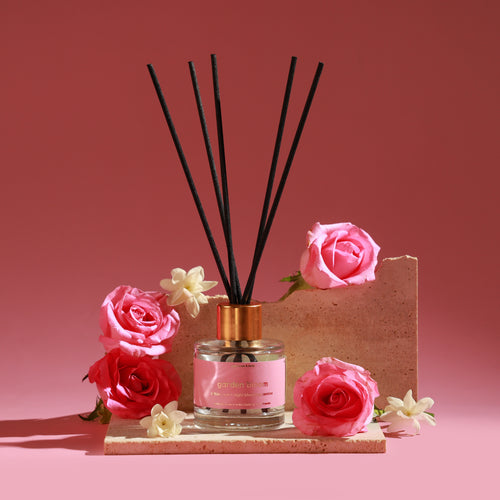 50ml, 6–8 weeks · Garden Bloom₹799Shop →
The same trap on the reed shelf, and the free levers first
If you are choosing between a 50ml and a 130ml because the room is not even, please stop and read this paragraph twice: the larger bottle will not change the shape of your room. Both bottles carry six fibre reeds, both present the same wetted surface, both emit at broadly the same rate, and neither moves any air at all. What the 130ml buys is 14–18 weeks against 6–8, which is better value per week at roughly ₹13–₹15 a day either way, and is genuinely the right buy for a room above about 150 sq ft — because a larger room turns its air over faster and drinks the bottle. In a 120 sq ft bedroom it is over-specified, and buying it for reach is buying the wrong axis.
Before any of the paid options, the free ones, because a good share of people who reach this page are finished by the end of them. Reed count: six is full projection, three is a soft bedside level that roughly doubles the life of the bottle. Distance: halving the gap between the bottle and where you sit or sleep does more than any change of scent. Height: at or slightly below nose height, on a surface, not the floor and not a high shelf. Draught: out of a running AC’s blast, off the windowsill, away from an open balcony door — but not in a dead corner either. The door: closed, because containment is half of concentration and costs nothing.
And the one worth more than the rest put together: turn the ceiling fan on low. A fan supplies transport, which is the exact thing a reed structurally lacks, and it is the closest anyone gets to buying the useful half of an active diffuser for free. It shortens the bottle, because moving air over a wetted surface speeds evaporation, and you should make that trade knowingly rather than discover it in week five. Judge the result by leaving the room for fifteen minutes and walking back in, and by asking a visitor — sitting in a room is the one situation in which your nose is guaranteed to under-report, since receptors adapt to a constant stimulus within minutes.
Choosing by room, in the order I would spend — and the gap
Matched to the size of the space rather than to the size of the container. The last row is the honest hole in our range and the most useful line here for a one-bedroom reader.
| Your room | What to buy | Why, in coverage terms | Price |
|---|---|---|---|
| Any room, first ★ | The free list — reed count, distance, height, draught, door, ceiling fan on low | The fan is genuine transport; the rest is dose and containment. Give it a week | ₹0 |
| Up to about 150 sq ft — bedroom, bathroom, home office | A 50ml reed, or Boond ₹899 if you want a machine | 50ml is sized to this room and lasts 6–8 weeks; Boond is rated to about the same area | ₹749–₹899 |
| Above 150 sq ft — living room, kitchen, open-plan end | A 130ml reed for a scented zone, all six reeds | 14–18 weeks, because a bigger room drinks a small bottle. Still a zone, not a plateau | ₹1,249–₹1,349 |
| A bedroom that must smell the same everywhere ★ | Sukoon ₹1,899 | 270–320 sq ft of coverage on a 500ml tank — the best coverage per rupee we sell | ₹1,899 |
| A whole floor, open-plan living-dining, a clinic or showroom | Vaayu ₹11,999 | 1000 m³, roughly 2,000–3,000 sq ft. In one 120 sq ft bedroom, nine-tenths is wasted | ₹11,999 |
| The honest gap | Between Safar ₹3,999 — a car and travel diffuser, with no published coverage figure — and Vaayu, there is nothing | No mid-sized waterless bedroom nebuliser exists at SOSA. Also skip Megh if coverage is your goal | — |
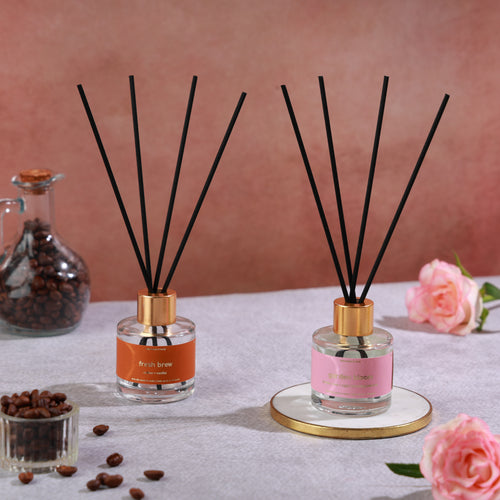
Versailles
I am aware that publishing the Megh comparison in this much detail is an odd thing for a founder to do. It is a product we sell, at ₹3,499, and I have just spent several paragraphs explaining that it covers less of your room than the machine at ₹1,899. But the alternative is worse. Somebody buys Megh because six litres sounds like the serious choice, waits a fortnight, finds the far side of the room unchanged, and concludes that scent machines do not work. That is one disappointed customer and one wrong conclusion, and I would rather lose the sale.
Megh is not a bad machine. It is a runtime and humidity machine and it is very good at being one. The mistake is not in the product, it is in the specification people read. Volume has been the headline number in this category for years because it is the easiest thing to photograph and the easiest thing to compare, and coverage — which requires actually measuring something in a room — is quietly left off a great many listings altogether. When you notice a listing has no coverage figure, that absence is the most informative thing on the page.
So the habit I would leave you with is small and permanent. Read the mechanism, find the coverage, then look at the tank last and ask yourself only how often you want to be filling it. And do the free week first: reeds, distance, door, and the ceiling fan on low. Everything is composed in Pune, and a part of every order funds a girl’s classroom through Nanhi Kali.
Frequently asked questions
- Even distribution across a bedroom — the head question of the family.
- Hot spots instead of consistency — why point sources make peaks.
- The same strength at bed, desk and door — which mechanism can deliver it.
- One strong corner and three weak ones — the fixes in order.
- Several passive or one active? — including where passive genuinely wins.
- Can active diffusion be more consistent? — the mechanism behind the yes.
- Fragrance in the air, not around the bottle — the vocabulary to search with.
- Distribution versus strength — the shape of the curve, not its height.
- Should I look beyond reed diffusers? — the family pillar.
- Brand: the SOSA founder story.
SOSA facts verified August 2026: Reed diffusers are supplied in 50ml and 130ml only — 50ml suits rooms up to about 150 sq ft and lasts 6–8 weeks, 130ml suits rooms above 150 sq ft and lasts 14–18 weeks, at roughly ₹13–₹15 a day. Six reeds is full projection; three is a soft bedside level and roughly doubles the life; two or three reeds in a 50 sq ft bathroom can make a 50ml last nearly three months; flip the reeds every 3–5 days. Morning Freshness ₹749 / ₹1,249 · Evening Calm ₹799 / ₹1,299 · Garden Bloom ₹799 / ₹1,299 · Mountain Breeze ₹849 / ₹1,349 · Fresh Brew ₹849 / ₹1,349. Duos: Day & Night ₹1,498, Fresh & Grounded ₹1,548, Warmth & Bloom ₹1,598 (50ml × 2); 130ml duos ₹2,498 / ₹2,548 / ₹2,598. Strength scale, perceived intensity rather than quality or coverage: Evening Calm 8.9 softest, Garden Bloom 8.9, Morning Freshness 9.0, Mountain Breeze 9.4, Fresh Brew 9.5 deepest. Six fibre reeds rather than rattan, heat-stable CCT carrier rather than DPG, alcohol-free, phthalate-free, paraben-free, IFRA-compliant, 0 ppm formaldehyde, refillable glass bottle, tested at 45°C and 85% RH, composed in Pune. Refills 300ml ₹2,399 (roughly six 50ml fills) and 500ml ₹3,499, oil only and never a first purchase. Machines: Boond ₹899 (300ml, up to about 150 sq ft, ~6h, USB, night light) · Sukoon ₹1,899 (500ml, 270–320 sq ft, 16–18h on low, three 15ml Hotel Collection scents included) · Megh ₹3,499 (6L, ~100h runtime but only ~215 sq ft, a runtime and humidity machine and never a coverage upgrade) · Safar ₹3,999, a waterless cold-diffusion device named and sold as a car and travel perfume diffuser, 6.9 cm, with a 20ml bottle, a 2000 mAh Type-C battery, up to 10 hours continuous or about 30 hours intermittent per charge, three speeds and a 1 / 2 / 3-hour auto-off timer · Vaayu ₹11,999, a waterless cold-air nebuliser rated to 1000 m³, roughly 2,000–3,000 sq ft, with a 400ml tank lasting up to about 90+ days, app and onboard control, 1h / 4h / 8h / 24h windows and under 38 dB operation, and the wrong purchase for one bedroom. Aangan ₹25,999 and Meenar ₹38,500 are commercial machines and are not home recommendations. No coverage figure is published for Safar and none is quoted here. Between Safar and Vaayu, SOSA has no mid-sized waterless bedroom nebuliser. Hotel Collection oils are water-based and ultrasonic-only: 15ml ₹299, 100ml ₹999, 300ml ₹1,799, pack of seven ₹1,799. Reed oil, the water-based Hotel Collection and pure fragrance oil are not interchangeable across these mechanisms, and there is no hotel-inspired reed diffuser. No health, air-quality, allergy, sleep or mood claims are made anywhere on this page, and fragrance is not presented as a way to remove a smell. Free shipping above ₹499, and a portion of every order supports girl-child education through Nanhi Kali. SOSA is an independent Indian fragrance house; the Hotel Collection is SOSA's own interpretation inspired by the world's finest hotels and SOSA is not affiliated with or endorsed by any hotel brand. Prices subject to change — see the live product pages.