

The three: direct sunlight heating the glass and the oil inside; a sill or ledge that stores and re-radiates heat; and air exchange with outside, which strips the reeds and carries fragrance out of the room.
How much? Our working guidance is that a sunlit, ventilated sill can take a 50ml well below its stated 6–8 weeks — a third to a half in a hot month. Treat that as a range from testing and customer reports, not a measurement.
The fix: move it two feet inward, out of the beam, onto a console or shelf at waist to chest height near a doorway. Free, and the room usually smells better afterwards, not worse.
2. The air part is the one that also costs you presence. Sun and heat empty the bottle while the room still smells of something. Outdoor air movement empties it and takes the fragrance out of the window with it, which is why a windowsill bottle so often produces the complaint "it goes down fast and I cannot smell it".
3. Even a closed window is not neutral. Glass transmits heat all afternoon whether or not it opens, and a sealed sunlit sill is still one of the hottest surfaces in the flat.
4. There is a dust cost as well. Air from outside carries road dust, and dust settling on the exposed reed ends is one of the things that shortens the working life of the fibre. Reeds are the consumable in this format, and a window ages them faster.
5. Move it two feet, not two rooms. An inner-wall shelf, a sideboard near a doorway, an entrance console — waist to chest height, clear space around it, out of the beam. Stand it on a tray; the oil marks wood and stone.
6. Do not answer a window by buying a stronger scent. The room is not weak; the position is expensive. Composed and handmade in small batches in Pune, and a portion of every order supports girl-child education through Nanhi Kali.

Part one — three accelerants, one square foot
Most placement mistakes are single-variable. A bottle behind a sofa has a dead-air problem; a bottle on the fridge has a heat problem; a bottle under a split unit has a draught problem. The window is the only common position in an Indian home that supplies all three of the classic accelerants at once, and because they are independent they do not merely add — the hot oil is being carried off by moving air, so each makes the other more effective. That is the whole reason this article exists as something separate from a general guide to heat or to airflow.
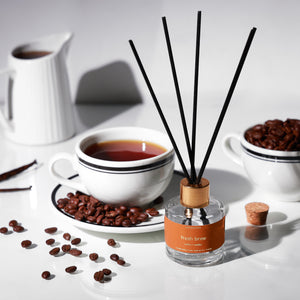
 Fresh Brew₹849 · 9.5/10Indian window ledges are usually stone, tile or granite, sometimes with a metal frame, and all of those store heat well. They take in sun through the middle of the day and give it back through the evening, so a bottle can be in complete shade at seven o'clock and still standing on something distinctly warm. This is the accelerant that survives your fix if the fix is only a curtain. Drawing a sheer curtain removes the beam but leaves the ledge warm, which is why the honest advice is distance rather than shading — off the sill entirely, onto a wooden or ceramic surface further into the room. It also solves a second problem: reed oil marks stone and wood, and a sill is a difficult place to keep a tray.
Part two — not all windows are equally expensive
A north-facing window in a sheltered room is a very different proposition from a west-facing balcony door in Ahmedabad. The table below sorts them, and every figure in it is SOSA's own working guidance from in-house testing and customer correspondence rather than laboratory measurement.
| Window and aspect | Sun on the glass | Air across the reeds | Rough cost to a 50ml | The better spot nearby |
|---|---|---|---|---|
| West-facing, opened daily ★ | Direct, hours of afternoon beam | Constant exchange with outside | Can cost a third to a half | Inner wall of the same room, out of the beam |
| Balcony door, left ajar | Varies, often direct | Heaviest exchange of all — a doorway to outdoors | Several weeks in an open month | The wall beside the door, indoors, waist height |
| South-facing, closed, sheer curtain | Diffused but persistent | None | A week or so, mostly from the warm ledge | Two feet inward on wood, off the stone |
| Kitchen window over the sink | Usually some | Extractor plus outdoor air | A week or more, plus a muddled smell | Out of the cooking zone entirely |
| Bathroom ventilator or louvre | Little | Continuous extraction to outside | Quiet room, fast bottle | A shelf on the opposite wall |
| North-facing, shaded, rarely opened | None to speak of | Minimal | Close to the rated window | Acceptable, though a doorway is still better |
| No window at all — inner console by a doorway | None | Gentle incidental traffic | Behaves as rated, and reads strongest | This is the reference position |
| The honest caveat: the fourth column ranks positions; it does not predict your bottle. A shaded balcony, a projecting chajja, double glazing, a high ceiling or a room that is opened for twenty minutes rather than all day will each move the number substantially. And one instruction overrides the whole table: never diffuse over live cooking. Extractor on, window open ten minutes, close up, then wait half an hour — fragrance layered onto cooking makes a third smell nobody designed. | ||||
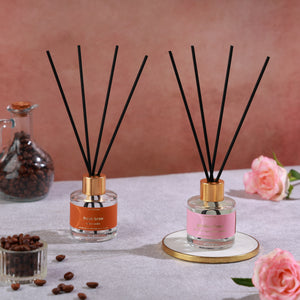
Garden Bloom · entrywaysfrom ₹799Shop → 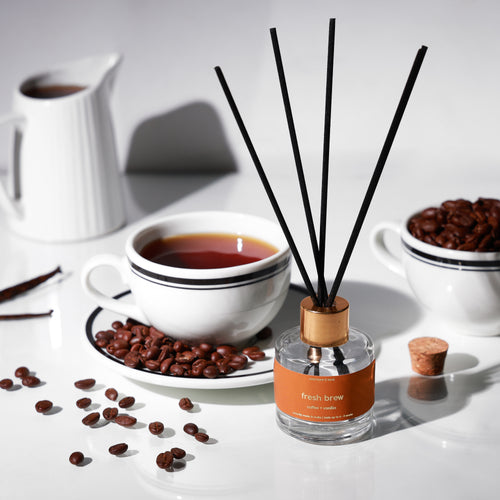 Fresh Brew · living roomsfrom ₹849Shop →
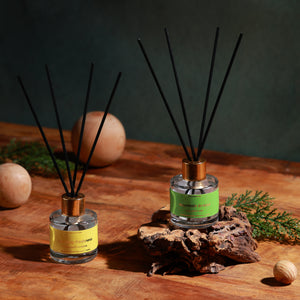
 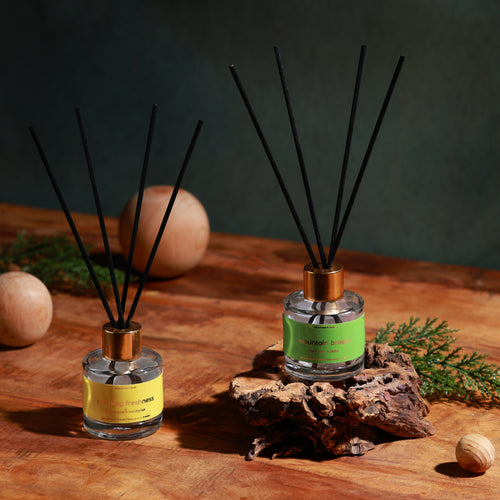 Fresh & Grounded duo · 2 × 50ml₹1,548Shop →
Part three — why the sill feels right, and what to trust instead
I have stopped being surprised by how consistent this is. When a customer writes to say a bottle has run down early, and I ask where it stands, roughly half describe a window. There are two good reasons for that and neither is carelessness. The first is aesthetic: a glass bottle with six pale reeds in it is a beautiful object, and daylight is where beautiful objects go. The second is a piece of borrowed intuition — that fragrance needs air, that a stuffy room is the enemy, that putting scent near a window will let it travel through the house. The intuition is half right, which is what makes it so durable. Fragrance does need air movement. It needs the room's own air moving gently past the reeds and carrying molecules onward into the space, which is what happens when people walk through a doorway a few times an hour. What it must not have is air leaving the room, because the fragrance leaves with it.
The corrected instinct is worth stating as a rule, because it applies far beyond windows: put the bottle where people pass, not where air escapes. An entrance console is the best position in most Indian flats — a door that opens several times a day, people arriving and leaving, no sun, no exchange with outside except in brief bursts. A sideboard beside a doorway between two rooms is next. A dressing table or a bookshelf at waist to chest height in a bedroom works well. All of them are indoor positions with incidental traffic, and all of them will make a bottle both last longer and smell more present than the sill will. That combination — longer and stronger — is rare in this format, where almost every conservation move costs you something. It exists here because a window is not saving anything; it is simply wasting the bottle out of doors.
One more consequence, less obvious and worth knowing if you are wondering why your reeds look tired early. Air from outside carries dust, and Indian urban air carries a good deal of it. Dust settles on the exposed ends of the fibre, mixes with the residue that naturally accumulates there, and forms a crust that slows wicking. Reeds are the consumable in this format and oil is the stable part — people replace the oil and keep the reeds, when it is almost always the other way round. A bottle by an open window ages its fibre faster than one on an inner shelf, so if you have run a diffuser on a sill, refresh the reeds when you refill rather than pouring good oil through a set that has stopped working. We do not sell replacement reeds separately, which is an honest gap in our range and one I would rather name than pretend around; our guidance is to refresh them every few months.
Part four — the two-foot move, and what it is worth
Every row below is a swap rather than a purchase, and all but the last two are free. This is the shortest useful table in the cluster because the answer really is that simple.
| Instead of… | Move it to… | What you keep | What you get back | Cost |
|---|---|---|---|---|
| A sunlit sill ★ | Entrance console or sideboard by a doorway | The whole configuration — six reeds, same scent | Weeks and presence together | Free |
| A ledge by a balcony door | The indoor wall beside the door, waist to chest height | The high-traffic advantage you wanted | The fragrance stops leaving the flat | Free |
| A stone sill you cannot avoid | A wooden or ceramic surface, on a tray | The same corner of the room | The stored-heat accelerant, removed | Free — a tray protects the surface |
| A kitchen window over the sink | Any shelf out of the cooking zone | A scented kitchen, minus the confusion | A clean smell instead of a layered one | Free |
| Replacing a bottle you lost to a sill | 300ml oil refill into your own vessel | Your glass, and the habit | About 8–11 months at roughly ₹7–8 per ml | ₹2,399 · oil only, no reeds |
| Two windowsill bottles in one big room | Two indoor positions at opposite ends | Both bottles, both behaving properly | Coverage a single point source cannot give | Duo set from ₹1,548 |
| Not the fix: a stronger fragrance | Nothing to buy — correct the position first | Your money | A 9.5 on a sunlit sill still behaves like a sunlit sill | Free advice |
Versailles
Every brand in this category, including ours at the beginning, has photographed a reed diffuser on a windowsill in morning light. It is the obvious shot. The bottle is glass, the reeds are pale, the light is free, and it looks like exactly the kind of calm domestic moment the product is meant to belong to. I have come to think it is the most quietly misleading image we produce, because it teaches a placement that costs the buyer weeks of the thing they bought.
What convinced me was reading complaint messages side by side with photographs. People send pictures when something is wrong, and after a couple of hundred of them the pattern was impossible to miss: a bottle on a sill, half empty, with reeds that looked pale and dry at the top. Every one of those was three problems in a trench coat — sun, a hot ledge and air going out of the window — and every one of them was solved by a shelf two feet away.
So we say it on the label and we say it here. Keep it out of direct sunlight. Stand it on a tray. Put it where people pass, not where the air escapes. It is a strange thing for a shop to publish, since the fastest way to sell more bottles would be to let everyone keep them on the sill. But the range is composed and handmade in small batches in Pune to sit at a level it can hold for the whole life of a bottle, and I would rather you got all eight weeks of it. A part of every order funds a girl's classroom through Nanhi Kali.
Frequently asked questions
- Does heat make it finish faster? — the largest single accelerant, isolated.
- Does air conditioning shorten it? — the draught and the dryness, separately.
- Why is my reed diffuser finishing so quickly? — all six accelerants, ranked.
- The complete longevity troubleshooting guide — this page and the eight around it, in one place.
- Brand: the SOSA founder story.
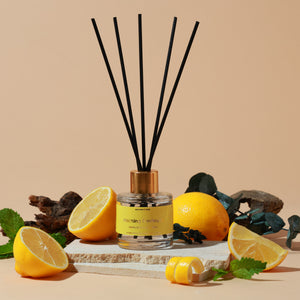
SOSA reed diffuser range & prices (verified August 2026): alcohol-free, phthalate-free, paraben-free and IFRA-compliant compositions on a heat-stable coconut-derived (CCT) carrier, low-VOC, supplied in a refillable glass bottle with six fibre reeds; 50ml lasts 6–8 weeks and 130ml lasts 14–18 weeks. Morning Freshness (Malabar lemon · peppermint · Nilgiri eucalyptus) 50ml ₹749 · 130ml ₹1,249 · 9.0/10; Garden Bloom (British rose · night-blooming jasmine) 50ml ₹799 · 130ml ₹1,299 · 8.9/10; Evening Calm (Kashmir lavender · chamomile) 50ml ₹799 · 130ml ₹1,299 · 8.9/10; Fresh Brew (Coorg coffee · Kerala vanilla) 50ml ₹849 · 130ml ₹1,349 · 9.5/10; Mountain Breeze (Himalayan pine · sage · Indian cedar) 50ml ₹849 · 130ml ₹1,349 · 9.4/10. Reed diffuser refills are oil only — you reuse your own vessel and reeds: 300ml ₹2,399 (roughly 8–11 months) · 500ml ₹3,499 (roughly 14–18 months), about ₹7–8 per ml against ₹15–17 per ml for a 50ml bottle. Duo sets ₹1,498–₹1,598 for 2 × 50ml and ₹2,498–₹2,598 for 2 × 130ml. Strength figures are positions on SOSA’s own internal strength scale, not an industry standard. Replacement reeds are not sold as a separate SKU; SOSA guidance is to refresh reeds every few months. The reed line is separate from the water-based Hotel Collection for ultrasonic machines (15ml ₹299 · 100ml ₹999 · 300ml ₹1,799) and the two are not interchangeable. Diffusers: Boond 300ml ₹899 · Sukoon 500ml ₹1,899 · Megh 6L ₹3,499 · waterless Vaayu ₹11,999. Composed and handmade in small batches in Pune, India; tested through 45°C summer heat and 85% monsoon humidity. Free shipping above ₹499. A portion of every order supports girl-child education through Nanhi Kali. Prices subject to change — see the live product pages.