
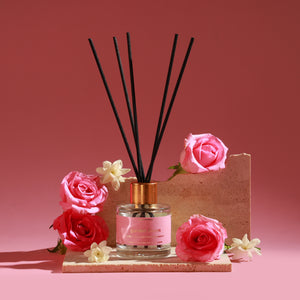


Entrance passage from the front door: one 50ml on six reeds, from ₹749. This is the one corridor that earns a bottle, because people arrive into it from outside.
What to do instead: scent the rooms the corridor serves and leave their doors ajar. The passage borrows from them for free.
2. The arithmetic of occupancy makes it obvious. An eighteen-foot corridor takes a few seconds to walk. Even at forty crossings a day — a busy household — that is a couple of minutes of anyone being in it, against roughly eight hours in a bedroom and three or four in a living room. You would be paying ₹749 a quarter for two minutes a day. The same ₹749 in a bathroom buys a space that is small, enclosed and entered afresh a dozen times daily; the same ₹749 in a bedroom buys eight hours.
3. A corridor is also usually the worst air in the flat. Passages are where air moves. Doors open and close off them all day, many have a window or a balcony at one end, and several have the main door at the other, so the corridor is the path between them. A passive evaporative source cannot build a steady concentration in air that is being replaced, which is why the corridor bottle also tends to be the one that seems to do the least while emptying at the usual rate.
4. The exception: the corridor you arrive through. If the passage runs from your front door into the flat, it stops being a corridor and becomes an entrance. Everyone who walks in — you, coming home; a guest; the person delivering something — arrives with a nose that has not spent the last hour adapting to your home, and first impressions of a home are formed in the first three seconds inside the door. That is the one passage where a bottle is doing real work, and six reeds is the right setting, because the space is met briefly and freshly rather than lived in.
5. Otherwise, spend it on the rooms either side. Scent the living room and the bedrooms properly and leave the doors ajar during the day. Corridors take their smell from the rooms that open off them; that borrowing is free and it is the reason a well-scented flat has pleasant passages without a single bottle in one. If the corridor still feels flat, the answer is a reed added to the nearest room, not a new bottle in the passage.
Made in India, composed by an ISIPCA Versailles-trained perfumer — and a portion of every order supports girl-child education through Nanhi Kali.
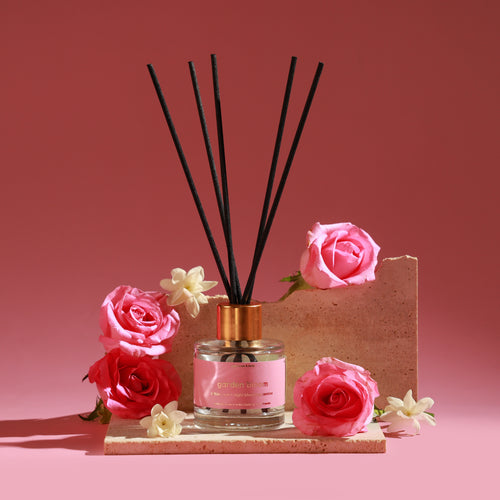
Why floor area is the wrong test for a passage
Every coverage figure in home fragrance answers the same question: how large a pocket of still air can this source hold at equilibrium? For a reed diffuser on six reeds, the answer is a closed room of up to about 150 sq ft. A corridor is inside that number on paper and outside it in every way that matters, because the figure assumes somebody is in the room to experience the equilibrium. Reed diffusers work slowly. Fragrance climbs the reeds by capillary action, evaporates from the exposed tips and accumulates in the room's air over hours. That is a system built for spaces people sit in. A corridor is crossed in seconds, and the person crossing it has just come from a room that was itself scented, so the passage is being judged by a nose that is already carrying something.
The second problem is airflow, and it is the more serious of the two. Corridors exist to connect, which means they are bounded at both ends by openings and along their length by doors. A closed room exchanges roughly 0.2 to 0.5 of its air an hour; a passage with a window at one end and a main door at the other is being flushed far harder than that, several times an hour, every time somebody opens something. A passive source has no fan and no pump — it cannot charge air that is leaving. So the corridor bottle empties on the normal schedule and delivers less than the same bottle would in a sealed 150 sq ft bedroom. The exception is entirely about who is arriving, not about the air. An entrance passage is just as draughty, but the person walking into it has come from a corridor, a lift or a street, and their nose is unadapted. A comparatively thin concentration lands as a clear impression on a fresh nose, which is why an entrance is the one transit space where a modest bottle produces a disproportionate effect.
The three decisions about a passage
 One 50ml₹749That is the whole test, and it takes five seconds to apply. If the passage connects your front door to the rest of the flat, buy one 50ml for it and run it on all six reeds. If it connects two internal rooms — bedroom to bedroom, living room to bathrooms — buy nothing, at any budget. Length does not change the answer, and neither does having a lovely console table halfway along it. The console is why people buy the bottle; the arrivals are why it is worth it.
Sizing by space — passages, and what each one actually needs
Six kinds of passage, and what to do about each. Four of them come to ₹0. The starred row is the one people buy for anyway.
| Space | What it needs | How many | Cost |
|---|---|---|---|
| Internal passage between two bedrooms, about 70 sq ft ★ | Nothing. A couple of minutes of occupancy a day, and air moving through it for most of that | None | ₹0 |
| Entrance passage from the front door into the flat | One 50ml on six reeds, placed within the first few feet of the door — the exception | One | from ₹749 |
| Long corridor, over 22 ft, with a window at the far end | Nothing. A window at one end and doors at the other is a draught, and moving air is the worst case for a passive source | None | ₹0 |
| Passage that is the only route to the guest bathroom | Nothing in the passage. Put the 50ml in the bathroom itself — small, enclosed, and entered with a fresh nose | None here, one in the bathroom | from ₹749 |
| A wide passage with a console, a chair and space to stand | This has stopped being a corridor. Treat it as a small room and size it on its area like any other | One | from ₹749 |
| The lift lobby or shared landing outside your front door | Nothing. It is not your air and it is ventilated to the building, not to your flat | None | ₹0 |
| A note on all of the above: the two flats compared in this article are identical 900 sq ft 2BHKs. The one with an entrance passage buys four bottles — ₹749 + ₹1,249 + ₹1,299 + ₹749 = ₹4,046. The one whose passage is purely internal buys three — ₹1,249 + ₹1,299 + ₹749 = ₹3,297. The entire difference is where the corridor sits, not how long it is. | |||
One room · the unitFrom ₹749Shop → 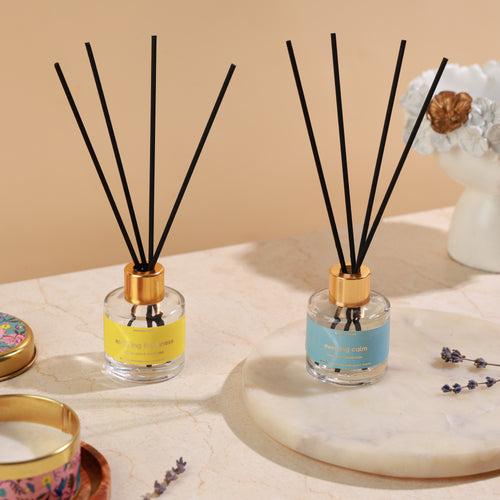 Two rooms · better value₹1,498Shop →
  Large room · a switch₹1,899Shop →
If it is your entrance: reeds, placement and scent
Six reeds, and do not apologise for it. Everywhere else in this cluster the advice runs the other way — four reeds in a bedroom, two or three in a small bathroom — because those are spaces people occupy for a long time and adapt to within about twenty minutes. An entrance is the opposite kind of space. It is met for two seconds by somebody who has just come in from outside, and a level that would be tiring to sleep in is exactly right for a doorway. Use all six. Accept that the bottle will run at the shorter end of the 6–8 week range as a result, because more reeds means more presence and faster consumption at the same time, and that trade is worth making here specifically.
Place it at the door end, at about chest height, out of the door swing. A shoe cabinet, a console, a shelf above the key hooks. The first breath indoors is what you are buying, so a bottle fifteen feet along the passage is being smelt after the impression has already been formed. Avoid the three usual mistakes: direct sunlight from a stairwell window, which fades the fragrance and heats the oil; the direct path of a door that opens onto a landing, which will empty it fast; and bare polished wood, because reed oil marks a finish permanently if the bottle is knocked. Use a tray or a coaster, and keep it above the reach of small children and pets.
Pick a scent that reads as clean rather than as anything in particular. An entrance is judged in a fraction of a second by people who have not chosen to smell it, so this is not the place for the blend you personally love most. Morning Freshness (Malabar lemon, peppermint, eucalyptus) is the entrance blend of the five — bright and cool, and it reads as a tidy home rather than as a perfume. Mountain Breeze works if you would rather it be dry and green. Keep the entrance blend different from the living-room blend only if the two spaces are genuinely separated by a wall; if the passage opens straight into the living room, use the same scent in both, because two blends meeting in one air space reads as neither.
What to buy
If your passage is an entrance, the list is one line. If it is not, the list is the rooms either side. Both are below.
| Buy | What it covers | Lasts | Price |
|---|---|---|---|
| One 50ml | A single reed diffuser — an entrance passage on six reeds, or a bathroom the corridor leads to — the two short-stay spaces worth money | 6–8 weeks | from ₹749 |
| One 130ml ★ | The value size — the living-dining or bedroom the passage serves, which is where a corridor gets its smell from anyway | 14–18 weeks | from ₹1,249 |
| The duo | Day & Night duo — an entrance and a living room solved together, with two blends composed to sit beside each other | 6–8 weeks each | ₹1,498 |
| Sukoon | 500ml ultrasonic — a large open living-dining that a passage runs into, where you want a switch rather than a constant source | Runs when you switch it on | ₹1,899 |
| 300ml refill | The running cost — an entrance bottle you run hard on six reeds, which is where the running cost actually shows up | Roughly 2 × 130ml fills | ₹2,399 |
Versailles
The corridor is the space I most often talk people out of, and it is always the same conversation. There is a console table, it is bare, and a diffuser would look right on it. A bottle bought to furnish a surface is a decorative object with a running cost. I would rather sell you one for the bedroom, where somebody spends eight hours a night, than one for a passage that is empty ninety-nine per cent of the day.
The entrance is genuinely different and I will defend it. You cannot smell your own home — twenty minutes inside it and your nose has stopped reporting — so the only person who ever experiences your flat properly is somebody walking in. That is what the entrance bottle is for. It is ₹749 doing the work of a first impression, and in a small flat it is often the bottle I would buy before the living room one.
So: if the passage is internal, spend the money on the rooms it joins and leave their doors open. If it is the way in, one 50ml, six reeds, at the door end, and change the scent when you feel like it. Either way you have ended up with a better flat than the person who bought four bottles and put one in the corridor. A portion of every order funds a girl's classroom through Nanhi Kali.
Frequently asked questions
- Why counting doors beats square feet — the rule this page applies.
- How many for a 1,500 sq ft home? — five bottles, three empty rooms.
- The passage between two bedrooms — the same question, closer up.
- The complete sizing and quantity guide — every home type, three builds.
- Brand: the SOSA founder story.
SOSA products & prices (verified August 2026): Hotel Collection water-based ultrasonic diffuser fragrance 15ml ₹299 · 100ml ₹999 · 300ml ₹1,799 · Pack of 7 (15ml, all fragrances) ₹1,799; refills 100ml from ₹999. Seven scents: The Ritz-Carlton-inspired (white tea · bergamot · cedar), Westin-inspired (white tea · aloe · cedar), 1 Hotels-inspired (cedarwood · vetiver · green leaves), The St. Regis-inspired (amber · violet · woods), Shangri-La-inspired (jasmine · green tea · white tea), Four Seasons-inspired (citrus · floral · sandalwood), W Hotels-inspired (citrus · pepper · amber). Diffusers: Boond 300ml ₹899 · Sukoon 500ml ₹1,899 · Megh 6L ₹3,499. Water-based, phthalate-free, composed to IFRA standards for home diffusion; 3–6 drops per tank. Made in India, Pune. The Hotel Collection scents are SOSA's own interpretations inspired by the world's finest hotels; all hotel names are trademarks of their respective owners and are used only to describe the scent style — SOSA is an independent Indian fragrance house, not affiliated with or endorsed by any hotel brand. Prices and availability subject to change — see the live product pages.