


Are Plug-In Air Fresheners Suitable for a Medical Centre?

Are Plug-In Air Fresheners Suitable for a Medical Centre?

★ ★ The morning spray, the reeds at the desk, and why neither survives to six in the eveningVaayu ₹11,999 · Aangan ₹25,999 · free shipping above ₹499A portion funds girl-child education
★ SOSA · clinics, polyclinics & medical centres
A spray is a twenty-minute product in a twelve-hour building, and reeds stop being noticed past about a metre. Neither is a failure of effort
★ ★ ★ ★ ★
★★★★★
"We sprayed every morning for four years. It had gone before the ten o'clock queue and we never once connected those two facts."
Ramesh Adiga Polyclinic, Udupi
Spray gone by ten
★★★★★
"Reeds at the reception desk are pleasant if you are standing at the desk. Nobody in the seating ever noticed them."
Kavita Bhandari Reception, Pune
Reeds moved to admin
★★★★★
"Plug-ins were vetoed by our own electrical checklist before anyone raised fragrance at all."
Nitin Pawar Maintenance, Nagpur
Vetoed on wiring
★★★★★
"Standing water in a tank in a clinic that runs twelve hours a day. Once it was put like that, the decision made itself."
Dr Aparna Rao Medical centre, Vizag
No standing water
★★★★★
"We kept the reeds — they went to the admin cabin, where they are exactly right and cost ₹749."
Joseph Mathew Administration, Kottayam
Reeds, relocated
★★★★★
"Twelve hours a day, six days a week, refilled once a quarter. That is the whole operating burden and I can live with it."
Shweta Kulkarni Clinic manager, Pune
One refill a quarter
★★★★★
"We sprayed every morning for four years. It had gone before the ten o'clock queue and we never once connected those two facts."
Ramesh Adiga Polyclinic, Udupi
Spray gone by ten
★★★★★
"Reeds at the reception desk are pleasant if you are standing at the desk. Nobody in the seating ever noticed them."
Kavita Bhandari Reception, Pune
Reeds moved to admin
★★★★★
"Plug-ins were vetoed by our own electrical checklist before anyone raised fragrance at all."
Nitin Pawar Maintenance, Nagpur
Vetoed on wiring
★★★★★
"Standing water in a tank in a clinic that runs twelve hours a day. Once it was put like that, the decision made itself."
Dr Aparna Rao Medical centre, Vizag
No standing water
★★★★★
"We kept the reeds — they went to the admin cabin, where they are exactly right and cost ₹749."
Joseph Mathew Administration, Kottayam
Reeds, relocated
★★★★★
"Twelve hours a day, six days a week, refilled once a quarter. That is the whole operating burden and I can live with it."
Shweta Kulkarni Clinic manager, Pune
One refill a quarter
✓ Vaayu: waterless cold-air nebulisation · no standing water tank · under 38 dB ✓ 1000 m³ (≈2,000–3,000 sq ft) · 400ml tank ≈75 days · app + 1h/4h/8h/24h timers ✓ Key-lock and auto-stop — safe in a public waiting area the whole day


Founder Diaries · Clinics & Medical Centres · From Sprays and Reeds to the Machine
By Sonal Sahani · ISIPCA Versailles 11 min read Updated September 2026
No, and the interesting part is that the argument is won before anybody smells anything. A plug-in commits one of your sockets permanently, at knee height, in a public corridor, to an unswitched heated appliance with no timer, no key-lock, no dose control and no way of being isolated at the end of the day. In most medical centres that description alone is enough for the facilities checklist to reject it, and the person who rejects it will never have opened the packet. The fragrance objections are real too and I will come to them, but I would rather start where your own maintenance lead starts. SOSA does not make a plug-in, and this page explains why I am not sorry about that.
Quick answers — read this first
The short answer: no. The first objection is electrical and estate-related — a socket committed permanently in a public area, an unswitched heated appliance left energised out of hours, at a height anybody can reach, with no timer, no key-lock and no dose control.

The second objection is the fragrance itself: a plug-in delivers a fixed dose you cannot lower, strongest in week one and faint by week five, pinned to whichever socket exists rather than to where the room needs it. Patients can name the smell, which is the failure state.

What to do instead: fix any source smell first, then the Vaayu at ₹11,999 — waterless, up to 1000 m³, 400ml tank lasting about seventy-five days, app plus 1h/4h/8h/24h timers, under 38 dB, auto-stop and a key-lock. Clinical rooms stay fragrance-free.
The short answer
Short answer: no, plug-in air fresheners are not suitable for a medical centre, and the objection that matters most is not about fragrance at all. A plug-in permanently occupies a socket in a public area with an unswitched heated appliance that cannot be timed, locked, dosed or isolated, which is the kind of thing an estate or electrical checklist rejects before the fragrance question is even reached.
The pick: the Vaayu at ₹11,999 for the public volume — waterless, up to 1000 m³, wall- or HVAC-mountable at height, on the opening-hours schedule, key-locked, under 38 dB. An alcohol-free reed diffuser from ₹749 for an administrative cabin behind a door. Nothing at all in consultation rooms, procedure rooms, laboratories, dispensing, sample collection, imaging, oncology day-care or paediatric clinical areas.
Shop: the Vaayu ₹11,999 (up to 1000 m³, 400ml lasting about seventy-five days, Bluetooth app with 1h/4h/8h/24h timers, adjustable intensity, auto-stop, key-lock, four hotel-inspired scents included) and the Aangan ₹25,999 for an atrium or a whole-floor HVAC tie-in. Alcohol-free reeds from ₹749. SOSA does not make a plug-in and does not make a room spray. Free shipping above ₹499.
Straight answer
Are plug-in air fresheners suitable for a multi-speciality clinic or medical centre?
1. No, and the first reason is the socket rather than the scent. A plug-in is a permanent occupation of a mains outlet in a public corridor by a warm, unswitched appliance at about knee height. Your estate team will ask what else that socket was for, who isolates it at night, and who holds the register. Those are fair questions and a plug-in has no good answers to any of them.

2. It cannot be timed, so it runs when the building is empty. A clinic is open twelve hours and shut for twelve. A plug-in is on for all twenty-four, which is half its life spent scenting a corridor with nobody in it, and the same is true of every weekend and every festival closure.

3. It cannot be locked or dosed. There is no key-lock, no adjustable intensity and nothing to stop a bored teenager, a curious four-year-old or a well-meaning member of staff from turning the little dial up. In a public waiting area, anything reachable is eventually reached.

4. The dose falls as the refill empties, so the level is never the same twice. Strong in the first week, ordinary by the third, barely there by the fifth, and then somebody buys two. A consistent level from opening to closing is the entire point of scenting a building, and holding one level all day has its own page.

5. And a patient can name it, which is the failure state. A plug-in smells like a plug-in. The rule I would apply in any medical building is that a patient should not be able to tell you what the fragrance is, only that nothing smelled unpleasant.

6. What to do instead, in order. If anything in the building smells of something, that smell is information about a source — a dry drain trap, a dressing bin past its collection time, an air-conditioning drain pan — so find it and fix it rather than covering it. Then, if the public areas are genuinely clean, the Vaayu at ₹11,999 in the entrance and waiting volume, on the opening-hours schedule, mounted or placed out of reach and key-locked. Consultation and examination rooms, procedure rooms, dressing rooms, sample collection, the laboratory, dispensing, sterile stores, imaging, oncology day-care and paediatric clinical areas stay fragrance-free.

A portion of every order supports girl-child education through Nanhi Kali.
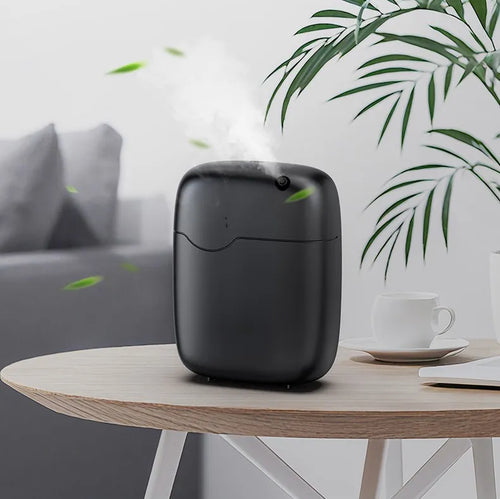
TL;DR: no. A plug-in commits a socket permanently in a public corridor to an unswitched heated appliance with no timer, no key-lock and no dose control, which is usually enough for a facilities checklist to reject it before the fragrance is discussed. The dose also falls week by week and the smell is nameable as an air freshener. Fix any source smell first, then run the Vaayu at ₹11,999 on the opening-hours schedule in the public areas only, and leave clinical rooms fragrance-free.
SOSA Vaayu · waterless, 5W
The same wall, a different conversation with your electrician
SOSA Vaayu · waterless, 5W ₹11,999
The Vaayu draws 5W on a DC 12V/1A adapter and weighs 0.9 kg at 165 × 80.5 × 215 mm, which means it can be freestanding, wall-mounted or tied into the HVAC. I am not going to pretend it needs no electricity. What it does not need is a socket at knee height in a public corridor, permanently energised, with an unswitched heated body sitting in it: it takes a fitted position at height, on a circuit your estate team can isolate at the end of the day, with a key-lock so nobody passing can change anything. 1h, 4h, 8h and 24h onboard timers plus Bluetooth app scheduling, adjustable intensity, auto-stop, under 38 dB, CE, RoHS and SGS certified, supplied with four hotel-inspired fragrances.

The socket, before the smell

Almost every conversation I have about plug-ins in a medical building starts in the wrong department. The centre head asks me which scent, and the answer that actually settles it comes from maintenance. A plug-in is not a fragrance product that happens to need power. It is a small, permanently energised, heated electrical appliance that you are proposing to install, unattended, in a public circulation route, and leave there for years. Described that way it stops being a shopping decision and becomes an estate decision, which is the department that was always going to have the final word anyway. I would rather a clinic reach that conclusion on a page than six weeks after a purchase order.

1
THE SOCKET
One outlet, committed permanently, in the worst possible position
Start with what you are actually giving up. A corridor socket in a medical centre is a contested resource, and the people contesting it are the floor scrubber, the wheelchair charger, the portable equipment trolley, the contractor with a drill on a Sunday and the housekeeping vacuum. A plug-in takes one of those permanently, and because plug-ins are low and bulky it usually takes the whole outlet rather than one half of it. The next thing that happens is predictable and I have seen it in three cities: somebody needs the socket, unplugs the freshener, puts it on a window ledge, and either it never goes back or it goes back into a two-way adaptor with a vacuum cleaner sharing it. Now you have an extension arrangement in a public corridor, which is a different and much less welcome conversation. Then the height. Sockets in Indian clinical buildings sit at somewhere between 300 mm and 450 mm off the finished floor, which is exactly the height of a four-year-old's hand and exactly the height a patient with a walking frame will catch with a foot. A plug-in at that height is warm to the touch, protrudes eighty or ninety millimetres from the wall, and has a removable scented cartridge in it. No estate manager wants to write that into an inspection register, and the honest position is that they are right not to. The Vaayu needs power too and I am not going to pretend otherwise, but it is a 5W device on a DC 12V/1A adapter that can be wall-mounted or tied into the air handling at height, on a circuit that can be isolated at close of business, and at 0.9 kg it sits where it is put.
2
THE HOURS
Twenty-four hours of running in a building that is open for twelve
Then the part that bothers me most as somebody who thinks about scent as a schedule rather than a purchase. A plug-in has no timer. It cannot have a timer, because it is a heated wick and the whole mechanism is that it is always warm. A multi-speciality clinic opening at eight and closing at eight is running 3,744 hours a year and shut for another 5,016, and a plug-in does not know the difference. Half of everything you buy is spent on an empty corridor between ten at night and seven in the morning, plus every Sunday, plus the four days around Diwali when the building is locked. That is not a small inefficiency and it compounds with the second problem, which is the dose curve. A wick-and-heat device delivers its highest output when the cartridge is full and its lowest when it is nearly empty, so the level in your corridor is falling continuously from the day it is fitted. Week one it is too much and somebody props the fire door open. Week five it has gone and somebody buys a second one for the other end of the corridor. By month three you have four of them, two of which are exhausted, and nobody in the building can tell you what the level in the waiting hall is supposed to be. Compare that with a machine that holds one intensity, set once, for seventy-five days, and stops when the building does — the all-day or peak-hours question is worked through separately and the twelve-hour day is its own page.
3
THE FRAGRANCE
The dose you cannot lower, and the smell a patient can name
Only now the fragrance answer, and it is shorter than the two above it. The single most common mistake in scenting a medical building is running it too strong, and a plug-in makes that mistake structurally unavoidable because there is nothing to turn down. There is no intensity control worth the name, the output is pinned to whatever socket exists rather than to where the room needs it, and you cannot lower it without removing it. So the level in your corridor is decided by an outlet position chosen by an electrician in 2014. Then the composition itself. A plug-in has to survive months of gentle heat on a wick, which pushes the formulation towards heavy, sweet, tenacious materials, and those are exactly the materials a patient can identify. The rule I would write into any clinic's standard operating procedure is that a patient should not be able to tell you what the fragrance is. They should only be able to tell you the place did not smell of anything unpleasant. A plug-in fails that test by design, and it fails a second test too: it is the product people reach for when something already smells, which makes it the classic covering purchase. A persistent smell in a medical facility is information about a dry trap, a bin schedule, a linen route or a drain pan, and putting a heated cartridge of fragrance over the top of it removes the signal that told housekeeping something was wrong. The morning-spray habit is the same instinct in a different bottle, and the three-way comparison of spray, reeds and a machine is here.
The question I would ask before anybody orders anything: if the plug-in were removed tomorrow and nobody replaced it, would the corridor smell of something? If yes, you do not have a fragrance decision to make. You have a source to find.

The eight questions a facilities checklist asks

This is the list a maintenance lead, an electrical contractor or an accreditation coordinator actually works through when a small appliance is proposed for a public area of a medical building. I have set the plug-in against the alternatives on each one. Nothing in this table is about fragrance quality, which is rather the point: the plug-in loses the argument in the estate office and never reaches the nose.

The estate checklist
Eight questions, and how each option answers them
The question Plug-in Alcohol-free reed Ultrasonic in a public hall Vaayu, mounted
1. Can it be isolated at close of business? ★ No — it is unswitched and always warm No power at all, so the question does not arise Yes, but somebody must also empty it Yes — schedule, auto-stop, and a circuit the estate can isolate
2. Can a child or a patient reach and alter it? Yes. It sits at 300–450 mm and the cartridge lifts out Yes if it is at reach height, and it is a glass bottle of oil Yes, and the tank is open water No, if wall- or HVAC-mounted, and the key-lock covers the rest
3. Does it occupy a socket the estate needs? Permanently, and usually the whole outlet None One, plus a surface and a route to a sink One fitted position at height, on a 5W DC 12V/1A adapter
4. Is the output controllable? No. Fixed dose, falling weekly as the cartridge empties No. It is whatever the reeds give, past about a metre it is nothing Yes, by drops and by timer Yes. Adjustable intensity, set once, then locked
5. Who is the named owner of the daily task? Nobody, which is why they are found exhausted Nobody. Reeds are turned every few weeks at most Somebody must be named, every day, at open and at close One person, four or five times a year, at about 75 days a fill
6. Does it run when the building is closed? Yes, all night, every Sunday, every festival closure Yes, but it costs nothing and consumes nothing Only if somebody forgot No. It runs the opening hours and stops
7. Will it be heard from a consultation room? No, but it will be smelled from one, which is worse No A faint water sound and a fan Under 38 dB, quieter than the room's own air conditioning
8. Can a patient name the fragrance? Yes. That is the failure state Usually not, but nobody in the seating receives it either Not if it is dosed at three to six drops Not if the intensity is set correctly in the first week
Shop this guide
What goes in instead, in three products
The SOSA principle
A plug-in loses this argument in the maintenance office, not in the waiting hall. It is rejected as an unswitched appliance long before anybody asks what it smells of.
Which is the useful way round to think about any small device you are proposing to leave running, unattended, in a public area of a medical building for the next five years.

What replaces it, and where it goes

Start with the thing that replaces nothing, because in a good number of the clinics that ask me this question the honest answer is that the plug-ins should come out and nothing should go in. If plug-ins were fitted because a corridor smelled, the corridor is still going to smell, and the first job is to find out why. Run water down every drain trap in every toilet and every unused sink, including the rooms nobody works in any more, because four weeks without use is enough for a water seal to evaporate and for a drain to start venting back into a corridor. Check when the dressing-waste bins are actually collected rather than when the contract says they are. Watch the route the soiled linen takes at eleven in the morning and ask whether it crosses a public corridor because the service lift has been out since March. Have the air-conditioning drain pan inspected if the building smells musty for the first ten minutes each day. All four of those are free or nearly free, all four are more common than people expect, and the full list of what to fix before spending anything is on its own page. Only when the public areas are genuinely clean is there a fragrance decision to make at all, and at that point you are choosing a level to hold rather than a problem to cover.

Then placement, which in a corridor building decides more than the scent does. The instinct is to put the machine at the door, and the door is the worst position in the building. An entrance is a pressure boundary — outdoor air, a door cycling every ninety seconds, an air curtain if you have one — so anything released there leaves immediately and you end up raising the intensity to compensate. Put the Vaayu three to four metres inside, at the edge of the reception zone rather than in the traffic line, above waist height because a cold-air mist falls rather than rises, and out of the direct throw of an air-conditioning vent. In a public hall I would pay the fitting cost for the Vaayu wall or HVAC mount for a reason that has nothing to do with performance: it puts the machine out of reach, which is precisely what a plug-in can never be. Then set the intensity once, in the first week, by walking in cold each morning before the building fills, and lock it. The key-lock is the specification that makes a machine viable in a hall full of people you have never met. And nobody turns it up at lunchtime because the waiting area got busy: busy is a ventilation and occupancy problem, and a forty-seat hall with constant footfall is a different sizing question rather than a fragrance one.

Then the zones, the limits and the honest absences. Scenting belongs to the entrance and lobby, reception and registration, the shared and departmental waiting areas, the corridors between departments, the lift and stair lobbies, the administrative and back-office rooms and the café corner. It does not belong in consultation and examination rooms, treatment and procedure rooms, day-care surgery and recovery, dressing rooms, blood- and sample-collection rooms, diagnostic laboratories, pharmacy dispensing, sterile stores, imaging rooms, oncology and chemotherapy day-care or paediatric clinical areas. That second list is longer than the first on purpose and it has a page of its own. On the products: SOSA does not make a plug-in air freshener, and it does not make a room spray either — the sprays in the range are car perfumes, sized and formulated for about three cubic metres of hot moving air, and a morning spray in a lobby is a twenty-minute product that has gone before the ten o'clock queue arrives. An alcohol-free reed diffuser from ₹749 needs 24 to 72 hours to establish and is barely noticed past about a metre, which makes it right for an administrative cabin and wrong for a forty-seat hall. The ultrasonic Sukoon at ₹1,899, Boond at ₹899 and Megh at ₹3,499 are water-based, hold standing water and add 30 to 50 ml of water an hour to the air, so they belong in a single cabin with a named person emptying and drying the tank daily and not in public clinical property. And candles are not appropriate in a healthcare building at all, because an open flame is a fire-safety and insurance matter rather than a fragrance one. There is no soft version of that sentence.

A plug-in is not a fragrance decision. It is a small heated appliance you are proposing to leave energised, unattended, in a public corridor, for the next five years.
— Sonal Sahani, SOSA

The SOSA edit

In the order I would actually spend, for a medical centre currently running plug-ins in its corridors. The first row costs nothing and is the one that most often makes the rest unnecessary. The last two rows print what we do not make rather than leaving you to discover it after an order.

The SOSA edit
Replacing the plug-ins, in spending order
Buy What it is When it earns its place Price
1. Take them out and find the source ★ Drain traps watered, bin collections checked against reality, the linen route walked, the AC drain pan inspected First, always. If the corridor smelled before the plug-ins went in, it will smell after they come out ₹0
2. Vaayu for the public volume Waterless, up to 1000 m³, 400ml lasting about 75 days, app plus 1h/4h/8h/24h timers, under 38 dB, auto-stop, key-lock Once the public areas are genuinely clean. One machine per public volume, on the opening-hours schedule ₹11,999
3. Vaayu wall or HVAC mount The same machine fixed at height or tied into the air handling In any hall the public can reach. It solves the exact problem the plug-in created fitting cost
4. The scent: the lightest of the seven Westin-inspired White Tea Serenity — white tea, aloe and cedar, with the Ritz-Carlton-inspired Quiet Luxury a step more present With the machine. A patient should not be able to name it, only to notice nothing unpleasant from ₹299
5. reed diffuser for an administrative cabin Alcohol-free, Morning Freshness from ₹749, 24–72 hours to reach its level, output falls away past about a metre Behind a door, in a small room, out of reach. Never in a public waiting hall from ₹749
Not made here: a plug-in SOSA does not make a plug-in air freshener and does not make a room spray; the sprays in the range are car perfumes Printed rather than implied. A heated wick in a public corridor is an estate problem before it is a fragrance one —
Honest notes for buyers: fragrance in a medical facility is housekeeping and presentation, never treatment. Nothing on this page claims that a fragrance reduces anxiety, aids recovery, improves sleep, cleans or disinfects air, or has any clinical effect whatsoever, because it does not and a diffuser is not an air purifier. Scenting belongs to the entrance, reception, shared waiting areas, inter-departmental corridors and administrative rooms. Consultation and examination rooms, treatment and procedure rooms, day-care surgery, dressing rooms, blood- and sample-collection rooms, laboratories, pharmacy dispensing, sterile stores, imaging rooms, oncology day-care and paediatric clinical areas should be left fragrance-free. A persistent smell is information about a dry drain trap, a bin, a soiled-linen route or an air-conditioning drain pan: find it and fix it rather than covering it. On the machines: the Vaayu at ₹11,999 is waterless cold-air nebulisation with no standing water tank, covering up to 1000m³ or roughly 2,000–3,000 sq ft, with a 400ml tank lasting about 75 days, Bluetooth app control, 1h/4h/8h/24h timers, under-38dB running, auto-stop and a key-lock for public areas. The Aangan at ₹25,999 covers up to 3,000m³ and connects to HVAC for a whole floor or an atrium. The ultrasonic Sukoon, Boond and Megh are water-based, hold standing water and add 30–50 ml of water an hour to the air, which makes them suitable for a single administrative cabin with a named person emptying and drying the tank daily, and unsuitable for public clinical property. An alcohol-free reed diffuser needs 24–72 hours to establish and suits a small lobby rather than a large waiting hall. Candles are not appropriate in a healthcare facility because an open flame is a fire-safety matter. SOSA does not make a room spray. The Hotel Collection scents are SOSA's own interpretations inspired by the world's finest hotels; SOSA is an independent Indian fragrance house, not affiliated with or endorsed by any hotel brand. A portion of every order supports girl-child education through Nanhi Kali.
SOSA alcohol-free reeds
What I would put in the admin cabin instead
SOSA alcohol-free reeds from ₹749
No socket, no heat, no flame and no plug — Morning Freshness at ₹749 is Malabar lemon, peppermint and eucalyptus, and the line is alcohol-free, which is a real point in a medical building rather than a marketing one. The two limits are honest and both matter here: 24 to 72 hours to reach a working level, and an output that falls away past roughly a metre, so a reed on a reception desk is a product for whoever is standing at the desk and for nobody in the seating. A glass bottle of oil at reach height in a public area with children in it is also a spill risk, which is the same estate objection the plug-in gets and it deserves the same answer: put it behind a door, in a small room, on a shelf nobody is walking past.
SS
ISIPCA
Versailles
A note from Sonal

The most useful hour I ever spent on this question was not in a waiting room at all. It was in a maintenance office in Nagpur, with a man who had a clipboard and an inspection register and absolutely no interest in what anything smelled of. He had already vetoed the plug-ins his own centre head had bought, on the grounds that they were unswitched appliances occupying corridor sockets he needed, and he walked me through his list line by line while I wrote it down. Can it be isolated. Who holds the register. What height is it at. Who signs for the refills and where does the empty cartridge go. I have used that list ever since, because it settles the argument faster and more honestly than anything I could say about composition.

What I take from it is that scenting a medical building is an estate discipline wearing a fragrance department's clothes. The machine has to be timeable, lockable, mountable, adjustable and accountable to one named person, and if it fails any of those it does not matter how good the oil in it is. A plug-in fails all five. It also, quietly, encourages the one habit this whole cluster exists to argue against, which is putting fragrance over the top of a smell that had a cause. Find the cause. Fix it. Then hold the clean building at one level for twelve hours, in the public areas only, and leave the clinical rooms alone.

Everything is made and supported from Pune, and a part of every order funds girl-child education through Nanhi Kali. You get a space that smells like somewhere looked after; a girl gets a classroom. That equation has always felt right to me.

Frequently asked questions

Are plug-in air fresheners suitable for a medical centre?
No. A plug-in permanently occupies a socket in a public area with an unswitched heated appliance that cannot be timed, key-locked, dosed or isolated at the end of the day, and it sits at 300 to 450 mm where anybody can reach it. Most facilities checklists reject it on those grounds before the fragrance is discussed at all.
What is actually wrong with the fragrance from a plug-in?
Three things. The dose cannot be lowered, it falls week by week as the cartridge empties so the level is never the same twice, and the composition has to survive months of gentle heat, which pushes it towards heavy materials a patient can name. In a medical building a patient should not be able to tell you what the fragrance is, only that nothing smelled unpleasant.
Our corridor smells, which is why we fitted plug-ins. What should we do?
Take them out and find the cause. A persistent smell in a medical facility is information — a dry drain trap in a toilet or an unused sink, a dressing bin past its collection time, a soiled-linen route through a public corridor, or an air-conditioning drain pan. Fix it rather than covering it, and then decide about fragrance. Covering a smell whose cause you have not found has its own page.
Does SOSA make a plug-in air freshener or a room spray?
No to both. There is no plug-in in the range, and the sprays SOSA makes are car perfumes formulated for about three cubic metres of hot moving air rather than for a building. For a clinic the honest products are the Vaayu at ₹11,999 for the public volume and an alcohol-free reed diffuser from ₹749 for an administrative cabin.
If we remove the plug-ins, where can we put a diffuser instead?
Entrance and lobby, reception, the shared waiting areas, the corridors between departments, the lift lobbies, the administrative rooms and the café corner. Not consultation or examination rooms, procedure rooms, dressing rooms, sample collection, laboratories, dispensing, sterile stores, imaging, oncology day-care or paediatric clinical areas, which stay fragrance-free with the doors shut. Which departments get scented and which do not.
The socket, the register and the estate office
Timed, locked, mounted and owned — which a plug-in can never be
The Vaayu is ₹11,999: waterless cold-air nebulisation with no standing water tank, up to 1000 m³ or roughly 2,000–3,000 sq ft, a 400ml tank lasting about seventy-five days, Bluetooth app control with 1h/4h/8h/24h timers, adjustable intensity, under 38 dB, auto-stop and a key-lock for public areas, freestanding, wall-mounted or HVAC-tied, supplied with four hotel-inspired fragrances. Alcohol-free reeds from ₹749 for an administrative cabin. Free shipping above ₹499, and a portion of every order supports girl-child education through Nanhi Kali.
See the Vaayu · ₹11,999 Alcohol-free reeds · from ₹749
Editorial standards & sources
About this guide: Written by Sonal Sahani, ISIPCA Versailles-trained founder and perfumer at SOSA Home & Body, on why plug-in air fresheners fail a medical centre's estate and electrical checklist before the fragrance question is reached, what a permanently energised heated appliance in a public corridor actually costs a facility, why a falling dose curve makes a consistent level impossible, and what to fix and then buy instead.

Facts verified August 2026: Product facts used in this guide. SOSA Vaayu ₹11,999: waterless cold-air nebulising diffuser, atomises undiluted fragrance oil to a dry residue-free nano-mist with no water reservoir, coverage up to 1000m³ (approximately 2,000–3,000 sq ft), 400ml refillable tank lasting up to about 75 days per fill, Bluetooth app plus onboard control, 1h/4h/8h/24h timer scheduling, adjustable intensity, under 38 dB, DC 12V/1A at 5W, 165 × 80.5 × 215 mm and 0.9 kg, freestanding or wall or HVAC mounted, auto-stop and key-lock, CE, RoHS and SGS certified, supplied with four hotel-inspired fragrances. SOSA Aangan ₹25,999: HVAC-connected or standalone commercial nebulising diffuser, coverage up to 3,000m³ (roughly 8,000–10,000 sq ft), 800ml reservoir, metal body, programmable schedules, under 42 dB. Ultrasonic machines are water-based, hold standing water and consume 30–50 ml of water an hour: Sukoon ₹1,899 (500ml, 270–320 sq ft, 16–18 hours on low, 3–6 drops per tank, steady/2H/4H timers, three 15ml Hotel Collection scents included), Boond ₹899 (300ml), Megh ₹3,499 (6 litres). Hotel Collection water-based fragrance 15ml ₹299, 100ml ₹999, 300ml ₹1,799, Pack of 7 at 15ml ₹1,799 against ₹2,093 bought singly; the Vaayu and Aangan take their own undiluted oil rather than these water-based bottles. Alcohol-free reed diffusers from ₹749, requiring 24–72 hours to reach their working level. Free shipping above ₹499. Coverage arithmetic: cubic metres equal floor area in square feet divided by 10.76 and multiplied by ceiling height in metres, counting only the volumes that are actually scented. This guide makes no medical, therapeutic or clinical claim of any kind for fragrance: a diffuser does not purify, disinfect or clean air, and does not treat, calm or affect any patient or condition. Fragrance is housekeeping and presentation. Clinical areas should be left fragrance-free, and a persistent odour should be traced to its source and corrected rather than covered. SOSA is not affiliated with or endorsed by any hotel brand. Prices subject to change — see the live product pages.
Torna al blog

