



Penthouse: double-height and terraces — exclude the outdoors from the sum, expect wind to strip a light composition, run something heavier, one machine placed away from the sliding doors.
Villa: multi-floor with a staircase acting as a flue, garden air arriving through open doors, ground contact and its moisture. Usually two machines, or an Aangan on an HVAC mount. Dry green register that agrees with the garden.
Duplex: one air space across two floors. One scent, two intensities.
All four: measure volume not floor area; one composition throughout; place low and near each zone's entrance, started early; and fragrance never covers a defect.
2. A penthouse is smaller than its brochure and windier than its plan. Terraces and balconies come straight out of the calculation because open air cannot be held at a level, double-height volumes multiply what remains, and moving air strips a light composition. Heavier register, one machine placed away from the sliding doors.
3. A villa is several volumes joined by a chimney. A staircase carries air upward continuously and does nothing downward, garden air arrives every time a door opens, and ground contact brings moisture up through the slab. Usually two machines, or an Aangan where there are ducts. Dry, green register that agrees with what is outside.
4. A duplex is one air space wearing two floors. The internal stair makes it genuinely connected, so it needs one scent at two intensities and one machine placed low, near the entrance.
5. Then the four rules that apply to every one of them: measure volume rather than floor area and subtract what will be closed or is outdoors; run one composition throughout and vary only intensity; place the machine low, near the entrance of each zone, and start it early enough that the level has arrived; and never let fragrance near a defect.
A portion of every order supports girl-child education through Nanhi Kali.
Four property types, four different problems
The unhelpful version of this advice treats the three types as a ladder — a villa is a big apartment, a penthouse is an apartment with a view — and recommends a bigger machine as you climb it. That is wrong in a way that costs money, because the differences between these buildings are not differences of magnitude. They are differences of mechanism: what the air does, where it comes from, where it leaves, and what arrives with it. A 3,000 sq ft flat and a 3,000 sq ft villa contain roughly the same quantity of air and present almost nothing in common as problems. Get the mechanism right and the machine question answers itself; get it wrong and no amount of coverage rating rescues it.
The comparison, in full
The four property types set against the five things that actually decide an arrangement: how much air they typically hold, how many separate volumes their doors create, the distinctive physical problem each one has, the machine that answers it and the register that suits it. The volumes assume a 10 ft ceiling except where noted, and the machine column assumes the closed rooms have been subtracted first.
| Property type | Typical volume | Separate volumes the doors create | The distinctive problem | Machine answer | Register |
|---|---|---|---|---|---|
| Apartment · 1,500–3,000 sq ft ★ | 420–840 m³ | Four to seven. Compact plan, everything off one hall | Inheritance — cooking, damp and refuse smells arriving from a shared stack, a common wall or a lift lobby | One Vaayu, near the entrance, lowest setting | Cool and clean — the Ritz-Carlton-inspired Quiet Luxury |
| Penthouse · 3,000–5,000 sq ft plus terraces | 1,000–1,400 m³ indoors, and the terrace is not in it | Five to eight, plus sliding doors that are the largest opening in the property | Half the square footage is open air, the interior is often double-height, and wind strips the light half of a composition | One Vaayu at the interior end, away from the glazing; a second for a bedroom wing behind doors | Heavier and drier — the 1 Hotels-inspired Forest Suite |
| Villa · 4,000–8,000 sq ft over two or three floors | 1,100–2,300 m³ | Eight to fifteen, plus a staircase and external doors | A staircase behaving as a flue — upward only — garden air arriving at every door, and moisture rising through ground contact | Two Vaayu units at ₹23,998, one per floor; an Aangan at ₹25,999 only where there are ducts | Dry and green, so it agrees with the garden rather than arguing with it |
| Duplex · 2,200–3,500 sq ft over two floors | 620–980 m³ | Six to ten, but the two floors are one volume because the stair connects them | It is genuinely one air space and gets treated as two, which produces two scents where one was needed | One Vaayu, low and near the entrance on the lower floor. The stair distributes upward for free | One composition, at two intensities — heavier below, lighter above |
| Double-height villa or penthouse volume | A 900 sq ft room at 20 ft is about 510 m³ on its own | One room, a third of the property's air | Height multiplies the volume and stratifies it, so the void is better scented than the occupied zone | One Vaayu low in the room, plus a ceiling fan on its slowest speed | Weighted downward. Bright top notes rise into the void and stay there |
| Any of the above, shown over months | Unchanged | Unchanged | You are not there to run a machine, and a listing gets shown at short notice | A reed diffuser from ₹749 — 24 to 72 hours to establish, then continuous and unattended | Whatever suits the property. It is a different product, not a weaker one |
The machine · Vaayu₹11,999Shop →  The scent · one, throughout₹299Shop →
  The long listing · reeds₹749Shop →
The four rules that apply to all of them
Take the rules in order, starting with the arithmetic, because everything else in this cluster depends on it being done honestly. Floor area divided by 10.76 gives square metres; multiplied by the ceiling height in metres gives cubic metres; a 10 ft ceiling is about 3 m and a 20 ft void about 6.1 m. Do each ceiling height separately rather than averaging, take out the terraces and balconies entirely, and subtract every room whose door will be shut during the viewing. The figure you arrive at is almost always smaller than people expect, which is why the honest recommendation across ten pages of this group has been one Vaayu at ₹11,999 far more often than two. Compare it with 1000 m³ for one unit and 3,000 m³ for an Aangan at ₹25,999, then look at the shape of the plan — a long or L-shaped 800 m³ is a harder property than a compact 900 m³, because distance and corners defeat a single machine before volume does. Two Vaayu units at ₹23,998 come in ₹2,001 under a single Aangan and stay useful afterwards, since 0.9 kg redeploys to another listing and a ducted installation does not. The Aangan earns its price in one situation and it is worth naming rather than implying: a genuinely large space with ducts to mount it into, so the building's airflow does the distribution — a sales gallery, a clubhouse, a very large ducted villa.
Then the second and third rules, which are about coherence and about timing. One composition throughout, whatever the property type, with intensity as the only thing that varies between spaces. Larger rooms at level, smaller and more enclosed rooms lighter, and the transition between them soft enough that you can only just detect it. The register changes by property type rather than by room: a cool clean white tea, bergamot and cedar in a sealed apartment; something heavier and drier at height, because moving air removes the volatile top of a composition and leaves the base standing alone; a dry green cedarwood, vetiver and green leaves in a villa, because it agrees with a garden instead of competing with it. Then the timing and the placement, which are worth more than the choice of bottle. Twenty-four hours out, open the property properly, windows on opposite elevations, and water down every drain trap — a villa has more traps than a flat and more of them are in rooms nobody enters. Three hours out, close up and let the property come to temperature with the air conditioning on, which doubles as a free distribution system. Two hours out, machine on low, at waist height or above, near the entrance of each zone, out of the AC's direct path and out of the sightline in an empty property, where the Vaayu wall-mounts and disappears. Thirty minutes out, walk the property from the front door as a buyer would, and adjust down rather than up. At the appointment the machine is still running quietly or has stopped itself on a timer.
Then the fourth rule, and the honest limits of everything above it. Fragrance never covers a defect. Damp, a leak, a drain, smoke damage, a smell with a structural cause — these are material facts about a property, and scenting over them to help a sale complete is misrepresentation rather than presentation. Find it, fix it or disclose it, and scent a listing that is genuinely sound. That is the line this brand does not cross and it is why the free work comes first on every page of this cluster. The second limit is about what scent can honestly be said to do: it changes how a space feels on arrival and how memorable a visit is, and it belongs with photography, styling and lighting — presentation, not persuasion. There is no defensible figure for what it does to an offer, a price or a time on market, and you will not find one invented here. On the equipment: the Vaayu and the Aangan take their own undiluted oil, while the water-based Hotel Collection at ₹299 for 15ml belongs in the ultrasonic Sukoon at ₹1,899, Boond at ₹899 and Megh at ₹3,499 — machines that consume 30–50 ml of water an hour and are therefore the wrong choice in any closed or humid vacant property, which is the cleanest argument waterless has. A reed diffuser from ₹749 needs 24 to 72 hours to establish and suits a listing shown over months. A candle from ₹379 scents a room in fifteen or twenty minutes and must be attended, which makes an unattended flame in a vacant flat an insurance problem rather than a fragrance decision. And SOSA does not make a room spray for the home; the sprays in the range are car perfumes.
The SOSA edit
The buying order for a realtor working across property types rather than preparing one listing. Two of the rows cost nothing, one is a fixed cost that spreads across a portfolio, and the last states an absence rather than leaving you to discover it.
| Buy | What it is | When it earns its place | Price |
|---|---|---|---|
| 1. The sum, and the internal doors ★ | Square feet ÷ 10.76 × ceiling height in metres, minus terraces and every room that will be shut; then open the doors two hours out | First, on every property type, and free. It decides the purchase and usually decides it downward | ₹0 |
| 2. Ventilation and the drain traps | Windows on opposite elevations 24 hours before; water down every waste, including the ones in rooms nobody enters | Before any machine. Most properties that smell wrong have a cause rather than a fragrance shortage | ₹0 |
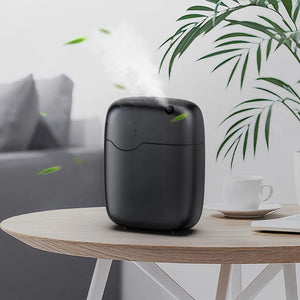
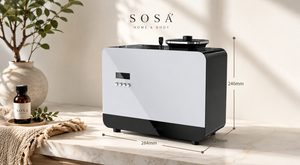
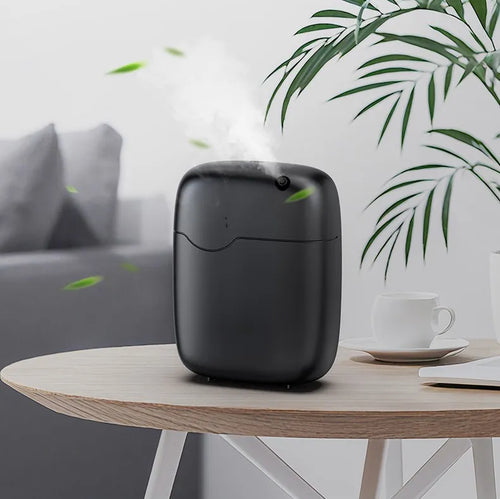
| 3. SOSA Vaayu | Waterless, up to 1000 m³, 400ml for about 75 days, app plus onboard control, 1h/4h/8h/24h timers, under 38 dB, key-lock, 0.9 kg | The answer for most apartments, penthouses and duplexes. Portable, so it is a fixed cost across a portfolio rather than a cost per listing | ₹11,999 |
| 4. A second Vaayu | The same machine again — same scent, lower setting in the smaller zone, one at each zone's entrance | A multi-floor villa, an L-shaped plan, or a double-height volume plus a bedroom wing. ₹23,998, and ₹2,001 under one Aangan | ₹11,999 |
| 5. SOSA Aangan | Up to 3,000 m³, 800ml, HVAC-mounted or standalone, metal body, programmable schedules, under 42 dB | Only where a genuinely large space has ducts to mount it into — a sales gallery, a clubhouse, a very large ducted villa | ₹25,999 |
| 6. Reed diffusers | Alcohol-free, unpowered and unattended, from ₹749, with 130ml from ₹1,249 and 300ml refills at ₹2,399 | A listing you will still be showing in five months at short notice. 24 to 72 hours to establish, so useless for tomorrow | from ₹749 |
| Not in the range: a room spray for the home | The sprays SOSA makes are car perfumes. There is no home spray, and a spray is a twenty-minute product in any case | Printed rather than implied, because ten questions in this cluster expect a spray answer | — |
Versailles
If there is one thing I would like a realtor to take from this whole group of ten pages, it is that the brochure figure is the least useful number in the conversation. Square footage tells you what a property costs. It does not tell you how much air is in it, how that air is divided, where it comes from or where it goes — and every one of those four is a better predictor of what will happen when you switch a machine on. A flat inherits its neighbours' cooking. A penthouse loses its scent through a sliding door. A villa sends everything upstairs through the stairwell and lets a garden in at every threshold. A duplex is one room with a floor across the middle of it. Four buildings, four mechanisms, one arithmetic.
The rest of what I believe about this is short. One scent, always, at different levels — because a buyer is forming an impression of a home rather than a tour of prepared rooms. Start two hours before rather than thirty minutes, because a property that has arrived at its level reads as a property and one still climbing reads as an event. Spend the free hour on ventilation and drain traps before you spend anything at all. And the last of it is the part I care about most: none of this belongs anywhere near a defect. If a property smells of damp or drains or smoke, that is a material fact about the property and the answer is to find it, fix it or disclose it. I would rather lose a sale than help conceal one, and I would rather say so on the page than in small print at the bottom of it.
Everything is made and supported from Pune, and a part of every order funds girl-child education through Nanhi Kali. You get a space that smells like somewhere considered; a girl gets a classroom. That equation has always felt right to me.
Frequently asked questions
- How should I scent a 2,000 sq ft luxury apartment before a viewing? and the 3,000 sq ft version — the arithmetic this group is built on, and the long-plate gradient.
- What's the best way to fragrance a 5,000 sq ft luxury villa during a property viewing?, the large penthouse and the double-height villa — the three property types where the sum stops being simple.
- Should a duplex apartment have different fragrance zones during a viewing? and should bedrooms smell different from the living areas — one scent, several intensities, argued vertically and horizontally.
- Can one scent machine handle a large luxury property or should I think in zones? and the entrance, living room and master bedroom specification — the decision procedure, and the room-by-room brief.
- Brand: the SOSA founder story.
Facts verified August 2026: Product facts used in this guide. SOSA Vaayu ₹11,999: waterless cold-air nebulising diffuser, atomises undiluted fragrance oil to a dry residue-free nano-mist, coverage up to 1000m³ (approximately 2,000–3,000 sq ft), 400ml refillable tank lasting up to about 75 days per fill, Bluetooth app plus onboard control, 1h/4h/8h/24h timer scheduling, adjustable intensity, under 38 dB, DC 12V/1A at 5W, 165 × 80.5 × 215 mm and 0.9 kg, freestanding or wall/HVAC mounted, auto-stop and key-lock, CE, RoHS and SGS certified, supplied with four hotel-inspired fragrances. SOSA Aangan ₹25,999: HVAC-connected or standalone commercial nebulising diffuser, coverage up to 3,000m³ (roughly 8,000–10,000 sq ft), 800ml reservoir, metal body, programmable schedules, under 42 dB. Ultrasonic machines are water-based and consume 30–50 ml of water an hour: Sukoon ₹1,899 (500ml, 270–320 sq ft, 16–18 hours on low, 3–6 drops per tank, steady/2H/4H timers, three 15ml Hotel Collection scents included), Boond ₹899 (300ml), Megh ₹3,499 (6 litres). Hotel Collection water-based fragrance 15ml ₹299, 100ml ₹999, 300ml ₹1,799, Pack of 7 at 15ml ₹1,799 against ₹2,093 bought singly; the Vaayu and Aangan take their own undiluted oil rather than these water-based bottles. Reed diffusers (separate alcohol-free line) from ₹749, requiring 24–72 hours to reach their working level. Scented candles from ₹379, scenting a room in roughly 15–20 minutes but requiring attendance. Free shipping above ₹499. Timings: a nebulising diffuser reaches a working level within minutes and a stated viewing level well inside two hours. This guide makes no claim that fragrance affects a property's price, offer level or time on market; it is presentation, in the same category as photography, styling and lighting. Fragrance must never be used to conceal a material defect. SOSA is not affiliated with or endorsed by any hotel brand. Prices subject to change — see the live product pages.