


The distinguishing question: is the reed wet and heavy, or dry and light? A saturated, slick, dark reed is stalled and will recover from a flip. A dry, light reed with the wet line barely above the oil has genuinely stopped drawing.
The one that is not a fault: cold. Below roughly the temperature of a Delhi or Shimla January living room, a CCT-based oil is simply more viscous and the climb slows. It returns on its own.
The one that is permanent: silting. Once the heavy fraction is inside the capillary channels, nothing you can pour, wipe or soak will get it out — the reed is finished, and only fresh reeds restore the rate.
2. Cause one — silting from the inside. Every millilitre that climbs a reed leaves a trace of its heaviest fraction behind in the channel walls. Over a few months the channels narrow everywhere at once. This is the commonest cause, it is invisible from the outside, and it is not reversible.
3. Cause two — dust at the exposed tip. Oil at the top of a reed is slightly tacky and catches airborne dust, which then binds into a fine skin. A bottle under a ceiling fan, beside an open window onto a road, or in a home with construction nearby will do this within weeks. Snipping or trimming is not a fix; the skin re-forms.
4. Cause three — the wrong material for the climate. Rattan's natural pores swell and clog at monsoon humidity, which is why imported rattan diffusers so often stall in their second month here. SOSA bottles ship with six fibre reeds for exactly this reason. If you have carried rattan reeds over from an older diffuser, that alone can be the whole answer.
5. Cause four — cold, and this one is temporary. A cool room makes the oil more viscous, the climb slows, and the wet line drops. Nothing has broken. It comes back when the room warms, and the only thing to avoid is concluding the bottle is faulty and throwing it out in January.
6. Then match the fix to the cause. Flip for saturation, wipe and reseat for dust and crust, wait for cold, and replace for silting. Fresh oil fixes none of them, which is the sentence I most wish had reached people before they bought a refill.
Composed and handmade in small batches in Pune, and a portion of every order supports girl-child education through Nanhi Kali.

Part one — why a fibre stops carrying oil
A reed is not a straw and it is not a sponge. It is a bundle of very narrow parallel channels, and oil rises in them because the liquid wets the channel walls and is pulled up against gravity by surface tension. The physics rewards narrowness — a narrower channel pulls higher — right up to the point where friction against the walls costs more than the pull gains, at which point the climb collapses. Everything that goes wrong with a reed is a change to the geometry or the wetting behaviour of those channels, and that framing is what separates this page from the mechanical questions of immersion depth and neck geometry. Here we are only interested in what the material of the reed and the state of the oil are doing.
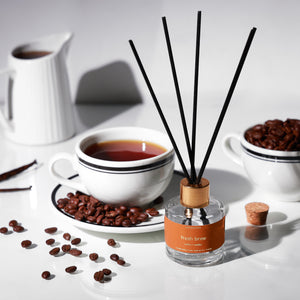
 Fresh Brew₹849 · 9.5/10The top centimetre of a working reed is faintly tacky, because that is where the oil arrives and sits briefly before it evaporates. Tacky surfaces catch dust, and dust plus oil makes a fine skin that seals the very openings the fragrance is supposed to leave through. Homes near a main road, homes with construction nearby, and any bottle sitting directly under a ceiling fan collect it fastest. You can often see it: a grey or fawn cast at the tip that does not match the amber further down. Flipping helps here more than anywhere else, because it puts the dusty end into the oil and presents a clean surface to the air. It is not a permanent cure — the new tip will collect dust too — but it buys you weeks, and it is free.
Part two — the four causes side by side
Read across your row. The confirmation column is what turns a suspicion into a diagnosis, and the last column is the one that decides whether you are spending money or waiting.
| Cause | What the reed looks like | What the bottle is doing | How to confirm it | Recoverable? |
|---|---|---|---|---|
| Silting · heavy residue inside ★ | Uniformly dark tip to base, no gradient, faintly tacky | Level has barely dropped in weeks | Flip all six; 24 hours later nothing has changed | No — fresh reeds only |
| Dust skin at the tip | Grey or fawn cast at the top, amber below | Level dropping slowly; room quiet | Flip; a clear lift within hours that lasts weeks | Partly, and repeatedly |
| Rattan pores swollen | Cane, not fibre — visible grain, often lighter | Stalled since the rains began | Swap in fibre reeds; the wet line starts climbing | Only by changing material |
| Cold-thickened oil | Perfectly normal, just a low wet line | Level dropping unusually slowly all winter | Warm room for a day, or wait for the season | Yes — it is not a fault |
| Not capillary failure at all | Dark, heavy, slick, wet line very high | Level dropping normally | The reed is saturated and stalled — flip it | Yes, in a few hours |
| The honest caveat: three of these five rows end with "you need reeds", and SOSA does not sell replacement reeds as a separate product — our refills are oil only. I would rather write that on the page than let you buy a ₹2,399 bottle of oil to solve a fibre problem. The practical answers are a new bottle, which arrives with six fresh fibre reeds and new oil, or plain unscented reeds from a craft or packaging supplier. Choose fibre over rattan if the supplier offers both; everything in row three is the reason why. | ||||
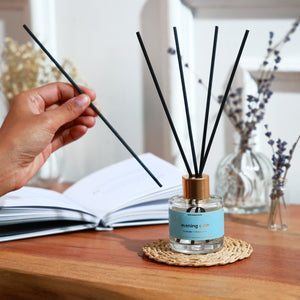
Morning Freshness · lightest residuefrom ₹749Shop → 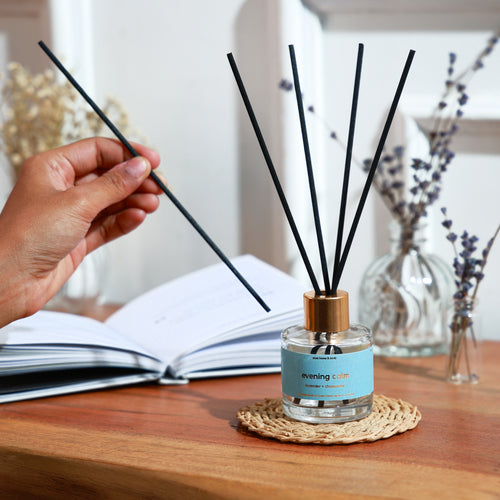 Evening Calm · gentle, low throughputfrom ₹799Shop →
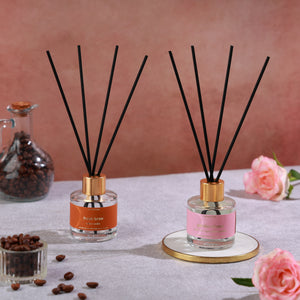
 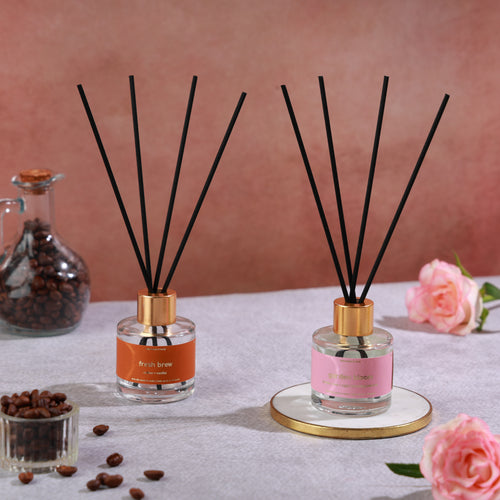 Warmth & Bloom · two fresh sets₹1,598Shop →
Part three — the cold cause, and the two things people do wrong about it
Every January I receive a small wave of messages from Delhi, Chandigarh, Dehradun and Shimla, all describing the same thing: a bottle that worked beautifully through the autumn and has gone quiet, with the oil level stubbornly refusing to drop. Nothing is wrong with any of those bottles. Oil is more viscous when it is cold, and a more viscous liquid climbs a capillary channel more slowly and settles at a lower height. Evaporation off the exposed length falls at the same time, so the room receives less as well. The whole system simply runs at a lower rate, and it returns to normal when the room does. Our carrier is a heat-stable coconut-derived CCT — chosen because it holds up through a 45°C summer without turning, which is the harder end of the Indian problem — and like any oil it thickens as the temperature drops.
The first thing people do wrong is take the cold reading as a verdict on the product and replace something. A reed that is drawing slowly in January is not a spent reed, and reeds bought in a cold snap will behave exactly the same way, because the reed was never the variable. The test that settles it costs nothing: bring the bottle into the warmest room in the house for a day and see whether the wet line climbs. If it does, you have your answer and you can leave everything alone. The second thing people do wrong is the opposite and worse — trying to warm the bottle deliberately, on a heater, in sunlight, near a stove. Direct sun and direct heat do not fix a slow bottle; they strip the reeds and empty it weeks early while degrading the composition, and a windowsill in a February sun is a surprisingly punishing place. Keep the bottle out of direct sunlight in every season.
There is one legitimate winter adjustment, and it is the free one. If a cool room has taken the fragrance below where you want it, add two or three reeds for the season and remove them in March. Six is the count each composition is dosed for, but that dose assumes an ordinary rate of evaporation, and a cold room is not offering one. Nine reeds through a north Indian winter will bring the room back up and cost you rather less bottle life than nine reeds in May would, because the underlying rate is lower anyway. Keep the spare reeds standing upright in a small glass rather than lying on furniture, and put the bottle back to six when the weather turns. That is the whole winter protocol, and it does not involve buying anything.
Part four — the diagnosis, in the order to run it
Four checks, each taking under a minute, ordered so that the free and reversible explanations are eliminated before you consider spending anything.
| Cause | How common | The 30-second check | The fix | How to delay it next time |
|---|---|---|---|---|
| Silting inside the channels ★ | Most common in a bottle over a few months old | Flip all six; check the room 24 hours later | Fresh reeds — they come with a new bottle from ₹749 | Run fewer reeds; refresh every few months |
| Dust skin at the tip | Common near roads, fans and building work | Compare tip colour against mid-reed colour | Flip to bury the dusty end; wipe the neck | Move the bottle out from under the ceiling fan |
| Rattan swelling | Only if the reeds did not come from us | Look at the material: cane grain, or smooth fibre | Change to fibre reeds | Stay on fibre — it is why our bottles ship with it |
| Cold-thickened oil | Seasonal, north India, December to February | Stand the bottle in the warmest room for a day | Wait, or add two to three reeds for the season | Nothing to prevent — it is not a fault |
| Saturated and stalled | Very common and frequently misread as failure | Is the wet line high and the reed slick and heavy? | Flip all six; it recovers within hours | Flip weekly, with gloves, on a tray |
Versailles
The decision to ship fibre reeds rather than rattan was made on a balcony in Pune in the middle of a monsoon, with two identical bottles side by side and a notebook. The rattan set looked better. It also stopped working. By the seventh week the rattan reeds had a wet line that had barely moved for a fortnight, and the fibre set was still climbing. Rattan is a lovely material for a dry climate and a poor one for ours, and no amount of formulation cleverness gets around a pore that has swollen shut.
What I could not design away is silting, because silting is not a flaw in the reed — it is the necessary consequence of a fragrance having a heavy end. Any composition with woods, resins or vanilla in it will leave something behind, and the alternative would be a fragrance made entirely of light materials, which would be thrilling for four days and gone by the second week. I would rather build the plateau and accept that the fibre wears out.
Which brings me to the sentence I dislike writing: we do not sell reeds on their own. It is a real gap and it is on my list. In the meantime a new bottle brings six, and a craft supplier will sell you plain ones. Everything is composed and handmade in Pune, and a part of every order funds a girl's classroom through Nanhi Kali.
Frequently asked questions
- Why is oil not travelling up my reeds? — the mechanical side: depth, neck and diameter.
- Can reed diffuser sticks become clogged? and why are they turning dark?
- How do you know when reeds need replacing? — the five signs, in order.
- The complete reed replacement guide and why can't I smell my reed diffuser?
- Brand: the SOSA founder story.
SOSA reed diffuser range & prices (verified August 2026): alcohol-free, phthalate-free, paraben-free and IFRA-compliant compositions on a heat-stable coconut-derived (CCT) carrier, low-VOC, supplied in a refillable glass bottle with six fibre reeds; 50ml lasts 6–8 weeks and 130ml lasts 14–18 weeks. Morning Freshness (Malabar lemon · peppermint · Nilgiri eucalyptus) 50ml ₹749 · 130ml ₹1,249 · 9.0/10; Garden Bloom (British rose · night-blooming jasmine) 50ml ₹799 · 130ml ₹1,299 · 8.9/10; Evening Calm (Kashmir lavender · chamomile) 50ml ₹799 · 130ml ₹1,299 · 8.9/10; Fresh Brew (Coorg coffee · Kerala vanilla) 50ml ₹849 · 130ml ₹1,349 · 9.5/10; Mountain Breeze (Himalayan pine · sage · Indian cedar) 50ml ₹849 · 130ml ₹1,349 · 9.4/10. Reed diffuser refills are oil only — you reuse your own vessel and reeds: 300ml ₹2,399 (roughly 8–11 months) · 500ml ₹3,499 (roughly 14–18 months), about ₹7–8 per ml against ₹15–17 per ml for a 50ml bottle. Duo sets ₹1,498–₹1,598 for 2 × 50ml and ₹2,498–₹2,598 for 2 × 130ml. Strength figures are positions on SOSA’s own internal strength scale, not an industry standard. Replacement reeds are not sold as a separate SKU; SOSA guidance is to refresh reeds every few months. The reed line is separate from the water-based Hotel Collection for ultrasonic machines (15ml ₹299 · 100ml ₹999 · 300ml ₹1,799) and the two are not interchangeable. Diffusers: Boond 300ml ₹899 · Sukoon 500ml ₹1,899 · Megh 6L ₹3,499 · waterless Vaayu ₹11,999. Composed and handmade in small batches in Pune, India; tested through 45°C summer heat and 85% monsoon humidity. Free shipping above ₹499. A portion of every order supports girl-child education through Nanhi Kali. Prices subject to change — see the live product pages.