


Why Does the Area Around My Wardrobe Smell Stale?

Why Does the Area Around My Wardrobe Smell Stale?

★ Cupboards, stored clothes and the smell that transfers onto everything you wearCandle ₹379 · reed ₹749 · Boond ₹899 · Sukoon ₹1,899 · free shipping above ₹499A portion funds girl-child education
★ SOSA · find the cause, then scent the room
A wardrobe is a small sealed room with no ventilation and a lot of fabric in it. Treat it as one and the problem solves itself
★ ★ ★ ★ ★
★★★★★
"Washing machine gasket. Four years of not knowing. Wiped it, left the door open between washes, and my towels stopped smelling sour."
Aarti B. Free fix · washer seal
Towels
★★★★★
"Cupboard doors open for an hour on a dry day, once a week. That is the entire fix and nobody had ever told me."
Shashank R. Free fix · air the cupboard
Monsoon, Pune
★★★★★
"Asked about putting a reed inside the wardrobe. Was told it would perfume every shirt I own and to put it beside the wardrobe instead. Exactly right."
Nandini P. Told where not to put it
Wardrobe
★★★★★
"Naphthalene smell in everything. Turns out the answer is time and air rather than a stronger smell on top."
Kabir M. Naphthalene
Air, not cover
★★★★★
"Clothes packed away for eight months came out smelling of the box, not of dirt. Sun and a day on a hanger sorted it."
Ruchi S. Stored clothes
Free fix · sunlight
★★★★★
"Morning Freshness on the shelf outside the wardrobe. Lemon and eucalyptus, nothing floral on my clothes, and the whole corner reads clean."
Aman T. Morning Freshness ₹749
Beside, not inside
★★★★★
"Washing machine gasket. Four years of not knowing. Wiped it, left the door open between washes, and my towels stopped smelling sour."
Aarti B. Free fix · washer seal
Towels
★★★★★
"Cupboard doors open for an hour on a dry day, once a week. That is the entire fix and nobody had ever told me."
Shashank R. Free fix · air the cupboard
Monsoon, Pune
★★★★★
"Asked about putting a reed inside the wardrobe. Was told it would perfume every shirt I own and to put it beside the wardrobe instead. Exactly right."
Nandini P. Told where not to put it
Wardrobe
★★★★★
"Naphthalene smell in everything. Turns out the answer is time and air rather than a stronger smell on top."
Kabir M. Naphthalene
Air, not cover
★★★★★
"Clothes packed away for eight months came out smelling of the box, not of dirt. Sun and a day on a hanger sorted it."
Ruchi S. Stored clothes
Free fix · sunlight
★★★★★
"Morning Freshness on the shelf outside the wardrobe. Lemon and eucalyptus, nothing floral on my clothes, and the whole corner reads clean."
Aman T. Morning Freshness ₹749
Beside, not inside
Reed diffusers: no electricity, no routine, one level for months · from ₹749 A reed needs 24–72 hours to establish — the right buy for a habit, the wrong one for tonight Air the room first · scent layers on clean air, it never replaces it


Founder Diaries · Home Fragrance · Wardrobes, Cupboards & Stored Clothes
By Sonal Sahani · ISIPCA Versailles 11 min read Updated August 2026
The corner of a bedroom that holds a cupboard is the one place in a flat where a stale smell has every advantage. A wardrobe is a small sealed room inside a room — under a cubic metre of air, thirty kilos of textile standing in it, and a door that opens for perhaps thirty seconds a day. Everything this cluster says about closed spaces applies to it in concentrated form, and there is usually a second thing going on behind it that nobody looks at: an outside wall, cooler than the room, with a thin back panel pressed flat against it. The fixes below cost nothing. The reed at ₹749 comes at the end, on the furniture beside the wardrobe rather than on a shelf inside it.
Quick answers — read this first
The cause: no air exchange. A wardrobe holds a large mass of fabric in a very small volume of air that is replaced for about thirty seconds a day, so everything the textiles release simply stays there.

Why the room gets it: opening the door pushes the cupboard's air out in one pulse at face height, and the clothes carry the rest out on themselves all day.

The free fixes: doors wide open for an hour on a dry day once a week; stop packing the rail to capacity so air can move between garments; pull the wardrobe two or three inches off an external wall; put a hand on the back panel and on the floor of the cupboard and check for damp.

Then, and only then: a Morning Freshness reed at ₹749 on the chest of drawers beside it. Not inside it.
The short answer
Short answer: a wardrobe has almost no air exchange and an unusually high density of fabric, so the volatiles that textiles release slowly accumulate instead of dispersing. Open the doors wide for an hour on a dry day once a week, stop packing the rail solid, and check the back panel for damp. That is the whole first-line answer and it costs nothing.
The checks, in order: put your hand flat on the inside of the back panel — if it is cooler than the sides, it is against an external wall and moisture is condensing there; kneel and smell the floor of the wardrobe, where shoes and folded cotton sit; then smell a shirt you have not worn for a month at the shoulder. If the shirt carries it, the cupboard is the source rather than the room.
Shop, once it is dry and airing: Morning Freshness — Malabar lemon, peppermint and eucalyptus — from ₹749, on the furniture beside the wardrobe. The Sukoon is ₹1,899 for 270–320 sq ft with steady, 2H and 4H timers and three 15ml Hotel Collection scents of your choice included, and the Boond is ₹899. Free shipping above ₹499.
Straight answer
Why does the area around my wardrobe smell stale, and how do I stop it?
1. Because a wardrobe is a sealed box with no air exchange and a great deal of fabric in it. A bedroom exchanges its air whenever a door opens or a fan runs. A closed cupboard exchanges its air for about thirty seconds a day, and everything the textiles inside it release stays in that small volume.

2. Open the doors wide for an hour on a dry day, once a week. Not five minutes, and not on a wet afternoon. An hour of the doors standing fully open, with the bedroom window open too, is the single most effective thing anybody does about this, and it costs nothing.

3. Stop filling the rail to capacity. Garments that touch along their whole length hold a layer of still air between them that never moves. A hand's width of visible gap along the rail changes the inside of a cupboard more than any product will.

4. Put your hand on the back panel, and then on the floor of the wardrobe. If the cupboard backs onto an external wall, the back panel is the coldest surface in the room and moisture condenses there. Pull the whole thing two or three inches forward so air can pass behind it.

5. Only after all of that, scent the corner rather than the cupboard. A Morning Freshness reed at ₹749 on the chest of drawers beside it gives that corner of the room a clean, steady character. Nothing scented goes inside, for reasons this group covers at length.

A portion of every order supports girl-child education through Nanhi Kali.

TL;DR: a wardrobe is a small sealed room inside a room: under a cubic metre of air, a large mass of fabric and a door that opens for thirty seconds a day, often with a cool external wall behind it. Air it for an hour a week on a dry day, leave gaps on the rail, pull it off the wall — then put a Morning Freshness reed at ₹749 beside it rather than in it.
Morning Freshness reed diffuser
On the chest of drawers, never on the shelf inside
Morning Freshness reed diffuser ₹749
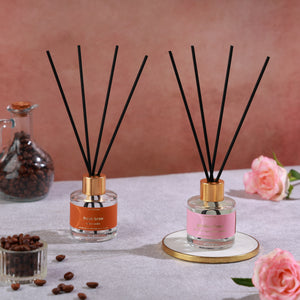
Malabar lemon, peppermint and eucalyptus in the alcohol-free reed line — the scent I would put on the piece of furniture standing next to a wardrobe once the wardrobe itself is dry and airing. The corner of a bedroom that holds a cupboard is usually the stillest part of the room, and stillness is what a reed is for: no electricity, no switching on, no routine, and one level held for months rather than a peak and a fade. Give it 24 to 72 hours to establish before you judge it. It is not a fix for a wardrobe that smells; it is what the corner deserves after the cause has gone. From ₹749, 130ml from ₹1,249, 300ml refills ₹2,399.

A small sealed room inside a room

The useful way to think about a wardrobe is to stop thinking of it as furniture and start thinking of it as architecture. It is a room. It has walls, a floor, a ceiling and a door, it has a volume of air in it, and it has occupants — a large and unusually absorbent population of cotton, wool, linen and synthetics. The difference between that room and the bedroom around it is not one of kind but of degree, and every one of those degrees runs the wrong way: less air, more fabric per litre of air, no window, no fan, no through-draught, and a door that is opened briefly, twice a day, by somebody who is already late.

1
THE RATIO
A great deal of fabric standing in very little air
Start with the arithmetic, because it explains why a cupboard behaves so differently from the room it stands in. A modest double wardrobe holds somewhere around a cubic metre of air. The clothes in it weigh twenty to forty kilos, and because textiles are woven rather than solid, the actual surface area of fibre in that box runs to hundreds of square metres. Compare that with the bedroom: thirty or forty cubic metres of air, a few kilos of curtain and bedding, and openings in three directions. The same fabric behaviour in the two spaces produces completely different results. Every textile in a home releases something slowly and continuously — sizing and finishing agents from manufacture, residual detergent and conditioner, skin lipids left behind from the last wearing, dust, and the ordinary breakdown products of cellulose and keratin. In a bedroom that release is diluted into a large volume and then carried away whenever the door opens. In a wardrobe it is released into a volume perhaps thirty times smaller, from a fabric surface many times larger, and then not carried away at all. This is why the smell has nothing to do with cleanliness, and why the reader who has just washed everything in the cupboard is so reasonably baffled. Clean clothes do this too. A wardrobe of freshly laundered cotton left shut for three weeks in August will produce a distinctly closed smell, and it will produce it faster than a wardrobe with half as much in it, because the ratio is the whole story.
2
THE PULSE
How the smell gets out into the room, twice a day
Now the part that puzzles people most, which is why the smell seems to belong to the room rather than to the cupboard. Every time you open a wardrobe door you displace its air. The door sweeps through the volume, pushes a slug of saturated air out into the bedroom in one movement, and pulls room air in behind it. That pulse arrives at chest and face height, lasts a few seconds, and then disperses into the bedroom and is gone within a minute or two — which is precisely why it reads as intermittent and why you have never been able to point at it. You notice it when you open the door, you turn around to look for it, and by then it has diluted into thirty cubic metres of bedroom. The second route out is slower and far more significant: the clothes carry it on themselves. A shirt that has hung in that air for a month has adsorbed it, and when you put the shirt on, your own body heat drives it back off through the day. This is also the reason you are the last person to know. You are wearing the wardrobe's air, at a low level, continuously, which is the exact condition in which olfactory receptors adapt and stop reporting. Within about a fortnight it becomes invisible to you while every colleague and every visitor still receives it. The diagnostic that settles it costs nothing: take out a shirt you have not worn for a month and smell it at the shoulder, where the fabric hung most exposed. If the shirt has it, the cupboard is the source, and no amount of work on the bedroom will touch it.
3
THE WALL BEHIND
The coldest surface in the room, with a thin panel pressed against it
Then the thing nobody checks, and the one that turns an ordinary closed smell into a genuinely musty one. Most wardrobes stand flat against a wall, and in a great many Indian flats that wall is an external one — or the back of a bathroom, or a wall that a neighbouring balcony drains past. An external wall runs cooler than the room's air for most of the year, and the back panel of a wardrobe is usually a sheet of thin ply or hardboard three or four millimetres thick, which offers almost no insulation and takes the wall's temperature. Warm room air containing water vapour meets that panel, cools against it, and gives up its moisture on the coldest surface available. The back panel of a cupboard is very often the coldest surface in a bedroom, and it is the only one with no air moving over it and a curtain of cotton hanging two inches away. That is a growth site, and what grows there is what people describe as musty rather than merely stale. The second unlooked-at place is the floor of the wardrobe, where shoes, folded knitwear and the bag of things nobody has decided about sit directly on a board that is also cold. Kneel down and smell it. Put a flat palm on the inside of the back panel and compare it with the side panels. If it is noticeably cooler, or if it feels faintly cool-damp rather than dry, you have found your answer and it is a moisture problem rather than a laundry one.
The correction, and it is free: pull the wardrobe two or three inches away from the wall so air can pass behind it, and leave the back of the cupboard empty of anything pressed flat against the panel. A gap you can slide a hand into is enough.

Where the stale smell is actually coming from

Five causes, in the order I would check them, with the confirmation for each rather than a guess. Four of the five cost nothing to fix and none of them is solved by adding a scent, which is why the fragrance row sits at the bottom of the table and is described as a finish rather than as a remedy.

Diagnose the cupboard
Five causes, how to confirm each one, and what it costs to fix
Cause What it smells like How to confirm it The fix Cost
No air exchange ★ Flat, closed, slightly dusty — the smell of air that has not been anywhere It is strongest in the first three seconds after the door opens and gone from the room within a minute Doors fully open for an hour on a dry day, once a week, with the bedroom window open too ₹0
Packed to capacity The same, but noticeably stronger at the dense end of the rail Push the hangers apart and smell between two garments that were touching Take out what you do not wear. A hand's width of visible gap along the rail, and nothing on top of the shelf stack ₹0
A cold back panel Genuinely musty rather than stale — earthy, closer to a cellar A flat palm on the inside of the back panel feels cooler than the sides, or faintly cool-damp Pull the unit two or three inches off the wall; keep the back rail clear; deal with the wall if it is actually wet ₹0
Something put away not quite dry Sharp and sour, and localised to one shelf or one garment Take everything off one shelf at a time and smell each item at the fold Wash and dry it properly. Nothing goes in at all unless it is completely dry, including shoes ₹0
The floor of the wardrobe Leathery, feet, or faintly sweet-stale Kneel down, open the door and smell at ankle height rather than at face height Empty it, wipe the board dry, and let shoes air outside the cupboard for a day before they go back in ₹0
The corner still reads dull once all of the above is done Nothing wrong — simply a still, unremarkable corner of a bedroom You have aired it, spaced it, moved it and it smells of nothing in particular A reed on the furniture beside the wardrobe, giving that corner a steady character. Never inside the cupboard ₹749
Shop this guide
Once the cupboard is dry and airing
The SOSA principle
A wardrobe is a small sealed room inside a roomand it is opened for about thirty seconds a day.
The clothes do not smell because they are dirty. They smell because they have been standing in the same cubic metre of air for a month, and so has everything else in there.

An hour a week, a hand's width of space, and the wall behind

Start with the airing, because it is free, it is the whole first-line answer, and almost everybody does it wrong. Doors fully open, both of them, for an hour, on a dry day, once a week — with the bedroom window open at the same time so the air the cupboard is exchanging with is itself being replaced. The three qualifications matter as much as the instruction. Fully open rather than ajar, because a wardrobe with one door pushed to forty-five degrees exchanges a fraction of its volume; an hour rather than five minutes, because the fabric is desorbing rather than the air merely mixing, and desorption is slow; and a dry day rather than any day, because in a monsoon month you are otherwise inviting saturated air into a box full of cotton, which is the exception to the open-the-windows rule and the one place it genuinely reverses. Mid-afternoon is the driest hour of most days. If you have a pedestal or table fan, stand it two feet from the open cupboard and point it in for twenty minutes of that hour; moving air does several times the work of still air at the same humidity, and this is the cheapest upgrade available to anybody reading this. Then the density. Fabric needs to be able to breathe on both faces, and garments compressed along their whole length simply cannot. A hand's width of visible gap along the rail, shelves stacked to three-quarters rather than to the underside of the shelf above, and nothing at all stuffed into the space behind the hanging rail is a permanent structural improvement rather than a chore.

Then the wall and the floor, which is where the difference between stale and musty is decided. Pull the wardrobe two or three inches clear of the wall behind it. That gap allows room air to circulate over the back panel, which stops the panel sitting permanently at the wall's temperature and stops water condensing on the inside face of it. If the unit is built in and cannot be moved, take everything off the back rail so nothing touches the panel, and check the wall itself for a source — a bathroom on the other side, a balcony that drains past, a window reveal that runs wet in the rains. Fragrance is not the answer to any of that, and a wall that is actually damp is a repair rather than a housekeeping matter. Then the floor: empty it, wipe the board with a dry cloth, and look at what has been living down there. Shoes are the commonest single item in a stale cupboard and the one nobody suspects, because leather and foam hold moisture for days and they are put away at the end of the day at their wettest. Let them stand outside the wardrobe overnight before they go back in. The same applies to a gym bag, a laundry pile that has been temporarily shoved in, and anything folded while still warm from the airer, which is a garment that finished drying inside the cupboard rather than on it. Nothing goes into a wardrobe that is not completely dry, and completely dry means cold to the back of the hand rather than merely not visibly wet.

Then the last two things, and they are the ones that decide whether any of this holds. The first is that you are the worst possible judge of your own cupboard. You open it twice a day and you wear its air on your clothes for the other twenty-three hours, which is exactly the exposure pattern under which olfactory receptors adapt and stop reporting a constant. Within a fortnight it becomes invisible to you and remains perfectly obvious to everybody else, and the instinct that produces — putting something more strongly scented in there — makes the eventual situation worse rather than better. One honest person, asked to smell a shirt straight off the rail and to say what they actually get, is worth more than a month of adjusting. The second is the commercial part, and I am going to keep it small and put it in the right place. Once the cupboard is airing weekly, spaced properly and standing clear of the wall, the corner of the bedroom it occupies is usually the stillest and dullest part of the room, and that is a legitimate thing to scent. A Morning Freshness reed at ₹749 — Malabar lemon, peppermint and eucalyptus — on the chest of drawers or the shelf beside the wardrobe holds one level for months with nothing to switch on, taking 24 to 72 hours to establish. If you would rather scent the whole bedroom, the Sukoon at ₹1,899 runs the water-based Hotel Collection at three to six drops per tank and reaches a steady level in about twenty minutes, with a Boond at ₹899 the smaller version of the same idea. Nothing scented goes inside the wardrobe, and the page on why not is the next one in this group.

You are the last person in the building who can smell your own wardrobe. You have been wearing its air since Tuesday.
— Sonal Sahani, SOSA

The SOSA edit

In the order I would actually do it, which is four free steps and then a decision about the room. The first four cost nothing and they are the ones that fix the problem; the fifth is a finish on a corner that has already been dealt with, and the last row states plainly what does not go inside a cupboard.

The SOSA edit
A stale wardrobe corner, in the order to do it
Do What it is Why it works Cost
1. An hour of open doors, weekly ★ Both doors fully open on a dry day, bedroom window open, a fan pointed in for twenty minutes of it It is the only step that exchanges the cupboard's air at all, and fabric desorbs slowly enough to need the full hour ₹0
2. Space on the rail A hand's width of visible gap between garments; shelves filled to three-quarters; nothing behind the hanging rail Compressed fabric holds a layer of still air along its whole length that no amount of airing reaches ₹0
3. Two inches off the wall The unit pulled forward so air passes behind it, and the back rail kept clear of the panel Stops the back panel sitting at an external wall's temperature, which is where room moisture condenses first ₹0
4. Nothing damp, and the floor emptied Shoes aired outside the cupboard overnight; nothing folded warm; the base board wiped dry and checked The floor and the shoes on it are the commonest localised source, and the last place anybody looks ₹0
5. Morning Freshness reed Malabar lemon, peppermint and eucalyptus, on the furniture beside the wardrobe, 24–72 hours to establish Gives a still corner a steady clean character once the cause has gone. It removes nothing and is not asked to ₹749
6. Sukoon or Boond 500ml for 270–320 sq ft with steady/2H/4H timers and three 15ml scents included, or 300ml for one room If you would rather scent the whole bedroom than one corner. Three to six drops per tank, twenty minutes to a steady level ₹1,899 / ₹899
Not inside the cupboard: anything scented No reed, no oil, no open bottle and no strongly perfumed sachet on a shelf between your clothes An enclosure with no exchange concentrates rather than disperses, and every garment in there takes it on
Honest notes for buyers: fragrance is the last step, never the first. It layers on air that is already clean and moving, and it will not remove a source — not damp, not a dry drain trap, not a loaded sofa, not a filter that needs washing. Deal with the cause, change the air, then scent the room. On timing: a candle puts scent into a room in fifteen to twenty minutes and a Sukoon reaches a steady level in about twenty, while a reed diffuser needs a day to three days before it is doing its job — the wrong buy for a deadline and the right buy for a room you want to hold one level for months. SOSA does not make a room or linen spray for the home; the sprays in the range are car perfumes. A cool-mist ultrasonic adds 30–50 ml of water an hour to the air, so it is the wrong machine for a room you are trying to dry out. The Hotel Collection is water-based and runs in the Sukoon, Boond and Megh only — not in reeds and not in the waterless Vaayu. Reed diffusers are a separate alcohol-free line with their own scents. Candles must be attended and put out. The Hotel Collection scents are SOSA's own interpretations inspired by the world's finest hotels; SOSA is an independent Indian fragrance house, not affiliated with or endorsed by any hotel brand. A portion of every order supports girl-child education through Nanhi Kali.
SOSA Sukoon
For the room the wardrobe opens into
SOSA Sukoon ₹1,899
A 500ml ultrasonic diffuser rated for 270–320 sq ft, 16–18 hours per fill on low at 30–50 ml/h, a 2.4MHz cool-mist plate, a remote, auto shut-off and steady, 2H and 4H timers, with three 15ml Hotel Collection scents of your choice included. It scents the bedroom, and that is all it does — it has no effect whatsoever on the air inside a closed cupboard, which is the one volume in the room it cannot reach. Three drops on the 2H timer while you are getting ready in the morning, with the machine at waist height and well away from open wardrobe doors, because a cool mist falls rather than rises and hanging cotton will take whatever reaches it.
SS
ISIPCA
Versailles
A note from Sonal

I have opened a great many wardrobes in other people's houses, which is a strange sentence to write but it is the job. The thing that surprises people most is that the clothes are almost never the problem. They are washed, they are folded, they are often better cared for than mine. What is wrong is the architecture: a box with no ventilation, filled to the brim with the most absorbent material in the house, standing against the coldest wall in the room, opened for half a minute a day. If you designed a container to develop a smell you would design that, and then you would be pleased with yourself.

So the whole of my advice here is about air rather than about scent, and I would rather sell you nothing than sell you something that goes on a shelf between your shirts. An hour of open doors on a dry day, a hand's width of space on the rail, and two inches between the back of the unit and the wall will do more than anything with a price on it. When that is in place, the corner the wardrobe stands in is usually the quietest part of the bedroom, and a reed on the dresser beside it at ₹749 gives that corner a character without giving it to your clothes. Beside, and never inside. That is the only rule in this group I would call absolute.

Everything is made and supported from Pune, and a part of every order funds girl-child education through Nanhi Kali. You get a home that smells like somewhere you chose; a girl gets a classroom. That equation has always felt right to me.

Frequently asked questions

Why does the area around my wardrobe smell stale?
Because a wardrobe has almost no air exchange and an unusually high density of fabric in a very small volume of air. Everything textiles release slowly accumulates instead of dispersing, and opening the door pushes that air out into the room in one pulse at face height.
How often should I air out a wardrobe?
Both doors fully open for an hour, once a week, on a dry day, with the bedroom window open at the same time. Mid-afternoon is usually the driest hour. A fan pointed into the open cupboard for twenty minutes of that hour does several times the work of still air.
Can a wardrobe make my clothes smell even though they are clean?
Yes, and it is the usual case. Clean cotton standing in unexchanged air for a month adsorbs what is in that air. Take out a shirt you have not worn for weeks and smell it at the shoulder — if the shirt carries it, the cupboard is the source rather than the laundry.
Should I move my wardrobe away from the wall?
If it stands against an external wall or the back of a bathroom, yes. Two or three inches is enough for air to pass behind it. The back panel is thin and takes the wall's temperature, which makes it the coldest surface in the room and the place where moisture condenses first.
Can I put a reed diffuser or a scented sachet inside the wardrobe?
I would not. An enclosure with no air exchange concentrates a scent rather than dispersing it, and every garment in there takes it on and then wears it. Put a Morning Freshness reed at ₹749 on the furniture beside the wardrobe instead, once the cupboard itself is dry and airing.
Air it first · then scent the corner
An hour of open doors beats anything with a price on itand then the reed goes beside the wardrobe
Morning Freshness is from ₹749 for the alcohol-free reed, 130ml from ₹1,249 and 300ml refills ₹2,399; a reed needs 24 to 72 hours to establish and then holds one level for months. The Sukoon is ₹1,899 for 270–320 sq ft with steady, 2H and 4H timers and three 15ml Hotel Collection scents of your choice included, and the Boond is ₹899. Free shipping above ₹499, and a portion of every order supports girl-child education through Nanhi Kali.
See Morning Freshness · ₹749 See the Sukoon · ₹1,899
Continue the read
More from SOSA
Editorial standards & sources
About this guide: Written by Sonal Sahani, ISIPCA Versailles-trained founder and perfumer at SOSA Home & Body, on why a wardrobe behaves as a sealed room rather than as furniture, how the ratio of fabric surface to air volume makes a cupboard accumulate what a bedroom disperses, why the smell reaches the room as a pulse when the door opens and on the clothes themselves for the rest of the day, why the back panel against an external wall is the coldest surface in a bedroom, and why anything scented belongs beside a wardrobe rather than inside it.

Facts verified August 2026: Diagnostic facts used in this guide: a closed room accumulates what it cannot exchange, so cross-ventilation needs two openings rather than one; a drain's U-bend water seal evaporates in roughly two to four weeks of disuse and then admits sewer gas, which is corrected by pouring water down the drain; microbial growth in fabric and on surfaces accelerates above about 60% relative humidity, and Indian monsoon indoor humidity commonly runs 80–95%, which is the one situation where ventilating on a wet day can import moisture rather than remove it; an air-conditioner's cold, wet evaporator coil and filter grow biofilm that is blown into the room on start-up; textiles adsorb cooking aerosol and body oils and re-release them for weeks; and olfactory adaptation makes a constant household smell undetectable to its residents within about a fortnight while visitors still perceive it. Timings: a scented candle scents a normal room in roughly 15–20 minutes, a Sukoon ultrasonic diffuser reaches a steady level in about 20 minutes from cold, and a reed diffuser needs roughly 24–72 hours. SOSA products and prices: Sukoon 500ml ₹1,899 (270–320 sq ft, 16–18h on low, 9–12h high, 30–50 ml/h, 2.4MHz cool mist, remote, steady/2H/4H timers, BPA-free, auto shut-off, includes three 15ml Hotel Collection scents of your choice); Boond 300ml ₹899; Megh 6-litre ₹3,499; waterless Vaayu ₹11,999 (up to 1000m³); Aangan ₹25,999. Hotel Collection water-based fragrance 15ml ₹299, 100ml ₹999, 300ml ₹1,799, Pack of 7 at 15ml ₹1,799; dose 3–6 drops per tank. Reed diffusers (separate alcohol-free line): Morning Freshness from ₹749, Garden Bloom and Evening Calm from ₹799, Fresh Brew and Mountain Breeze from ₹849; 130ml from ₹1,249; duos from ₹1,498; 300ml refills ₹2,399. Scented candles: Bookshop 80g ₹379, Amber Rose 130g ₹599 and 220g ₹799, Smoked Oudh 130g ₹449, ceramic jar candles ₹949, Pure Calm wax melt set ₹854. Free shipping above ₹499. SOSA does not make a room or linen spray for the home. The Hotel Collection scents are SOSA's own interpretations; SOSA is not affiliated with or endorsed by any hotel brand. Prices subject to change — see the live product pages.
Retour au blog