



What accumulates: no air exchange, so everything that off-gasses slowly builds up; drain traps evaporate and start venting; the fridge and the bin carry on unattended; the washing machine sits closed and damp.
The useful part: treat the first thirty seconds inside the door as data. It is the most accurate reading of your own home you will take all year, and it fades as your nose adapts again within minutes.
Then act before you unpack: windows, drains, fridge, bin, washing machine, laundry. Half an hour, and free.
2. And because the flat genuinely changed while it was shut. A closed room does not stop producing smell, it stops removing it. Everything that off-gasses slowly — furniture, foam, paint, plastics, textiles, dust — accumulates with nowhere to go.
3. The drains are the specific culprit most people never suspect. A U-bend holds a water seal that keeps sewer gas out of the room, and in an unused bathroom that seal evaporates in two to four weeks. That sharp, faintly sulphurous note on the doorstep is very often a dry trap.
4. The fridge, the bin and the washing machine worked alone all week. A vegetable drawer, a bin that was two days from being emptied, and a machine shut on a damp gasket produce more in ten days than they ever do while you are there to interrupt them.
5. So the first thirty seconds are the most accurate reading of your home all year — use them. Stand in the hall before you unpack. Note what you smell and where. You have about half a minute before the fast clock starts again and it goes away.
6. Then work the checklist before the suitcase. Windows, drains, fridge, bin, washing machine, laundry. Half an hour, no money, and it is the only time you will be able to tell whether it worked.
A portion of every order supports girl-child education through Nanhi Kali.

Two things happened, and they arrive together
It is worth separating the two causes, because people who conflate them tend to reach the wrong conclusion in both directions. Half of what you are experiencing is a restored instrument and half of it is a changed room, and the two have completely different remedies. If it were only your nose, the smell would be one you had simply forgotten and there would be nothing to do about it. If it were only the flat, you would have noticed it building up before you left. It is both, which is why the doorstep reading is so much sharper than anything else in your year, and why it deserves half an hour of your attention before the suitcase gets opened.
The first half hour, in order
Six things to do before the suitcase is opened, arranged in the order that gets the most out of the reading you have just taken. All six are free and the whole sequence is about half an hour, and it matters that they happen now rather than tomorrow — this is the only moment in the year when you can actually tell whether any of it made a difference.
| Step | What to do | Why it matters after a trip | What it fixes | Cost |
|---|---|---|---|---|
| 1. Stand still and record ★ | Thirty seconds in the hall. Note what you smell and where it seems strongest, out loud or on your phone | Your nose is fully reset for the first time in a year and the state lasts about a minute | Nothing yet — but it is the only accurate reading you will take, and everything below depends on it | ₹0 |
| 2. Two windows, twenty minutes | Openings on opposite or adjacent walls so air exchanges rather than merely moves. Internal doors open | A shut flat has had no exchange for the length of your trip, so everything slow has accumulated | The general closed-up smell, which is usually the largest single component of a homecoming | ₹0 |
| 3. A mug of water down every drain | Every floor gully, basin, unused shower and utility drain; flush every WC twice | The U-bend seal evaporates in two to four weeks of disuse and the drain then vents into the room | The sharp, faintly sulphurous smell nobody can place. It works within minutes | ₹0 |
| 4. Fridge, then bin | Vegetable drawer, door seal, anything at the back older than the trip. New liner, and wipe the bin itself | Both worked unattended for the whole trip, and the bin is nearly always dirtier than what was in it | The sour or sweetish note that seems to come from the kitchen doorway | ₹0 |
| 5. Washing machine open | Door and detergent drawer open, rubber gasket wiped dry, drum empty | Shut on a damp gasket for ten days is long enough to establish a smell that then travels into your laundry | Sour towels and clothes that smell odd within a day of being washed | ₹0 |
| 6. Laundry and textiles | Anything left on a rack or in a basket, plus bedlinen if the trip was long. Sun on a mattress or a rug for two hours | Textiles are where a room keeps its memory, and they have been re-releasing into still air all week | The stale layer that returns two days later if you only opened the windows | ₹0 |
Reeds · running while away₹749Shop → 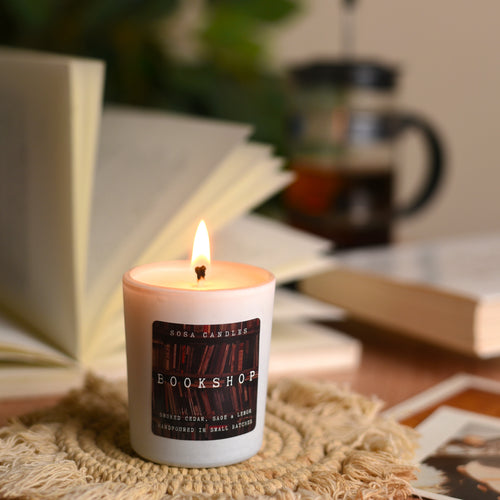 Candle · twenty minutes₹379Shop →
  Sukoon · once it is aired₹1,899Shop →
What to do with the reading, and what not to buy in a hurry
The first rule of the homecoming is that nothing gets bought in the first hour. A person standing in a hall that smells wrong, at the end of a journey, with a suitcase still in the doorway, is in exactly the state of mind our industry is built to take advantage of — and almost everything sold into that moment is the wrong product. The single most useful thing available to you costs nothing and takes twenty minutes, which is a genuine cross-draught: two openings on opposite or adjacent walls, internal doors propped, for a full twenty minutes. One window is ventilation and two is exchange, and the difference between them is not marginal. Do the drains at the same time, because a mug of water in every trap is a two-minute job that resolves the single most common homecoming smell in the country and cannot be resolved by anything you purchase. Then wait, and smell the flat again in an hour. A very large proportion of returning-home smells are simply gone by then, and the household that bought something in the first ten minutes will spend the next year believing the product fixed it. If the smell survives an hour of proper exchange, refilled traps, an emptied bin and an opened washing machine, then you have a real finding and it is worth pursuing properly rather than covering. Damp, a fridge, a loaded sofa, a filter that needs washing: these are sources, and a fragrance over a source gives a room two smells rather than one. That is the whole order this cluster is built on — find the source, change the air, deal with moisture and fabric, clean, and only then scent.
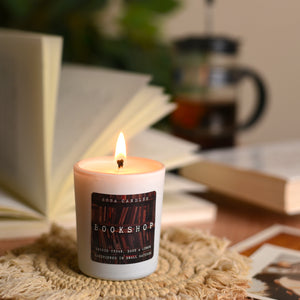
Then the timings, because the panic buy in this situation is nearly always a format mismatch rather than a bad product. A reed diffuser needs 24 to 72 hours to establish, which makes it the worst possible purchase for the evening you get home and one of the best things to have running while you are away. Think of it as the format that works on your behalf in your absence: no socket, no water, nothing to switch on, oil climbing rattan by capillary action for as long as you are gone, so the hall you walk into has been held at one level all week rather than sitting closed. Morning Freshness at ₹749 is Malabar lemon, peppermint and eucalyptus; Mountain Breeze at ₹849 is Himalayan pine, sage and cedar; Evening Calm at ₹799 is Himalayan lavender and chamomile. If what you want is scent tonight, a candle is the honest answer at fifteen to twenty minutes from match to scented room — the Bookshop candle at ₹379 for 80g, roughly fifteen to eighteen hours of burn, or the Amber Rose candle at ₹599 for 130g — with the standing condition that a candle must be attended and put out. An ultrasonic reaches a steady level in about twenty minutes from cold, so the Sukoon at ₹1,899 also qualifies for tonight if you already own one. And the thing that does not exist: SOSA does not make a room spray or a linen spray for the home. The sprays in the range are car perfumes, formulated and sized for roughly three cubic metres of hot moving air. A spray is a thirty-minute product in any case, which is precisely the wrong shape for a flat that has just told you something true about itself.
Then what to do with the reading itself, which is the part most people waste. Write it down within the first ten minutes, in whatever words you actually used, along with the current dose on the machine and the date. Six months from now that note will be the only evidence you have about what your home smells like to other people, because your own nose will have gone back to reporting nothing. If the finding was staleness, the note is a reminder to air the flat properly on a schedule and to check the traps monthly in any room you rarely use. If the finding was your own fragrance, the note is a dose record: whatever number of drops the machine was running is what produced that impression, and the decision to keep it or reduce it should be made now rather than in a fortnight when you cannot smell it again. The Hotel Collection is composed at three to six drops per tank, per tank rather than per litre, since you are scenting the mist and not the water — so a 300ml Boond at ₹899 takes the same drops as a 500ml Sukoon at ₹1,899, and a Megh at ₹3,499 with a six-litre tank buys hours and coverage rather than intensity. On the constraints: the Hotel Collection is water-based and for ultrasonic machines only, so it does not go into a reed diffuser, which is a separate alcohol-free line with its own scents, and it does not go into the waterless Vaayu at ₹11,999, which takes its own undiluted oil. Rinse the tank when you change scent, never substitute raw essential or carrier oils, and if the flat you have come home to is damp rather than stale, remember that a cool-mist machine adds 30 to 50 millilitres of water an hour and is the wrong device for a room you are trying to dry out.
The SOSA edit
The homecoming, in the order that actually helps, with the first five steps at no cost. The product rows are deliberately last and deliberately conditional, because most returning-home smells are gone within an hour of doing the free things properly.
| Step | What it is | When it earns its place | Cost |
|---|---|---|---|
| 1. Thirty seconds, before the suitcase ★ | Stand in the hall, record the impression and where it is strongest, and do not start opening doors yet | Immediately. Your nose is reset for the first time in a year and it lasts about a minute | ₹0 |
| 2. Cross-ventilate and refill the traps | Two openings for twenty minutes, and a mug of water down every drain and unused shower | Next, together. Between them they resolve most homecoming smells before anything is bought | ₹0 |
| 3. Fridge, bin, washing machine, laundry | The four things that worked unattended while you were away, in that order | Third. These are sources rather than smells, and no fragrance addresses a source | ₹0 |
| 4. Smell the flat again an hour later | The same standing-still test, over aired air, before any decision is made | Fourth, and it is the step that prevents the panic purchase. Many findings simply do not survive it | ₹0 |
| 5. A candle for tonight, or the Sukoon if you own one | 15–20 minutes from match to scented room, or about 20 minutes to a steady level from cold | Only once the air has actually turned over. Fragrance is a finishing layer, not a remedy | ₹379 / ₹1,899 |
| 6. A reed diffuser — for next time, not for tonight | 24–72 hours to establish, no socket, no water, nothing to switch on. From ₹749 | Bought before your next trip rather than after this one, so the hall is being held at a level while you are gone | from ₹749 |
Versailles
I have come to think of the walk from the lift to the front door after a long trip as the most valuable thirty seconds a household gets. It is the one moment in the year when you are equipped to assess your own home, because you have been away long enough for the filter in your head to let go, and it is over almost before you have registered that it is happening. Most people spend it looking for the keys. I would like more people to spend it paying attention, because the information is genuinely unavailable at any other time and it is free.
What I would ask is that you resist buying anything with it. Open two windows properly, put a mug of water down every drain in the flat, open the washing machine, deal with the bin, and then go back and smell the place again an hour later. A great deal of what people describe to me as a serious problem with their home turns out to be ten days of no air exchange and a bathroom trap that dried out, both of which cost nothing to correct and neither of which any product of mine would have improved. And if what you smelled on the doorstep was your own diffuser rather than the flat, that is worth knowing too, because it is the level your guests receive on an ordinary evening. Decide about it while you can still smell it. That window closes faster than you expect.
Everything is made and supported from Pune, and a part of every order funds girl-child education through Nanhi Kali. You get a home that smells like somewhere you chose; a girl gets a classroom. That equation has always felt right to me.
Frequently asked questions
- Why does my bathroom smell much worse when I come back from holiday? — the dry trap, in full.
- How long does it take to go nose-blind to your own house? — why three days away is the reset and one night is not.
- My house smells and I cannot find the source — how do I track it down? — what to do when the reading survives the checklist.
- Nose-blindness at home: why you cannot smell your own house, and what to do — the pillar guide.
- Brand: the SOSA founder story.
Facts verified August 2026: Diagnostic facts used in this guide: a closed room accumulates what it cannot exchange, so cross-ventilation needs two openings rather than one; a drain's U-bend water seal evaporates in roughly two to four weeks of disuse and then admits sewer gas, which is corrected by pouring water down the drain; microbial growth in fabric and on surfaces accelerates above about 60% relative humidity, and Indian monsoon indoor humidity commonly runs 80–95%, which is the one situation where ventilating on a wet day can import moisture rather than remove it; an air-conditioner's cold, wet evaporator coil and filter grow biofilm that is blown into the room on start-up; textiles adsorb cooking aerosol and body oils and re-release them for weeks; and olfactory adaptation makes a constant household smell undetectable to its residents within about a fortnight while visitors still perceive it. Timings: a scented candle scents a normal room in roughly 15–20 minutes, a Sukoon ultrasonic diffuser reaches a steady level in about 20 minutes from cold, and a reed diffuser needs roughly 24–72 hours. SOSA products and prices: Sukoon 500ml ₹1,899 (270–320 sq ft, 16–18h on low, 9–12h high, 30–50 ml/h, 2.4MHz cool mist, remote, steady/2H/4H timers, BPA-free, auto shut-off, includes three 15ml Hotel Collection scents of your choice); Boond 300ml ₹899; Megh 6-litre ₹3,499; waterless Vaayu ₹11,999 (up to 1000m³); Aangan ₹25,999. Hotel Collection water-based fragrance 15ml ₹299, 100ml ₹999, 300ml ₹1,799, Pack of 7 at 15ml ₹1,799; dose 3–6 drops per tank. Reed diffusers (separate alcohol-free line): Morning Freshness from ₹749, Garden Bloom and Evening Calm from ₹799, Fresh Brew and Mountain Breeze from ₹849; 130ml from ₹1,249; duos from ₹1,498; 300ml refills ₹2,399. Scented candles: Bookshop 80g ₹379, Amber Rose 130g ₹599 and 220g ₹799, Smoked Oudh 130g ₹449, ceramic jar candles ₹949, Pure Calm wax melt set ₹854. Free shipping above ₹499. SOSA does not make a room or linen spray for the home. The Hotel Collection scents are SOSA's own interpretations; SOSA is not affiliated with or endorsed by any hotel brand. Prices subject to change — see the live product pages.