



Do these before you buy anything: a lidded pantry bin emptied every evening, a rule about where food is eaten, twenty minutes of real ventilation a day, and the air-conditioning filters washed. Those four decide most of how an office smells and they cost ₹0.
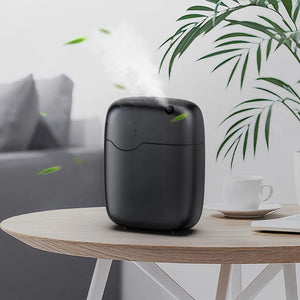
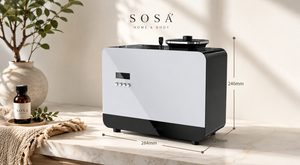
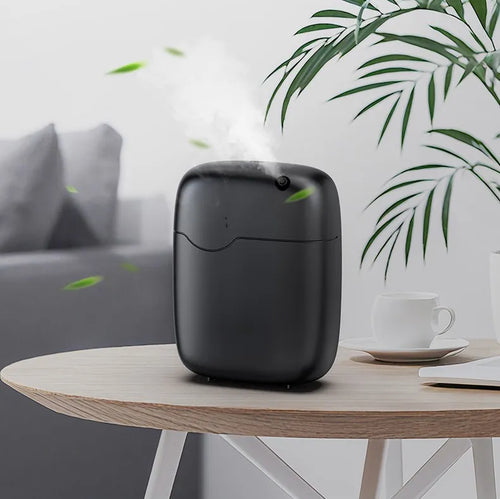
Then the machine: the Vaayu at ₹11,999, waterless so nothing damp goes near paper or a printer, on a schedule that starts before the office opens and stops after it closes.
The part most guides skip: ask the people who work there before you install anything. They breathe it for something like two thousand hours a year and a client breathes it for twenty minutes.
2. Decide where food is eaten, and say it out loud. Not a ban, and not a moral position — a rule about geography. Food at desks puts a warm meal into upholstered chairs and carpet in a room that is then sealed and air-conditioned for the rest of the afternoon. A pantry with a door and a working exhaust, used for twenty minutes, solves it.
3. Ventilate on purpose, even in a sealed building. Twenty minutes with something genuinely open, early, before the air conditioning takes over the day. An office is a closed box holding eight or fifteen people and everything they brought in on their shoes, and it never gets the equivalent of a house having its windows thrown open on a Sunday.
4. Wash the air-conditioning filters, and put it in the calendar. The return air of every indoor unit in the office has been pulling dust, paper fibre and pantry air across a mesh in front of a cold coil since the last time anybody looked. That is why an apparently clean office smells flat in the first minute after the units start on a Monday.
5. Ask the people who work there before you install anything. This is the step that separates scenting a workplace from scenting a listing. Your team will meet this scent for something like two thousand hours a year. Somebody may have a migraine history, a pregnancy, asthma or simply a strong preference, and all four are reasonable. A fragrance imposed on a workplace is a different object from one chosen for a viewing.
6. Then the machine, the setting and the schedule. The Vaayu at ₹11,999, waterless so nothing damp goes near files or a printer, in the reception zone, on the lowest setting that produces a consistent impression, scheduled to start half an hour before opening and stop after the last person leaves.
A portion of every order supports girl-child education through Nanhi Kali.
Three things an office does that a listing does not
Everything else in this cluster is written about a property you are borrowing for ninety minutes. An office inverts almost every assumption in that work. It is occupied, so it collects; it is scented continuously, so the level has to be survivable rather than remarkable; and it belongs to people whose noses adapt to it while every visitor's does not. Those three differences are the whole of this page, and each one changes a decision you would otherwise make automatically.
What an office accumulates, and what each one costs to fix
Six real sources in a working brokerage, what each one does to how the place smells to somebody arriving, and what it costs to deal with. Five of the six are free and they are the ones that decide the outcome. The paid row is at the bottom because that is where it belongs in the order of work, not because it is unimportant.
| Source | What it actually does | The answer | Cost |
|---|---|---|---|
| The pantry bin ★ | Tea leaves, milk and lunch boxes in a warm closed room — the loudest smell in most offices and the one nobody names | A lidded bin, emptied every evening without exception, and the pantry door kept shut with its exhaust running | ₹0 |
| Food eaten at desks | Puts a warm meal into carpet and upholstered chairs in a space that is then sealed for the afternoon | A rule about geography rather than a ban. Twenty minutes in the pantry, and the desks stay out of it | ₹0 |
| No real ventilation | A sealed, recirculated box holding everything eight or fifteen people brought in that morning | Twenty minutes with something genuinely open, early, before the air conditioning owns the day | ₹0 |
| Loaded air-conditioning filters | A flat, closed, slightly dusty note arriving in the first minute after the units start on a Monday | Pull, wash, dry completely, refit. Put the date in the calendar rather than trusting anybody to notice | ₹0 |
| Wet umbrellas, wet shoes, damp mats | In monsoon this is the difference between an office that smells looked after and one that does not | A stand and a tray at the door, mats lifted and dried, and nothing wet left in a cupboard overnight | ₹0 |
| The machine and the bottle | Sets one quiet, consistent level in the arrival zone once the five rows above have been dealt with | Waterless, low, scheduled to the office hours. Never installed before the free work is done | ₹11,999 / ₹299 |

The dose, the schedule, and the conversation with your team
Start with the level, because in an office the number is the whole argument and it goes down rather than up. The rule I would give any brokerage is the lowest setting that produces a consistent impression at the front door, and then one notch below that, because you are setting it for the eighth hour rather than the first minute. On the Vaayu that is a matter of the intensity control and then the key-lock, which exists precisely so that a setting arrived at properly is not quietly undone over a year by everybody who walks past it. On an ultrasonic such as the Sukoon at ₹1,899 the equivalent is the drop count: the Hotel Collection is composed at three to six drops per tank, and an office takes three. The dose is per tank rather than per litre, since you are scenting the mist and not the water, so a larger machine buys you hours and coverage and never intensity. Then the schedule, which is the specification that actually distinguishes an office installation from every other use in this cluster. The 1h, 4h, 8h and 24h timers and the app on the Vaayu exist so that the machine starts about half an hour before the first person unlocks the door and stops after the last one leaves. Nobody remembers to switch a diffuser on at nine in the morning while they are answering a phone, and an office scented on somebody's memory is an office that smells different on Tuesday from how it smelt on Monday. Set it once, on a schedule, and stop thinking about it.
Then the geography, which in an office is more particular than in a flat. The machine goes in the arrival zone — reception, or the first four or five metres inside the door — at waist height or above, at the edge of the space rather than in the doorway itself, and out of the direct throw of an air-conditioning vent, which strips the light end off a composition and leaves the heavy end standing alone. It does not go on a desk somebody works at, because a person sitting a metre from a diffuser is receiving something quite different from a person standing at the counter. It does not go in the pantry, where its job would be concealment rather than presentation. And it should be kept away from the printer, both because a printer produces its own warm plastic note that nothing usefully overlays and because a water-based ultrasonic near paper stock is a poor idea in any case — which is the practical reason I recommend the waterless Vaayu in an office with files, contracts and a printer in it rather than a machine that puts 30 to 50 millilitres of water an hour into the air. On the meeting room, treat it as a separate volume rather than an extension of reception. A closed room where somebody is going to sit for an hour discussing a number wants less, not more, and in most offices it needs no machine of its own at all — the scent that reaches it when the door opens is sufficient, and anything more turns a working room into a scented one.
Then the two things that will decide whether this is still working in three years. The first is the conversation with your team, and I would have it before you order rather than after the machine arrives. Tell them what you are proposing, let them smell the bottles, and make it genuinely possible for somebody to object without it being awkward. Somebody with a migraine history, somebody pregnant, somebody with asthma or somebody who simply finds a particular note unpleasant all have a legitimate view, and unlike a client they cannot leave after twenty minutes. If one person reacts badly, the answer is to stop running that scent, not to run it at a lower setting — a reduced dose of something that gives a colleague a headache is still a headache, arriving more slowly. The Sukoon at ₹1,899 comes with three 15ml scents of your choice, which makes running a fortnight of each and letting the room decide the least expensive part of this whole exercise. The second is the boundary, and it is the same one that governs every page in this cluster. If your office has a damp patch on a wall, a dry trap in the pantry, a leak from the floor above or a smell with a physical cause, that is a repair and a landlord conversation rather than a fragrance decision. Scenting over it is the same error as scenting over damp in a listing, with the added indignity that you are doing it to your own staff. Fix the building, then scent the room. And on what fragrance is honestly for: it makes a space feel consistent and considered on arrival, in the same category as the lighting and the furniture. It is not a persuasion tool, nothing here claims it affects a client's decision, and I would rather keep your trust than tell you otherwise.
The SOSA edit
In working order for a brokerage office, from the bin to the bottle. The first five rows are free, the sixth is a conversation, and only the seventh costs anything. The last row prints the thing this page will not do, because in an office the request comes from a landlord as often as from an agent.
| Do this | What it is | When | Cost |
|---|---|---|---|
| 1. The pantry bin ★ | Lidded, lined, emptied every evening. Pantry door shut, exhaust running while anybody is using it | Today, and every evening after. The single highest-yield instruction on this page | ₹0 |
| 2. Where food is eaten | A rule about geography, not a ban. Meals in the pantry rather than at upholstered chairs over carpet | Agreed with the team rather than announced. It holds better that way | ₹0 |
| 3. Twenty minutes of real air, daily | Something genuinely open, early, before the air conditioning takes over. A sealed office never gets a Sunday | Every morning. Non-negotiable in monsoon, when wet things come in with people | ₹0 |
| 4. Air-conditioning filters | Every indoor unit: pull, wash, dry completely, refit. Ducted systems go to the building team | On a repeating calendar entry rather than when somebody eventually notices | ₹0 |
| 5. Ask your team before you install | They meet this for about two thousand hours a year; a client meets it for twenty minutes | Before you order. If one person reacts, you stop rather than reduce | ₹0 |
| 6. Vaayu and Quiet Luxury | Waterless, up to 1000 m³, app scheduling, under 38 dB, key-lock; white tea, bergamot and cedar | Reception zone, lowest consistent setting, scheduled to open before the door and stop after close | ₹11,999 / ₹299 |
| Not this: scenting a damp wall or a dry trap | A physical cause in your own office is a repair and a landlord conversation, not a fragrance decision | Printed rather than implied. It is the same rule we apply to a listing, applied to you | — |

Versailles
The most useful visit I have ever made to a brokerage office lasted about eleven minutes and did not involve a product. A firm in Pune had asked me which of the seven scents suited their reception, and I walked in and immediately smelt something that was not reception at all. The pantry was at the end of a short corridor with its door propped open by a chair, and the bin under the counter had held that morning's tea leaves and two lunch boxes since eleven o'clock in a room that was about four degrees warmer than the rest of the office. We shut the door, changed the liner, and agreed the bin would go out every evening. I sent them a bottle later, but the bottle was never the point, and I have watched a great many offices try to solve that corridor with a machine.
The other thing I would say, and it is the part that separates an office from a listing entirely, is that you are not the person who has to live with this decision. You are in and out — a viewing at eleven, a site at three, a client at five. The person at the second desk is in that room from nine until seven, and they will meet whatever you install roughly two thousand hours a year. Ask them. Let them smell it first. Make it genuinely safe to say no, because somebody with a migraine history or a pregnancy or plain dislike is not being difficult, and a scent that gives a colleague a headache at half strength is still giving them a headache. I have told firms to abandon an installation over one member of staff, and I have never regretted it. An office that smells of nothing in particular is an entirely respectable outcome, and it is a great deal better than one that smells of a decision somebody was not consulted about.
Everything is made and supported from Pune, and a part of every order funds girl-child education through Nanhi Kali. You get a space that smells like somewhere considered; a girl gets a classroom. That equation has always felt right to me.
Frequently asked questions
- Should a premium property consultancy have a signature scent? — a yes, with the limits printed.
- What fragrance works best in a luxury real-estate office? — the seven ranked against an eight-hour brief.
- How to scent a 1,500 sq ft premium real-estate office — the sizing arithmetic done properly.
- One signature fragrance across your office and selected viewings — where it extends and where it should not.
- Brand: the SOSA founder story.
Facts verified August 2026: Product facts used in this guide. SOSA Vaayu ₹11,999: waterless cold-air nebulising diffuser, atomises undiluted fragrance oil to a dry residue-free nano-mist, coverage up to 1000m³ (approximately 2,000–3,000 sq ft), 400ml refillable tank lasting up to about 75 days per fill, Bluetooth app plus onboard control, 1h/4h/8h/24h timer scheduling, adjustable intensity, under 38 dB, DC 12V/1A at 5W, 165 × 80.5 × 215 mm and 0.9 kg, freestanding or wall/HVAC mounted, auto-stop and key-lock, CE, RoHS and SGS certified, supplied with four hotel-inspired fragrances. SOSA Aangan ₹25,999: HVAC-connected or standalone commercial nebulising diffuser, coverage up to 3,000m³ (roughly 8,000–10,000 sq ft), 800ml reservoir, metal body, programmable schedules, under 42 dB. Ultrasonic machines are water-based and consume 30–50 ml of water an hour: Sukoon ₹1,899 (500ml, 270–320 sq ft, 16–18 hours on low, 3–6 drops per tank, steady/2H/4H timers, three 15ml Hotel Collection scents included), Boond ₹899 (300ml), Megh ₹3,499 (6 litres). Hotel Collection water-based fragrance 15ml ₹299, 100ml ₹999, 300ml ₹1,799, Pack of 7 at 15ml ₹1,799 against ₹2,093 bought singly; the Vaayu and Aangan take their own undiluted oil rather than these water-based bottles. Reed diffusers (separate alcohol-free line) from ₹749, requiring 24–72 hours to reach their working level. Scented candles from ₹379, scenting a room in roughly 15–20 minutes but requiring attendance. Free shipping above ₹499. Timings: a nebulising diffuser reaches a working level within minutes and a stated viewing level well inside two hours. This guide makes no claim that fragrance affects a property's price, offer level or time on market; it is presentation, in the same category as photography, styling and lighting. Fragrance must never be used to conceal a material defect. SOSA is not affiliated with or endorsed by any hotel brand. Prices subject to change — see the live product pages.