
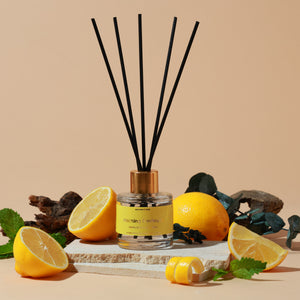

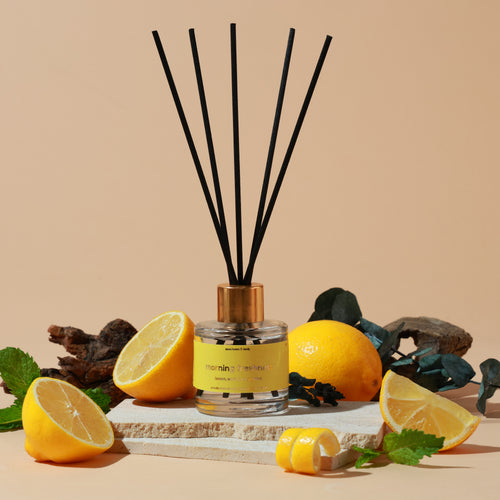
1 · Citrus — Morning Freshness ₹749. Sharp, dry, structurally unlike food. Contrast rather than competition.
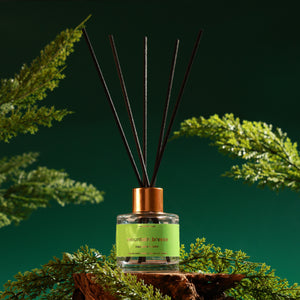
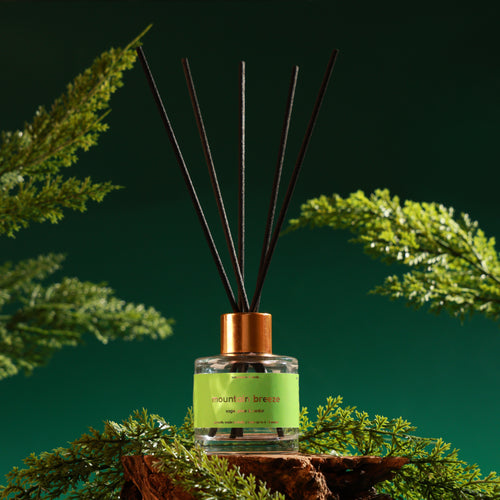
2 · Woody — Mountain Breeze ₹849. Resinous and unsweet, so it has nothing to stack with. Deeper at 9.4, which cuts both ways.
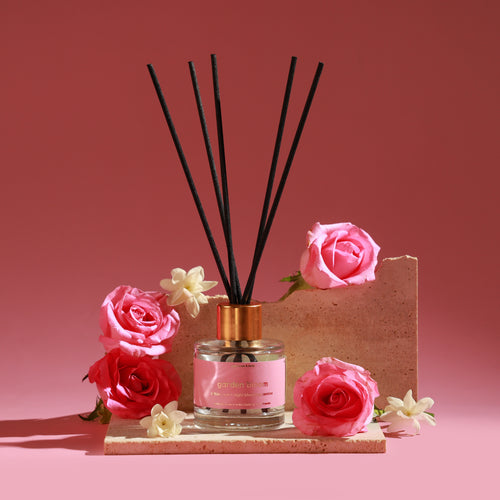
3 · Floral — Garden Bloom ₹799. Beautiful, but sweet and warm in structure, which is also how fried food reads.
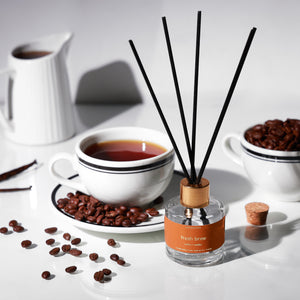
4 · Gourmand — Fresh Brew ₹849. Our own coffee-and-vanilla reed, and the one I would not put in this room. It reads as food, and food plus food is a blur.
The honest gap: if what you actually want is for the smell to go, nothing on our shelf does that. That job belongs to the chimney, the exhaust fan and ten minutes of open windows, and we do not sell any of them.
2. Citrus first, because it is the furthest thing from food in structure. Morning Freshness at ₹749 is cold-pressed Malabar lemon over peppermint with a eucalyptus globulus base — sharp, dry, cool, with no sweetness and no roundness. Placed next to a warm rounded residue it stays legibly separate, which is the best result available.
3. Woody second, because dry resin is also unsweet. Mountain Breeze at ₹849 is Himalayan pine, sage and Indian cedar. It contrasts well and it is the better choice if citrus reads as too bright for you. At 9.4 on the SOSA strength scale it is the deepest woody we make, which means it holds its own in a large room and can feel like a lot in a small one.
4. Floral third, and this surprises people. Garden Bloom at ₹799 is a genuinely good rose and jasmine, but florals carry a natural sweetness and a warm body, and that is precisely the shape of fried-onion and ghee residue. The two do not fight; they merge, and a merged smell is harder to place than two clear ones.
5. Gourmand last, and it is our own bottle. Fresh Brew at ₹849 is Coorg coffee, Kerala vanilla and soft caramel, and at 9.5 it is the deepest thing we make. It is superb in a study on a cold evening. In a living room an hour after dinner it adds a second food smell to a room that already has one.
Alcohol-free, phthalate-free, paraben-free, IFRA-compliant, 0 ppm formaldehyde, six fibre reeds, refillable glass, composed in Pune. Free shipping above ₹499, and a portion of every order supports girl-child education through Nanhi Kali.
The four registers, scored against a room that has just had a tadka in it
The criterion is not which fragrance is best. It is which fragrance stays separable from the residue of a heavy meal. A room in that state contains something warm, fatty, spice-heavy and slightly sweet, released in slow drifts from soft surfaces as the evening goes on. Your nose is very good at tracking two distinct things and very poor at tracking two similar things — put a scent close in structure to that residue and the brain gives up and files the whole room as one muddled smell. Register distance is therefore the entire scoring system, and everything below is a measure of how far a scent sits from cooked food.
 Morning Freshness₹749Citrus wins because of everything it is not. It carries no sweetness, no fat, no roasted note and no warmth, so there is nothing in it for the residue of a meal to blend with. It is also the register your nose has learned to associate with a room that has just been dealt with — cut fruit, an opened window, a wiped counter — and association is doing real work here even though the odour itself has removed nothing. Morning Freshness is the version I would use, and the eucalyptus base matters more in this room than anywhere else in the house, because a fragrance you have to replace every fortnight is not a fragrance you will keep up with in a household that cooks twice a day.
 Mountain Breeze₹849Woody is second and it is a close second. Mountain Breeze — Himalayan pine, sage, Indian cedar — is dry and resinous with no sugar anywhere in it, so it also has nothing to merge with. What separates it from citrus is weight. At 9.4 it is the deepest woody in the range, and depth is an advantage in a 200 sq ft living room where a bright citrus can get lost, and a disadvantage in a 1BHK where the sitting area and the cooking area are one space. There is a second, quieter argument for it: a woody scent is a very different object from a floor cleaner, so nobody in the house reads it as cleaning. Some households find that more dignified than lemon, and that is a legitimate reason to choose it.
 Garden Bloom₹799This is the placement people argue with, so here is the reasoning. A rose-and-jasmine composition is warm, rounded and naturally sweet, and it has a certain fullness in the air. Warm, rounded and sweet is also a fair description of what a kitchen leaves in a living room. The result is not a clash — it is worse than a clash, it is a merge, and a merged smell is the one people describe as "the room smells of something, I cannot tell what". Garden Bloom is well built for Indian heat — its indole, the material that makes jasmine smell alive and that turns unpleasant above a certain concentration, is held below that threshold so the jasmine stays floral above 30°C — and it is still third here, on register alone. If your house loves florals, buy it and put it in a bedroom rather than in the room the cooking reaches.
Why contrast works, and why "covering it" is the mistake underneath the question
The instinct behind this search is usually a hope that the right fragrance will cancel the cooking. It will not, and it is worth being blunt about why, because the mechanism explains everything else on this page. Adding a pleasant odour to an unpleasant one produces a mixture, not a subtraction. There is no arithmetic in the nose where lemon minus tadka equals nothing. Both signals arrive, both are processed, and the only thing you control is whether they arrive as two clearly different things or as one blurred thing. Two clearly different things is a room that smells of dinner and of lemon, which most people find perfectly pleasant. One blurred thing is the smell people complain about and cannot name.
This is also why the hour after cooking is the hour you should judge nothing. The airborne fraction goes quickly once air is moving; the fraction that condensed onto the cushions and the curtain hem comes back out slowly, over hours, as the room warms and cools. During that release the fragrance is genuinely outnumbered, and no reed diffuser or machine changes that. It is not a fault in the product and it is not a fault in your ventilation. It is what an aerosol does to soft furnishings, and the only real lever on it is textiles: washable cushion covers, curtains that go into the machine occasionally, and a habit of not leaving the kitchen door open through a long fry.
The last piece is dose, and it is the piece that decides whether any of these four reads as expensive or as cheap. Almost any composition, pushed too high in a room, flattens into a single sweet or sharp impression — which is exactly what people mean when they say something smells like an air freshener. The same oil at a lower dose reads as layered, because the nose has room to resolve the separate materials. In a room that already has a competing load, the temptation is to go louder. Resist it. Six fibre reeds is full projection; three is a soft level and roughly doubles the life of the bottle, and in most Indian living rooms three or four is the setting that makes a good oil sound like a good oil.
The four registers, scored
Scored on the only thing that matters here: how far each register sits from the smell of a heavy Indian meal, and therefore how cleanly the two stay separable in the same room. Strength figures are the published SOSA scale, which measures perceived intensity in a room and not quality.
| Rank | Register & scent | Strength | Distance from cooking residue | Why it lands there | 50ml |
|---|---|---|---|---|---|
| 1st | Citrus · Morning Freshness ★ | 9.0 · bright | Furthest | No sweetness, no warmth, no fat. Nothing for the residue to merge with, and the eucalyptus base keeps it alive for 6–8 weeks instead of a fortnight | ₹749 |
| 2nd | Woody · Mountain Breeze | 9.4 · deep woody | Far | Dry and resinous, also unsweet. Loses to citrus only on weight — 9.4 is a lot of presence for a small flat, and an asset in a large one | ₹849 |
| 3rd | Floral · Garden Bloom | 8.9 · medium floral | Close | Rose and jasmine are warm, round and naturally sweet — the same shape as the residue. They merge rather than contrast. Better in a bedroom than in the cooking room | ₹799 |
| 4th | Gourmand · Fresh Brew | 9.5 · deepest in range | Closest — avoid here | Coffee, vanilla and caramel are food. Adding food to food gives you a second dinner rather than a contrast. Our own bottle, and the wrong room for it | ₹849 |
| — | The alternative that costs nothing | — | Furthest of all | Ten minutes of cross-ventilation and a chimney run on for ten minutes after the last tadka. It does more than any bottle on this table, and we do not sell it | ₹0 |
Dose, placement and the hour you should not judge
Two households can buy the same bottle and have completely different opinions of it, and the difference is almost never the oil. Put the diffuser at the far end of the living room from the kitchen, out of the direct path between the cooking area and the rest of the flat, at or slightly below nose height, off the windowsill and out of direct sun. That path — usually a doorway or an archway — is where the aerosol travels, and a bottle sitting in it is being run through the very thing you are trying to keep separate. Slightly out of the traffic, in the room's ordinary airflow rather than in its main current, is the placement that performs.
Then set the dial rather than the scent. Six reeds for a living room above 150 sq ft, three or four for a compact 1BHK sitting area, and flip them every three to five days for Morning Freshness or every five to seven for Garden Bloom. Flipping gives a burst; the useful time to do it is after the room has been cleaned and aired rather than before dinner, so the lift lands in a room that can hold it. And if you cannot smell your own diffuser, do not assume it has stopped. You adapt to a constant unchanging smell within minutes, which is exactly why you notice other people's homes and not your own. Leave the flat for a quarter of an hour and walk back in; that is the only reliable test, and a visitor is a better instrument than you are.
What to buy, in order — and the one we would steer you away from
The buying order for a household that cooks heavy Indian food regularly, with prices, sizes and the honest note at the end. The last row is our own product, named as the one to avoid in this particular room, because a comparison that only ranks the things we would like you to buy is not a comparison.
| Buy | What it is | When it is the right answer | Price |
|---|---|---|---|
| 1. Morning Freshness 50ml ★ | Malabar lemon, peppermint, eucalyptus — the furthest register from food | First, for almost every Indian kitchen-adjacent living room. Up to ~150 sq ft, 6–8 weeks | ₹749 |
| 2. Morning Freshness 130ml | The same composition, sized for a room above 150 sq ft | Open-plan living rooms and larger sitting areas. 14–18 weeks | ₹1,249 |
| 3. Mountain Breeze 50ml | Himalayan pine, sage, cedar — dry, resinous, unsweet at 9.4 | If citrus reads as a cleaning product to anyone in the house, or the room is large | ₹849 |
| 4. Fresh & Grounded duo | The first and second placed scents together, two 50ml bottles | If you want the citrus in the room the cooking reaches and the woody elsewhere | ₹1,548 |
| 5. Garden Bloom 50ml | British rose and night-blooming jasmine, indole held below the threshold that turns it animalic in heat | A bedroom rather than the cooking room — a genuinely good floral in the wrong seat here | ₹799 |
| Not this room: Fresh Brew — the honest gap | Coorg coffee, Kerala vanilla, soft caramel. 9.5, the deepest thing we make and the most food-like | A study, a reading corner, a quiet evening. Not a living room an hour after dinner, and we would rather say so than take the order | ₹849 |
Versailles
I grew up in a house where the pressure cooker went twice a day, and I have never once believed the claim that a fragrance can take a cooking smell away. What it can do is give the room a second, clearer thing to be — and whether that works is decided almost entirely by how far apart the two smells sit. That is why this ranking exists and why it is not a matter of taste.
The part I want to be honest about is Fresh Brew. It is one of the compositions I am proudest of, the coffee in it is real Coorg and the vanilla is real, and it is the wrong bottle for a living room that gets the kitchen. There is nothing subtle about the reason: it smells of food, the room already smells of food, and the two do not stay separate. I would rather write that down than sell somebody a ₹849 bottle they quietly dislike and never place.
And the thing I would most like a reader to take away costs nothing. Run the extraction on for ten minutes after you have finished. Open two openings on different walls, not one. Then close the room, and only then think about the bottle. Fragrance is the last twenty per cent of this problem and it is genuinely good at that twenty per cent. Everything is composed in Pune, and a part of every order funds a girl's classroom through Nanhi Kali.
Frequently asked questions
- Tadka twice a day — what there is to do once the ventilating is done.
- A 1BHK that smells of breakfast until lunch — small volumes have nowhere for the aerosol to go.
- Fried fish through a whole 2BHK — a high-deposition case, handled honestly.
- The chimney works and the sofa still smells — fabric is the reservoir.
- Should you avoid sweet fragrances — largely yes, and the reason is register.
- One AC across kitchen and living room — one air volume, one decision.
- A reed a few feet from the kitchen — yes, with one honest caveat.
- Cook at 7, guests at 8 — the hour, minute by minute.
- Sukoon or a reed for speed — the whole family's answer in one place.
- Brand: the SOSA founder story.
SOSA reed diffusers — facts verified August 2026: Five scents, all alcohol-free, on a heat-stable CCT (caprylic/capric triglyceride) carrier rather than DPG, phthalate-free, paraben-free, IFRA-compliant, 0 ppm formaldehyde, six fibre reeds in a refillable glass bottle, composed and made in Pune, India. Morning Freshness (Malabar lemon · peppermint · eucalyptus globulus) 50ml ₹749 · 130ml ₹1,249 · 9.0 on the SOSA strength scale. Evening Calm (Kashmir lavender · chamomile · soft musk) 50ml ₹799 · 130ml ₹1,299 · 8.9, the softest in the range. Garden Bloom (British rose · night-blooming jasmine) 50ml ₹799 · 130ml ₹1,299 · 8.9. Mountain Breeze (Himalayan pine · sage · Indian cedar) 50ml ₹849 · 130ml ₹1,349 · 9.4. Fresh Brew (Coorg coffee · Kerala vanilla · caramel) 50ml ₹849 · 130ml ₹1,349 · 9.5, the deepest in the range. Longevity 6–8 weeks on 50ml and 14–18 weeks on 130ml; 50ml suits rooms up to about 150 sq ft and 130ml above that. Six reeds is full projection, three is a soft level lasting roughly twice as long. Duos: Day & Night ₹1,498, Fresh & Grounded ₹1,548, Warmth & Bloom ₹1,598. Refills 300ml ₹2,399 · 500ml ₹3,499, oil only and not a first purchase. Climate-tested through 45°C heat and 85% RH. The reed line contains no oud, sandalwood, vetiver or amber. Reed oil and the water-based Hotel Collection are separate systems and are not interchangeable in either direction; there is no hotel-inspired reed diffuser. Free shipping above ₹499. A portion of every order supports girl-child education through Nanhi Kali. SOSA is an independent Indian fragrance house and is not affiliated with or endorsed by any hotel brand. Prices subject to change — see the live product pages.