



What you want instead: the entrance at the property's level, and that level held everywhere the buyer walks.
Why consistency beats a gradient: a buyer moving from a strongly scented hall into a neutral bedroom experiences the drop, and reads it as the hall having been prepared. A single level reads as a building.
Placement: waist height or above, a metre or more back from the door, out of the draught the door makes, never in the doorway itself, and out of the sightline in an empty flat where the room is the product.
2. The threshold is the worst place to be strong. It is the one moment in the viewing when the buyer's nose is un-adapted, attentive and comparing against the corridor. Anything emphatic there gets identified, and an identified fragrance moves the property from maintained to prepared.
3. What you want is one level everywhere they walk. Hall, living room, passage, bedrooms — the same quiet character throughout, so there is nothing for the buyer to notice as they move.
4. Because a drop is more legible than a level. A buyer who walks from a strongly scented hall into a neutral bedroom experiences the fall, and the conclusion they draw is that the hall was done rather than that the bedroom was missed.
5. The honest exception: in a large property the far rooms will be lighter whatever you do. Accept that. Do not compensate by overdosing the hall, which fixes nothing and creates the gradient you were trying to avoid. If it matters, a second Vaayu at ₹11,999 in the far zone is the answer.
6. Placement, precisely. Waist height or above, a metre and a half back from the door, out of the draught the door creates, never in the doorway itself, off the floor, away from an air-conditioning vent, and out of the sightline in an empty flat where the room is the product.
A portion of every order supports girl-child education through Nanhi Kali.
Why the instinct is wrong in an interesting way
The instinct is not silly and it is worth taking seriously before disagreeing with it. It goes: the entrance is where the first impression is made, first impressions are disproportionately important, therefore the entrance should carry the strongest version of whatever you are doing. Every part of that is true except the last step. The reason it fails is that the entrance is not only where the property is first read — it is also where the buyer is most alert, least adapted and actively comparing against the corridor they have just walked. Strength in the one place somebody is paying attention is not emphasis. It is exposure.
Level by zone, in a 2,400 sq ft flat
A worked example: a 2,400 sq ft three-bedroom apartment with a hall opening onto a connected living and dining space, a passage and three bedrooms behind doors. What level each zone should carry, what actually happens there with one machine at the entrance, and what to do about the gap. Note that the target column says the same thing five times, which is the point of the page.
| Zone | Target level | What one entrance machine delivers | What to do |
|---|---|---|---|
| Entrance and hall ★ | The property's level. Low | The highest concentration in the flat, by definition — the source is here | Machine at waist height, a metre and a half back, out of the door draught, on the lowest usable setting |
| Living and dining | The same level | Close to it, if the space is connected to the hall rather than behind a door | Nothing. This is the volume the entrance position is chosen to serve |
| Passage | The same level | Lighter, and falling with distance from the source | Leave it. A passage is walked through in four seconds and nobody assesses it |
| Bedrooms behind doors | The same level, and lighter in practice | Very little, because a closed door is a far bigger constraint than machine output | Open the doors for the two hours before the viewing. Air them properly the day before. Add nothing |
| Master bedroom | Clean rather than scented | Whatever reaches it, which is not much | Leave it alone deliberately. A stranger's fragrance feels most like an intrusion in the room somebody sleeps in |
| Kitchen and utility | Clean, and nothing else | Almost nothing, and it should stay that way | Subtraction only: extraction run, bins gone, traps filled, door shut for the last two hours |
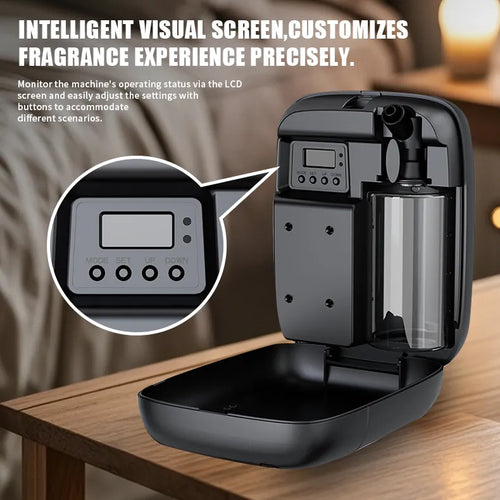
| A separate wing or floor | The same level, and unreachable | Nothing at all. Air does not travel there | The only case for a second Vaayu at ₹11,999. Not a bigger machine in the same hall |
Entrance zone · low₹11,999Shop →  One scent, whole flatfrom ₹299Shop →
  Second wing · second machine₹11,999Shop →
Placement, the large-property exception, and what to do about it
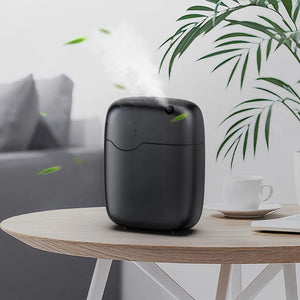
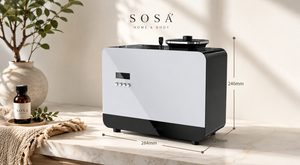
Start with the physical placement, because it is more specific than most advice on the subject and it changes the result more than the setting does. Waist height or above — roughly a metre and up — because a nebulised nano-mist disperses into a room rather than sinking the way a cool ultrasonic mist does, and a machine on the floor is both badly placed and visible. A metre and a half or more back from the front door, so the machine is outside the pulse of air that the door pushes into the flat every time it opens; a diffuser sitting in that draught delivers an uneven, gusting level that a buyer reads as movement rather than as a condition. Never in the doorway itself, and never within a metre of where somebody will stand taking their shoes off, because proximity to the source is the fastest way to make a low level read as a strong one. Out of the direct path of an air-conditioning vent, which strips the light top off a composition and pushes the rest of it somewhere you did not choose. Off the main sightline in an empty flat, which matters more than people expect: in a vacant property there is nothing else to look at, so a small black box on an otherwise bare console is the first object the buyer's eye lands on, and it announces the arrangement more effectively than the fragrance ever could. Behind a plant, on a shelf, in a niche, wall-mounted at head height, or in a utility cupboard with the door ajar. At 165 × 80.5 × 215 mm and 0.9 kg the Vaayu has more places it can go than most machines, and the wall and HVAC mounting options exist precisely for the flat where a surface would be conspicuous.
Then the setting and the check, which follow from everything above. Lowest usable intensity, started two hours out on the 4h timer, and then judged from the lift rather than from inside. The walk-in at thirty minutes is where the entrance question is actually settled: come up as the buyer will, open the door, and pay attention to the first three seconds. If you can name the scent, turn it down. Then walk the property the way a buyer walks it — hall, living room, passage, the furthest bedroom, back — and pay attention not to each room but to the transitions between them. Any point where you notice the air changing is a point where the buyer will notice it too, and the fix is almost always to reduce the source rather than to add anything at the far end. Open the internal doors two hours before so the flat behaves as much like one volume as it can; that single free action does more for evenness than any adjustment to the machine. Use one scent throughout: Quiet Luxury by default, White Tea Serenity for a small flat where even a low level of the default is too present, and Forest Suite where the property runs warm or the kitchen has no door. Four hotel-inspired scents ship with the machine, which is enough to find out which of them your buildings suit without another invoice.
Then the limits and the machines that do not belong here. The large-property exception is real and it should be met with a second machine or with acceptance, never with intensity. Above roughly 3,000 sq ft of connected volume, or wherever a staircase, a wing or a closed floor divides the property, a second Vaayu at ₹11,999 in the second zone is the correct answer — two machines at ₹23,998 cover two volumes properly, where one machine turned up covers one volume badly and the other not at all. The Aangan at ₹25,999 covers up to 3,000 m³ and belongs in a sales gallery, a clubhouse or an 8,000 to 10,000 sq ft villa with ducted HVAC, and putting it into a 2,400 sq ft apartment is overselling. On the smaller machines: the Sukoon at ₹1,899 covers 270 to 320 sq ft and is a genuinely good answer for one occupied room, but it is ultrasonic and puts 30 to 50 millilitres of water an hour into the air, which is the wrong thing in a sealed stone-floored listing. The Boond at ₹899 and Megh at ₹3,499 are the same technology at other sizes. A reed diffuser from ₹749 takes 24 to 72 hours to establish and suits a listing shown over months; reeds in a hall are also the one arrangement that produces a genuine gradient by design, since a passive diffuser scents a radius rather than a property. A candle from ₹379 must be attended, which rules it out of a vacant flat entirely. And the rule that stands above all of the placement advice: if the entrance smells of something with a cause, the answer is not a machine at the entrance. Damp, a leak, a drain or smoke damage is a material fact about the building — find it, fix it or disclose it, and scent a property that is genuinely sound.
The SOSA edit
For a realtor deciding where the machine goes and how hard to run it, in buying order. The first row costs nothing and does more for evenness than any purchase below it. The last row is the arrangement that guarantees the gradient this page argues against.
| Buy | What it is | Why it belongs here | Cost |
|---|---|---|---|
| 1. Open the internal doors ★ | Every internal door in the flat, wedged open, from two hours before the viewing | Free, and it does more for an even level than any adjustment to a machine. A closed door is a bigger constraint than output | ₹0 |
| 2. SOSA Vaayu | Waterless, 1000 m³, 400ml for about 75 days, adjustable intensity, timers, key-lock, 0.9 kg, under 38 dB | One machine in the entrance zone, waist height, a metre and a half back, out of the door draught, lowest usable setting | ₹11,999 |
| 3. Quiet Luxury | White tea, bergamot and cedar, in every room rather than one scent for the hall and another for the bedrooms | Two characters in one property is two pieces of evidence that somebody arranged it. One bottle, everywhere | from ₹299 |
| 4. A second Vaayu | An identical second machine for a separate wing, a second floor or a guest annexe | The honest answer to a divided property. Two at ₹23,998 beat one Aangan at ₹25,999 for an apartment | ₹11,999 |
| 5. Aangan | Up to 3,000 m³ or 8,000–10,000 sq ft, HVAC-connected or standalone, under 42 dB | A sales gallery, a clubhouse or a very large villa with ducted HVAC. Not a 2,400 sq ft flat | ₹25,999 |
| Guarantees a gradient: reeds in the hall alone | A passive diffuser scents a radius around itself and takes 24–72 hours to do it | Right for a listing shown over months as a whole-property arrangement; wrong as a strong entrance | from ₹749 |
Versailles
This is the correction I make most often, and it is always made in good faith by somebody doing their job properly. The entrance matters, therefore make the entrance strong — it is a reasonable-sounding step and it is the one place in the property where being strong can only work against you. The buyer is standing still, paying attention, carrying the corridor in their nose and comparing. It is the most sensitive measuring position in the flat, and putting your loudest signal into it is like turning up the volume on the one microphone in the room.
What I would ask instead is a harder brief and a cheaper one. Make it so there is no moment anywhere in the property where the buyer notices the air changing. That means one scent, one low level, internal doors open, the machine set back from the front door and out of the sightline, and the far bedrooms simply aired rather than compensated for. The result is a flat nobody comments on, which sounds like a failure and is exactly the objective: a buyer who walks out having thought about the light, the ceiling height and the view, and not once about what the place smelled of. That is what the machine is for, and it is why I keep telling people to run it lower than they want to.
Everything is made and supported from Pune, and a part of every order funds girl-child education through Nanhi Kali. You get a space that smells like somewhere considered; a girl gets a classroom. That equation has always felt right to me.
Frequently asked questions
- How long before a viewing should I turn on the scenting system? — the schedule this placement runs on.
- Fragrance in the entrance, living room and master bedroom of a listing — room by room.
- Should bedrooms smell different from the living areas during a viewing? — the same argument, from the other end.
- Can one machine handle a large property, or should I think in zones? — where the exception applies.
- Brand: the SOSA founder story.
Facts verified August 2026: Product facts used in this guide. SOSA Vaayu ₹11,999: waterless cold-air nebulising diffuser, atomises undiluted fragrance oil to a dry residue-free nano-mist, coverage up to 1000m³ (approximately 2,000–3,000 sq ft), 400ml refillable tank lasting up to about 75 days per fill, Bluetooth app plus onboard control, 1h/4h/8h/24h timer scheduling, adjustable intensity, under 38 dB, DC 12V/1A at 5W, 165 × 80.5 × 215 mm and 0.9 kg, freestanding or wall/HVAC mounted, auto-stop and key-lock, CE, RoHS and SGS certified, supplied with four hotel-inspired fragrances. SOSA Aangan ₹25,999: HVAC-connected or standalone commercial nebulising diffuser, coverage up to 3,000m³ (roughly 8,000–10,000 sq ft), 800ml reservoir, metal body, programmable schedules, under 42 dB. Ultrasonic machines are water-based and consume 30–50 ml of water an hour: Sukoon ₹1,899 (500ml, 270–320 sq ft, 16–18 hours on low, 3–6 drops per tank, steady/2H/4H timers, three 15ml Hotel Collection scents included), Boond ₹899 (300ml), Megh ₹3,499 (6 litres). Hotel Collection water-based fragrance 15ml ₹299, 100ml ₹999, 300ml ₹1,799, Pack of 7 at 15ml ₹1,799 against ₹2,093 bought singly; the Vaayu and Aangan take their own undiluted oil rather than these water-based bottles. Reed diffusers (separate alcohol-free line) from ₹749, requiring 24–72 hours to reach their working level. Scented candles from ₹379, scenting a room in roughly 15–20 minutes but requiring attendance. Free shipping above ₹499. Timings: a nebulising diffuser reaches a working level within minutes and a stated viewing level well inside two hours. This guide makes no claim that fragrance affects a property's price, offer level or time on market; it is presentation, in the same category as photography, styling and lighting. Fragrance must never be used to conceal a material defect. SOSA is not affiliated with or endorsed by any hotel brand. Prices subject to change — see the live product pages.