Founder Diaries · Property Viewings · The First Sixty Seconds
By Sonal Sahani · ISIPCA Versailles 11 min read Updated September 2026
Yes, and the interesting question is not whether but why, because the answer explains something a lot of realtors get backwards.
Starting early is not about giving a slow machine time. A nebulising diffuser reaches its working output within minutes. Starting early is about letting the property reach an equilibrium and then sit at it, so that what the buyer walks into is a level rather than a climb. A rising concentration is the single clearest signal a nose has that something has just been done to a room, and it is produced almost every time somebody starts late and compensates by turning the machine up. Two hours before, on low, with the
Vaayu at ₹11,999 on its 4h timer.
Quick answers — read this first
Yes — and early beats strong. A room settles at an equilibrium between what the diffuser puts in and what leaves through doors, windows, gaps and air conditioning. Start early and the property holds that level.
What goes wrong when you start late: turning the output up to catch up means the buyer arrives during the climb. A nose detects change far better than it detects a steady state, so a rising level reads as an event happening now rather than as a property of the building.
Timings: the machine reaches working output within minutes and a stated viewing level well inside two hours. Two hours before is the working default; the 4h timer covers the run-up plus the viewing plus a buffer.
Ventilation is the opposite case: air exchange is a much slower job than scenting, so the airing happens the day before, not two hours before.
The short answer
Short answer: yes, start before the buyer arrives, and start early rather than strong. Two hours ahead on the lowest usable setting is the working default, because a room needs time to reach a steady state between what is going in and what is leaving. A property sitting at its level reads as a building. A property still climbing reads as something being done to the buyer.
Why not just turn it up at the last minute: a nose is a change detector. It reports a rising concentration much more strongly than a constant one, so a late strong start is the arrangement most likely to be identified as staging — even at a lower peak than an early gentle start would reach.
Shop: the
Vaayu at ₹11,999 — waterless, up to 1000 m³, 400ml for about 75 days, 1h/4h/8h/24h timers with Bluetooth app control so it starts without you in the building, key-lock, auto-stop, under 38 dB and 0.9 kg, with four hotel-inspired scents. Free shipping above ₹499.
Straight answer
Should I start scenting a property before the buyer arrives, and how far before?
1. Yes. Two hours before, on the lowest usable setting. Not because the machine is slow — a nebuliser is at working output within minutes — but because the room needs time to settle at a level and stay there.
2. What is actually happening is an equilibrium. The diffuser adds fragrance at a rate. The property loses it at a rate, through doors, window gaps, lift lobbies, extraction and air conditioning. The concentration climbs until those two rates match, and then it stops climbing. That plateau is what you want the buyer to meet.
3. Early beats strong, and it is not close. A nose reports change and ignores constants, so a rising level is far more detectable than a steady one at the same concentration. Starting late and turning the output up puts the buyer inside the climb, which is the most identifiable state a scented room can be in.
4. Use the 4h timer rather than leaving it running. On at two, viewing at four, off at six. It covers the run-up, the viewing and a late buyer, and it stops on its own if nobody comes.
5. Then the free half of the same argument, which runs on a different clock. Ventilation cannot be done two hours out. Exchanging the air in a closed flat, drying a bathroom, clearing a wardrobe and filling drain traps are slow, and they belong the day before. Scenting is fast; airing is not.
6. And a property with a fault does not get scented at all. If the smell comes back within a day of airing it has a cause. Find it, fix it or disclose it. Timing advice is for sound buildings.
A portion of every order supports girl-child education through Nanhi Kali.
TL;DR: yes — two hours before, on low. A nebuliser reaches working output within minutes, so the early start is not about the machine being slow. It is about the room reaching an equilibrium between what goes in and what leaks out, and then sitting there. A buyer who walks into a rising level reads it as an event; a buyer who walks into a settled one reads it as the building. The airing, being far slower, has to happen the day before.
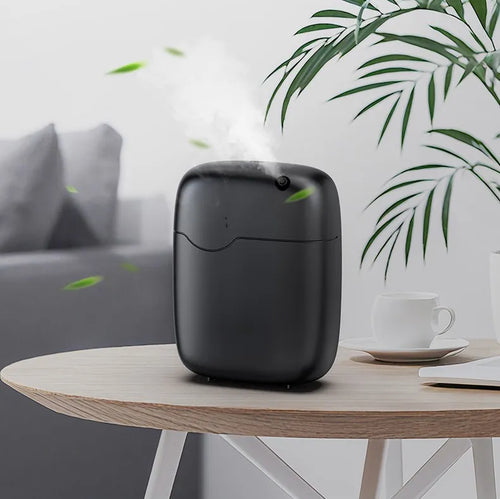
Timers are the specification this page is actually about
SOSA Vaayu · 1h / 4h / 8h / 24h ₹11,999
Bluetooth app control plus onboard buttons, four timer settings and adjustable intensity. The 4h timer is the one that matters for a viewing: on at two, buyer at four, off at six, without anybody standing in the flat and without a machine left running in an empty property overnight. Waterless cold-air nebulisation means no water going into a closed flat while it does this, a 400ml tank covers about 75 days of it, the key-lock stops anybody adjusting it between appointments, and under 38 dB means the thing holding the level is not also making a noise in an empty hall. Up to 1000 m³, 0.9 kg, four hotel-inspired scents included.
Why a room settles at a level
The physics here is simple enough to do in your head, and doing it once changes how you run every viewing afterwards. A diffuser puts fragrance into a room at some rate. The room loses it at some rate — under doors, through window gaps, out of the lift lobby every time the front door opens, into an extraction fan, through an air conditioner exchanging with outside. The concentration in the room rises until those two rates are equal, and then it stops rising. That plateau is not a theory. It is what every scented room in the world is doing, and the only question a realtor has to answer is whether the buyer arrives before it or after it.
1
THE EQUILIBRIUM
Input against leakage, and the plateau where they meet
So take a real case. A 2,000 sq ft flat with 3 metre ceilings holds roughly 170 cubic metres of air, and a closed apartment in a modern tower typically exchanges a meaningful fraction of that with outside every hour through gaps, doors and its air conditioning — more if a window is cracked, much more every time the front door opens onto a lift lobby. Against that, the machine is adding a very small mass of fragrance per hour. Run those two against each other and what you get is not a straight line but a curve that rises quickly at first, then flattens: fast while the room is far from its equilibrium, slower as it approaches, and effectively flat once it is there. The practical consequence is the one worth memorising. Most of the climb happens early and the last part of it happens slowly, so the difference between forty minutes and two hours is not that the room is twice as scented. It is that at forty minutes the level is still visibly moving and at two hours it is not. This also explains something that confuses people: turning the machine up does not make the room reach its level faster in any useful sense. It raises the level the room is heading towards. You still spend the same period climbing, you simply climb towards a higher number, which is the worst of both arrangements — a buyer who arrives mid-climb at a higher target has the most detectable possible experience. The lever that controls when the room is settled is the start time. The lever that controls how much is there when it settles is the intensity. They are different controls and they are constantly confused with each other.
2
WHY A CLIMB IS DETECTABLE
A nose reports change, and a rising level is change
Then the perceptual half, which is where the commercial argument actually lives. A nose is not a meter. It does not report absolute concentration; it reports change, and it adapts to anything that stays the same. That is why you cannot smell your own hall after five minutes in it and why a buyer will stop registering a steady low fragrance within a few minutes of walking in — which is exactly what you want, because at that point the scent has stopped being a thing and become a condition of the building. A rising concentration does the opposite. It presents the nose with continuous change, which is precisely the input it is built to notice, and it goes on presenting it for as long as the climb continues. So the buyer standing in a room that is still filling gets a second reading, and a third, each slightly stronger than the last, and the conclusion the brain draws from a scent that is getting stronger while you stand still is not a flattering one. It is that something is happening now. It is the same reason a room that has just been sprayed reads as sprayed even when the concentration is low: what gives it away is not the amount, it is the gradient in time. This is the single clearest tell that a property has just been worked on, it is entirely avoidable, and avoiding it costs nothing except starting the machine at two o'clock instead of at ten to four. It is also why I would rather a realtor ran a low level from early than a moderate level from late, even though the second one peaks lower. The peak is not what is being detected.
3
THE FREE HALF, ON A SLOWER CLOCK
Airing is a day-before job, because air exchange is slow
And then the part of the same physics that runs in the other direction, which is the free half of this page and the more important one. Scenting a property is fast because you are adding a tiny quantity of a highly perceptible material to a large volume. Un-scenting one is slow, because you are trying to replace the entire volume of air in the building and everything the soft surfaces in it have absorbed. Those are not symmetrical jobs and they do not run on the same clock. A closed flat that has been shut for three weeks does not clear in the two hours before a viewing. Curtains, a mattress, a rug, a wardrobe full of somebody's clothes and the cushions on a sofa are all reservoirs that release slowly into the air, and a dry drain trap will keep contributing indefinitely until somebody pours water into it. So the airing goes the day before: windows on opposite walls so the air actually crosses the property rather than sitting, internal doors wedged open, wardrobes and cupboards opened, bathrooms dried, bins removed and washed, and a mug of water down every floor trap, basin, sink and utility drain in the flat. Then close the property, let it come to temperature, and only then think about fragrance. Doing it in the other order is the commonest mistake in this whole subject: a machine started at two into air that has not been changed since March produces a flat that smells of both things, and a buyer reads a mixture far more suspiciously than they read either component. And if the smell returns within a day of a proper airing, it has a physical cause. That is a material fact about the property. Find it, fix it or disclose it, and scent a building that is genuinely sound.
The asymmetry in one line: you can scent a property in two hours and you cannot air one in two hours. Plan the two jobs on the clocks they actually run on rather than on the one that suits your afternoon.
Early against strong, compared honestly
The same flat and the same machine, run five different ways, with what the buyer actually experiences in each. The third column is where the argument is settled: two of these arrangements put the buyer inside a rising level and one of them puts the buyer inside a settled one. The peak concentration is not what separates them.
Early against strong
Five ways to run the same machine before a 4pm viewing
| Arrangement |
State of the room at 4pm |
What the buyer's nose reports |
Verdict |
| On at 2pm, low, 4h timer ★ |
Settled. At its plateau for the last hour and holding |
A constant, which it adapts to within minutes — so the scent becomes a condition of the building rather than an event |
The working default |
| On at 3.40pm, high, to catch up |
Climbing steeply and still rising when the door opens |
Continuous change, read three times over as increasing. The most identifiable state a room can be in |
The commonest mistake in the cluster |
| On at 11am, low, left running |
Settled, but the property has been at level for five hours |
The same constant. No harm done, only fragrance spent — sensible if you have back-to-back viewings |
Fine, and wasteful for one viewing |
| On at 3.55pm as the lift comes up |
Barely started. Working output reached, room nowhere near its level |
Almost nothing at the door, then a slow rise through the viewing that reads as something switching on |
Worse than not scenting at all |
| Not scented, but properly aired the day before |
Clean, neutral, at temperature |
Nothing to report, which is never a failure. A well-aired property with no fragrance is always a defensible answer |
Always acceptable |
Shop this guide
Starting early, in three products
The SOSA principle
Turning the machine up does not get the room to its level sooner. It raises the level the room is climbing towards, and leaves the buyer arriving in the middle of the climb.
Start time controls when the property is settled. Intensity controls how much is there when it settles. They are two different controls and confusing them is how a good machine produces a bad viewing.
Two hours, the 4h timer, and the airing that has to happen a day earlier
Start with the numbers, because they are specific and they save you guessing. A nebulising machine reaches its working output within minutes of switching on — there is no warm-up in the sense that a heated or passive product has one — and a normally sealed apartment reaches a stated viewing level well inside two hours on a low setting. Which makes two hours the working default rather than a ritual: it is comfortably past the point at which the curve has flattened, it leaves room for a viewing that starts late, and it is short enough that you are not running the machine all day for one appointment. The 4h timer is built for exactly this shape of afternoon — on at two, buyer at four, off at six — and it means the property is never left with a machine running unattended after everyone has gone. Use the app rather than the drive: at 0.9 kg the Vaayu lives in the listing between appointments behind its key-lock, and starting it from your car on the way to the previous viewing is the difference between this being a system and this being an errand. Adjust the two hours in only two directions, both of them intuitive: longer for a large or leaky property, and never shorter to compensate for a late start with more intensity.
Then the sequence around it, which is where most of the result is decided. The order is fixed and it runs backwards from the viewing: air the day before, close and bring to temperature about three hours out, scent from two hours out, walk it as a buyer at thirty minutes, and change nothing after that except downwards. The walk-in at T-30 is the only quality check that works, because you are the person least able to judge the flat from inside it — come up in the lift, along the corridor, through the door, and take the reading the buyer will take. If you can name the fragrance, turn it down. If you notice that the flat smells clean without being able to say of what, leave it exactly where it is. Where the machine stands matters as much as when it starts: waist height or above, a metre or more back from the door so it is out of the draught the door creates, off the floor, and away from the direct path of an air-conditioning vent, which will otherwise strip the top off the composition and move the whole level around in a way the plateau argument assumes is not happening. Choose Quiet Luxury unless you have a reason not to; White Tea Serenity is the lightest of the seven for a small flat, and Forest Suite is the dry one for a warm property or a kitchen with no door. Four hotel-inspired scents come with the machine, so this is a decision rather than an extra invoice.
Then the constraints, and the things that do not run on this clock at all. An ultrasonic diffuser cannot be scheduled into a closed flat the way a nebuliser can, for a reason that has nothing to do with timers: it is water-based, and two hours of it puts 60 to 100 millilitres of water into the air of a property you may be trying to keep dry. In monsoon, in a stone-floored empty flat, or anywhere with the air conditioning off, that is the wrong direction. The Sukoon at ₹1,899 is a good machine for a single occupied room of 270 to 320 sq ft with somebody living in it, and the Boond at ₹899 and Megh at ₹3,499 have their own places, but they are not the machine for a sealed listing on a wet August afternoon. A reed diffuser from ₹749 runs on a 24 to 72 hour clock and cannot be aimed at Saturday at four; it is the right answer for a property being shown for months and the wrong one for a property being shown tomorrow. A candle from ₹379 works in fifteen or twenty minutes and must be attended and put out, which rules it out of anywhere unoccupied. And SOSA does not make a room spray for the home — the sprays in the range are car perfumes — which is just as well, because a spray is the purest form of the mistake this page is about: a sharp spike twenty minutes before the door opens, falling away through the viewing, with the gradient pointing the wrong way the entire time. Last, the rule that outranks every timing on this page: none of it applies to a property with a fault. If a smell returns after a proper airing it has a cause, and a cause is a material fact. Find it, fix it or disclose it.
A settled level reads as a property of the building. A rising one reads as an event, and the buyer is standing in the middle of it.
— Sonal Sahani, SOSA
The SOSA edit
Ordered by the clock each item runs on rather than by price, because that is the actual subject of this page. The first row happens a day early and costs nothing. The last row is the product this brand does not make, printed rather than left for you to search for.
The SOSA edit
What to start when, before a viewing
| Job |
What it is |
When it runs |
Cost |
| 1. The airing ★ |
Cross-ventilation, doors wedged, cupboards open, water down every trap |
T-24h. Air exchange is far slower than scenting and cannot be compressed into the last two hours |
₹0 |
| 2. Temperature and light |
Close up, air conditioning to 24–25°C, every fitting on, blinds fully back |
T-3h. Settled rather than starting, because a compressor working hard is a sound and a draught |
₹0 |
| 3. SOSA Vaayu
|
Waterless, 1000 m³, 400ml for about 75 days, 1h/4h/8h/24h timers, app, key-lock, under 38 dB |
T-2h on low with the 4h timer. Working output in minutes, viewing level well inside the window |
₹11,999 |
| 4. The walk-in |
Up in the lift, along the corridor, through the door, exactly as the buyer will |
T-30m, and the only adjustment permitted at this point is downwards |
₹0 |
| 5. Reed diffusers
|
Alcohol-free passive diffusers, 24–72 hours to establish, no timer and no setting |
For a listing shown over months rather than a viewing tomorrow. Right product, different clock |
from ₹749 |
| Not made here: a room spray for the home
|
SOSA's sprays are car perfumes. A spray is a twenty-minute spike that falls away through the viewing |
The gradient points the wrong way the whole time, which is precisely what this page argues against |
— |
Honest notes for buyers: fragrance is the last step in preparing a property, never the first, and it must never be used to cover a defect. Damp, a leak, drains, smoke or anything structural is a material fact about a property: find it, fix it or disclose it. Scent a listing that is genuinely sound. On the machines: the
Vaayu at ₹11,999 is waterless cold-air nebulisation — no water, no heat and no dampness — covering up to 1000m³ or roughly 2,000–3,000 sq ft, with a 400ml tank lasting about 75 days, Bluetooth app control, 1h/4h/8h/24h timers, under-38dB running, auto-stop and a key-lock, at 0.9 kg and smaller than a shoebox, so one machine can serve a whole portfolio. The
Aangan at ₹25,999 covers up to 3,000m³ for sales galleries and clubhouses. The ultrasonic
Sukoon,
Boond and
Megh are water-based and add 30–50 ml of water an hour to the air, which makes them the wrong choice for a closed or humid vacant property. A
reed diffuser needs 24–72 hours to establish, so it suits a listing shown over months rather than a viewing tomorrow. A candle must be attended and put out, which rules it out of an unoccupied property. SOSA does not make a room spray for the home; the sprays in the range are car perfumes. The Hotel Collection scents are SOSA's own interpretations inspired by the world's finest hotels; SOSA is an independent Indian fragrance house, not affiliated with or endorsed by any hotel brand. A portion of every order supports girl-child education through Nanhi Kali.

The same argument, run at a much slower speed
SOSA reed diffusers · alcohol-free from ₹749
A reed diffuser is the passive version of everything on this page and its clock is entirely different.
It takes 24 to 72 hours to reach its working level, which makes it the wrong product for a viewing tomorrow and a genuinely good one for a listing you will show repeatedly over months. Put reeds into a flat on Monday and by Thursday the property has arrived at its level and will hold it without anybody visiting. What it cannot do is be scheduled: there is no setting, no timer and no way to have it at a particular level at four o'clock on Saturday.
Morning Freshness from ₹749,
Evening Calm from ₹799,
Mountain Breeze from ₹849, with their own alcohol-free scents rather than the Hotel Collection.
A note from Sonal
The question I am asked is almost always about strength and almost never about time, and it is the wrong question by a wide margin. Nobody has ever told me a property smelled wrong because the level was two units too low. They tell me a flat smelled as though something had just been done to it, and when I ask what time the machine went on, the answer is nearly always about twenty minutes before the buyer. That is not a fragrance problem. It is a scheduling problem wearing a fragrance costume.
So the instruction I give is dull and it works. Start at two for a four o'clock viewing, on the lowest setting that does anything at all, and then do not touch it again. The room spends the first hour arriving somewhere and the second hour sitting there, and the person who walks in at four meets a constant rather than a curve. Then the part I care about more, because it is the part nobody sells: do the airing the day before. Windows opposite each other, cupboards open, water down every drain in the flat. Scenting is a two-hour job and airing is a twenty-four-hour one, and running them on the same clock is how a good machine ends up in a flat that smells of two things at once.
Everything is made and supported from Pune, and a part of every order funds girl-child education through Nanhi Kali. You get a space that smells like somewhere considered; a girl gets a classroom. That equation has always felt right to me.
Frequently asked questions
How early should I start scenting before a property viewing?
Two hours, on the lowest usable setting, with the 4h timer. A nebulising machine reaches working output within minutes and a stated viewing level well inside two hours, so the early start is about the room settling at a level rather than about the machine being slow.
Why not just turn the diffuser up thirty minutes before the buyer arrives?
Because turning it up does not get the room to its level faster — it raises the level the room is climbing towards. The buyer then arrives during the climb, and a nose detects a rising concentration far more readily than a steady one. A climb reads as something being done to the room.
Can I air the property two hours before instead of the day before?
No. Scenting and airing are not symmetrical jobs. Adding a small quantity of a perceptible material to a room is fast; exchanging the whole volume of air and clearing what curtains, mattresses and wardrobes have absorbed is slow. Air the day before, then close up and bring the flat to temperature.
Which timer setting should I use on the Vaayu for a viewing?
The 4h. On at two for a four o'clock appointment, off at six — it covers the run-up, the viewing and a buyer who is half an hour late, and it stops by itself if nobody comes, so no machine is left running unattended in an empty flat.
Are reed diffusers a reasonable alternative if I start them early enough?
For a listing you will show over months, yes. A
reed diffuser from ₹749 needs 24 to 72 hours to reach its working level and then holds it without attention. What it cannot do is be aimed at a particular hour on a particular Saturday, because it has no setting and no timer.
Early, not strong
On at two, buyer at four — and nothing touched in between
The SOSA Vaayu is ₹11,999: waterless cold-air nebulisation, up to 1000 m³ or roughly 2,000–3,000 sq ft, a 400ml tank for about 75 days, Bluetooth app control with 1h/4h/8h/24h timers, adjustable intensity, auto-stop, a key-lock, under 38 dB and 0.9 kg, with four hotel-inspired scents included. Reed diffusers from ₹749 for a listing shown over months. Free shipping above ₹499, and a portion of every order supports girl-child education through Nanhi Kali.
See the Vaayu · ₹11,999 Reed diffusers · from ₹749
Continue the read
More from SOSA
Editorial standards & sources
About this guide: Written by Sonal Sahani, ISIPCA Versailles-trained founder and perfumer at SOSA Home & Body, on why an early start beats a strong one before a property viewing: how a room settles at an equilibrium between what a diffuser adds and what leaks away, why a rising concentration is the clearest signal a nose has that a room has just been prepared, what the real timings are for a nebulising machine, and why ventilation runs on a twenty-four-hour clock rather than a two-hour one.
Facts verified August 2026: Product facts used in this guide. SOSA Vaayu ₹11,999: waterless cold-air nebulising diffuser, atomises undiluted fragrance oil to a dry residue-free nano-mist, coverage up to 1000m³ (approximately 2,000–3,000 sq ft), 400ml refillable tank lasting up to about 75 days per fill, Bluetooth app plus onboard control, 1h/4h/8h/24h timer scheduling, adjustable intensity, under 38 dB, DC 12V/1A at 5W, 165 × 80.5 × 215 mm and 0.9 kg, freestanding or wall/HVAC mounted, auto-stop and key-lock, CE, RoHS and SGS certified, supplied with four hotel-inspired fragrances. SOSA Aangan ₹25,999: HVAC-connected or standalone commercial nebulising diffuser, coverage up to 3,000m³ (roughly 8,000–10,000 sq ft), 800ml reservoir, metal body, programmable schedules, under 42 dB. Ultrasonic machines are water-based and consume 30–50 ml of water an hour: Sukoon ₹1,899 (500ml, 270–320 sq ft, 16–18 hours on low, 3–6 drops per tank, steady/2H/4H timers, three 15ml Hotel Collection scents included), Boond ₹899 (300ml), Megh ₹3,499 (6 litres). Hotel Collection water-based fragrance 15ml ₹299, 100ml ₹999, 300ml ₹1,799, Pack of 7 at 15ml ₹1,799 against ₹2,093 bought singly; the Vaayu and Aangan take their own undiluted oil rather than these water-based bottles. Reed diffusers (separate alcohol-free line) from ₹749, requiring 24–72 hours to reach their working level. Scented candles from ₹379, scenting a room in roughly 15–20 minutes but requiring attendance. Free shipping above ₹499. Timings: a nebulising diffuser reaches a working level within minutes and a stated viewing level well inside two hours. This guide makes no claim that fragrance affects a property's price, offer level or time on market; it is presentation, in the same category as photography, styling and lighting. Fragrance must never be used to conceal a material defect. SOSA is not affiliated with or endorsed by any hotel brand. Prices subject to change — see the live product pages.


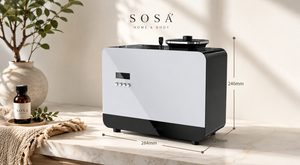


 Low, and heldfrom ₹299Shop →