

Where instead: the far side of the room from the opening, on a stable surface at or slightly below nose height, in the room's gentle circulation and out of direct sun.
Why the sun matters as much as the draught: heat accelerates evaporation, so a sunlit sill costs you weeks of bottle life on top of the projection you were already losing.
The thing not worth doing: adding reeds to compensate. More reeds is stronger and shorter, not better — in a draughty position it mostly buys a faster-emptying bottle.
2. The sun is the second half of the penalty and nobody counts it. A sill is usually the brightest and warmest surface in a room. Heat accelerates evaporation, so a bottle in direct sunlight empties faster than the identical bottle two metres away in the shade — before any air movement is taken into account. That is unavoidable physics rather than a fault, and it is entirely avoidable by choosing a different shelf.
3. What heat must never do is change the smell, and that is a formulation question. Most reed diffusers sit on DPG, which can crack and turn bitter above about 40°C — an ordinary afternoon in much of India. Every SOSA reed uses a heat-stable CCT carrier instead, and the range is tested through a 45°C heat soak and 85% relative humidity. So a warm room will shorten a SOSA bottle; it should not sour it. I would still not put it in direct sun.
4. Do not solve a placement problem by buying. The order is always: move it, then set the reed count, then consider the scent. Moving costs nothing and is right more often than everything else combined.
5. And be realistic about what a good placement can achieve. Off the draught, a bottle in a room whose windows are open all day will still read as quiet, because the room's air is being replaced whatever you do. Good placement makes a ventilated room better; it does not make it a sealed one. The hours that genuinely belong to the product are the hours the windows are shut.
Alcohol-free, phthalate-free, made in Pune. A portion of every order supports girl-child education through Nanhi Kali.
Two penalties, one windowsill
It is worth separating the two, because they behave differently and only one of them disappears when the window shuts. The draught penalty is about where the fragrance goes; the heat penalty is about how quickly the bottle empties. A sill in a shaded north-facing room carries only the first. A sill in full sun with the window closed carries only the second. The ordinary Indian windowsill carries both at once, which is why it is the placement I ask people to change before anything else.
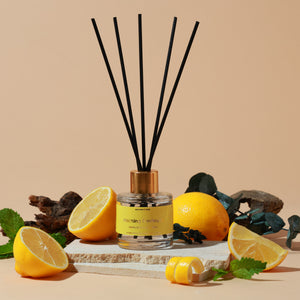
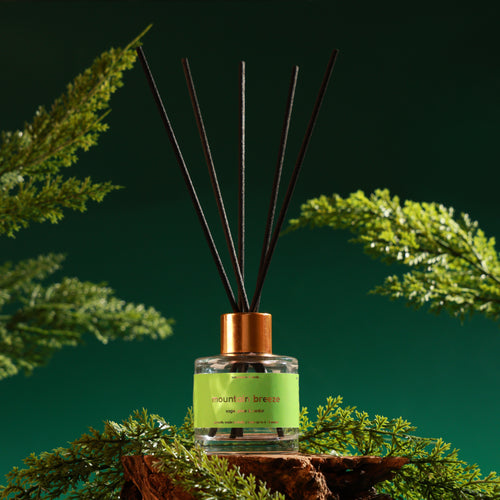
 Mountain Breeze₹849A reed diffuser releases into the air immediately around the bottle and then relies on the room to distribute it. In still or gently circulating air, that works: the fragrance drifts outward and reaches nose height across the space. In directional air, it does not — the release is caught and carried in one direction, and if that direction is out of a window then the room never sees it. This is why a diffuser on a sill smells strong when you lean over it and reads as absent from the sofa. Nothing is wrong with the projection; the projection is happening outdoors.
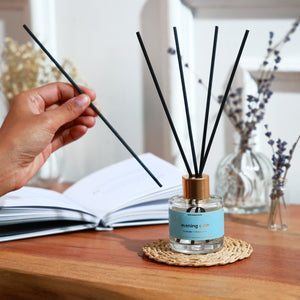
 Evening Calm₹799Evaporation is temperature-dependent, so a bottle standing in direct sunlight will run out sooner than the same bottle in shade — that part is unavoidable and applies to every reed diffuser ever made. What is avoidable is the second effect, which is a smell that changes rather than merely shortens. DPG, the industry-standard carrier, can crack and go bitter above about 40°C, which is why so many people have met a diffuser that turned acrid on a hot afternoon. SOSA reeds use a heat-stable CCT carrier and are tested at a 45°C heat soak and 85% relative humidity, so the composition holds. It still empties faster in the sun, and there is no formulation that changes that.
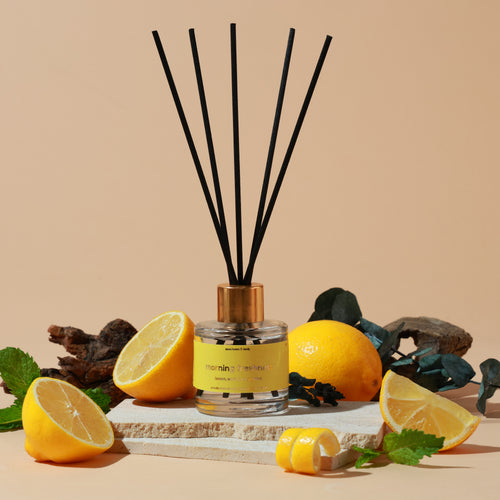
 Morning Freshness₹749Very often the sill placement comes from a reasonable but mistaken expectation: that a home fragrance should be continuously perceptible, and that if it is not, it needs to be closer to the air. In fact a diffuser you can smell all the time in your own room is set too strong for the space. Home fragrance is written for arrival and for transitions — walking in, coming out of the bathroom, sitting down. Your own nose adapts to a constant unchanging smell within minutes regardless of where the bottle stands, so chasing continuous perception by moving the bottle into the airflow achieves nothing except a shorter bottle.
What the right placement actually looks like
Take the wall furthest from the opening and find a stable surface on it — a console, a shelf, a chest of drawers, a bedside table. Height matters more than people expect: at or slightly below nose height for the way the room is used, so a bedside table for a bedroom you are lying down in, and a console or shelf for a room you stand and walk in. A diffuser on the floor is wasted; a diffuser above head height mostly scents the ceiling.
Then check three things. It should be out of direct sun at every hour of the day. It should be on something that will not be damaged, and on a spot nothing has to be cleaned around daily — a diffuser that is moved every morning performs worse than one left alone, and eventually it is knocked over. And it should be well clear of any flame. Fragrance oil is flammable, so a diya, an agarbatti or a lit candle and a reed diffuser do not share a surface and do not sit within reach of the same curtain moving in a breeze.
One more consideration specific to a room with an open window: the diffuser wants to be in the room's circulation and out of its through-draught, and those are not the same thing. A dead corner behind a wardrobe is not the answer either — a reed diffuser needs some air movement or the fragrance simply sits around the bottle. What you are looking for is the part of the room where air is moving gently and continuously rather than quickly and directionally. In most rooms that is the middle of the wall opposite the opening, a little in from the corner.
| Placement | Air movement | Sun exposure | Verdict |
|---|---|---|---|
| Shelf or console on the wall opposite the window | Gentle circulation | Usually none | Best. Start here |
| Bedside table, far side of the bed from the window | Slow | None | Best in a bedroom; three reeds |
| Side table a couple of metres in from the opening | Moderate | Depends on the hour | Acceptable if the sun never lands on it |
| Dead corner behind furniture | Almost none | None | Poor — fragrance sits around the bottle |
| Table directly beneath the window | Fast and directional | Often significant | Poor. Move it |
| The windowsill itself | Fastest in the room | Highest in the room | Worst placement in the house |
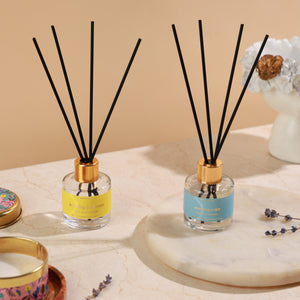
Bright · Morning Freshness₹749Shop → 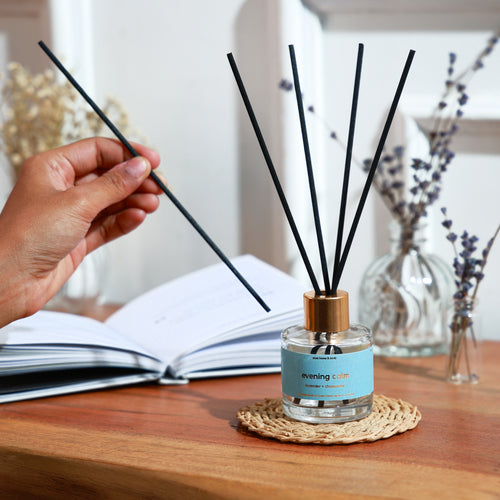 Soft · Evening Calm₹799Shop →
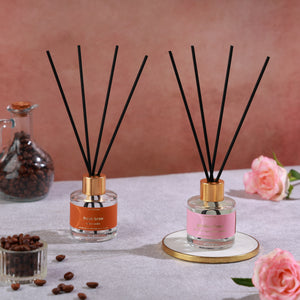
  Green · Mountain Breeze₹849Shop →
Why adding reeds is the wrong correction
Once a diffuser has been sitting in a draught and reading as absent, the near-universal response is to put all six reeds in and, if that fails, to buy a stronger scent. It is worth being precise about what reed count controls. Reeds set the rate at which oil leaves the bottle. They do not set how well the room holds what has left. So in a well-placed room, going from three reeds to six roughly doubles the release and halves the life, which is a real and useful trade. In a draughty position it does something less appealing: it doubles the rate at which oil is sent out of the window, and the room reads almost exactly as it did before.
This is why over-dosing is so common and why it is worth resisting. Almost any composition read at too high a concentration flattens into a single sharp or sweet impression, which is precisely what people mean when they describe something as smelling like an air freshener. The same oil at a lower dose reads as layered, because the nose has room to resolve the separate materials. Restraint is the cheapest luxury signal there is, and it costs nothing to apply — six reeds for a living room above about 150 sq ft, three or four for a bedroom, two or three for a small bathroom, where a 50ml can then run close to three months.
The one adjustment that genuinely restores projection without shortening the bottle disproportionately is the flip. Turning the reeds over releases a burst as the newly exposed length gives up its oil, and the cadence is every three to five days for Morning Freshness and every five to seven for Garden Bloom. Do it on a fixed day rather than whenever the room seems quiet, because "whenever the room seems quiet" is a judgement made by a nose that has adapted, and it will have you flipping daily.
What to buy — and the purchase that placement makes unnecessary
If you already own a bottle, the honest first instruction on this page is to buy nothing and move what you have. What follows is for somebody buying, in the order I would spend. The last row is the purchase that people make instead of moving the bottle, and it is the one I would like to prevent.
| Buy | What it is | When it is the right answer | Price |
|---|---|---|---|
| 1. Morning Freshness 50ml ★ | Malabar lemon, peppermint, eucalyptus globulus — 9.0, bright | A shelf on the far wall of a bathroom, kitchen-adjacent room or study | ₹749 |
| 2. Evening Calm 50ml | Kashmir lavender, chamomile, soft musk drydown — 8.9, softest | A bedside table on the far side of the bed from the window | ₹799 |
| 3. Mountain Breeze 50ml | Himalayan pine, sage, Indian cedar — 9.4, deep and green | A living room or study where you want more presence off the draught line | ₹849 |
| 4. Day & Night duo | Two 50ml bottles rather than a set or a box | If you have two good positions in two different rooms | ₹1,498 |
| The honest gap: the replacement bottle a better shelf makes unnecessary | Most people who conclude a diffuser is weak beside a window buy a second one, or a 130ml at ₹1,249–₹1,349, or a 300ml refill at ₹2,399 that is oil alone and not a first purchase. A larger bottle does not release faster and a refill is not a product on its own. Moving the bottle two metres costs nothing and fixes more | Said first, because it is the cheaper answer and the true one | ₹0 |
Versailles
If I could change one habit across every home that owns a reed diffuser, it would be this one. The windowsill is where the bottle looks best — the glass catches the light, the reeds are visible, it reads as a considered object — and it is the single worst spot in the house for the thing to actually work. Aesthetics put it there and physics empties it there, and the customer usually concludes the product was disappointing.
The heat half of the problem is the one I care about professionally. A warm bottle empties faster, and no formulation prevents that. What a formulation can prevent is a bottle that turns — which is why we use CCT rather than DPG and test through a 45°C soak. It means a SOSA reed in a warm Indian room gets shorter rather than nastier. That was an expensive decision and it is invisible on a note list, and it is the reason people write to say the pine stayed pine.
So move it. Opposite wall, no sun, nose height, nothing burning nearby. Then leave it alone for a fortnight before you decide anything. Everything is composed in Pune, and a part of every order funds a girl's classroom through Nanhi Kali.
Frequently asked questions
- Is it a waste of money? — the honest answer, given first.
- Can't smell it with the window open — air exchange and adaptation, told apart.
- Fresh air, no compromise — fragrance only the rooms that are already shut.
- Cross-ventilated 2BHK — finding the line and placing off it.
- Balcony doors — and Sukoon for a ventilated flat.
- Without wasting oil — and more reeds in strong airflow?
- A high floor with constant breeze — the complete system.
- Brand: the SOSA founder story.
SOSA reed diffusers — facts verified August 2026: Five scents, all alcohol-free, on a heat-stable CCT (caprylic/capric triglyceride) base rather than DPG, which can crack and go bitter above 40°C; phthalate-free, paraben-free, IFRA-compliant, 0 ppm formaldehyde, six fibre reeds in a refillable glass bottle, composed and made in Pune, India. Morning Freshness 50ml ₹749 · 130ml ₹1,249 · 9.0, with a eucalyptus globulus base that slows lemon evaporation three to four times. Evening Calm 50ml ₹799 · 130ml ₹1,299 · 8.9, the softest in the range. Garden Bloom 50ml ₹799 · 130ml ₹1,299 · 8.9. Mountain Breeze 50ml ₹849 · 130ml ₹1,349 · 9.4. Fresh Brew 50ml ₹849 · 130ml ₹1,349 · 9.5, the deepest. Longevity 6–8 weeks on 50ml and 14–18 weeks on 130ml; 50ml suits rooms up to about 150 sq ft and 130ml above that; two or three reeds in a 50 sq ft bathroom can make a 50ml last nearly three months. Six reeds is full projection, three is a soft level and roughly doubles the life; flip cadence every 3–5 days for Morning Freshness and 5–7 days for Garden Bloom. Duos: Day & Night ₹1,498, Fresh & Grounded ₹1,548, Warmth & Bloom ₹1,598. Refills 300ml ₹2,399 · 500ml ₹3,499, oil only and not a first purchase. Machines: Boond ₹899, Sukoon ₹1,899 (500ml, 270–320 sq ft, 16–18 hours on low), Megh ₹3,499 (six-litre tank, around 100 hours, but only about 215 sq ft — a runtime and humidity machine, never a coverage upgrade). Climate-tested through a 45°C heat soak and 85% relative humidity. The reed line contains no oud, sandalwood, vetiver or amber; Smoked Oudh and Sandalwood exist as ₹449 jar candles. SOSA sells no room spray, air purifier, dehumidifier, plug-in or timer, and every SOSA spray is a car perfume. Reed oil and the water-based Hotel Collection are separate systems and are not interchangeable in either direction. Free shipping above ₹499. SOSA is an independent Indian fragrance house and is not affiliated with or endorsed by any hotel brand. Prices subject to change — see the live product pages.