



One: it will perfume every garment you own, and a scent chosen for a room is not a scent you chose to wear. It will also fight whatever perfume you actually put on.
Two: a wardrobe has almost no air exchange, so the scent accumulates rather than dispersing and reaches an intensity nothing in a room ever does.
Three: reed oil is undiluted and marks wood, laminate and fabric permanently. A wardrobe is full of all three, and the door swings.
Four: it treats a symptom. If a wardrobe smells, the cause is moisture or airflow, and scent fixes neither.
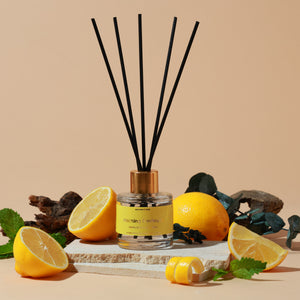
What to do instead: fix the air, then put a Morning Freshness reed at ₹749 on a shelf or dresser beside the wardrobe — lemon, peppermint and eucalyptus, which read as clean rather than as perfume.
2. Because a wardrobe has almost no air exchange, it accumulates rather than disperses. A reed's output is designed against a room with a door and a window. In a sealed cubic metre it reaches an intensity nothing in a room ever does, and it does not come back down.
3. Because reed oil is undiluted, and it marks. It lifts laminate, leaves a permanent ring on wood and stains fabric that will not wash out. A wardrobe contains wood, laminate and fabric, and a swinging door and a shelf full of sticks is a spill waiting to happen.
4. And because it treats the symptom rather than the cause. If a wardrobe smells, the answer is moisture or airflow. Scent dries nothing and moves nothing, so the original smell continues underneath the new one.
5. So fix the air first — an hour of open doors on a dry day, gaps on the rail, the unit pulled off the wall, nothing damp put in. Then put the reed on the shelf or dresser beside the wardrobe, where it scents the room the wardrobe opens into.
6. Morning Freshness at ₹749 is the one I would choose for that spot. Malabar lemon, peppermint and eucalyptus read as clean rather than as perfume, which is what this corner of a bedroom actually wants.
A portion of every order supports girl-child education through Nanhi Kali.

Four reasons, in order of how expensive they are
It is a reasonable idea and I understand exactly where it comes from. The cupboard smells of nothing much, the reed smells lovely, and the two are three feet apart. The trouble is that a reed diffuser is engineered against the behaviour of a room, and a wardrobe is not a small room — it is a different kind of space, defined by the one property a room never has, which is no air exchange at all. Every objection below follows from that, and they get progressively harder to undo.
Inside, beside, and the difference between them
The same bottle, the same oil, the same five scents, moved eighteen inches. Every column changes, and three of them change from a problem into an advantage. This is the whole argument of the page in one table, and the last row is what to do about the cupboard itself.
| Inside the wardrobe | On the shelf beside it | Why the difference is so large | |
|---|---|---|---|
| Air exchange ★ | Roughly thirty seconds a day, when the door opens | Continuous — a bedroom exchanges its air through a door, a window and a fan | A reed's output is designed against a room's exchange rate. Remove the exchange and only the accumulation is left |
| Concentration reached | Saturating, and far beyond anything a room reaches | One steady level, held for months, which is what a reed is for | The same evaporation into a thirtieth of the volume, with nothing carrying it away |
| What gets scented | Every garment you own, evenly and continuously | The corner of the room, and nothing you wear | Fabric adsorbs from saturated air. It cannot choose, and neither can you afterwards |
| Effect on your own perfume | It sits underneath everything you put on and argues with it | None — the two never meet on the same surface | A room scent and a skin scent are separate decisions and should stay separate |
| Spill risk | High. A narrow top-heavy bottle on a shelf behind a swinging door, over fabric and laminate | Low, and a dresser top is a surface you can wipe | Reed oil is a solvent: it marks wood, clouds laminate and stains fabric permanently |
| What it does about the actual smell | Nothing. The cause is moisture or airflow, and both continue underneath | Nothing either — but it is not being asked to, because the cause has been dealt with | This is the difference between a cover-up and a finish |
| What to do with the cupboard instead | An hour of open doors on a dry day, weekly, with a fan pointed in | A hand's width of gap on the rail, two inches off the wall, nothing damp put in | Free, and it is the part that actually removes the smell rather than adding to it |

What to do first, and where the bottle actually goes
Start with the free part, because it is genuinely the answer and the bottle is genuinely the finish. Open both wardrobe doors fully for an hour on a dry day, once a week, with the bedroom window open at the same time, and point a fan into the opening for twenty minutes of that hour. Then take out what you do not wear, so there is a hand's width of visible gap along the rail and air can pass between garments rather than sitting still between them. Then pull the unit two or three inches away from the wall behind it, particularly if that wall is an external one or backs onto a bathroom, so the thin rear panel is not the coldest surface in the room. Then apply one rule permanently: nothing goes into that cupboard unless it is cold and dry to the back of the hand — no shoes worn that day, no gym bag, no umbrella, nothing folded warm off an airer, nothing damp at the seams. Those four things take about an hour of effort the first time and ten minutes a week afterwards, and between them they resolve the overwhelming majority of wardrobe smells at no cost whatsoever. If a musty note survives all four, the problem is humidity rather than airflow and the correct purchase is a desiccant rather than a fragrance. Only when the cupboard is dry and airing on a schedule is there anything for a scent to sit on top of, and that is the point at which the question this page is titled with becomes a sensible one to ask.
Then the placement, which is the whole of the positive recommendation. Put the reed on the chest of drawers, the dresser, the shelf or the windowsill beside the wardrobe, at roughly waist height or above, where it scents the room the wardrobe opens into rather than the wardrobe itself. That position gives you everything the original idea was after and none of the costs. The corner reads as looked after whenever you walk into it; the pulse of air that leaves the cupboard when you open the door arrives into scented rather than dead air, which is the actual moment people are trying to fix; your clothes stay unscented and your own perfume stays yours; and a spill goes onto a surface you can wipe rather than onto a shelf full of shirts. Keep it out of direct sun and out of the path of a fan or an air-conditioning vent, both of which strip the top of a composition and make a reed run through its oil faster, and give it 24 to 72 hours to establish before you decide whether you like it, because a reed is a slow product and judging it on the first evening is judging it before it has started. Turn the sticks once a week if you want it livelier and leave them alone if you do not; that is the entire maintenance.
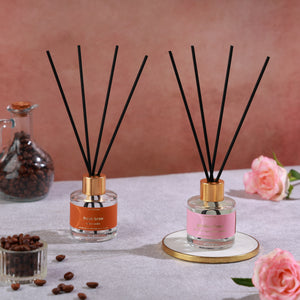
Then the choice of scent, the alternatives, and one last piece of housekeeping. For this particular corner I would use Morning Freshness at ₹749 — Malabar lemon, peppermint and eucalyptus — and the reason is the composition rather than the price. Lemon, mint and eucalyptus read to a nose as clean rather than as perfume, which is exactly what a wardrobe corner wants: it suggests air and laundry rather than scent, it carries no floral or sweet material that would compete with anything you wear, and it is a register nobody objects to at eight in the morning while getting dressed. If you would rather the corner read quiet and resinous, Mountain Breeze at ₹849 is Himalayan pine, sage and cedar; if you want the bedroom rather than the corner, Evening Calm at ₹799 is lavender and chamomile and belongs on the far side of the room. All of them are alcohol-free, need no electricity and hold one level for months, with 130ml from ₹1,249 and 300ml refills at ₹2,399. If you would rather scent the whole bedroom on a schedule instead, a Boond at ₹899 or a Sukoon at ₹1,899 runs the water-based Hotel Collection at three to six drops per tank and reaches a steady level in about twenty minutes, with three 15ml scents of your choice included with the Sukoon — and in that case keep the machine well away from open wardrobe doors, because a cool mist falls rather than rises and hanging cotton will take whatever reaches it. Nothing scented goes inside the cupboard: not a reed, not an open bottle, not a strongly perfumed sachet on a shelf between your shirts. That is the one rule in this group I would call absolute, and the whole of this page is an explanation of it.
The SOSA edit
Four free steps and then one bottle, standing in the right place. The order is the argument — air, space, wall, dryness, and only then a fragrance, which is a finish on a corner rather than a treatment for a cupboard.
| Do | What it is | Why it works | Cost |
|---|---|---|---|
| 1. An hour of open doors, weekly ★ | Both doors fully open on a dry day, bedroom window open, a fan pointed in for twenty minutes of it | It is the only step that exchanges the cupboard's air, which is the property that caused all of this | ₹0 |
| 2. Gaps on the rail, and off the wall | A hand's width between garments; the unit pulled two or three inches clear of the wall behind it | Still air between compressed garments and a cold rear panel are the two structural causes of a stale cupboard | ₹0 |
| 3. Nothing damp goes in | No shoes worn that day, no gym bag, nothing folded warm off an airer, nothing damp at the seams | One damp item raises the humidity of a sealed box and then feeds what grows in it | ₹0 |
| 4. A desiccant if a musty note survives | Silica gel recharged in the sun, or a calcium-chloride absorber tub. SOSA does not make either | If it is musty rather than stale the cause is humidity, and the correct purchase is a drying agent rather than a scent | ₹100–₹400 |
| 5. Morning Freshness reed ★ | Malabar lemon, peppermint and eucalyptus, on the dresser or shelf beside the wardrobe, at waist height or above | Lemon, mint and eucalyptus read as clean rather than as perfume, and the corner is scented without a single garment being | ₹749 |
| 6. Boond or Sukoon | 300ml for one room, or 500ml for 270–320 sq ft with steady/2H/4H timers and three 15ml scents included | If you would rather scent the whole bedroom. Keep the machine away from open wardrobe doors — cool mist falls rather than rises | ₹899 / ₹1,899 |
| Never: a reed inside the cupboard | No reed, no open bottle of oil, no strongly perfumed sachet on a shelf among the clothes | No exchange means accumulation rather than dispersal; and reed oil is a solvent that marks wood, laminate and fabric permanently | — |
Versailles
This question arrives in my inbox most weeks, and I always answer it the same way even though the answer costs me a sale. Do not put a reed inside a wardrobe. It will scent every garment you own rather than the cupboard, which is a decision about what you smell like for the next two years made accidentally on a Sunday afternoon. It will keep climbing, because there is nothing in a sealed box to carry it away and a reed does not know it is in one. And sooner or later the door will swing and the bottle will go over, and undiluted fragrance oil takes the finish off a laminate shelf and leaves a ring in wood that does not come out.
But the impulse behind the question is completely sound, and it deserves the good version of itself. Deal with the air first — an hour of open doors on a dry day, space on the rail, the unit off the wall, nothing damp put away — and then stand the reed on the dresser beside the wardrobe. Now the corner smells considered every time you walk into it, the air that comes out of the cupboard when you open the door arrives into something rather than into nothing, and your clothes stay yours. I would use Morning Freshness there, at ₹749, because lemon, peppermint and eucalyptus read as clean rather than as perfume, and clean is what that corner of a bedroom is actually asking for at half past seven in the morning.
Everything is made and supported from Pune, and a part of every order funds girl-child education through Nanhi Kali. You get a home that smells like somewhere you chose; a girl gets a classroom. That equation has always felt right to me.
Frequently asked questions
- How to make a wardrobe smell good without perfuming all your clothes — the positive version of this page.
- Why the area around your wardrobe smells stale — the cause, and the four free fixes in full.
- Why your cupboard smells musty in monsoon — when the answer is a desiccant rather than a scent.
- Why your wardrobe smells stale, and how to fix it properly — the complete guide for this group.
- Brand: the SOSA founder story.
Facts verified August 2026: Diagnostic facts used in this guide: a closed room accumulates what it cannot exchange, so cross-ventilation needs two openings rather than one; a drain's U-bend water seal evaporates in roughly two to four weeks of disuse and then admits sewer gas, which is corrected by pouring water down the drain; microbial growth in fabric and on surfaces accelerates above about 60% relative humidity, and Indian monsoon indoor humidity commonly runs 80–95%, which is the one situation where ventilating on a wet day can import moisture rather than remove it; an air-conditioner's cold, wet evaporator coil and filter grow biofilm that is blown into the room on start-up; textiles adsorb cooking aerosol and body oils and re-release them for weeks; and olfactory adaptation makes a constant household smell undetectable to its residents within about a fortnight while visitors still perceive it. Timings: a scented candle scents a normal room in roughly 15–20 minutes, a Sukoon ultrasonic diffuser reaches a steady level in about 20 minutes from cold, and a reed diffuser needs roughly 24–72 hours. SOSA products and prices: Sukoon 500ml ₹1,899 (270–320 sq ft, 16–18h on low, 9–12h high, 30–50 ml/h, 2.4MHz cool mist, remote, steady/2H/4H timers, BPA-free, auto shut-off, includes three 15ml Hotel Collection scents of your choice); Boond 300ml ₹899; Megh 6-litre ₹3,499; waterless Vaayu ₹11,999 (up to 1000m³); Aangan ₹25,999. Hotel Collection water-based fragrance 15ml ₹299, 100ml ₹999, 300ml ₹1,799, Pack of 7 at 15ml ₹1,799; dose 3–6 drops per tank. Reed diffusers (separate alcohol-free line): Morning Freshness from ₹749, Garden Bloom and Evening Calm from ₹799, Fresh Brew and Mountain Breeze from ₹849; 130ml from ₹1,249; duos from ₹1,498; 300ml refills ₹2,399. Scented candles: Bookshop 80g ₹379, Amber Rose 130g ₹599 and 220g ₹799, Smoked Oudh 130g ₹449, ceramic jar candles ₹949, Pure Calm wax melt set ₹854. Free shipping above ₹499. SOSA does not make a room or linen spray for the home. The Hotel Collection scents are SOSA's own interpretations; SOSA is not affiliated with or endorsed by any hotel brand. Prices subject to change — see the live product pages.