



It does not work for: height (a double-height room or a tall stairwell) and ventilation (an open balcony door, a running extractor, a high air-exchange room).
Do these first, free: flip all six reeds, move and raise the bottle, close the room for an hour, add two to four reeds.
The ceiling: past roughly 250–300 sq ft of connected open volume, stop at two bottles. A Sukoon at ₹1,899 covers 270–320 sq ft actively.
2. Then check the geometry, because that is what decides it. Length and division are the two conditions a second source cures. A living-dining that runs twenty feet, an L-shaped room, a bedroom and study off one passage — in all of these the fragrance is not failing, it is simply not present in the second half of the space.
3. Rule it out for height. In a double-height room or an open stairwell, scented air rises away from the level you occupy. A second bottle standing on a console adds fragrance to the ceiling void, which nobody smells.
4. Rule it out for ventilation. An open balcony door, a window kept ajar for the breeze, or a kitchen extractor running for an hour each evening will each remove the contents of a room faster than a passive source can rebuild them. You cannot scent outdoors, and a room with the door open to outside is temporarily outdoors.
5. If you do add one, separate them properly. Two bottles at the two ends of the space, both near a doorway or walking route, waist to chest height. Two bottles side by side on the same console buy almost nothing over one.
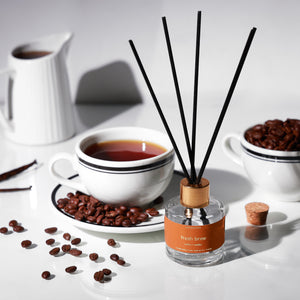
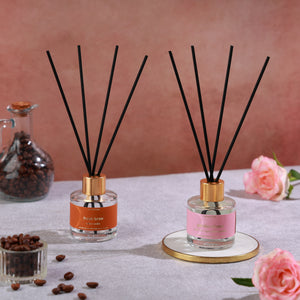
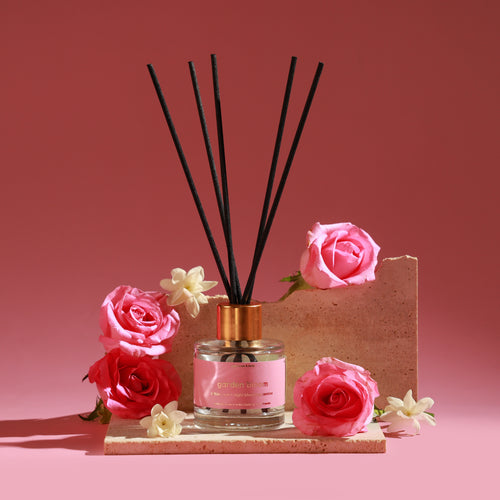
6. Two scents in one connected space must share a note. Fresh Brew and Garden Bloom meet on warmth; Mountain Breeze and Morning Freshness meet on green eucalyptus. Or run two of the same scent for an even field with no seam.
7. Stop at two. A third bottle at ₹749 + ₹749 + ₹749 = ₹2,247 costs more than a Sukoon at ₹1,899, which covers 270–320 sq ft actively and can be switched on when you want it. That arithmetic is on our own listed prices, and it is the point at which I would rather sell you the machine.
Composed and handmade in small batches in Pune, and a portion of every order supports girl-child education through Nanhi Kali.
Part one — what a second bottle actually adds, stated precisely
It is worth being exact about this, because the vague version of the idea — "more diffusers, more smell" — is what leads people to buy a third and a fourth. A reed diffuser produces a fixed output determined by how much reed surface is exposed to the air, and it distributes that output into whatever volume of air surrounds it. A second bottle therefore does one thing: it creates a second region of the home where the concentration is high. It does not raise the concentration at the first bottle, it does not push fragrance further from either bottle, and it does not overcome anything that is removing scented air from the room. Whether that single capability is worth ₹749 depends entirely on whether your problem is a missing region or something else altogether.
 Fresh Brew₹849 · 9.5/10Length is the long living-dining: sofa at one end, table at the other, no wall between them, and a single bottle that scents whichever half it stands in. Division is any partition the air has to negotiate — an L-shaped room where the corner acts as a boundary, a bedroom and a study opening onto the same short passage, a hall that turns. In both cases the fragrance in the bottle is doing its job perfectly well in the volume it occupies, and the complaint is really about a second volume that has no source in it. A second bottle addresses that directly and it is the cheapest correct fix available, at ₹749–₹849 for a 50ml or from ₹1,498 for a duo set with the scents already paired to share a note.
Part two — the diagnosis table
Find the reason your room is under-scented in the first column and read across. Roughly half of these are free to fix, and one of them wants a different product entirely.
| Why the room is under-scented | Second bottle? | What actually fixes it | What that costs |
|---|---|---|---|
| The space runs long — two ends, two purposes ★ | Yes — the textbook case | Two 50ml at the two ends, near walking routes | From ₹1,498 as a duo |
| An L-shape, a passage or two rooms off one corridor | Yes | One source per air volume, both at chest height | ₹749–₹849 for the second |
| Double-height ceiling or an open stairwell | No | An active machine, or accept scenting only the seating area | Sukoon ₹1,899 |
| Balcony door or window open for hours | No | Close the room for an hour before you want it — free | Free |
| Extractor running, or scenting over live cooking | No | Extractor on, window ten minutes, close up, wait half an hour | Free |
| Reeds never flipped, or the bottle in an alcove | No | Flip all six weekly; move it into gentle passing air | Free |
| You want the room strong before guests, quiet after | No | Reeds cannot surge — this is a format question | Sukoon ₹1,899 |
| The composition is a quiet one for the job | Only after you have tried a louder one | Move up the scale to 9.4 or 9.5 | ₹849 |
| The honest caveat: a second bottle also doubles the running cost, and that is the part nobody prices in. Two 50ml finishing every six to eight weeks is a repurchase roughly every seven weeks rather than every fourteen to eighteen, and if both bottles are in constant use the 500ml oil refill at ₹3,499 ÷ 500 ≈ ₹7 per millilitre becomes the sensible way to feed them, against ₹749 ÷ 50 ≈ ₹15 per millilitre for a new small bottle. The refill is oil only — no reeds in the box, and we do not sell reeds as a separate product. | |||
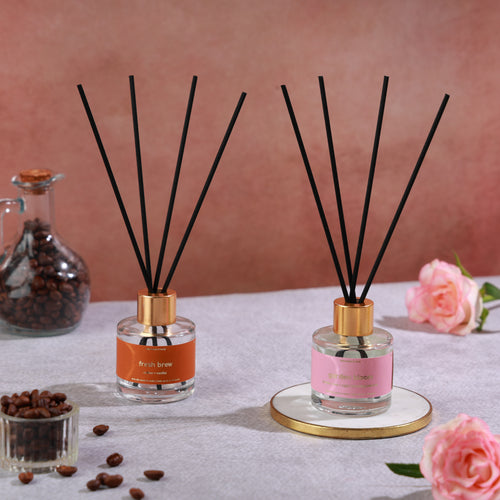 Two sources, one note₹1,598Shop → A single second bottlefrom ₹799Shop →
  When bottles are the wrong tool₹1,899Shop →
Part three — the free checks that come first, and why they matter more here
In most of this cluster the free ladder is a courtesy: try these before you buy. Here it is closer to a necessity, because a second bottle multiplies whatever is already happening rather than correcting it. If the first bottle is stalled because the reeds have not been flipped, the second will stall on the same schedule. If the first is standing in an alcove where no air passes, the second will be too, because it will go on the matching alcove at the other end. If the first is under a split AC being stripped of fragrance and emptied weeks early, the second doubles your rate of spending on an outcome you already dislike. The order matters: verify the bottle you own is working properly, then decide whether the space needs a second one.
So: flip all six reeds, end for end, with gloves on, and give it a day. Lift one reed afterwards and find the wet line — the boundary between the oil-soaked part and the dry part. High and dark means the reed was saturated and stalled and the flip was the fix. Barely above the oil means the reeds are not wicking, which is a reed problem rather than a room problem, and adding a second bottle of new reeds to the far end of the room will conveniently seem to solve it while leaving the first bottle broken. Then move the bottle you own: a console or shelf near a doorway or walking route, waist to chest height, clear space around it, several feet from any AC vent or fan, out of direct sun. Then close the room for an hour before the time you most want it to smell good. Then, if you still want more, add two to four reeds — six is the calibrated count and nine is a noticeably fuller room at roughly five weeks instead of eight on a 50ml.
Only when all four of those have been done and the far half of the space is still empty does a second bottle become the right purchase. And there is a hard stop after it. Past roughly 250 to 300 square feet of connected open volume, a third reed diffuser is a diminishing return, and the arithmetic makes the point better than I can: three 50ml bottles at ₹749 + ₹749 + ₹749 = ₹2,247 is more than a Sukoon at ₹1,899, which covers 270–320 sq ft actively, runs 16–18 hours a fill on low, has steady, 2H and 4H timers and arrives with three 15ml Hotel Collection fragrances in the box. That is a different product line — reed oil never goes into a machine and Hotel Collection never goes into a reed bottle — but it is the honest answer at that size, and most homes end up running both formats in different rooms.
Part four — the five checks, in the order I would run them
Half an hour of work spread over two days, and at the end of it you will know whether you are buying a second bottle, a stronger composition, a machine or nothing at all.
| The check | How to run it | If it fails | If it passes |
|---|---|---|---|
| 1. The doorway test ★ | Leave for fifteen minutes, return, judge the first three seconds | You cannot smell it on re-entry — carry on to check two | You can — the bottle is fine and you have adapted. Buy nothing |
| 2. The flip | All six reeds end for end, gloves on, wait 24 hours | No improvement — carry on to check three | Room recovers — flip weekly from now on. Buy nothing |
| 3. The wet line | Lift one reed and find the oil boundary | Barely above the oil — the reeds are spent, not the room | Wet well up the reed — supply is fine, look at the room |
| 4. The walk | Walk the space and mark where the scent stops | It stops at a corner, a passage or halfway down a long room | It is weak everywhere equally — that is air, not geometry |
| 5. The closed hour | Shut doors and windows for an hour, then walk in | Still nothing — the room is losing air faster than reeds can fill it | It smells right — your problem is ventilation, and it is free to manage |
| Buy a second bottle when | Checks 1–3 pass and check 4 fails at a corner or an end | — | Duo sets from ₹1,498 · single 50ml from ₹749 |
| Buy a machine when | Check 5 fails, the ceiling is double height, or you want scent on demand | — | Sukoon ₹1,899 · 270–320 sq ft |
Versailles
The second bottle is the easiest sale in our shop and the one I have argued myself out of most often. Somebody writes to say their living room is not enough, and the obvious commercial reply is a link to a second diffuser. The trouble is that roughly half of those rooms are not short of a bottle at all — they are tall, or they have a balcony door that stands open until ten at night, or the reeds in the bottle they own have not been turned since the day it arrived.
I would rather ask four questions than take that order. It is not only a matter of principle: a customer who buys a second bottle for a ventilation problem does not conclude that they misdiagnosed it, they conclude that our diffusers are weak, and they are right to, from where they are standing. One honest email is worth more to us than the ₹799, and considerably more than the review that would otherwise arrive in seven weeks.
Where a second bottle is the answer it is a genuinely lovely thing — two envelopes, placed properly, make a long room feel considered in a way one heroic bottle never does. And where it is not, the honest recommendation is often our own ₹1,899 machine, which I would rather sell you than a third reed diffuser you will be disappointed by. Everything is composed and handmade in small batches in Pune, and a part of every order funds a girl's classroom through Nanhi Kali.
Frequently asked questions
- One large or two smaller? — the same decision made before you have bought anything.
- Reed diffuser against the Sukoon — constant versus controllable, priced honestly.
- Weak in a large room and the living-room problem.
- Another bottle, a Sukoon or a Vaayu? — the pillar for the whole cluster.
- Brand: the SOSA founder story.
SOSA reed diffuser range & prices (verified August 2026): alcohol-free, phthalate-free, paraben-free and IFRA-compliant compositions on a heat-stable coconut-derived (CCT) carrier, low-VOC, supplied in a refillable glass bottle with six fibre reeds; 50ml lasts 6–8 weeks and 130ml lasts 14–18 weeks. Morning Freshness (Malabar lemon · peppermint · Nilgiri eucalyptus) 50ml ₹749 · 130ml ₹1,249 · 9.0/10; Garden Bloom (British rose · night-blooming jasmine) 50ml ₹799 · 130ml ₹1,299 · 8.9/10; Evening Calm (Kashmir lavender · chamomile) 50ml ₹799 · 130ml ₹1,299 · 8.9/10; Fresh Brew (Coorg coffee · Kerala vanilla) 50ml ₹849 · 130ml ₹1,349 · 9.5/10; Mountain Breeze (Himalayan pine · sage · Indian cedar) 50ml ₹849 · 130ml ₹1,349 · 9.4/10. Reed diffuser refills are oil only — you reuse your own vessel and reeds: 300ml ₹2,399 (roughly 8–11 months) · 500ml ₹3,499 (roughly 14–18 months), about ₹7–8 per ml against ₹15–17 per ml for a 50ml bottle. Duo sets ₹1,498–₹1,598 for 2 × 50ml and ₹2,498–₹2,598 for 2 × 130ml. Strength figures are positions on SOSA’s own internal strength scale, not an industry standard. Replacement reeds are not sold as a separate SKU; SOSA guidance is to refresh reeds every few months. The reed line is separate from the water-based Hotel Collection for ultrasonic machines (15ml ₹299 · 100ml ₹999 · 300ml ₹1,799) and the two are not interchangeable. Diffusers: Boond 300ml ₹899 · Sukoon 500ml ₹1,899 · Megh 6L ₹3,499 · waterless Vaayu ₹11,999. Composed and handmade in small batches in Pune, India; tested through 45°C summer heat and 85% monsoon humidity. Free shipping above ₹499. A portion of every order supports girl-child education through Nanhi Kali. Prices subject to change — see the live product pages.