



Take three readings, not one. At the source, at the furthest occupied chair, and at the threshold of the corridor to consultation. The far chair should be faint or nothing; the corridor threshold must be nothing, and that reading is a boundary check rather than a subtlety check.
Use somebody who has just walked in from outside. A courier, an accountant, a colleague from another branch. Ask an open question — "tell me anything you notice about this room" — never "can you smell the diffuser", which supplies its own answer. If fragrance is in their first three observations, lower it.
Check at the wrong moment and you will get the wrong answer. Eight in the morning, cold, empty and just unlocked is the least representative moment of the day. Judge at your busiest hour with the chairs full, and re-check in peak summer and again in the monsoon.
2. The reason to verify has nothing to do with your patients. It is that a nose stops reporting a constant within minutes, and adapts hardest in the building it occupies most. Whoever set the level is therefore disqualified as a witness to it. No claim is made here about how any age group perceives fragrance; this is about the unreliability of the operator, and it would be equally true in a bank.
3. Take three readings, always in the same three places. Beside the source; at the furthest occupied chair; and at the threshold of the corridor to consultation. Faint at the far chair is a pass. Anything at all at the corridor threshold is a fail, and that one is a boundary check rather than a subtlety check — it is telling you the fragrance is on the wrong side of the building.
4. The pass condition is behavioural, not a feeling. A first-time visitor, asked an open question, does not mention fragrance in their first three observations about the room. That is a design standard and not a claim about anybody's health or comfort.
5. Timing decides the answer more than the setting does. The first three days of a new bottle run high while dry reeds saturate and the lightest notes leave; weeks one and two settle; what follows is a plateau that holds to the end of the bottle. Verify on the plateau, at your busiest hour, with the room warm and the chairs full — never at eight in the morning in a cold, empty, freshly unlocked room.
6. Re-check with the seasons. The same setting behaves differently through a 45°C summer and an 85% humidity monsoon, and differently again when the air-conditioning runs all day rather than intermittently. Two extra readings a year cost nothing and catch most drift.
7. Write it down, or it did not happen. The setting, the date, the room's condition, the three readings, the witness's exact words, the action taken and the next review date. A written record is the only thing that makes a slow upward climb visible, because nobody in the building can perceive it as it happens.
8. Subtle is not a safety property and this page does not treat it as one. No SOSA product or setting is described as safe, unsafe or suitable for any patient group; some people are sensitive to airborne fragrance, which is why the clinical pathway stays fragrance-free, why a fragrance-free seat must genuinely exist, and why the practice — not a supplier — sets its own policy. Composed and made in small batches in Pune, and a portion of every order supports girl-child education through Nanhi Kali.

Part one — why your own nose cannot certify a room
Every practice I have corresponded with about an over-scented reception set the level correctly at the start. Not one of them raised it deliberately; the level climbed, one reasonable-feeling adjustment at a time, and nobody in the building could perceive the total. Three things make that inevitable, and understanding them is what turns verification from bureaucracy into the only sensible response.
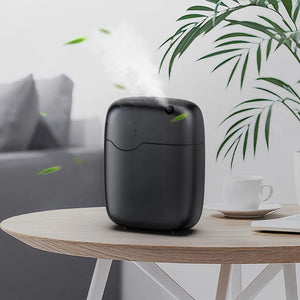
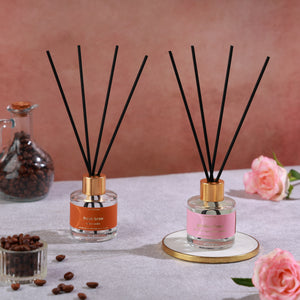
 Mountain Breeze₹849 · verify on the plateauA reed diffuser has three phases and only one of them is the product. Days one to three run high as dry reeds saturate and the lightest top notes depart. Weeks one and two settle. What follows is a plateau that holds fairly flat to the end of the bottle, and the plateau is the thing you are meant to be verifying — everything before it is a transition that will not return. Meanwhile your own sensitivity is moving in the opposite direction as you adapt. Those two curves crossing is why so many readings taken in the first fortnight are wrong, and wrong in the direction of adding. Then there is the moment of day. Almost everyone judges a reception at eight in the morning: cold, empty, freshly unlocked — the least representative moment there is. Bodies, warmth and door traffic change how a room carries a fragrance, so read it at your fullest hour instead, and again in peak summer and in the monsoon.
Part two — the seven checks, and the pass condition for each
Seven checks, when each is run, exactly what a person does, and what counts as a pass. None of them requires equipment, all of them are free, and the whole set takes under twenty minutes on the day you run it.
| The check | When you run it | Exactly what you do | The pass condition |
|---|---|---|---|
| The corridor threshold reading ★ | Weekly, and after any change of any kind | Stand at the threshold of the corridor to consultation, in the door's usual position, and pause for thirty seconds | Nothing to report. This one is pass or fail, never "a little" — and a fail is a placement problem, not a setting problem |
| The re-entry walk | Monthly, on a normal working morning | Leave the building for twenty minutes, return through the patient entrance, and note what you register in the first three seconds | You register the room before you register the fragrance |
| The far-chair reading | Monthly, at your busiest hour | Sit in the furthest occupied chair from the source and stay for two minutes before deciding anything | Faint or absent. If it is clearly present at the far chair, the level is set for the room's near half only |
| The stranger's three observations | Whenever a suitable person walks in — aim for once a month | Ask a first-time visitor "tell me anything you notice about this room". Never mention fragrance, and write their words down as they said them | Fragrance is not among their first three observations |
| The forty-minute sit | Once a quarter, and after any change | Somebody from the practice who has been outside for an hour sits a full wait in an ordinary chair, doing nothing | It is still unremarkable at minute forty. This is the check that catches a dose set for the door |
| The staff fortnight question | Week two and week four after any change, then quarterly | Ask the desk "if you could change one thing about this room, what would it be" — not "does this bother you" | Fragrance does not come up unprompted. If it does, that is the answer, and it outranks every other reading here |
| The seasonal re-check and setting audit | Peak summer, mid-monsoon, and on your written review date | Re-run the three readings, then compare the actual setting against what your written standard says it should be | The readings still pass and the machine is on the setting the paper says |
| The honest caveat: these are practical design checks for an arrival zone and nothing more. They are not measurements of air quality, not a clinical or safety assessment, and passing them does not make a product safe, suitable or appropriate for any patient or staff group — that judgement belongs to the practice and its clinicians, along with ventilation, infection control, accreditation and every regulatory matter. No claim of any kind is made here about how people of any age perceive, tolerate or respond to fragrance. Some people are sensitive to airborne fragrance, which is exactly why the clinical pathway stays fragrance-free and why a fragrance-free seat must genuinely exist regardless of what any check returns. A diffuser adds a scent to the air; it does not clean, purify, filter, sanitise or disinfect it, and it removes no existing smell. Frequencies given are sensible working intervals, not standards. | |||
 Mountain Breeze · take a reed out₹849Shop → Sukoon · halve the dose₹1,899Shop →
 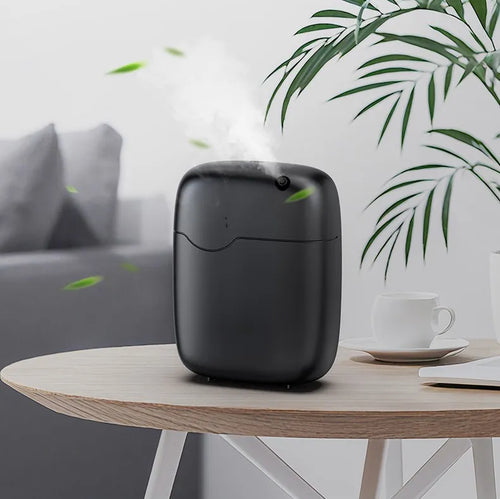 Vaayu · lock the verified setting₹11,999Shop →
Part three — what to change when a check fails
A failed check is useful information and should be acted on the same week, in a strict order of cost. Free before cheap, cheap before paid, and never two changes at once. Start with placement, because it is the adjustment that most often makes a level acceptable without lowering it at all: move the source further from the seating, turn it into the room rather than at the chairs, and get it out of the air-conditioning return path so the whole space is not being dosed through the ceiling. Then reduce the source. On a bottle that means taking a reed out — reed count is the only true volume control a reed diffuser has, and the spare reeds should leave the building rather than sit in a drawer beside it. On an ultrasonic it means halving the dose in the tank before touching the mode, since fewer drops in the same volume of water is a continuous adjustment where the mode is a coarse one. Then shorten the hours, if the format has any. Only after all of that would I consider a different composition — and never in the same fortnight as a change of level, because you will not know afterwards which one did the work.
A failure at the corridor threshold is the exception and it does not belong in that ladder at all. That reading is not telling you the level is high; it is telling you the fragrance is in the wrong part of the building, and no reduction fixes a boundary problem — it just makes the same failure quieter. The response is to move the source further into the arrival zone and away from the corridor mouth, to look at what is actually moving air across that threshold — door swing, corridor pressure, where the air-conditioning returns sit — and, if the geometry genuinely cannot separate the two, to stop. That last option should be a real one in your own mind before you take the first reading. A protocol whose only possible outcomes are "keep going" and "keep going more quietly" is not a protocol.
The last thing to say about failure is that most of it is invisible without a record, which is why Part four exists. Nobody can perceive a slow climb they participated in, and no one remembers accurately what a room was like four months ago. A single sheet with the date, the room's condition, the setting, the three readings, the witness's exact words and the next review date converts an argument about impressions into a comparison of two entries. It also makes the setting a shared object rather than one person's preference: when the level is written down, anybody on the front desk can see that it has moved and say so. Ten minutes a month, on one sheet of paper, in a building where the alternative is finding out from a courier eleven months later.
Part four — the written log, field by field
One sheet, seven fields, filled in on a fixed day. The third column is the argument for each field; the fourth is what stops the log becoming somebody's private project and then quietly stopping.
| Field | An example entry | Why this field earns its place | Who fills it in |
|---|---|---|---|
| Date, time and where you were in the bottle's life ★ | Second Monday, 11:40, week six of a 50ml at three reeds | Days 1–3 run high and weeks 1–2 settle; only the plateau is worth reading | Whoever runs the check |
| Room condition at the moment of reading | 18 of 22 chairs occupied, AC on since 09:00, front door in normal use, warm | An empty cold room and a full warm one carry the same output very differently | Same person, same line |
| Format and exact setting | One 50ml bottle, three reeds, far corner, on a tray, 2.5m from the nearest chair | This is the field that makes drift visible — a setting you cannot state is a setting that can move | Whoever is authorised to change it |
| The three readings | At source: clearly present · far chair: faint · corridor threshold: nothing | One reading tells you almost nothing; the relationship between three tells you where the fragrance actually is | Whoever runs the check |
| Witness, and their words verbatim | Courier, first visit: "it is very tidy in here" — no mention of fragrance | Your summary of what somebody said is already an interpretation; their words are evidence | Whoever asked — and never the person who set the level |
| Action taken, and the one thing changed | Moved bottle 1m further from seating. No other change this fortnight | One variable at a time is the only way a later reading means anything | The person authorised to act, named on the sheet |
| Next review date, and the standing stop rule | Re-read in four weeks. Stop and remove if the desk asks, or if the threshold ever reads anything | A protocol without a next date stops after two entries; a protocol without a stop rule has only one outcome | The practice owner or manager |
Versailles
An optometrist wrote to me with a written standard she was rather proud of, and she was right to be. It named the zone, the composition, the reed count, the placement and the person authorised to change it, and it had been agreed by everybody at the practice. She wanted to know whether I would add anything to it. There was one thing, and it was not a clause. It was a column.
Her standard described a setting. It contained no record of anybody ever having read the room against it. Nine months in, nobody in the practice could have told me whether what was running matched what was written, because nobody had ever compared the two — and the whole point of adaptation is that they would not have noticed the difference if it had appeared. We added three lines: a monthly reading at the far chair, a weekly thirty-second pause at the corridor threshold, and the verbatim words of whoever had most recently walked in from the street.
The first month's entry recorded a courier saying the reception was "nice and cool", which is the kind of unremarkable sentence that constitutes a pass. The third month's recorded a pharmaceutical representative leading with the fragrance. Nothing had been changed on purpose in between; a reed had been added during a refill by somebody being helpful. That is the entire case for the log in one anecdote — not that practices are careless, but that the change was invisible from inside the building and obvious from outside it, and only a written line caught the difference. Composed and made in small batches in Pune, and a part of every order funds a girl's classroom through Nanhi Kali.
Frequently asked questions
- What suits a clinic with many senior patients — the specification this page verifies.
- What to do if a patient says the reception fragrance is too strong and what a neutral direction actually means.
- Why a clinic runs materially below a salon or a showroom.
- The most conservative way to introduce fragrance at all — where the written standard comes from.
- Brand: the SOSA founder story.
SOSA range, specifications and prices used in this guide (verified August 2026): Vaayu ₹11,999 — waterless cold-air nebulisation of undiluted fragrance oil; no water, no heat, no added humidity, no white mineral dust. Coverage up to 1000 m³, about 2,000–3,000 sq ft. 400ml refillable tank lasting roughly 90+ days at a mid setting. Bluetooth app plus onboard controls, 1h / 4h / 8h / 24h run windows, day selection, adjustable intensity, auto-stop and key-lock. Under 38 dB. DC 12V / 1A, 5W. Freestanding or wall / HVAC mount. CE, RoHS and SGS certified. SOSA does not currently sell a separate Vaayu cold-air refill oil; the 400ml supplied in the box is the fragrance available at the time of writing, so a practice planning continuous or multi-site use should confirm current refill availability with SOSA before committing. The water-based Hotel Collection is made for ultrasonic machines and must not be used in a Vaayu. Other machines: Boond 300ml ₹899 (~150 sq ft, ultrasonic) · Sukoon 500ml ₹1,899 (270–320 sq ft, 16–18 hours on low, remote and steady/2H/4H timers, three 15ml fragrances included, ultrasonic) · Megh 6L ₹3,499 (~215 sq ft — a runtime and humidity machine that covers less than a Sukoon, never a coverage upgrade) · Safar ₹3,999 (waterless cold diffusion, cordless, 20ml, about 6.9cm, three speeds, 1/2/3-hour auto-off — sold as a car and travel diffuser, personal-scale only; SOSA publishes no coverage figure for it) · Aangan ₹25,999 (HVAC nebulising, ~8,000–10,000 sq ft) · Meenar ₹38,500 (commercial HVAC, 12,000–18,000 sq ft). Water-based Hotel Collection for ultrasonic machines: 15ml ₹299 · 100ml ₹999 · 300ml ₹1,799 · pack of seven ₹1,799; scents are inspired by the atmosphere of well-known hotels — SOSA is an independent Indian brand and is not affiliated with, endorsed by or supplying any hotel group. Reed diffusers ₹749–₹1,349 (50ml 6–8 weeks, 130ml 14–18 weeks, six fibre reeds, no 100ml size; replacement reeds are not sold separately). Reed oil cannot be used in an ultrasonic machine and Hotel Collection oil cannot be used in reeds. SOSA sells no room spray or home spray — every SOSA spray is a car perfume. Nothing in this guide is medical, clinical or safety advice. A fragrance diffuser adds a scent to the air. It does not clean, purify, filter, sanitise or disinfect air, does not remove or neutralise disinfectant, damp or occupancy smells, and has no effect on comfort, anxiety, waiting time, recovery or any clinical outcome. Some people are sensitive to airborne fragrance, which is why this guide recommends that examination rooms, diagnostic areas, consultation cabins, procedure suites and post-operative areas remain fragrance-free, that a fragrance-free seating option always exist, and that a diffuser is never mounted into shared HVAC in a clinical building. Decisions about clinical policy, ventilation standards, infection control and patient suitability rest entirely with the practice and its clinicians. A persistent stale, damp or disinfectant smell is a ventilation, moisture or cleaning problem — SOSA sells no dehumidifier and no air purifier, and fragrance should never be used to cover one. Coverage, runtime and longevity figures are manufacturer specifications and typical ranges, not guarantees, and vary with room volume, ceiling height, air exchange, occupancy and season. SOSA publishes no commercial or bulk pricing, no corporate account, no annual maintenance contract, no installation service, no stated warranty term and no multi-location programme; warranty length, spare parts, servicing and app platform availability are unconfirmed, and larger or multi-site enquiries should go through the contact page before any commitment. Composed and made in small batches in Pune, India. Free shipping above ₹499. A portion of every order supports girl-child education through Nanhi Kali. Prices subject to change — see the live product pages.