Founder Diaries · Clinics & Medical Centres · Shared Waiting Areas
By Sonal Sahani · ISIPCA Versailles 11 min read Updated September 2026
One, and the reason is physics rather than taste.
Two fragrances released into a single volume of air do not produce two zones. They produce one blend, in a ratio set by wherever the air handling happens to be throwing that hour, and that blend is a third composition that no perfumer formulated and nobody chose. It is also not a stable third composition, because the ratio moves with the fan speed, the front door and the time of day. A shared waiting area is one room in the only sense that matters to a molecule, and the useful rule is that a scent zone is defined by a door rather than by a signboard. One machine, one oil, one setting: the
Vaayu at ₹11,999 exists to make that easy.
Quick answers — read this first
The answer: one fragrance, for the whole shared hall.
Why: two compositions in one volume mix. A person sitting between them receives a blend whose ratio changes with fan speed, door cycles and the hour — a third composition nobody formulated, and not even a consistent one. The nose does not separate two ambient scents at low concentration; it integrates them into a single impression.
The rule: a scent zone is defined by a door, not by a signboard. Six departments feeding one hall is one zone. An administrative corridor behind a closed door is a second, and can legitimately carry something of its own.
What to vary instead: seating, signage, light and where the queue forms. Not the composition. And paediatric clinical areas get nothing at all.
The short answer
Short answer: one. A shared waiting area is a single volume of air, and two fragrances released into it mix into a third that nobody formulated, in a proportion that changes with the fan speed and the front door. A scent zone is defined by a door, not by a departmental signboard.
The pick: one
Vaayu at ₹11,999 running one oil for the whole public envelope — waterless, up to 1000 m³, key-locked, under 38 dB, with one intensity setting written into the standard operating procedure. The Westin-inspired
White Tea Serenity is the lightest of the seven and the default for a medical building. Where a door genuinely closes — an administrative corridor, a separate office suite — an alcohol-free
reed diffuser from ₹749 can carry something of its own.
Shop: the
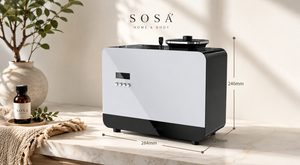
Vaayu ₹11,999 (up to 1000 m³, 400ml tank lasting about seventy-five days, Bluetooth app and 1h/4h/8h/24h timers, auto-stop, key-lock, four hotel-inspired scents supplied) and the
Aangan ₹25,999 where a whole floor or an atrium genuinely needs it. Ultrasonic
Sukoon ₹1,899 and
Boond ₹899 for one administrative cabin. Alcohol-free
reed diffuser from ₹749. Free shipping above ₹499.
Straight answer
Should a waiting area used by several specialities have one fragrance or several?
1. One. A shared hall is one volume of air, and air mixes. Two machines at either end of the same room do not give you a paediatric end and an orthopaedic end. They give you one room containing both compositions in a proportion that varies with the fan speed.
2. And the blend is not the average of your two intentions. A composition is a balance of materials with different volatilities, arranged so that what reaches a nose at any moment is what the perfumer meant. Put two finished compositions into one room and what arrives is the sum of two decay curves starting from two different points, which is a third thing nobody designed.
3. It is not even a consistent third thing. At half past nine the ratio is one figure. At half past one, with the air handling working harder because the building is warm and the front door cycling every forty seconds, it is another. You would be signing off a fragrance whose formula is a function of the outside temperature.
4. The nose does not separate them anyway. Two ambient scents at low concentration are integrated into one impression rather than heard as two. So the practical outcome of buying two is not two experiences. It is one worse experience, at twice the cost.
5. The rule that settles every case: a scent zone is defined by a door, not by a signboard. Six departments feeding one hall is one zone. An administrative corridor with a door that closes is a second, and may legitimately carry something of its own. A separate floor is a separate conversation.
6. Vary the other things instead. Seating, signage, lighting, queue position and where the children's corner sits will differentiate departments far better than a bottle, and paediatric clinical areas stay fragrance-free regardless. So do consultation cabins, procedure rooms, sample collection, the laboratory, dispensing, sterile stores, imaging and oncology day-care.
A portion of every order supports girl-child education through Nanhi Kali.
TL;DR: one. Two compositions in a single volume of air mix into a third nobody formulated, in a ratio that changes with fan speed and door cycles, and a nose integrates two ambient scents into one impression rather than separating them. A scent zone is defined by a door, not a signboard — so one
Vaayu at ₹11,999, one oil, one locked setting, and vary seating and signage instead.
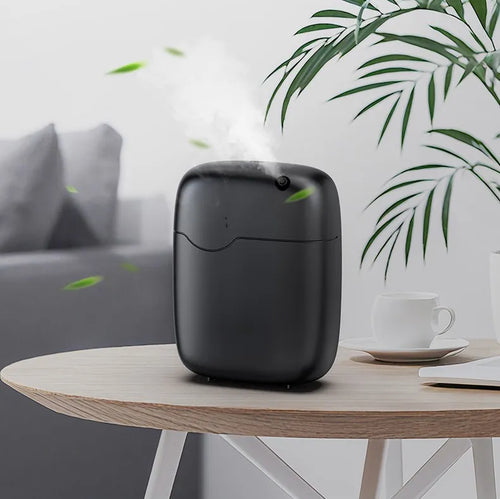
One composition, one tank, one number in the standard operating procedure
SOSA Vaayu · a single oil ₹11,999
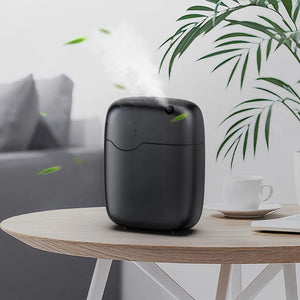
A 400ml tank, one intensity setting, one schedule in the Bluetooth app, one refill date about seventy-five days out, and a key-lock so the setting survives contact with the public. The second machine in a shared hall does not give you a second zone. It gives you a second variable, and every variable in a clinic eventually meets a housekeeping supervisor who started last Tuesday. If you want the paediatric end of the hall to feel different from the orthopaedic end, the honest levers are seating, signage, light and where the queue forms. Not a second bottle in the same volume of air. Up to 1000 m³, under 38 dB, auto-stop, four hotel-inspired fragrances supplied with the machine.
What actually happens when two compositions share a volume
This question arrives in a reasonable form and I want to take it seriously, because the instinct behind it is a good one. A centre head with six specialities under one roof is looking for a way to make a large undifferentiated hall feel less like a bus station, and giving each department its own character is an entirely sensible thing to want. The problem is only that fragrance is the one medium in the building that cannot be used for it, and the reason is worth understanding rather than taking on trust, because once you have it you will also know why the same argument does not apply to lighting, seating, signage or colour. Air mixes. Light does not.
1
THE MIXING
Two compositions, one room, and a third thing nobody formulated
Take the simplest case: two machines, one at the paediatric end of a long hall and one at the orthopaedic end, forty feet apart. What a patient sitting between them receives is not fragrance A or fragrance B. It is a blend, and the proportion of that blend at any given seat is decided by the air handling, the front door, the corridor doors and the temperature outside — none of which you control and all of which change through the day. That much most people accept. The part that matters more is what kind of thing the blend is. A composition is not a flavour; it is a structure. It is a set of materials with different vapour pressures, balanced so that what reaches a nose at any moment is a proportion the perfumer chose, and so that the thing decays gracefully rather than falling apart into its loudest component. When two finished compositions enter the same air, what arrives at a seat is the sum of two of those structures, decaying at different rates from two different starting points, and the result is a third composition with no structure at all. In practice the light tops of both arrive together and cancel into something vaguely citric, and the heavy ends of both accumulate together through the afternoon into something muddier than either. Two cedars in one hall is not twice as woody; it is one indistinct wood. A white tea and an amber is not a gradient between clean and warm; it is a flat, slightly sweetish thing that belongs to neither. And it is not stable, which is the part I find genuinely indefensible. At half past nine the ratio is one figure; at half past one, with the plant working harder and the entrance cycling every forty seconds, it is another. You would be committing your building to a fragrance whose formula is a function of the outdoor temperature, and no perfumer would put their name on that.
The way I test this claim in a real hall, for anybody who does not believe it: run machine A alone for a week, then B alone for a week, then both. Ask three people who come in cold to describe each week. The third week is always described as less pleasant than either of the first two, and usually as stronger.
2
THE NOSE
Two ambient scents at low concentration are integrated, not separated
There is a second reason, and it survives even if you solved the mixing problem with perfect ducting. A nose in a room is not listening to two channels. At the low concentrations a well-run public space operates at, two simultaneous ambient fragrances are integrated into a single impression rather than picked apart, which is exactly the opposite of what somebody buying two machines is paying for. This is not a deficiency; it is how ambient smell works and it is the same property that makes a single composition read as one thing rather than as its eleven materials. Which means the money spent on the second machine buys you no second experience at all. It buys a slightly higher total concentration, which is the one variable in a medical waiting hall you were trying to keep down, and a muddier impression, which is the one quality you were trying to avoid. The failure mode that follows is predictable and I have watched it three times: somebody decides the paediatric end is being overwhelmed by the other bottle and turns their machine up, so the other department turns theirs up, and within a month a hall that was supposed to feel considered has an arms race in it and a patient asking reception what the smell is. A patient asking that question is the clearest signal in this entire cluster that the level is wrong. The target is that they should not be able to tell you what the fragrance is — only that nothing in the building smelled unpleasant. Two machines in one hall make that target almost impossible to hold, because nobody owns the result and the result is nobody's composition.
3
THE DOOR TEST
Where several genuinely is right, and where it is not
None of this means a facility can only ever have one fragrance, and the boundary is simple enough to write into a standard operating procedure.
A scent zone is defined by a door, not by a signboard. If two volumes are separated by something that closes, they are two zones and they can carry different things without anybody ever meeting both at once. The administrative corridor and the back office behind a fire door are a legitimate second zone, and it is the one place in a clinic where an alcohol-free
reed diffuser from ₹749 is genuinely the right product rather than a compromise — small room, closed door, no children, nobody waiting fifty minutes in it. A separate floor with its own lift lobby is a second zone, and
a multi-floor centre where each floor is a different speciality goes into that properly. A café that is a room rather than a counter is a second zone.
What is not a second zone: a departmental corner of the same hall, a seating bank on the other side of a low partition, a paediatric play area with no door on it, or anything separated by a sign. And the further rule that overrides all of it: paediatric clinical areas, consultation and examination cabins, treatment and procedure rooms, dressing rooms, sample-collection rooms, laboratories, pharmacy dispensing, sterile stores, imaging and oncology day-care are fragrance-free, whatever the zoning says. Children cannot consent and their parents did not choose it; aversion to smells during oncology treatment is real and well known to any oncology nurse; a clinician needs to be able to notice what a room and a patient smell of.
The full fragrance-free list is worth reading before, rather than after, a purchase order.
One zone or two: the door test, applied
Every boundary I get asked about in a shared-waiting-area plan, with the honest verdict and the reason. The test is the same every time and it takes two seconds: is there something between these two volumes that closes? If not, it is one zone and it gets one fragrance.
The door test
Which boundaries make a second scent zone, and which only look as though they do
| Boundary |
Is it a second zone? |
Why |
What to do |
| One hall, six departmental signboards ★ |
No |
Signage does not stop air. One volume, one mixed result, one fragrance |
One machine, one oil, one locked setting |
| A low partition between seating banks |
No |
Air moves over and around it freely; the two sides differ by a few per cent and by the hour |
Handle it as one zone. Differentiate with seating and light |
| A paediatric corner inside the hall |
No |
And in any case paediatric clinical areas are fragrance-free, and the corner should be left alone too |
Nothing added. Differentiate visually |
| The corridor mouth to the consultation cabins |
No — and it should receive nothing |
It is the clinical edge. The fragrance curve has to be dead before it |
Move the machine, do not turn it down |
| Administrative corridor behind a fire door |
Yes |
A door closes. Nobody meets both at once, and no patient waits fifty minutes in it |
A reed diffuser from ₹749, or a small ultrasonic with a named owner |
| A separate floor with its own lift lobby |
Yes |
A different volume entirely, reached through a lift car rather than an opening |
Its own machine. Same scent across branches is a different question |
| A café that is a room rather than a counter |
Yes, if it has a door |
A counter open to the hall is part of the hall; a room with a door is not |
If it is open to the hall, fix the extract hood instead |
Shop this guide
One hall, one fragrance, in three products
The SOSA principle
Two compositions in one volume do not give you two zones. They give you a third composition nobody formulated, in a ratio set by the fan speed.
Which is why the rule worth writing into the SOP is not about scent families at all: a scent zone is defined by a door, and six signboards in one hall define nothing.
One oil, one setting, and what to vary instead
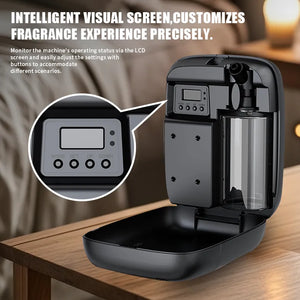
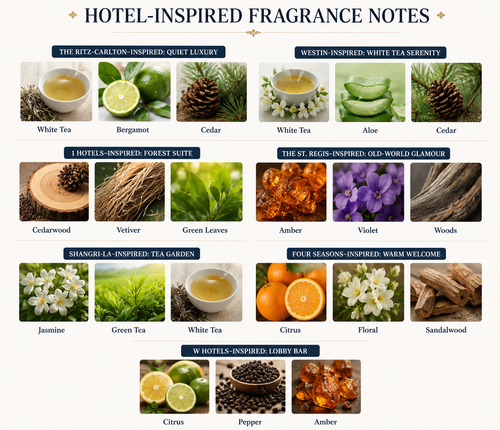
Start with what one fragrance actually looks like in practice, because it is less restrictive than it sounds. One oil, one 400ml tank, one intensity setting, one schedule and one refill date about seventy-five days out — and in a facility with six department heads and a housekeeping roster that turns over, the value of that is operational before it is aesthetic. Every variable in a clinic eventually meets a supervisor who started last Tuesday, and a single number in the standard operating procedure survives that meeting where two numbers do not. The Vaayu helps here specifically: the key-lock means the setting you chose is the setting in March, the Bluetooth app means the facilities team can check the schedule without walking into reception, and the 1h/4h/8h/24h timers mean the hall is scented during opening hours and not overnight into an empty building. On the composition itself, the medical brief is narrow and one scent covers it comfortably: the Westin-inspired White Tea Serenity — white tea, aloe and cedar — is the lightest of the seven and the default, the Ritz-Carlton-inspired Quiet Luxury is a step more present for a large hall, and the 1 Hotels-inspired Forest Suite is the drier one where a refreshment counter is part of the room. Pick one of those three and stop. Nothing sweet, nothing heavily floral, nothing a patient could name as a perfume they own.
Then what to vary instead, because the underlying wish is legitimate and there are four good answers to it. Seating is the first and the most powerful: a children's bank with lower chairs and a wipe-clean floor reads as a different place from a row of high-backed chairs near orthopaedics, and it does it without putting anything into the air. Signage is the second, and the useful move is to use the words patients use rather than the words specialists use. Light is the third and it is underrated — a warmer colour temperature over one seating bank and a cooler one over the registration queue changes the character of a hall more than any bottle, costs a lighting order rather than a machine, and is invisible in the sense that nobody attributes it to anything. The fourth is queue geometry: where each department's queue forms, where the token screen sits, and whether a patient waiting for imaging is sitting in the middle of the paediatric traffic. Intensity, incidentally, is the one fragrance variable that can legitimately differ across a facility — a lobby, a corridor and a back office can all sit at different levels of the same composition — and zoning by intensity rather than by scent is a page in its own right. What does not vary is the composition, and what never varies is the fragrance-free list.
Then the limits, and the boundary. The Vaayu at ₹11,999 is waterless cold-air nebulisation with no reservoir, up to 1000 m³ or roughly 2,000–3,000 sq ft, 400ml lasting about seventy-five days on a clinic's opening hours, under 38 dB, key-locked and auto-stopping, supplied with four hotel-inspired fragrances and taking its own undiluted oil rather than the water-based Hotel Collection bottles. The Aangan at ₹25,999 covers up to 3,000 m³ and connects to HVAC, which is a whole floor or an atrium rather than a polyclinic waiting hall; recommending it below that size is overselling. The ultrasonic Sukoon at ₹1,899, Boond at ₹899 and Megh at ₹3,499 hold standing water and add 30–50 ml of it an hour to the air, which makes them right behind a door with a named person emptying and drying the tank daily and wrong in public clinical property. An alcohol-free reed diffuser from ₹749 takes 24 to 72 hours to establish and is barely noticed past about a metre. Candles are not appropriate in a healthcare facility, because an open flame is a fire-safety and insurance matter, and SOSA does not make a room spray. And underneath all of it: fragrance in a clinic is housekeeping and presentation and nothing else. It has no clinical effect, a diffuser is not an air purifier and does not clean or disinfect anything, and if a smell has a source the answer is to find it and fix it rather than covering it — one composition or six.
Signage does not stop air, and a low partition does not either. A scent zone is defined by a door, and six departments in one hall define nothing at all.
— Sonal Sahani, SOSA
The SOSA edit
In buying order for a shared hall with several specialities feeding it. The second row is a deliberate absence — the machine you do not buy — and the last row names the product SOSA does not make, because a buying guide that lists only what is in stock is an advertisement.
The SOSA edit
One hall, several specialities, in buying order
| Buy |
What it is |
When it earns its place |
Cost |
| 1. One Vaayu for the whole hall ★ |
Waterless, up to 1000 m³, one 400ml tank lasting about 75 days, app and timers, under 38 dB, key-lock, auto-stop |
First and usually only. One oil, one setting, one refill date, one number in the SOP |
₹11,999 |
| 2. The second machine for the same hall |
The purchase this page exists to talk you out of |
Never, while both units share a volume of air. It buys a higher concentration and a muddier result |
Not ₹11,999 |
| 3. One scent, from three |
Westin-inspired White Tea Serenity, Ritz-Carlton-inspired Quiet Luxury, or 1 Hotels-inspired Forest Suite where a café is in the room |
With the machine. Pick one and stop. A patient should not be able to name it |
from ₹299 |
| 4. reed diffuser for the administrative corridor |
Alcohol-free, Morning Freshness from ₹749, 24–72 hours to reach its level, output falls away past about a metre |
Only behind a door that closes. That is a genuine second zone and it is the one place reeds are right |
from ₹749 |
| 5. Seating, signage and lighting |
Lower chairs for a children's bank, patient-language signboards, a warmer colour temperature over one seating area |
Instead of a second fragrance. These differentiate departments properly and nothing goes into the air |
Varies |
| Not made by SOSA: a room spray |
The sprays in the range are car perfumes, formulated for about three cubic metres of hot moving air |
Never in a shared hall, and a second sprayed scent compounds every problem on this page |
— |
Honest notes for buyers: fragrance in a medical facility is housekeeping and presentation, never treatment. Nothing on this page claims that a fragrance reduces anxiety, aids recovery, improves sleep, cleans or disinfects air, or has any clinical effect whatsoever, because it does not and a diffuser is not an air purifier. Scenting belongs to the entrance, reception, shared waiting areas, inter-departmental corridors and administrative rooms. Consultation and examination rooms, treatment and procedure rooms, day-care surgery, dressing rooms, blood- and sample-collection rooms, laboratories, pharmacy dispensing, sterile stores, imaging rooms, oncology day-care and paediatric clinical areas should be left fragrance-free. A persistent smell is information about a dry drain trap, a bin, a soiled-linen route or an air-conditioning drain pan: find it and fix it rather than covering it. On the machines: the
Vaayu at ₹11,999 is waterless cold-air nebulisation with no standing water tank, covering up to 1000m³ or roughly 2,000–3,000 sq ft, with a 400ml tank lasting about 75 days, Bluetooth app control, 1h/4h/8h/24h timers, under-38dB running, auto-stop and a key-lock for public areas. The
Aangan at ₹25,999 covers up to 3,000m³ and connects to HVAC for a whole floor or an atrium. The ultrasonic
Sukoon,
Boond and
Megh are water-based, hold standing water and add 30–50 ml of water an hour to the air, which makes them suitable for a single administrative cabin with a named person emptying and drying the tank daily, and unsuitable for public clinical property. An alcohol-free
reed diffuser needs 24–72 hours to establish and suits a small lobby rather than a large waiting hall. Candles are not appropriate in a healthcare facility because an open flame is a fire-safety matter. SOSA does not make a room spray. The Hotel Collection scents are SOSA's own interpretations inspired by the world's finest hotels; SOSA is an independent Indian fragrance house, not affiliated with or endorsed by any hotel brand. A portion of every order supports girl-child education through Nanhi Kali.
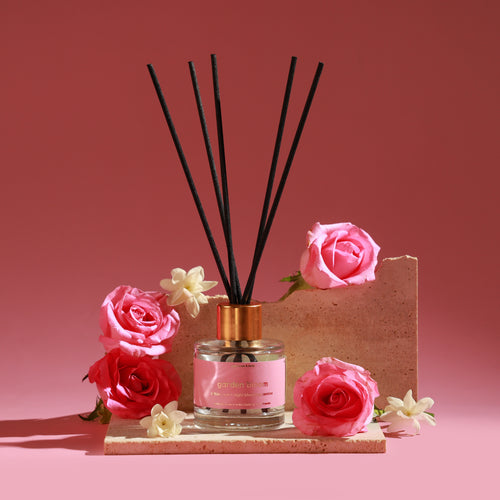
Where a second fragrance is legitimate: behind a closed door
SOSA alcohol-free reeds from ₹749
Alcohol-free, which is a genuine point in a medical building rather than a marketing one, and
Morning Freshness at ₹749 is Malabar lemon, peppermint and eucalyptus.
A scent zone is defined by a door, not by a signboard. The administrative corridor, the accounts cabin and the centre head's office are separate volumes because something closes between them and the hall, and they can carry something of their own without anybody ever meeting the two at once. Two honest limits: reeds take 24 to 72 hours to reach their working level, and their output falls away past roughly a metre, which is why they are right for a cabin and useless in a forty-seat hall. A glass bottle of oil at reach height in a public area with children in it is a spill and an ingestion risk.
A note from Sonal
The request that prompted this page came from a medical centre in Bengaluru with six specialities and a long hall, and it was put to me thoughtfully. Could paediatrics have something a little friendlier at its end, and could the orthopaedic end have something more serious, so that a family with a child and a man with a knee brace both felt the room had been arranged with them in mind. I liked the question enough that I spent an afternoon trying to find a way to say yes to it, and there is not one. The hall was forty-one feet long with a single air-handling branch serving the whole of it. Whatever went in at one end was at the other end within minutes, in a proportion set by the fan.
What we did instead was better than what was asked for, and cheaper. The paediatric end got lower seating, a wipe-clean floor, a warmer light and its own queue geometry, and the clinical side of paediatrics got nothing at all in the air, which is the correct answer there and not a compromise. The hall runs one machine on the lightest scent in the range at one setting nobody has changed in over a year. Both ends feel deliberate, and neither of them feels fragranced, which is the result a medical building should be after. I would rather sell one machine that holds a room honestly than two that argue with each other across it, and in this cluster that is not a slogan — it is simply what the air does.
Everything is made and supported from Pune, and a part of every order funds girl-child education through Nanhi Kali. You get a space that smells like somewhere looked after; a girl gets a classroom. That equation has always felt right to me.
Frequently asked questions
Should each department in a shared waiting area have its own fragrance?
No. A shared waiting area is one volume of air and air mixes, so two compositions produce a single blend whose ratio changes with the fan speed, the front door and the hour. That blend is a third composition nobody formulated. One machine, one oil and one locked setting is the correct configuration.
What happens if we run two diffusers at opposite ends of the same hall?
You get a higher total concentration and a muddier impression rather than two experiences. The light tops of both cancel into something vaguely citric and the heavy ends accumulate together through the afternoon. The usual sequel is that each department turns its own machine up, and a patient asks reception what the smell is — which is the clearest sign the level is wrong.
When is more than one fragrance in a clinic legitimate?
When a door closes between the two volumes. An administrative corridor behind a fire door, a separate floor with its own lift lobby, or a café that is a room rather than a counter are genuine second zones. A departmental corner, a low partition or a signboard is not. A scent zone is defined by a door, not by signage.
How do we make departments feel different without using different scents?
Seating, signage, lighting and queue geometry, in that order. Lower chairs and a wipe-clean floor for a children's bank, signboards using the words patients use, a warmer colour temperature over one seating area, and queues that do not cross each other. All four work, none of them puts anything into the air, and paediatric clinical areas stay fragrance-free.
Can we at least run the same scent at different strengths in different areas?
One volume, one composition
A scent zone is defined by a door — not by a signboard
The Vaayu is ₹11,999: waterless cold-air nebulisation with no standing water tank, up to 1000 m³ or roughly 2,000–3,000 sq ft, a 400ml tank lasting about seventy-five days, Bluetooth app control with 1h/4h/8h/24h timers, under 38 dB, auto-stop and a key-lock so one setting stays one setting, supplied with four hotel-inspired fragrances. Alcohol-free reed diffusers from ₹749 for a room with a door on it. Free shipping above ₹499, and a portion of every order supports girl-child education through Nanhi Kali.
See the Vaayu · ₹11,999 Alcohol-free reeds · from ₹749
Continue the read
More from SOSA
Editorial standards & sources
About this guide: Written by Sonal Sahani, ISIPCA Versailles-trained founder and perfumer at SOSA Home & Body, on why a waiting area shared by several specialities takes one fragrance rather than several: what happens physically when two compositions decay into the same volume of air, why the resulting blend is neither chosen nor stable, why a nose integrates two ambient scents rather than separating them, and the door test that decides where a genuine second scent zone begins.
Facts verified August 2026: Product facts used in this guide. SOSA Vaayu ₹11,999: waterless cold-air nebulising diffuser, atomises undiluted fragrance oil to a dry residue-free nano-mist with no water reservoir, coverage up to 1000m³ (approximately 2,000–3,000 sq ft), 400ml refillable tank lasting up to about 75 days per fill, Bluetooth app plus onboard control, 1h/4h/8h/24h timer scheduling, adjustable intensity, under 38 dB, DC 12V/1A at 5W, 165 × 80.5 × 215 mm and 0.9 kg, freestanding or wall or HVAC mounted, auto-stop and key-lock, CE, RoHS and SGS certified, supplied with four hotel-inspired fragrances. SOSA Aangan ₹25,999: HVAC-connected or standalone commercial nebulising diffuser, coverage up to 3,000m³ (roughly 8,000–10,000 sq ft), 800ml reservoir, metal body, programmable schedules, under 42 dB. Ultrasonic machines are water-based, hold standing water and consume 30–50 ml of water an hour: Sukoon ₹1,899 (500ml, 270–320 sq ft, 16–18 hours on low, 3–6 drops per tank, steady/2H/4H timers, three 15ml Hotel Collection scents included), Boond ₹899 (300ml), Megh ₹3,499 (6 litres). Hotel Collection water-based fragrance 15ml ₹299, 100ml ₹999, 300ml ₹1,799, Pack of 7 at 15ml ₹1,799 against ₹2,093 bought singly; the Vaayu and Aangan take their own undiluted oil rather than these water-based bottles. Alcohol-free reed diffusers from ₹749, requiring 24–72 hours to reach their working level. Free shipping above ₹499. Coverage arithmetic: cubic metres equal floor area in square feet divided by 10.76 and multiplied by ceiling height in metres, counting only the volumes that are actually scented. This guide makes no medical, therapeutic or clinical claim of any kind for fragrance: a diffuser does not purify, disinfect or clean air, and does not treat, calm or affect any patient or condition. Fragrance is housekeeping and presentation. Clinical areas should be left fragrance-free, and a persistent odour should be traced to its source and corrected rather than covered. SOSA is not affiliated with or endorsed by any hotel brand. Prices subject to change — see the live product pages.