


The arithmetic: ₹5,244 ÷ 6 rooms works out to ₹874 a room. One Vaayu costs more than the entire eight-room reed ceiling with ₹4,657 left over — and in a flat with internal doors, it will still only scent whichever single room it stands in.
The consumable nobody costs in: Vaayu runs its own neat fragrance oil — not reed oil, not the water-based Hotel Collection. Budget for that refill as an ongoing line, not a one-off ₹11,999.
2. Count the doors you shut, not the square metres you own. A 4BHK flat with a split AC in each room has, on any given evening, four or five closed doors and no shared moving air between them. Stand a Vaayu in the living room of a house built that way and it does exactly what a reed bottle does — it scents the room it is standing in — for fifteen times the money and a socket besides.
3. Run the numbers. The standard 4BHK reed kit is six bottles at ₹5,244 — ₹874 a room. The eight-bottle ceiling, every bedroom slept in plus a closed kitchen, is ₹7,342. One Vaayu is ₹11,999 — more than the entire eight-room house's reed ceiling, with ₹4,657 to spare, for one room's worth of scent in a flat that cannot let it travel further.
4. Know when the Vaayu is actually correct. A villa or bungalow with a genuinely continuous double-height ground floor. A home on ducted or central air conditioning, where the AC itself is already moving air between rooms. A home office, clinic, boutique or studio built into the same structure. A household that entertains at a scale where a room needs to be scented in fifteen minutes rather than three days — the app and timer exist for exactly that.
5. The verdict. For a 4BHK flat, reeds — ₹5,244 or ₹7,342, done, no socket required. For a villa with ducted air and a hall you could hold a wedding in, the Vaayu earns its ₹11,999. And even there, reeds still do the bedrooms, because no ducted system gives a bedroom its own character — it gives the house one character, evenly, and a bedroom deserves better than even.
Alcohol-free, IFRA-compliant, composed by an ISIPCA Versailles-trained perfumer and handmade in small batches in Pune — and every purchase funds a girl's education through Nanhi Kali.

Why the dividing line is ducted air, not the size of the home
Every SOSA machine in this comparison works by putting scent into air that is already moving. A reed diffuser has no fan and moves nothing — it lets oil climb six fibre reeds and evaporate off the ends at whatever rate the room allows, which is why its reach has always been a radius, not a coverage figure. The Vaayu is different in kind, not degree: it is a waterless cold-air nebuliser that actively throws atomised fragrance outward, controlled from a phone over Bluetooth, on a timer. Standing on its own, without any ducting at all, it can genuinely fill a large continuous volume — a double-height hall, a reception area, a villa's open ground floor — because the machine itself is doing the work of moving air that a reed bottle was never built to do. The Aangan goes further still and does not rely on its own throw at all — it feeds fragrance into a building's HVAC system and lets the building's own air handling carry it through 8,000–10,000 sq ft of ducted floor.
None of that changes what a closed door does. A door is an absolute barrier to every one of these systems except the one built to be piped through ducting that runs above or beside it. Stand a Vaayu in the living room of a flat where each bedroom has its own split AC and its own door, and the machine has no more reach past that door than a reed bottle does — it simply produces a stronger, faster, more expensive version of the exact same one-room result. This is the part square footage hides. A 3,000 sq ft 4BHK and an 800 sq ft continuous studio can take the identical Vaayu with the identical result, because the qualifying fact was never the floor area — it was whether the air in that space is one body or five separate ones.
This is also where the comparison against SOSA's own ultrasonic machine, the Sukoon, is useful context rather than a distraction. The Sukoon, at ₹1,899, is built on the same assumption reeds are — one machine, one room, switched on when that room needs to perform. It does not pretend to cross a doorway either. The Vaayu is the only device in the SOSA range built to genuinely ignore a doorway, and it can only do that where the air itself does not stop at one — ducted, or one uninterrupted volume. Everything else in the lineup, reeds included, is honestly a one-room-at-a-time proposition, and pricing a large flat's worth of rooms against a single machine only makes sense once that distinction is on the table.
The three decisions before you buy either system
 Vaayu₹11,999Ask one question before any other: does central or ducted air conditioning already move air between the rooms you want scented? If the answer is yes, a machine standing at the return or supply side can ride that existing air movement and reach genuinely far. If every room runs its own split unit — the layout in the overwhelming majority of Indian 4BHK flats — there is no shared air to ride, and a Vaayu standing in the living room is, functionally, a very expensive living-room-only device. This is not a criticism of the machine. It is doing precisely what a cold-air nebuliser does; it is the home's ductwork, or lack of it, doing the rest.
Reeds vs Sukoon vs Vaayu vs Aangan — the head-to-head
Every figure below is SOSA's own stated rating for that product. Read it as a filter for which category you belong in, not a menu to choose the biggest number from — the biggest number is frequently the wrong purchase for the home asking about it.
| Factor | Reed diffuser | Sukoon | Vaayu | Aangan |
|---|---|---|---|---|
| Coverage | A soft radius per bottle, roughly one room | 270–320 sq ft per machine | Large continuous volumes on its own cold-air throw | 8,000–10,000 sq ft via a building's HVAC ducting |
| Power / mechanism | None — capillary wicking, no fan | Mains, ultrasonic mist | Mains, waterless cold-air nebulising, Bluetooth app + timer | Mains, nebulising fed into HVAC ductwork |
| Price | ₹749–₹1,299 a bottle | ₹1,899 | ₹11,999 | ₹25,999 |
| What it is for | The baseline, one room with a door | One room, changed on demand | A continuous zone with ducted or open air | Genuine commercial square footage |
| Who should buy it | Any flat with split ACs and internal doors | A home wanting one room to perform for guests | A villa with ducted air or a double-height hall; a clinic, boutique or studio | A retail floor, lobby or office tied into shared HVAC |
| Running cost | Refill 300ml ₹2,399 · 500ml ₹3,499 | Hotel Collection 100ml ₹999 | Own neat fragrance oil — a separate consumable | Own neat fragrance oil, at commercial volume |
| Read this as a filter, not a ladder: for a 4BHK with split ACs and shut doors, only the first two columns apply. The Vaayu column belongs to a different building — ducted air or one continuous room — and the Aangan column belongs to a different kind of address entirely. | ||||
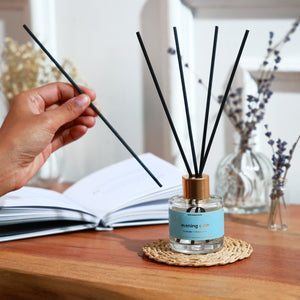
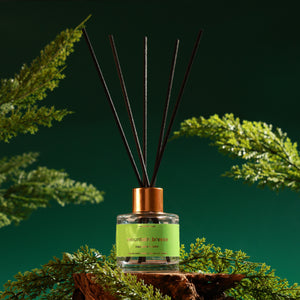
Garden Bloom · the public zone130ml ₹1,299Shop → 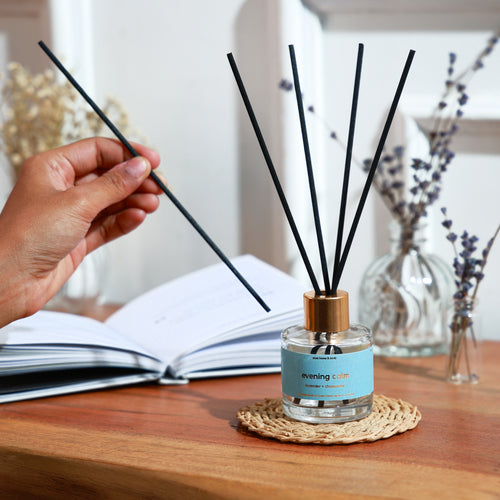 Evening Calm · the master50ml ₹799Shop →
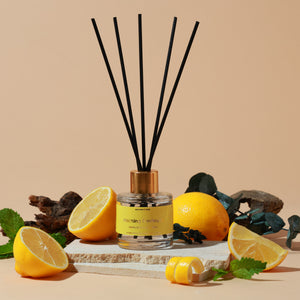
 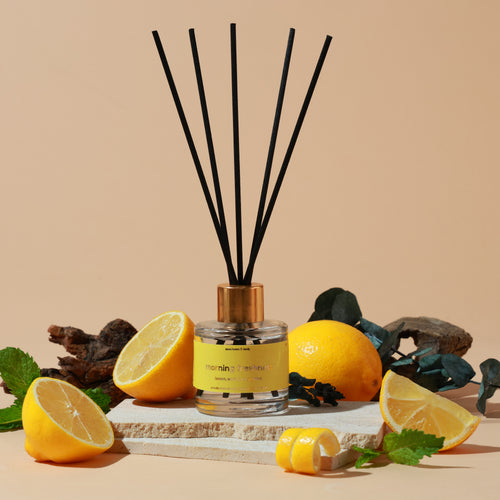 Morning Freshness · the bathrooms50ml ₹749Shop →
Running the reed side, and what Vaayu actually asks of you
The reed side of this decision runs on the same discipline as every other home size in this cluster, because nothing about owning more rooms changes how a fibre reed works. Six reeds in the public zone, three in each occupied bedroom, two to three in each bathroom — flip every reed saturated-end up every three to five days, and refill at roughly eighty per cent empty. The full detail of that layout, room by room, for a standard 4BHK is covered in the dedicated 4BHK setup guide; the short version is six bottles, ₹5,244, and a Sunday flip that resets the whole house together.
The Vaayu side of the routine is different in shape, not just in cost. There is no reed to flip, but there is a fragrance cartridge to monitor, a water-free cold-air chamber to keep clear of dust, and an app to actually open — the Bluetooth control and timer are the machine's real advantage over a reed bottle, letting a household schedule the hall to switch on twenty minutes before a dinner party rather than running continuously and going stale on the nose by the time guests arrive. That scheduling only pays for itself in a room built to receive it: a continuous hall or a ducted zone. Point the same machine, on the same schedule, into a closed room with a shut door, and the app is faithfully switching on a device that is, once again, simply scenting the room it stands in — expensively, and on a timer nobody in that room can smell the benefit of.
The one housekeeping rule that matters more than either routine is keeping the liquids apart. Reed oil is fractionated coconut oil, built to wick. Hotel Collection is water-based, built to atomise in an ultrasonic machine like the Sukoon. Vaayu's own fragrance oil is formulated for a cold-air nebulising chamber and belongs in neither of the other two vessels, nor do either of those belong in it. Three products, three bottles, and a habit of reading the label before you refill anything is worth more than memorising which is which.
What reeds and a Vaayu actually cost in a large home
The arithmetic in full, checked by hand. Reeds carry no running cost beyond the oil itself. A Vaayu carries its own fragrance cartridge on top of the ₹11,999 machine price, which is worth naming plainly rather than discovering after the first refill is needed.
| Setup | What you get | Covers | Total |
|---|---|---|---|
| The start | One Morning Freshness 50ml ₹749 | One bathroom — the highest-return single bottle at any home size | ₹749 |
| The whole-house baseline ★ | Six reed bottles, the standard 4BHK kit — public zone, three bedrooms, two bathrooms | Every occupied room, steady, no power | ₹5,244 |
| The ceiling | Eight reed bottles — all four bedrooms slept in, closed kitchen too | The entire house, at the honest ceiling for this cluster | ₹7,342 |
| If your home genuinely qualifies | One Vaayu for the continuous zone — plus reeds for every bedroom behind a door | A villa hall or ducted public zone, and every bedroom still on its own bottle | from ₹11,999 |
| Running cost | A 500ml reed refill ₹3,499 (ten 50ml fills), or the Vaayu's own oil cartridge | Reed refill runs roughly ₹350 a fill; the Vaayu's oil is a separate, ongoing line | from ₹2,399 |
Versailles
We build the Vaayu and I am proud of it — it is a properly engineered machine, and the app and timer genuinely solve a problem reeds cannot: turning a large room over in minutes rather than months. So when someone calls asking whether they should buy one for their 4BHK, I do not want to talk them out of a good product. I want to ask them one question first: does your air conditioning move air between rooms, or does every room have its own unit? Nine times out of ten, the answer ends the conversation before it starts, and it ends it in favour of six reed bottles and ₹5,244.
The households where I do recommend the Vaayu are unmistakable once you meet them — a villa with a hall you can see across from the front door to the far wall, or a house on genuinely central air where the AC itself is already doing half the machine's job for it. In those homes ₹11,999 is not a splurge, it is the correct tool. What it is not, in either kind of home, is a replacement for the bedrooms. Ducted air gives a house one character. A bedroom deserves its own, and only a bottle standing three feet from the bed gives it that.
Selling the honest answer costs us a sale more often than it makes one, and that has never once made me reconsider it. Every purchase — the ₹749 bottle and the ₹11,999 machine alike — funds a girl's education through Nanhi Kali, not a percentage, not a quarterly cheque. Every one.
Frequently asked questions
- How many reed diffusers does a 4BHK need? — the count logic behind the five-to-eight-bottle range.
- Should every bedroom in a 4BHK have its own reed diffuser? — the occupancy question that decides six bottles or eight.
- Where to place reed diffusers in a large home — the surface, the height and the draught, room by room.
- How many reed diffusers are too many for one home? — the ceiling, and why past it a house stops smelling of a fragrance.
- Brand: the SOSA founder story.
SOSA reed diffusers & prices (verified August 2026): Morning Freshness (Malabar lemon · peppermint · eucalyptus) 50ml ₹749 · 130ml ₹1,249 · Evening Calm (lavender · chamomile) 50ml ₹799 · 130ml ₹1,299 · Garden Bloom (British rose · night-blooming jasmine) 50ml ₹799 · 130ml ₹1,299 · Fresh Brew (Coorg coffee · Kerala vanilla) 50ml ₹849 · 130ml ₹1,349 · Mountain Breeze (Himalayan pine · sage · cedar) 50ml ₹849 · 130ml ₹1,349. Duo sets: Day & Night 2 × 50ml ₹1,498 · 2 × 130ml ₹2,498; Fresh & Grounded 2 × 50ml ₹1,548 · 2 × 130ml ₹2,548; Warmth & Bloom 2 × 50ml ₹1,598 · 2 × 130ml ₹2,598. Refills 300ml ₹2,399 · 500ml ₹3,499. Six fibre reeds included with every bottle; refillable glass. 50ml suits rooms up to 150 sq ft and lasts 6–8 weeks; 130ml suits rooms above 150 sq ft and lasts 14–18 weeks. Fractionated coconut oil (CCT) carrier, alcohol-free, phthalate-free, paraben-free, IFRA-compliant, low VOC; tested through 45°C heat and 85% monsoon humidity. Composed and handmade in small batches in Pune. Ultrasonic machines quoted for comparison: Boond ₹899 · Sukoon ₹1,899 · Megh ₹3,499, which run the separate water-based Hotel Collection fragrances (15ml ₹299 · 100ml ₹999 · 300ml ₹1,799) — the two lines are not interchangeable. Vaayu (₹11,999) and Aangan (₹25,999) are SOSA's waterless nebulising machines for large or commercial spaces and run their own separate fragrance oil, compatible with neither reed oil nor the Hotel Collection. Every purchase funds a girl's education through Nanhi Kali. Prices and availability subject to change — see the live product pages.