
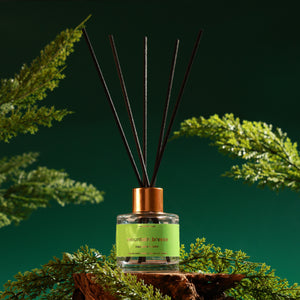

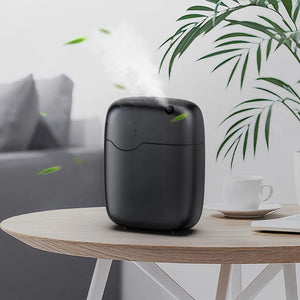
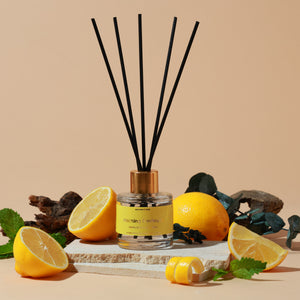

A reed diffuser has no off switch and no dial. Reed count is its only volume control, and changing it takes a day or two to register in the room. That is a structural property of passive capillary diffusion, not a fault — and in a clinic it is the decisive limitation.
Where the reed wins: silence, and nothing to maintain. No power, no motor, no noise at all, no refill schedule beyond the bottle itself, and nothing for a member of staff to fiddle with. Under about 150 sq ft, in a practice that never needs to switch it off, it is a perfectly good answer at ₹749–₹1,349.
What this page will not claim: fragrance does not calm anyone, shorten a wait, improve comfort or aid recovery, and no format cleans, purifies or removes anything from the air. Nothing here is medical, clinical or safety advice, and the practice — not SOSA — sets its own policy.
2. Consistency — the machine, with one caveat. A reed bottle follows a predictable curve: a spike over the first two or three days as dry reeds saturate and top notes leave, a settling fortnight, then a long flat plateau. The plateau is the product and it is genuinely steady, but you cannot skip the first fortnight. A machine is at its setting from the first minute — provided you can keep buying the oil, which is where the caveat sits.
3. Noise — a real question, and the number is public. The Vaayu is specified under 38 dB. That matters more in a waiting area than anywhere else, because a machine you can hear in a quiet room is worse than no fragrance at all. A reed diffuser makes no sound whatsoever, which is the one criterion it wins outright.
4. Who can change the setting — the machine, and this is underrated. Levels drift upward in busy buildings because someone decides the room smells of nothing and turns it up. The Vaayu's key-lock exists precisely to stop that; on a Sukoon, keep the remote in a drawer and name one person who owns the setting. A reed cannot be turned up, which sounds like the same protection, but it also cannot be turned down when it needs to be.
5. Price is not the deciding factor here. A 130ml reed at ₹1,349 runs 14–18 weeks; a Sukoon at ₹1,899 is a one-off with 15ml Hotel Collection refills from ₹299. Over a year the two are closer than they look, and the Vaayu at ₹11,999 is a different order of spend justified by area and control rather than by fragrance quality.
6. Whichever you choose, the rest of the clinic gets nothing. Reception and waiting only; examination rooms, refraction and diagnostics, consultation cabins, dilation bays, the procedure suite and post-operative areas stay fragrance-free. Freestanding placement only — a Vaayu is never mounted into shared air-conditioning in a clinical building. Ventilation, cleaning protocol and patient suitability are decisions for you and your clinicians, not for me.
Everything SOSA makes is composed and made in small batches in Pune, and a portion of every order supports girl-child education through Nanhi Kali.

Part one — three of the four criteria, in detail
Fragrance quality is not one of the four, and that is deliberate: the same composition can be run in either format at a level you would struggle to tell apart. What separates them is everything around the fragrance — and in a medical building that is what decides.
 Mountain Breeze₹849 · silent, no controlsA new reed bottle does not present its final character for a fortnight. There is a spike over the first two or three days while dry reeds saturate and the lightest materials leave, a settling period of a week or two, and then a long flat plateau that holds to the end of the bottle. The plateau is the product, and it is genuinely consistent — but a practice that judges a bottle in week one is judging the wrong thing. Indian conditions move it about as well: heat raises evaporation and monsoon humidity slows it, so the same bottle behaves differently in May and August. A machine has no such curve; it produces its setting from the first minute. Its consistency risk is elsewhere — it depends entirely on being able to buy the same oil again, which is the caveat in Part three.
Part two — the two formats on eight measures
Three columns, because "machine" means two different things at two very different prices. The four criteria that decide a clinic are the first four rows.
| Measure | Reed diffuser ₹749–₹1,349 | Sukoon ultrasonic ₹1,899 | Vaayu waterless ₹11,999 |
|---|---|---|---|
| Control over the level ★ | Reed count only; acts over a day or two | Intensity, remote, steady / 2H / 4H timers | Intensity plus 1h/4h/8h/24h windows and day selection |
| Consistency | Spike, settle, then a long flat plateau | At its setting from the first minute | At its setting from the first minute |
| Noise | Silent. Nothing to hear at all | Quiet ultrasonic operation | Under 38 dB, 5W |
| Who can change it | Anyone, by adding reeds — and slowly | Anyone holding the remote; keep it in a drawer | Nobody, with the key-lock on |
| Can it be switched off? | No. Removing reeds takes a day or two to register | Yes, instantly | Yes, instantly, and on a schedule |
| Coverage | A fragrant zone around the bottle, not a room | 270–320 sq ft | Up to 1000 m³ ≈ 2,000–3,000 sq ft |
| Humidity added | None | Yes — ultrasonic; keep it away from records and equipment | None; waterless nebulisation of undiluted oil |
| Consumable, and the honest gap | 50ml 6–8 weeks, 130ml 14–18 weeks. Reeds not sold separately | Hotel Collection 15ml ₹299 · 100ml ₹999 · 300ml ₹1,799 | 400ml in the box; no separate cold-air refill oil sold at present |
| The honest caveat: this compares product behaviour, not effects on people. No claim is made about comfort, anxiety, perceived waiting time, recovery, reviews or revenue, and no product is described as safe or unsuitable for any patient group. Coverage figures are manufacturer specifications and vary with ceiling height, air exchange and occupancy. Reed oil cannot be used in an ultrasonic machine, water-based Hotel Collection oil cannot be used in a reed bottle, and neither belongs in a Vaayu. Whether fragrance suits your building is a judgement for you and your clinicians. | |||
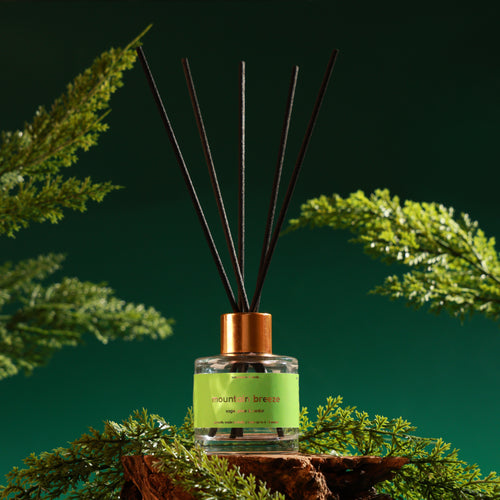 Mountain Breeze · silent, passive, small zones₹849Shop → Sukoon · control at clinic scale₹1,899Shop →
 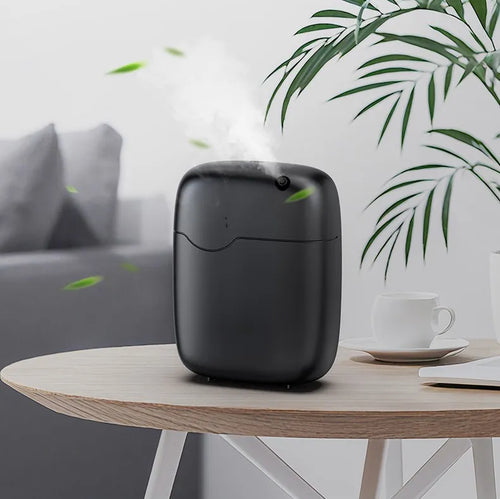 Vaayu · scheduling and a key-lock₹11,999Shop →
Part three — when neither format is the answer
Two situations rule out both, and one rules out the expensive option specifically. The first is an under-ventilated reception. If the front of your building smells closed by mid-afternoon, neither a bottle nor a machine improves it — you are adding a second thing to air that is not leaving, and the room reads heavier rather than fresher. A diffuser adds a scent alongside what is already there; it removes nothing, cleans nothing and neutralises nothing. That is a ventilation question with a ventilation answer, it costs nothing to test, and it comes first.
The second is a children's eye clinic or a large paediatric caseload, where I would decline outright rather than recommend a format. The third is narrower: a reed diffuser is the wrong instrument where waits routinely run to two or three hours, because the response to very long exposure is a scheduled run window with gaps rather than a lower continuous level — and only a machine can do that.
Then the supply point, which applies specifically to the most capable option. SOSA does not currently sell a separate cold-air refill oil for the Vaayu. The 400ml in the box lasts roughly ninety days or more at a mid setting and is the whole supply at the time of writing. A home buyer finds that inconvenient; a practice that has standardised a scent across a reception, or across branches, finds it a business problem. The water-based Hotel Collection is made for ultrasonic machines and is not a Vaayu refill. Confirm current availability through the contact page before committing to continuous or multi-site use.
Part four — which format for your reception
Measure reception plus waiting and ignore the consulting rooms. The right-hand column is the honest part: whichever you choose, you are accepting a specific limitation.
| Your reception | The format | Product and price | The limitation you accept |
|---|---|---|---|
| ~150–320 sq ft, ordinary clinic hours ★ | Ultrasonic machine | Sukoon ₹1,899, lowest intensity, 4H timer | It adds humidity; keep it away from records and equipment |
| Under ~150 sq ft, quiet list, never needs switching off | Reed diffuser | Mountain Breeze 130ml ₹1,349, three reeds | No off switch, and corrections take a day or two |
| ~320–800 sq ft of connected public area | Waterless machine | Vaayu ₹11,999, freestanding, key-lock on | Refill supply is unresolved — confirm before committing |
| Procedure days when fragrance must be off entirely | Machine, no exceptions | Sukoon ₹1,899, or Vaayu with day selection | Someone must own the schedule and actually keep it |
| Staff room or back office, if the team wants it | Reed diffuser | Morning Freshness 50ml ₹749 | Ask the team, not the patients — it is their air all day |
| Reception that smells closed by mid-afternoon | Neither, yet | ₹0 today; ventilation first, re-test in a fortnight | You accept that this is a building problem, not a product one |
Versailles
I sell more reed diffusers than anything else, and I have talked several eye practices out of them. What usually decides it is asking what happens on a day the practice wants the fragrance switched off — and there is a pause, because with a bottle on a console table there is no such day available. You can carry it out of the room, which is an admission rather than a plan.
What the reed does better than any machine is disappear as an object. It makes no sound, needs no socket, has nothing to service and cannot be adjusted by an enthusiastic member of staff at four in the afternoon. In a small reception, in a practice that has settled on a level and wants to stop thinking about it, that is a genuinely good answer and I would rather sell a ₹1,349 bottle that fits than a machine that does not.
But most eye clinics eventually want the off switch, and the honest thing is to say so before the purchase rather than after it. I would also rather a practice bought the ₹1,899 machine that matches its arrival zone than the ₹11,999 one that matches its floor plate; sizing to the reception rather than the clinic is the correction I make most often in this trade. Made in Pune in small batches, and a part of every order funds a girl's classroom through Nanhi Kali.
Frequently asked questions
- Scenting reception only — what physically holds the boundary.
- A small waiting room and a large reception with a hot spot.
- Where the source goes once you have chosen the format.
- Should patients notice the fragrance at all — the intensity doctrine.
- Brand: the SOSA founder story.
SOSA range, specifications and prices used in this guide (verified August 2026): Vaayu ₹11,999 — waterless cold-air nebulisation of undiluted fragrance oil; no water, no heat, no added humidity, no white mineral dust. Coverage up to 1000 m³, about 2,000–3,000 sq ft. 400ml refillable tank lasting roughly 90+ days at a mid setting. Bluetooth app plus onboard controls, 1h / 4h / 8h / 24h run windows, day selection, adjustable intensity, auto-stop and key-lock. Under 38 dB. DC 12V / 1A, 5W. Freestanding or wall / HVAC mount. CE, RoHS and SGS certified. SOSA does not currently sell a separate Vaayu cold-air refill oil; the 400ml supplied in the box is the fragrance available at the time of writing, so a practice planning continuous or multi-site use should confirm current refill availability with SOSA before committing. The water-based Hotel Collection is made for ultrasonic machines and must not be used in a Vaayu. Other machines: Boond 300ml ₹899 (~150 sq ft, ultrasonic) · Sukoon 500ml ₹1,899 (270–320 sq ft, 16–18 hours on low, remote and steady/2H/4H timers, three 15ml fragrances included, ultrasonic) · Megh 6L ₹3,499 (~215 sq ft — a runtime and humidity machine that covers less than a Sukoon, never a coverage upgrade) · Safar ₹3,999 (waterless cold diffusion, cordless, 20ml, about 6.9cm, three speeds, 1/2/3-hour auto-off — sold as a car and travel diffuser, personal-scale only; SOSA publishes no coverage figure for it) · Aangan ₹25,999 (HVAC nebulising, ~8,000–10,000 sq ft) · Meenar ₹38,500 (commercial HVAC, 12,000–18,000 sq ft). Water-based Hotel Collection for ultrasonic machines: 15ml ₹299 · 100ml ₹999 · 300ml ₹1,799 · pack of seven ₹1,799; scents are inspired by the atmosphere of well-known hotels — SOSA is an independent Indian brand and is not affiliated with, endorsed by or supplying any hotel group. Reed diffusers ₹749–₹1,349 (50ml 6–8 weeks, 130ml 14–18 weeks, six fibre reeds, no 100ml size; replacement reeds are not sold separately). Reed oil cannot be used in an ultrasonic machine and Hotel Collection oil cannot be used in reeds. SOSA sells no room spray or home spray — every SOSA spray is a car perfume. Nothing in this guide is medical, clinical or safety advice. A fragrance diffuser adds a scent to the air. It does not clean, purify, filter, sanitise or disinfect air, does not remove or neutralise disinfectant, damp or occupancy smells, and has no effect on comfort, anxiety, waiting time, recovery or any clinical outcome. Some people are sensitive to airborne fragrance, which is why this guide recommends that examination rooms, diagnostic areas, consultation cabins, procedure suites and post-operative areas remain fragrance-free, that a fragrance-free seating option always exist, and that a diffuser is never mounted into shared HVAC in a clinical building. Decisions about clinical policy, ventilation standards, infection control and patient suitability rest entirely with the practice and its clinicians. A persistent stale, damp or disinfectant smell is a ventilation, moisture or cleaning problem — SOSA sells no dehumidifier and no air purifier, and fragrance should never be used to cover one. Coverage, runtime and longevity figures are manufacturer specifications and typical ranges, not guarantees, and vary with room volume, ceiling height, air exchange, occupancy and season. SOSA publishes no commercial or bulk pricing, no corporate account, no annual maintenance contract, no installation service, no stated warranty term and no multi-location programme; warranty length, spare parts, servicing and app platform availability are unconfirmed, and larger or multi-site enquiries should go through the contact page before any commitment. Composed and made in small batches in Pune, India. Free shipping above ₹499. A portion of every order supports girl-child education through Nanhi Kali. Prices subject to change — see the live product pages.