





Why it seems to go even faster: your nose adapts to a steady smell in roughly twenty minutes. Some of "gone by noon" is you, not the room.
What actually holds a background: a continuously fed evaporating surface. That is what a reed diffuser is, and it is the reason it runs for weeks rather than an hour.
2. Then: some of "gone by noon" is your nose rather than the room. Olfactory adaptation is essentially complete within about twenty minutes. Your sense of smell is built to detect change, not steady state, so a constant background stops registering long before it is actually absent. That means your reading of your own home at noon is unreliable in a specific and predictable direction — it under-reports. Confirm it with the thirty-minute test: at eleven, leave the flat for half an hour, then come back in and judge the very first breath at the door before you take your shoes off. If there is a faint trace of the cleaner still there, part of what you called "gone" was adaptation. If there is genuinely nothing, the fragrance really has left.
3. Then: there is nothing left behind to keep releasing it. Every long-lasting smell in a home works the same way — something holds the molecules and lets them out slowly. Curtains do it with cooking oil. A reed does it with fragrance oil. A mopped floor does neither. Once the film has evaporated, the tile is a hard, non-porous surface with nothing on it, which is what you wanted from the cleaning. A wet floor is a delivery, not a source. This is also why buying a stronger cleaner, or using more of it in the bucket, does not extend the afternoon: you get a bigger delivery and the same empty tile an hour later. And in a small flat you can reach a point where the nine o'clock hour becomes unpleasantly sharp while noon is unchanged, which is the worst of both.
4. And this matters: neutral is the correct state for a clean home. It is worth being explicit, because a lot of advertising suggests otherwise. A clean, dry, ventilated flat has no smell of its own to speak of. Reaching neutral is the achievement; everything past it is decoration, and there is nothing wrong with wanting decoration. Your flat is at the finish line, and you would simply like to keep going. That reframes the purchase completely — you are not buying a corrective, you are choosing what your home smells like in the same way you chose the paint. Which, unlike almost every other question in this series, means the answer really is a product.
5. The one thing here that would be a genuine fault. Watch what happens after noon. If the flat sits at neutral all afternoon, everything above applies and you are simply choosing a background. If by four or five it goes past neutral into stale, closed or musty, that is a different problem and no fragrance will help — that is an air-change or moisture or fabric issue, and scenting over it gives you both smells at once. Test it by leaving for half an hour at five and judging the first breath back. Neutral at five: buy the diffuser. Stale at five: fix the cause first, and come back to the diffuser afterwards.
Made in India, composed by an ISIPCA Versailles-trained perfumer — and a portion of every order supports girl-child education through Nanhi Kali.
Why a top note cannot last an afternoon, and why that is fine
There is a simple physical reason a floor cleaner behaves the way yours does, and once you see it the whole question stops being frustrating. Fragrance materials differ enormously in how readily they evaporate. The light ones — lemon, mint, pine, eucalyptus and the crisp green notes that the whole world has learned to read as "clean" — leave a surface quickly, which is why they are the obvious choice for something you spread across a floor and want to notice immediately. Heavier materials would linger far longer, but they would also cling to a floor, dull with time and be entirely wrong in a cleaning product. So the formulator picks the volatile end on purpose. The brevity is not a compromise in the product; it is the specification.
The second half is the carrier. Everything in your mop bucket arrives on the floor dissolved in water, and it leaves when the water leaves. As the film evaporates it takes the fragrance with it into the air, which is the lovely part, and then there is nothing left on the tile to continue the process. Compare that with how a persistent background actually works anywhere in a home: something has to hold a supply and release it slowly. Your curtains do it involuntarily with cooking oil, which is why last night's dinner is still around at breakfast. A reed diffuser does it deliberately — capillary action draws oil up the fibre and it evaporates from the exposed length, so as fast as the surface gives fragrance up, more arrives. One is a single delivery; the other is a fed source, and only a fed source can hold an afternoon. No amount of stronger cleaner turns the first into the second, because they are different mechanisms rather than different strengths.
What is actually happening, in order
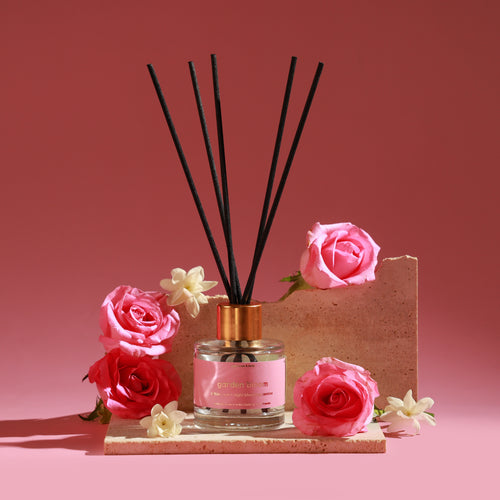
 The right tool hereFrom ₹749Oil-based fragrance travels up the porous fibre reeds by capillary action and evaporates from the length that is exposed to the room. The rate is set by how much surface is exposed, how warm the room is and how much air moves past — which is why the number of reeds is your volume dial. Six is full strength for a living room or hall, four suits a bedroom, and two or three is right for a small bathroom. It needs no electricity, has nothing to switch on, and cannot be forgotten. A 50ml at ₹749 runs 6–8 weeks and a 130ml at ₹1,249 runs 14–18, covering a room up to roughly 150 sq ft. That is the shape of what you asked for: a quiet background that is simply there at three in the afternoon without anyone having done anything at nine.
Symptom to cause: what your afternoon is telling you
Most of this table is not a fault list. It is a set of readings, and only two of the rows describe something that needs fixing rather than choosing.
| What you notice | Most likely cause | How to confirm it | What actually fixes it |
|---|---|---|---|
| Fragrance disappears roughly when the floor finishes drying ★ | Normal — a volatile top note carried in a water film that has now evaporated | Note the minute the floor dries, then check the room twenty minutes later | Nothing is wrong. For an all-day background, add a fed source rather than a stronger cleaner |
| It seems to fade faster than other people say it should | Olfactory adaptation — your nose stops registering a steady smell in about twenty minutes | Leave the flat at 11 AM for thirty minutes and judge the first breath at the door | Judge levels on returning, never from inside; set a diffuser by the same test |
| Buying a stronger cleaner made the morning sharper and the afternoon identical | The limit is mechanism, not concentration — there is no reservoir to feed the afternoon | Compare a double-strength bucket with a normal one at 9:30 and again at 12:00 | Go back to normal dilution and put the money into a continuous source instead |
| The flat is neutral all afternoon and you simply want it to have a character | Nothing at all — this is a preference, and neutral is the correct state for a clean home | Confirm it stays neutral rather than sliding: judge the first breath back at 5 PM | A reed diffuser at six reeds in the hall and four in the bedroom; choose for the room |
| By 4 or 5 PM it has gone past neutral into closed or stale | Air-change rate or a fabric reservoir — this is a real problem, not a fragrance gap | Thirty minutes out at five, then judge the door; check curtains and sofa at close range | Ten minutes of cross-ventilation twice daily; wash the large textiles; then fragrance |
| A musty, earthy or drain-like note appears at any point in the day | Damp, mould or a dry water seal — not a fragrance problem in any version | Check wall bases and ceiling corners; pour water down every rarely-used drain | Find the moisture or the failed trap and fix it. Adding scent here makes it worse. |
| If none of these fit: leave the flat for half an hour and judge the first breath back at 9:30, at noon and at five. Three honest readings tell you whether you are choosing a fragrance or fixing a fault, and they cost nothing but a walk. | |||
Reeds · always-on roomsFrom ₹749Shop →  Sukoon · when you want a switch₹1,899Shop →
  Hotel Collection · the scentFrom ₹299Shop →
How to set it up for an all-day background
Start with one bottle in the right place rather than three in the wrong ones. The highest-value position in almost any flat is the entrance — a console, a shoe cabinet top, a shelf near the door — because it is where you and every visitor take the first breath, and because entrances are small and sheltered, so scent holds there. Put it at roughly chest height, on an internal wall, away from a direct draught or a fan. A bottle in a strong draught throws harder and empties much faster; a bottle in a still corner behind a curtain does very little. Then set the level with the reeds, because the reed count is the volume dial. Six for a hall or living room, four for a bedroom, two or three for a small bathroom. Start one reed lower than you think you want and add rather than subtract, because a reed already soaked in oil keeps giving even after you remove it.
Choose the blend for the room and the time of day you care about. Since your reference point is the way the flat smells after mopping, you probably want something in the same family — crisp and clean rather than sweet. Morning Freshness is the closest to that impression: Malabar lemon, peppermint and eucalyptus, which is the vocabulary of a freshly aired room. Mountain Breeze is drier and more resinous if you would rather the flat read as calm than as bright. Evening Calm suits a bedroom, and Garden Bloom a living room where you want something floral without it turning sugary. A 50ml at ₹749 covers a room up to roughly 150 sq ft for 6 to 8 weeks; a 130ml from ₹1,249 does 14 to 18, which in practice is the better value if you know you will keep it running. When the throw drops after a couple of months, replace the reeds rather than the liquid — reeds clog with time, and six fresh ones in a half-full bottle usually restores it completely. Refills are 300ml at ₹2,399 and 500ml at ₹3,499 once you have settled on a scent, and the duo sets — Day & Night at ₹1,498, Warmth & Bloom at ₹1,598, Fresh & Grounded at ₹1,548 — are the cheaper way to try two.
And judge it from the doorway, not from the sofa. This is the part people get wrong, and it follows directly from why your floor cleaner seemed to vanish at noon. You adapt to a constant smell in about twenty minutes, so within half an hour of setting a diffuser up you will conclude it is too weak and add reeds — and then a visitor will find the flat overpowering. Set it, leave the house for thirty minutes, and judge the first breath on the way back in. Adjust once a week rather than once an hour. If what you actually want is something stronger for a specific evening rather than more background, that is a different tool: the Sukoon at ₹1,899 covers roughly 270 to 320 sq ft on 3 to 6 drops of the water-based Hotel Collection from ₹299 and switches off afterwards. For the all-day background you described, though, the reeds are the better answer — a machine you have to remember to switch on is not a background, and the two liquids are not interchangeable in either direction.
What to do, in order
The first three steps you are already doing, which is why your flat reaches neutral in the first place. For once, the interesting part of this page is the fourth step.
| Step | What to do | When | Cost |
|---|---|---|---|
| 1. Remove the source | You are already here — the flat reaches genuine neutral, which means there is no live source to find | Before anything else | ₹0 |
| 2. Move the air | Keep the ten minutes of cross-ventilation twice a day; it is why noon is neutral rather than stale | Daily, five to ten minutes | ₹0 |
| 3. Deal with what holds it | Keep bedding weekly and curtains seasonal, so nothing accumulates a reservoir to release later | Weekly to monthly | ₹0 |
| 4. Then the always-on layer ★ | A SOSA reed diffuser — exactly what you asked for — a continuously fed source that holds a quiet background from morning to night | 50ml 6-8 weeks · 130ml 14-18 | from ₹749 |
| 5. Or the on-demand layer | Sukoon with a Hotel Collection scent — a specific evening rather than an all-day background; it needs switching on, so it is not a background | Run it when you want it | ₹1,899 |
Versailles
I spend most of this series telling people not to buy anything. This is the page where I get to say the opposite, and I want to be clear about why the answer changes. Everywhere else the reader has a live source and fragrance would only add to it. You do not. Your flat reaches genuine neutral by noon, which means the cleaning, the airing and the laundry are all doing their job. There is nothing to fix. What you want is a background, and a background is precisely what a reed diffuser is for.
The reason your floor cleaner cannot give you one is not a defect in the cleaner. It is a light top note in a water film, and both the note and the film are gone within the hour by design. Asking it to hold an afternoon is like asking a match to heat a room. Buying a stronger one gives you a louder nine o'clock and the same empty noon, and in a small flat it can make the first hour genuinely unpleasant.
So: one bottle near the door, six reeds in a hall and four in a bedroom, at chest height and out of the draught, and then leave it alone for a week. Judge it from the doorway after half an hour outside, never from the sofa, because you will always under-read your own home. And do keep the ten-minute purge — a diffuser is an addition to a well-aired flat, never a substitute for airing one. A portion of every order funds a girl's classroom through Nanhi Kali.
Frequently asked questions
- Keeping a home fresh once it is clean — the maintenance side of the same question.
- A consistent living-room signature — why consistency beats strength.
- Spotless but not fresh — clean is a negative; fresh is a positive.
- Is one reed diffuser enough for a small room? — reed count, volume and placement.
- Brand: the SOSA founder story.
SOSA products & prices (verified August 2026): Hotel Collection water-based ultrasonic diffuser fragrance 15ml ₹299 · 100ml ₹999 · 300ml ₹1,799 · Pack of 7 (15ml, all fragrances) ₹1,799; refills 100ml from ₹999. Seven scents: The Ritz-Carlton-inspired (white tea · bergamot · cedar), Westin-inspired (white tea · aloe · cedar), 1 Hotels-inspired (cedarwood · vetiver · green leaves), The St. Regis-inspired (amber · violet · woods), Shangri-La-inspired (jasmine · green tea · white tea), Four Seasons-inspired (citrus · floral · sandalwood), W Hotels-inspired (citrus · pepper · amber). Diffusers: Boond 300ml ₹899 · Sukoon 500ml ₹1,899 · Megh 6L ₹3,499. Water-based, phthalate-free, composed to IFRA standards for home diffusion; 3–6 drops per tank. Made in India, Pune. The Hotel Collection scents are SOSA's own interpretations inspired by the world's finest hotels; all hotel names are trademarks of their respective owners and are used only to describe the scent style — SOSA is an independent Indian fragrance house, not affiliated with or endorsed by any hotel brand. Prices and availability subject to change — see the live product pages.